Week 5 Sphere pressing on a plate
Objective:-
To perform the analysis to simulate a sphere pressing on a plate. Use structure steel for both sphere and plate but the material of the plate must be Non-Linear. Press the sphere onto plate 4mm downwards and retract it. Capture the plastic deformation of the plate.
Materials use:-
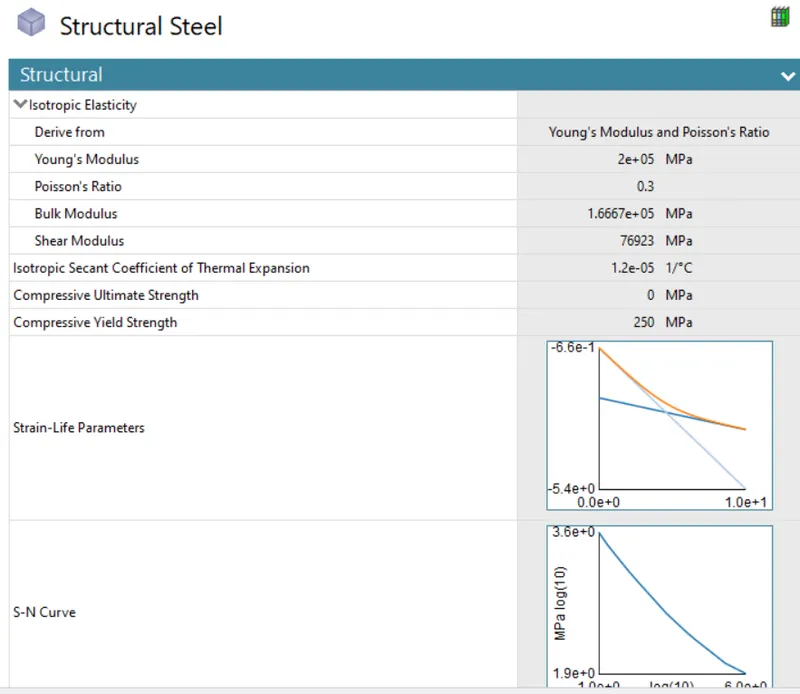
Structural steel(sphere):
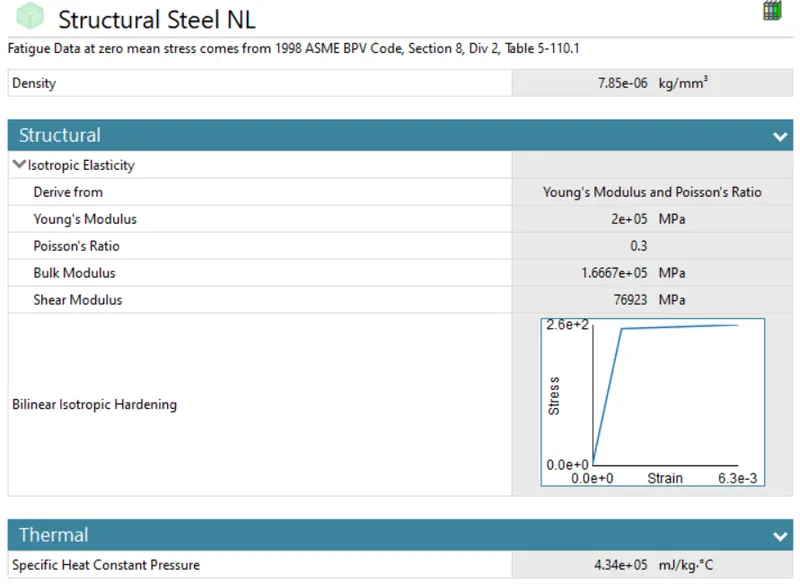
Structural steel NL (Plate):
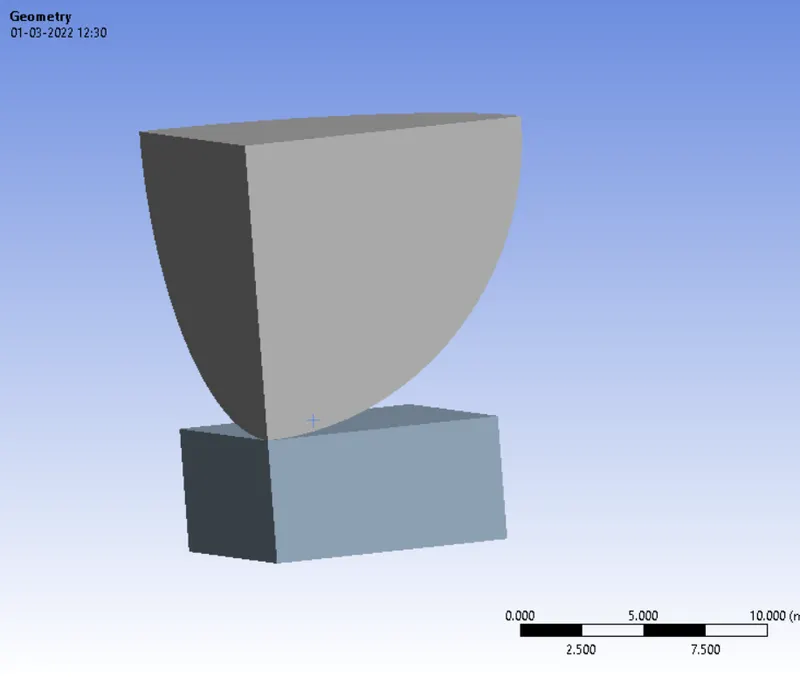
Geometry model:-
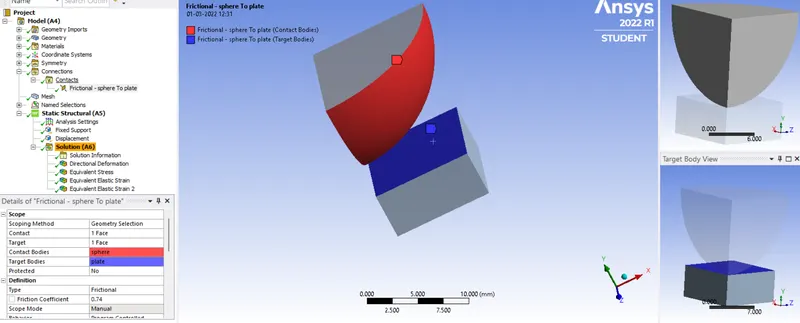
Contacts:- The default contact regions are deleted and a new contact pair is defined between the sphere and plate. Sphere is the contact body and the plate is the target body. The defined contact is frictional. Since impact is involved, the coefficient of friction of 0.74 is obtained by referring to the Roymech tribology table. The behavior of contact pair and formulation are defined as PROGRAM CONTROLLED.
Symmetry Regions:- Since this is a symmetric geometry and the loads applied are equally distributed along all faces, we can simplify our design and use only a quarter portion of the geometry. To calculate the complete effect, symmetric regions are then defined along the respective axes.
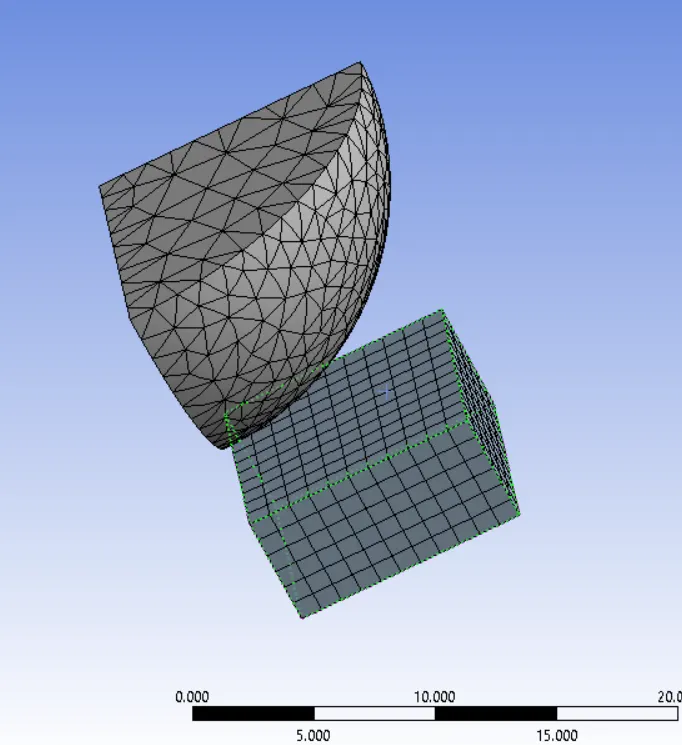
Meshing:- I have adopted an overall mesh sizing of 1mm for this case. Since we are analying the plastic deformation of the non-linear structural steel plate, i've refined the mesh on the plate by giving a face sizing of 0.35mm. This element size is selected by keeping the ANSYS academic version limits in mind. The obtained mesh has 22887 nodes and 5566 elements.
Moreover, by observing the element quality graph, it can be seen that the solver has mostly used hexahedral elements for the sphere. Since the sphere is not our concern here, i have proceeded with the obtained mesh without further refining the quality.
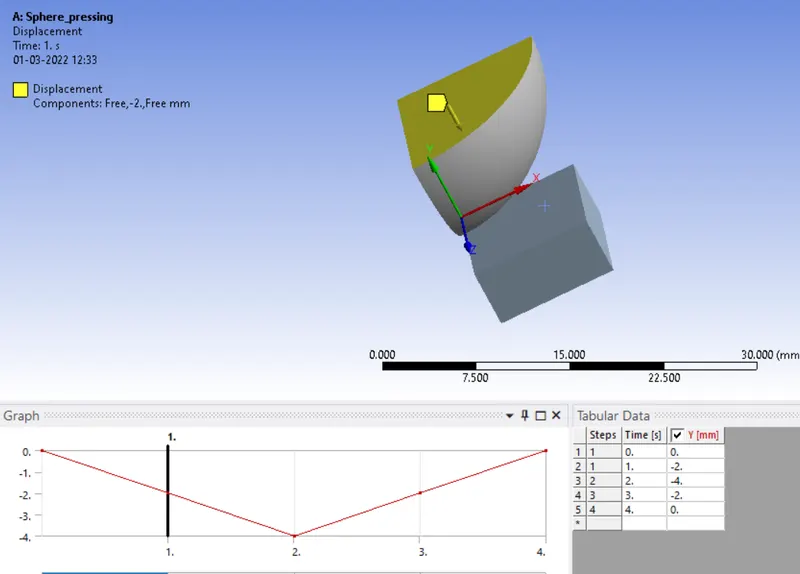
Analysis setting and boundary conditions:- The load will be defined in 4 steps. The solver type is selected as Direct and large deflection as ON . The rest of the features are kept PROGRAM CONTROLLED as the solver will select optimum values for them.
The bottom portion of the plate is fixed and a displacement of 4mm is defined for the sphere in the negative Y direction. To obereve the plastic deformation of the plate clearly, the sphere is retracted by 2mm after impact.
Results:-
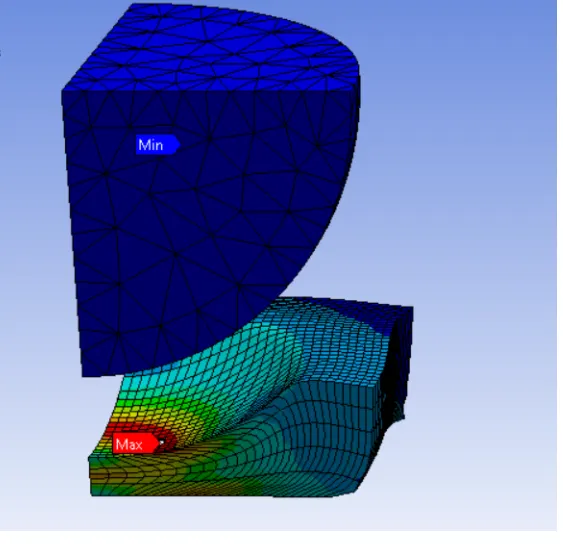
Equivalent stress on plate= 8676.9MPa (max).
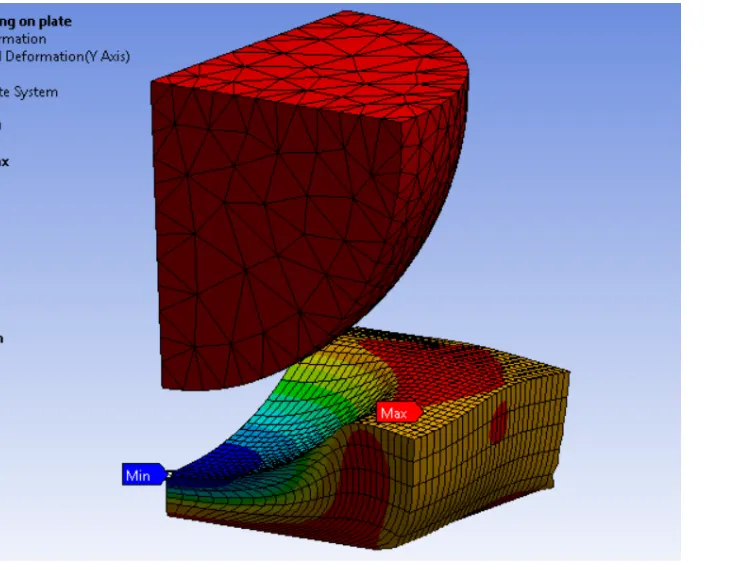
Directional Deformation along the Y axis = 0.3317mm (max).
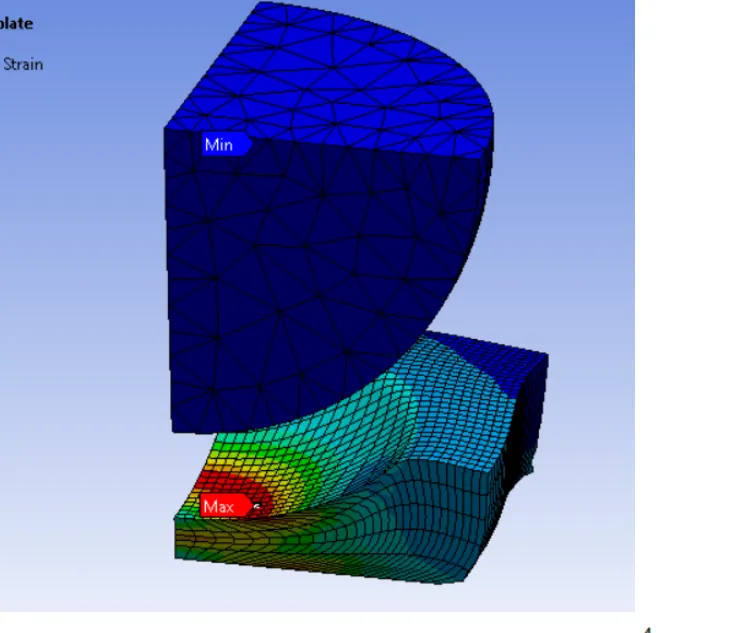
Equivalent Elastic strain on plate = 0.0433mm/mm(max).
Conclusion:-
- Plastic deformation of the plate is achieved as visible in the results. The plate is permanently strained beyond elastic limits and strain energy is stored in the molecules by absorbting the work done by the sphere.
- Max Equivalent stress acts on the plate at the bottom most point of impact, just before the sphere starts to retract.