Week 5 - Rayleigh Taylor Instability
Aim--> Demonstration of Rayleigh-Taylor Instabilities
Rayleigh-Taylor Instabilities
Named after Lord Rayleigh and G.I. Taylor
It is the instability of an interface between two fluids of different densities which occurs when the lighter fluid is pushing the heavier fluid. Examples are water suspended above the oil in gravity action, nuclear explosions, volcanic eruptions, etc. Water suspended atop oil is an everyday example of Rayleigh–Taylor instability, and it may be modeled by two completely plane-parallel layers of immiscible fluid, the denser on top of the less dense one and both subject to the Earth's gravity. The equilibrium here is unstable to any perturbations or disturbances of the interface: if a parcel of heavier fluid is displaced downward with an equal volume of lighter fluid displaced upwards, the potential energy of the configuration is lower than the initial state. Thus, the disturbance will grow and lead to a further release of potential energy, as the denser material moves down under the (effective) gravitational field, and the less dense material is further displaced upwards. This was the set-up as studied by Lord Rayleigh. The important insight by G. I. Taylor was his realization that this situation is equivalent to the situation when the fluids are accelerated, with the less dense fluid accelerating into the more dense fluid. This occurs deep underwater on the surface of an expanding bubble and in a nuclear explosion.
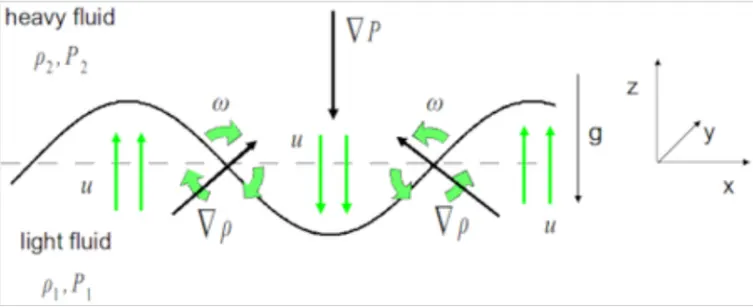
As the RT instability develops, the initial perturbations progress from a linear growth phase into a non-linear growth phase, eventually developing "plumes" flowing upwards (in the gravitational buoyancy sense) and "spikes" falling downwards. In the linear phase, the fluid movement can be closely approximated by linear equations, and the amplitude of perturbations is growing exponentially with time. In the non-linear phase, perturbation amplitude is too large for a linear approximation, and non-linear equations are required to describe fluid motions. In general, the density disparity between the fluids determines the structure of the subsequent non-linear RT instability flows (assuming other variables such as surface tension and viscosity are negligible here). The difference in the fluid densities divided by their sum is defined as the Atwood number, (A). For (A) close to 0, RT instability flows take the form of symmetric "fingers" of fluid; for (A) close to 1, the much lighter fluid "below" the heavier fluid takes the form of larger bubble-like plumes.
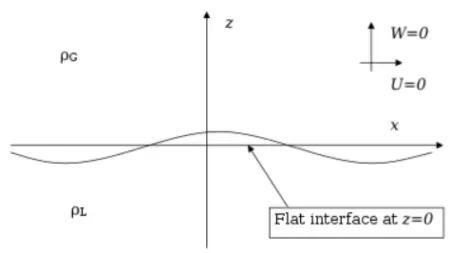
Geometry of the problem
Following is the geometry of the problem, bottom part represents the lighter fluid and the top part represents the more dense fluid. At the interface mesh has to be shared by both the fluids i.e. mesh must be conformal. The boundaries represent the walls. Individual boxes are 20 mm in length and height.
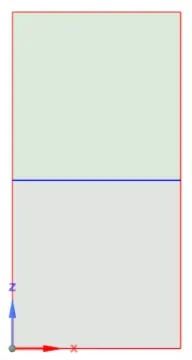
Air (bottom)
Water (Top)
Mesh
For the current case we use 2 meshes, Base-mesh and refined mesh. We observe the patterns for the rayleigh-taylor waves.
1. Base-mesh --> element size -- 0.5 mm
nodes -- 3321
elements -- 3200
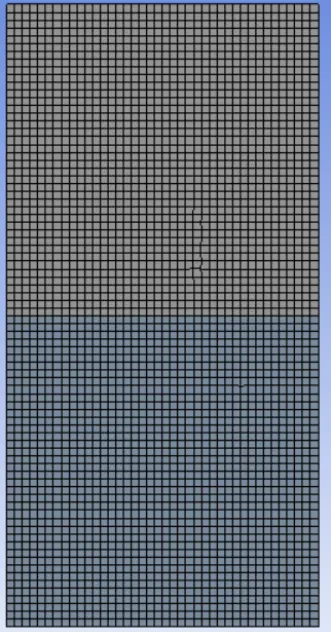
2. Refined Mesh --> element size -- 0.1 mm
nodes -- 75301
elements -- 80000
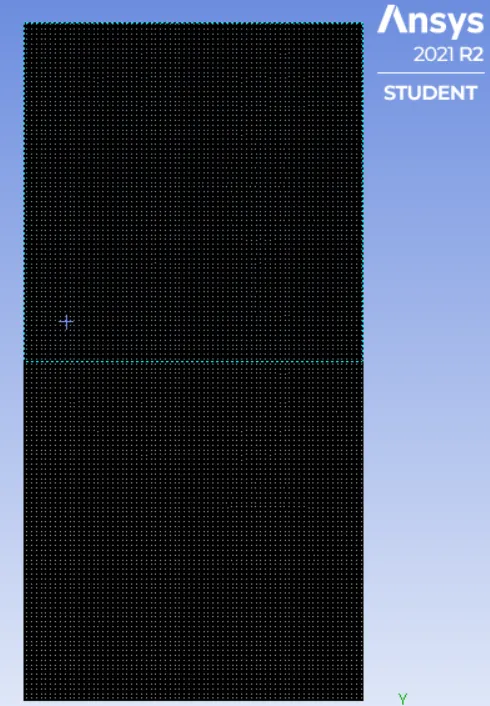
Case-Setup
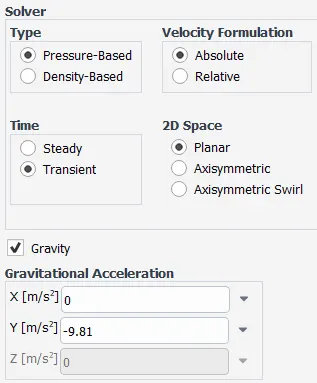
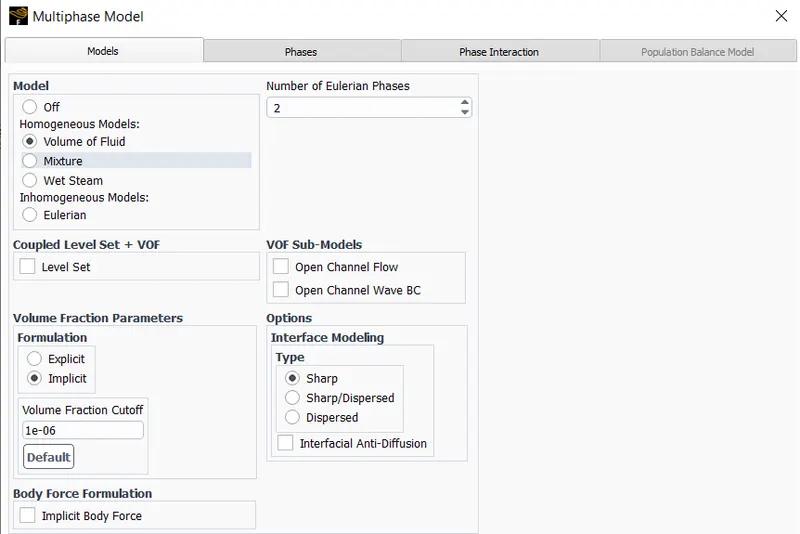
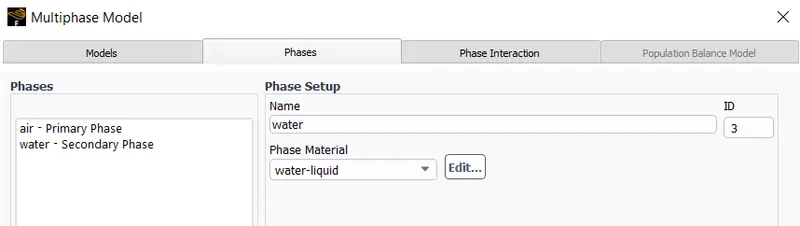
Multiphase model (Volume of Fluid)
Solution Methods
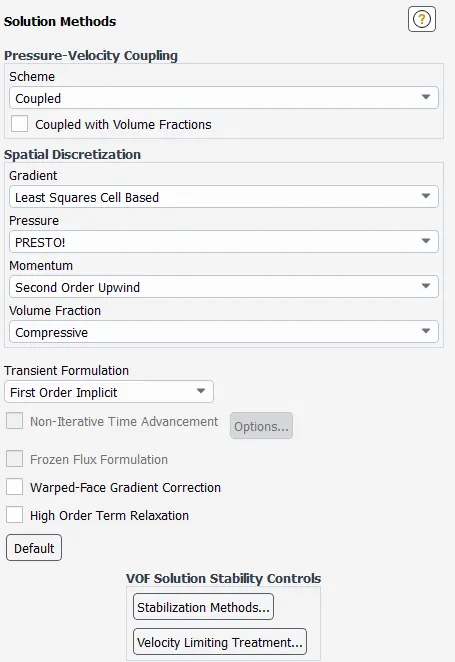
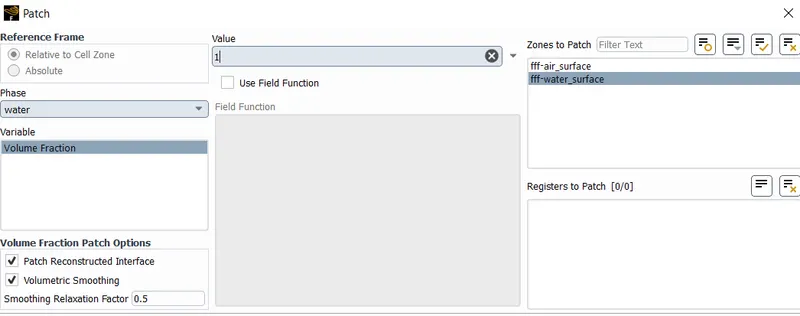
Dynamic time step and settings
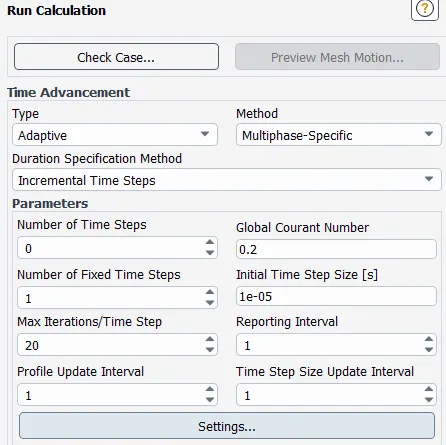
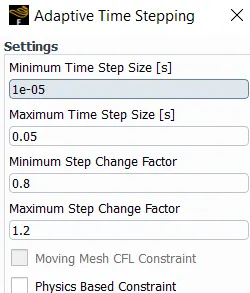
Fixed time-step = 0.005
No. of time steps =1500
Results
Case 1
1. Base-Mesh
--> We use the transient simulation for this type of simulation. We are using the Volume of Fluid method (VOF) in Ansys fluent solver.
Viscous model -- Laminar
Time-step -- 0.05 s
2. Refined-Mesh
Viscous model -- Laminar
Time-step -- 0.005 s
3. User-defined Material -->
density = 400 kg/m3
viscosity = 0.001 kg/m-s
Definition of Atwood Number
It is a nondimensional constant in fluid dynamics which is used in the study of hydrodynamical instabilities in density stratified flows. It is a dimensionless density ratio. It is given as follows -->
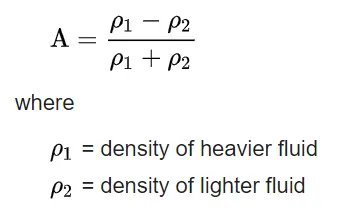
Atwood number is an important parameter in the study of Rayleigh–Taylor instability and Richtmyer–Meshkov instability. In Rayleigh–Taylor instability, the penetration distance of heavy fluid bubbles into the lighter fluid is a function of acceleration time scale Agt^2 where g is the gravitational acceleration and t is the time.
ρ1 = 997
ρ2 = 1.225
A = 0.99754
Thus, the Atwood number in our case is 0.99754.