Week 5 - Rayleigh Taylor Instability
(1) Some practical CFD models on the mathematical analysis of Rayleigh Taylor waves are:-
(a) Water suspended atop oil
(b) Petroleum industry
(c) Plasma fluids
(d) Mushroom clouds
(e) Shock waves
(f) Equitorial Plasma Bubbles (EPBS) and GNSS Signals
(g) Chemical industries
These mathematical models have been developed to study the instability of fluids of different phases with respect to time and their effects on the practical utility.
(2) Geometric Model:-
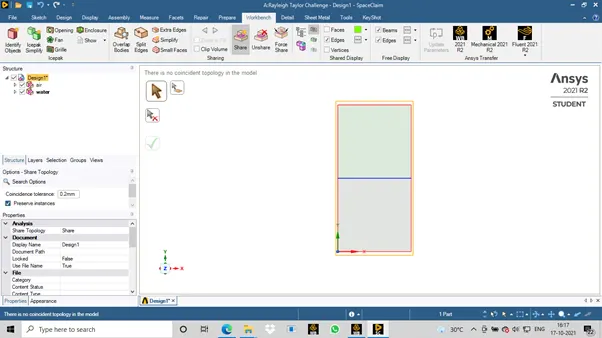
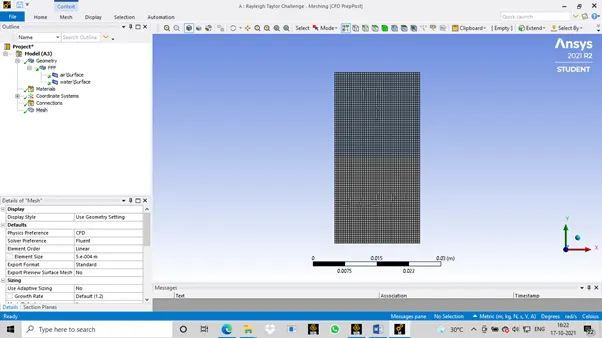
Baseline mesh of 0.5 mm :-
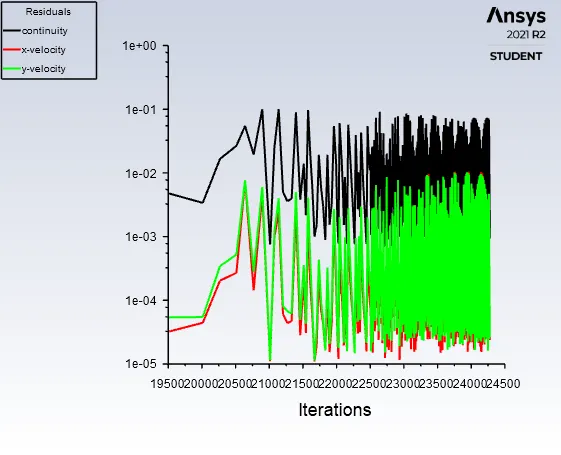
Calculations:-
Final Contours of Volume Fraction (Water):-
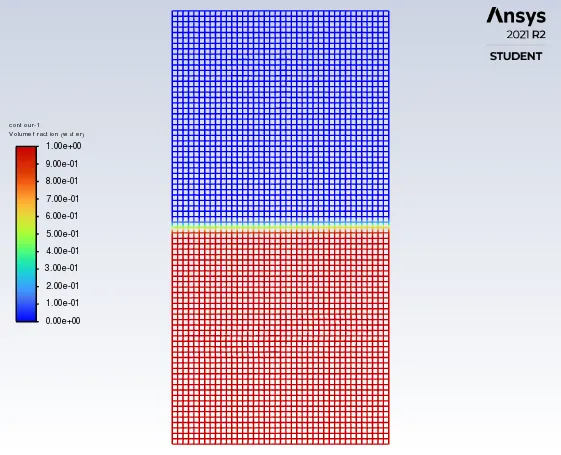
Animation File for Contours of Volume Fraction (Water) for baseline mesh size of 0.5 mm is attached as VLC File:- Baseline mesh
Mesh Size of 0.4 mm :-
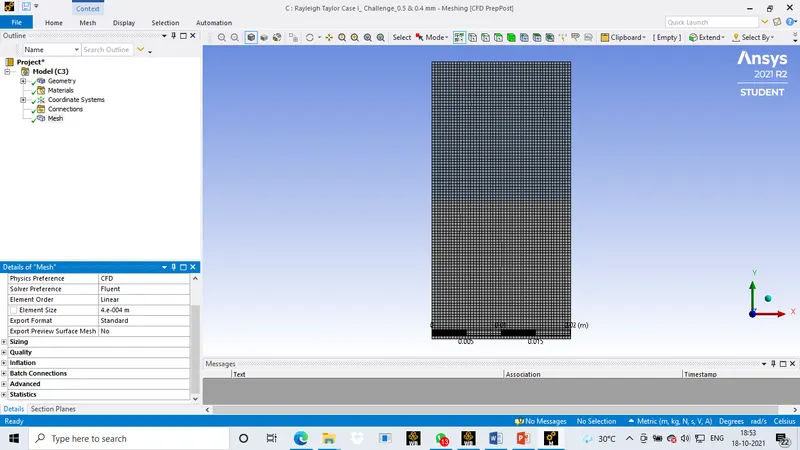
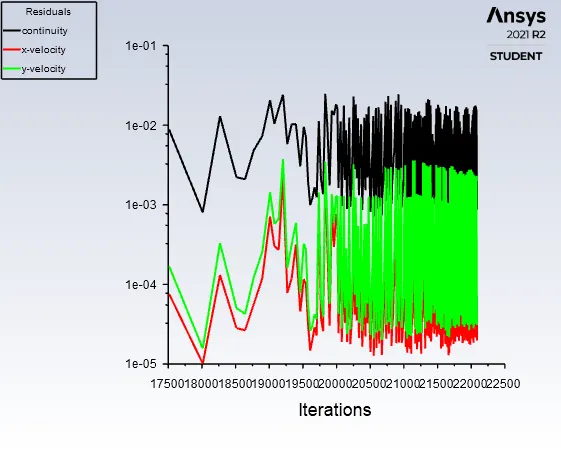
Calculations:-
Final Contours of Volume Fraction (Water):-
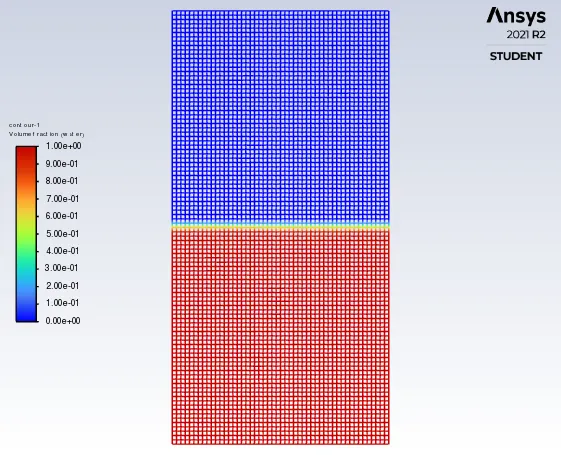
Animation File for Contours of Volume Fraction (Water) for refined mesh size of 0.4 mm is attached as VLC File:- 0.4 mm
Mesh Size of 0.3 mm :-
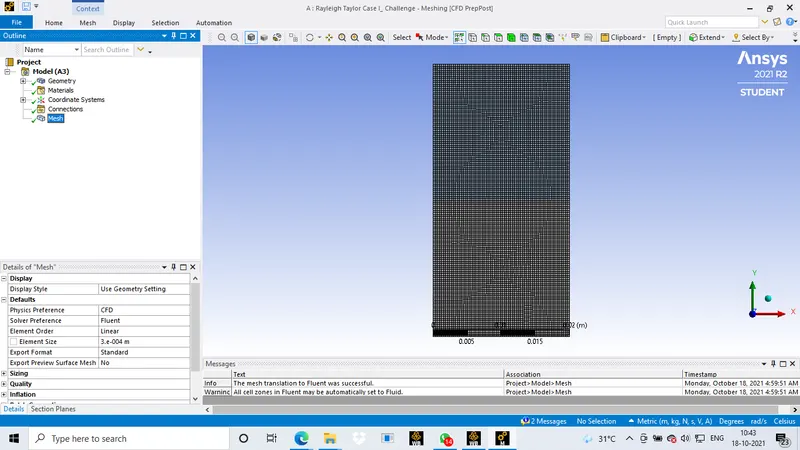
Calculations:-
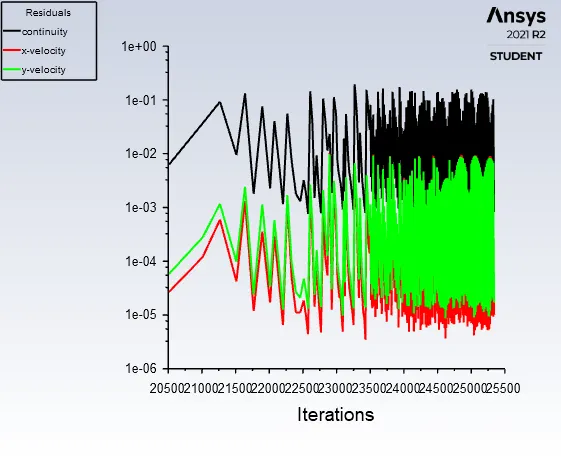
Final Contours of Volume Fraction (Water):-
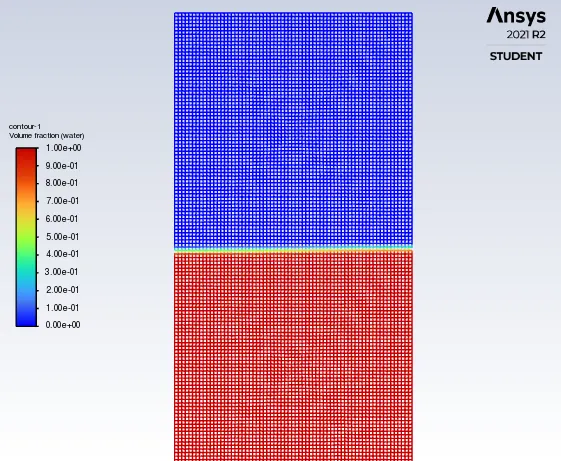
Animation File for Contours of Volume Fraction (Water) for refined mesh size of 0.3 mm is attached as VLC File:- 0.3 mm
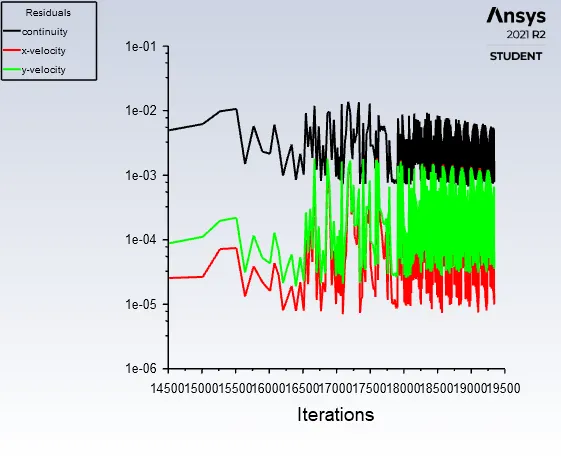
Finer, is the mesh size, clear is the penetration effect in the mixture. Steady state approach might not be suitable for these types of simulation, because the penetration depends highly on the time duration and steady state approach will take more time (steady state is equivalent to infinite time scale). The bubble formation and Reyleigh Taylor pattern is dynamic in nature and completely depends on time scale.
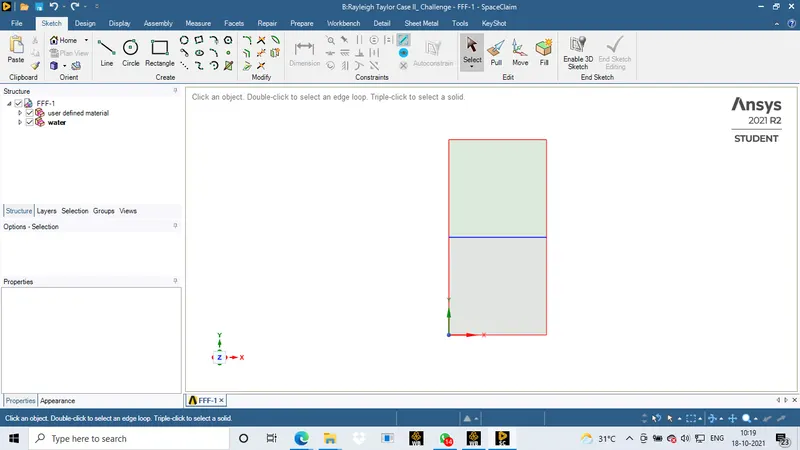
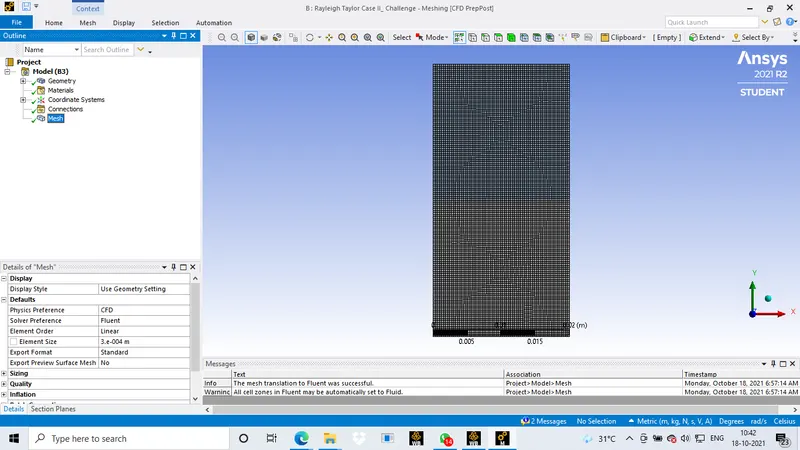
(3) Simulation with water and user-defined material(density = 400 kg/m3, viscosity = 0.001 kg/m-s) for refined mesh 0f 0.3 mm (calculations) :-
Geometry:-
Meshing:-
Calculations:-
Final Contours of Volume Fraction (Water):-
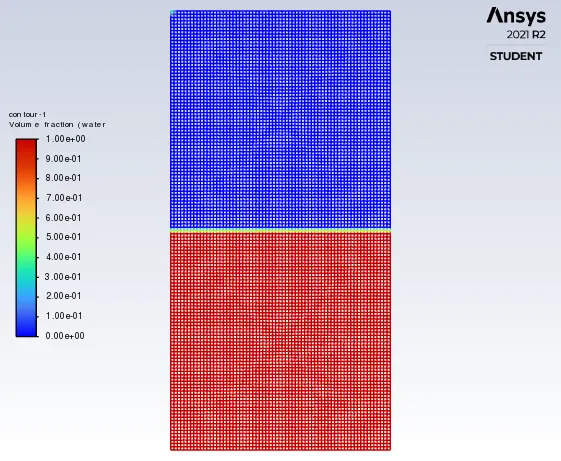
Animation File for Contours of Volume Fraction (Water) for refined mesh size of 0.3 mm for Simulation with water and user-defined material(density = 400 kg/m3, viscosity = 0.001 kg/m-s) is attached as VLC File:- User defined material_water_0.3 mm
(4) Atwood Number:-
The Atwood number (A) is a dimensionless number which is used in the study of hydrodynamic instabilities in density stratified flows. It is a dimensionless density ratio defined as

where
 = density of heavier fluid
 = density of lighter fluid
Atwood number is an important parameter in the study of Rayleigh Taylor instability and Richtmyer Meshkov instability. In Rayleigh–Taylor instability, the penetration distance of heavy fluid bubbles into the light fluid is a function of acceleration time scale,  where g is the gravitational acceleration and t is the time.
For First case Atwood Number = (998.2 - 1.225)/(998.2 + 1.225) = 0.99755
For Second case Atwood Number = (998.2 - 400)/(998.2 + 400) = 0.427836
Atwood Number for second case is smaller, so penetration and instability is less than first case.
Regards.