Week 5 Challenge
Question 1:
Consider a scenario where an aggressive driver is accelerating very rapidly and braking harshly in a city driving. Is battery better a choice to supply power than UC in this scenario?
- True
- False
Why?
ANSWER:-
Batteries for Hybrid and Plug-In Electric Vehicles
Most plug-in hybrids and all-electric vehicles use lithium-ion batteries like these.
Energy storage systems, usually batteries, are essential for hybrid electric vehicles (HEVs), plug-in hybrid electric vehicles (PHEVs), and all-electric vehicles (EVs).
Types of Energy Storage Systems
The following energy storage systems are used in HEVs, PHEVs, and EVs.
Lithium-Ion Batteries
Lithium-ion batteries are currently used in most portable consumer electronics such as cell phones and laptops because of their high energy per unit mass relative to other electrical energy storage systems. They also have a high power-to-weight ratio, high energy efficiency, good high-temperature performance, and low self-discharge. Most components of lithium-ion batteries can be recycled, but the cost of material recovery remains a challenge for the industry. Most of today's PHEV's and EV's use lithium-ion batteries, though the exact chemistry often varies from that of consumer electronics batteries. Research and development are ongoing to reduce their relatively high cost, extend their useful life, and address safety concerns in regard to overheating.
Nickel-Metal Hydride Batteries
Nickel-metal hydride batteries, used routinely in computer and medical equipment, offer reasonable specific energy and specific power capabilities. Nickel-metal hydride batteries have a much longer life cycle than lead-acid batteries and are safe and abuse tolerant. These batteries have been widely used in HEV's. The main challenges with nickel-metal hydride batteries are their high cost, high self-discharge and heat generation at high temperatures, and the need to control hydrogen loss.
Lead-Acid Batteries
Lead-acid batteries can be designed to be high power and are inexpensive, safe, and reliable. However, low specific energy, poor cold-temperature performance, and short calendar and cycle life impede their use. Advanced high-power lead-acid batteries are being developed, but these batteries are only used in commercially available electric-drive vehicles for ancillary loads.
Ultracapacitors
Ultracapacitors store energy in a polarized liquid between an electrode and an electrolyte. Energy storage capacity increases as the liquid's surface area increases. Ultracapacitors can provide vehicles additional power during acceleration and hill climbing and help recover braking energy. They may also be useful as secondary energy-storage devices in electric-drive vehicles because they help electrochemical batteries level load power.
FALSE. The reason why a battery is'nt a better choice compared againt a ULTRA CAPACITOR(UC) is because of the charge and discharge rate.
Let us consider aggressive acceleration initially, then the battery is having a certain discharge capacity beyond which it may heat up or get damaged so it is limited, but an Ultra capacitor has no limit. It can discharge very quickly.
Simillarly let us consider agressive discharging, then we know that the battery can only charge quickly upto a certain limit and forcing more power into it may result into it getting damaged or exploding. But a Ultra capacitor can charge up significantly quicker when compared with a battery pack.
It is ideal to use the Ulta Capacitor as a buffer between the drive system and the battery. Also the Ultra capacitor has less weight compared to battery.
Question 2:
Consider the following components.
1) Lead acid battery 2) Nickel cadmium battery 3) Nickel Metal hydride battery 4) Lithium ion (specify chemistry) battery 5) Ultra Capacitor
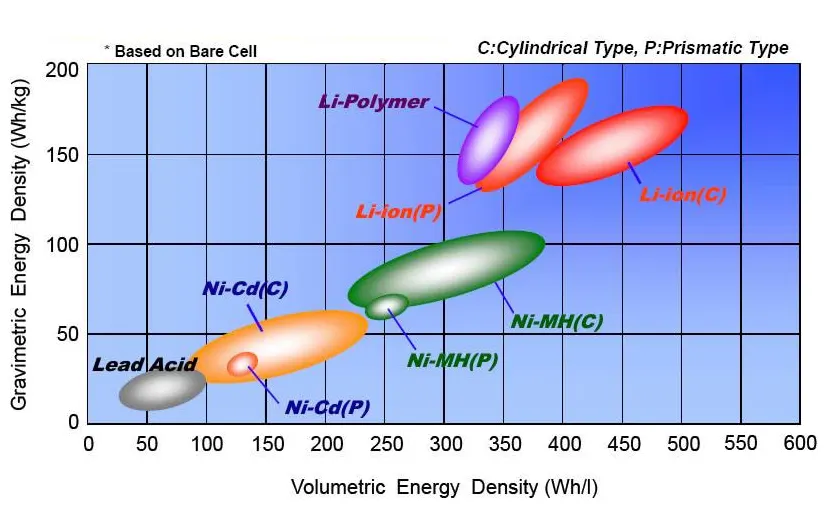
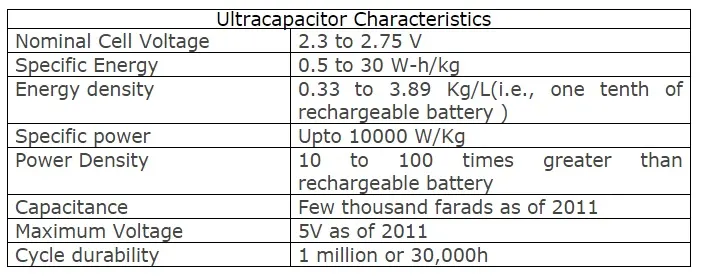
Note: In case of a range of energy density, take the average value for the plot.
Create a plot with energy density on the X Axis and cell voltage on the Y axis.
Comment on the capabilities of these batteries based on the plot created.
ANSWER:-
Lead Acid Batteries:-
Introduction:-
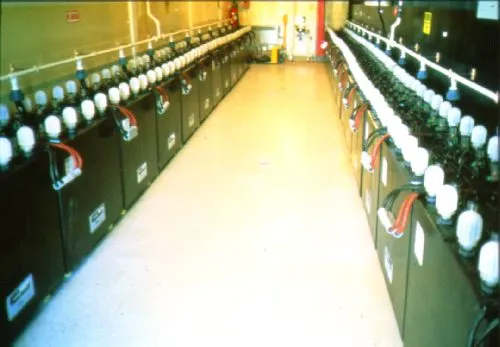
Lead acid batteries are the most commonly used type of battery in photovoltaic systems. Although lead acid batteries have a low energy density, only moderate efficiency and high maintenance requirements, they also have a long lifetime and low costs compared to other battery types. One of the singular advantages of lead acid batteries is that they are the most commonly used form of battery for most rechargeable battery applications (for example, in starting car engines), and therefore have a well-established established, mature technology base.
Operation of Lead Acid Batteries
A lead acid battery consists of a negative electrode made of spongy or porous lead. The lead is porous to facilitate the formation and dissolution of lead. The positive electrode consists of lead oxide. Both electrodes are immersed in a electrolytic solution of sulfuric acid and water. In case the electrodes come into contact with each other through physical movement of the battery or through changes in thickness of the electrodes, an electrically insulating, but chemically permeable membrane separates the two electrodes. This membrane also prevents electrical shorting through the electrolyte. Lead acid batteries store energy by the reversible chemical reaction shown below.
The overall chemical reaction is:
PbO2+Pb+2H2SO4⇔chargedischarge2PbSO4+2H2O
At the negative terminal the charge and discharge reactions are:
Pb+SO42-⇔chargedischargePbSO4+2e-
At the positive terminal the charge and discharge reactions are:
PbO2+SO42-+4H++2e-⇔chargedischargePbSO4+2H2O
As the above equations show, discharging a battery causes the formation of lead sulfate crystals at both the negative and positive terminals, as well as the release of electrons due to the change in valence charge of the lead. The formation of this lead sulfate uses sulfate from the sulfuric acid electrolyte surrounding the battery. As a result the electrolyte becomes less concentrated. Full discharge would result in both electrodes being covered with lead sulfate and water rather than sulfuric acid surrounding the electrodes. At full discharge the two electrodes are the same material, and there is no chemical potential or voltage between the two electrodes. In practice, however, discharging stops at the cutoff voltage, long before this point. The battery should not therefore be discharged below this voltage.
In between the fully discharged and charged states, a lead acid battery will experience a gradual reduction in the voltage. Voltage level is commonly used to indicate a battery's state of charge. The dependence of the battery on the battery state of charge is shown in the figure below. If the battery is left at low states of charge for extended periods of time, large lead sulfate crystals can grow, which permanently reduces battery capacity. These larger crystals are unlike the typical porous structure of the lead electrode, and are difficult to convert back into lead.
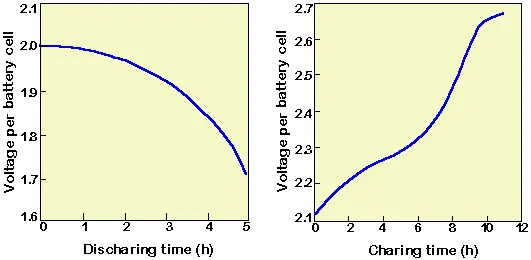
Voltage of lead acid battery upon charging.
The charging reaction converts the lead sulfate at the negative electrode to lead. At the positive terminal the reaction converts the lead to lead oxide. As a by-product of this reaction, hydrogen is evolved. During the first part of the charging cycle, the conversion of lead sulfate to lead and lead oxide is the dominant reaction. However, as charging proceeds and most of the lead sulfate is converted to either lead or lead dioxide, the charging current electrolyzes the water from the electrolyte and both hydrogen and oxygen gas are evolved, a process known as the "gassing" of the battery. If current is being provided to the battery faster than lead sulfate can be converted, then gassing begins before all the lead sulfate is converted, that is, before the battery is fully charged. Gassing introduces several problems into a lead acid battery. Not only does the gassing of the battery raise safety concerns, due to the explosive nature of the hydrogen produced, but gassing also reduces the water in the battery, which must be manually replaced, introducing a maintenance component into the system. In addition, gassing may cause the shedding of active material from the electrolyte, thereby permanently reducing battery capacity. For these reasons, the battery should not regularly be charged above the voltage which causes gassing. The gassing voltage changes with the charge rate.
Lead sulphate is an insulator, and therefore the way in which lead sulfate forms on the electrodes determined how easily the battery can be discharged.
Characteristics of Lead Acid Batteries
For most renewable energy systems, the most important battery characteristics are the battery lifetime, the depth of discharge and the maintenance requirements of the battery. This set of parameters and their inter-relationship with charging regimes, temperature and age are described below.
Depth of Discharge and Battery Capacity
The depth of discharge in conjunction with the battery capacity is a fundamental parameter in the design of a battery bank for a PV system, as the energy which can be extracted from the battery is found by multiplying the battery capacity by the depth of discharge. Batteries are rated either as deep-cycle or shallow-cycle batteries. A deep-cycle battery will have depth of discharge greater than 50%, and may go as high as 80%. To achieve the same useable capacity, a shallow-cycle battery bank must have a larger capacity than a deep-cycle battery bank.
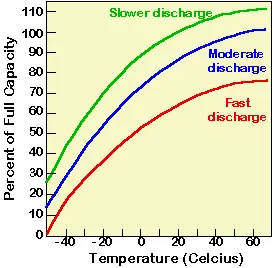
In addition to the depth of discharge and rated battery capacity, the instantaneous or available battery capacity is strongly affected by the discharge rate of the battery and the operating temperature of the battery. Battery capacity falls by about 1% per degree below about 20°C. However, high temperatures are not ideal for batteries either as these accelerate aging, self-discharge and electrolyte usage. The graph below shows the impact of battery temperature and discharge rate on the capacity of the battery.
Battery Lifetime
Over time, battery capacity degrades due to sulfation of the battery and shedding of active material. The degradation of battery capacity depends most strongly on the interrelationship between the following parameters:
- the charging/discharging regime which the battery has experienced
- the DOD of the battery over its life
- its exposure to prolonged periods of low discharge
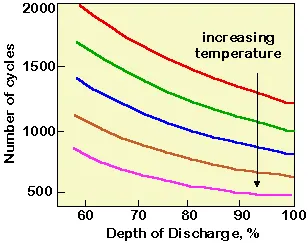
- the average temperature of the battery over its lifetime
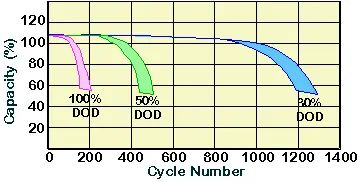
The following graph shows the evolution of battery function as number of cycles and depth of discharge for a shallow-cycle lead acid battery. A deep-cycle lead acid battery should be able to maintain a cycle life of more than 1,000 even at DOD over 50%.
In addition to the DOD, the charging regime also plays an important part in determining battery lifetime. Overcharging or undercharging the battery results in either the shedding of active material or the sulfation of the battery, thus greatly reducing battery life.
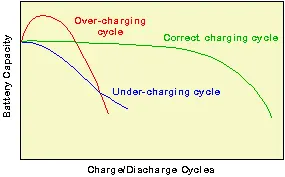
The final impact on battery charging relates to the temperature of the battery. Although the capacity of a lead acid battery is reduced at low temperature operation, high temperature operation increases the aging rate of the battery.
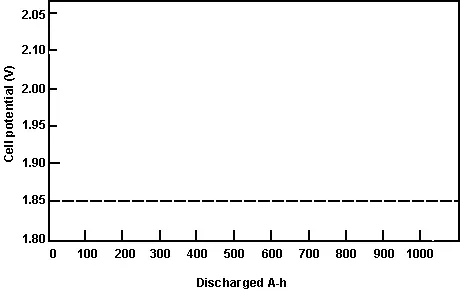
Constant current discharge curves for a 550 Ah lead acid battery at different discharge rates, with a limiting voltage of 1.85V per cell (Mack, 1979). Longer discharge times give higher battery capacities.
What is a Nickel-Cadmium Battery?
It’s a device that produces, DC voltage based on the chemical reaction between the substances involved. In a nickel-cadmium battery, the redox material is used as a base, and around it, the layer of nickel and a separator are used. The nickel-cadmium cell voltage is around 1.2 V. When connected in series generally 3 to 4 cells are packed together to get an output of 3.6 to 4.8 V
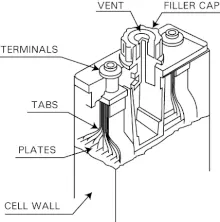
Nickel-Cadmium Battery Theory
The operating principle of a nickel-cadmium battery is the same as other batteries. To improve efficiency, nickel and cadmium are used. A battery is the source of DC voltage, hence it must consist of two potential points i.e positive and negative or also called anode and cathode. In a nickel-cadmium battery, first, a layer of nickel oxide NiO2 is kept around the redox.
This layer of nickel oxide acts as a cathode layer. Above the nickel oxide layer, a layer of KaOH is kept, which acts as a separator. It must be noted that this separator layer must be soaked in water or moist. Its purpose is to provide required OH negative ions, for the chemical reaction. Above the separator layer, cadmium is placed. The cadmium layer acts as the anode for the nickel-cadmium battery. The nickel-cadmium battery diagram is shown below.
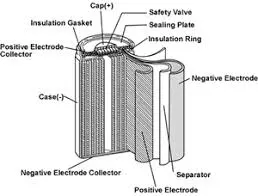
As shown, in the diagram, the nickel acts as a positive electrode collector and the cadmium layer acts as a negative layer collector. The separator layer between the two layers is made up of KOH or NaOH. Its purpose is to provide OH ions. Apart from these, it also consists of a safety valve, sealing plate, insulation ring, insulation gasket, and an outer case.
The purpose of the insulator ring is to provide insulation between the two layers. The insulator gasket is the place where the insulation ring is kept nearby. The separator layer is connected to this ring. The outer case is to provide protection to the inner layers from external factors such as damages and mishandling of the battery. It must be noted that, due to chemical reactions taking place within the batter, it always hazardous to work with the battery.
The case of the battery is never opened, as all the layers are exposed and it may cause harm to the person using. Similarly, when not in use, it is recommended to remove the battery out of the device.
Nickel Cadmium Battery Equations
The chemical equations representing the chemical reaction can be given as


The first equation represents the reaction between the cathode layer nickel and the separator. It gives an output of Nickel oxide OH ions. The need for the separator layer as mentioned before is the provide the OH ions required for the chemical reaction. For the provision of H20, the separator layer is soaked with water for the initial reaction. Later H2O is obtained as one of the byproducts.
On the anode side, the cadmium layer is also combined with OH ions which are obtained from the separators layer. This results in cadmium oxide and electrons. It may be noted that the electrons in both the equations get canceled. Also, OH ions get canceled. The reminder equation is given by the third equation, where nickel is combined with cadmium and water. It results in nickel oxide and cadmium oxide.
Nickel-Cadmium Battery Temperature Range
The temperature range for nickel battery is 0 to 45-degree centigrade during charging and -20 to 65 degrees centigrade during discharging. Beyond this temperature range, the battery fails to operate and even chances of explosion exist.
Nickel-Cadmium Battery Toxicity
Nickel-cadmium battery is very toxic to the human body. Cadmium is a heavy metal posing several risks to the human body. Cadmium even has a physiological effect on the system. The average presence of cadmium in the human body is approximately 1 microgram per liter. It has a direct effect on the digestive system. Similarly, nickel is also poisonous to the human respiratory system.
Nickel-cadmium battery voltage
In general, each voltage for a Nickel-cadmium battery would be approximately 1.2 V. Number of cells are connected in series or parallel to get the required voltage. Apart from the voltage, its specific energy is around 50-60 Wh per Kg. This is moderately high that nickel-iron, but relatively less than nickel-zinc and nickel-metal hydride batteries.
The specific power is 200 W per kg. This is moderately high than nickel-iron but relatively less than nickel-zinc and nickel-metal hydride batteries. For nickel-metal batteries, it is around 170-1000. For nickel-iron batteries, it is around 100. The energy efficiency is around 70-75%. This is moderately high than nickel-iron but relatively less than nickel-zinc and nickel-metal hydride batteries. For nickel-metal batteries, it is around 70-80 %. For nickel-iron batteries, it is around 60-70%.
Construction of Nickel-Cadmium Battery
Constructional, the nickel-cadmium battery is the same as lead acid-based batteries. It consists of three fundamental layers. The first one is a nickel layer, then the separator layer, and the cadmium layer. The nickel acts as a positive electrode collector and the cadmium layer acts as a negative layer collector.
The separator layer between the two layers is made up of KOH or NaOH. Its purpose is to provide OH ions. Apart from these, it also consists of a safety valve, sealing plate, insulation ring, insulation gasket, and an outer case. The purpose of the insulator ring is to provide insulation between the two layers. The insulator gasket is the place where the insulation ring is kept nearby. The separator layer is connected to this ring.
The outer case is to provide protection to the inner layers from external factors such as damages and mishandling of the battery. It must be noted that, due to chemical reactions taking place within the batter, it always hazardous to work with the battery. The layers along with the separator layer form the required chemical reaction and form the potential difference.
Nickel Cadmium Battery Working
The working of the nickel-cadmium battery is based on the chemical reaction taking place between the layers. The battery which is a source of DC voltage consists of two ports i.e. anode and cathode. While making the battery, first the cadmium layer is kept on the redox. The cadmium layer acts as the cathode terminal. Cadmium is one of the heavy material and has good conducting properties. Above the cadmium layer, separator layers are kept.
The purpose of the separator layer is to provide required OH ions for the chemical reaction. The OH ions are required for the reaction between the cathode layer nickel and the separator. It gives an output of Nickel oxide OH ions. The need for the separator layer as mentioned before is the provide the OH ions required for the chemical reaction. For the provision of H20, the separator layer is soaked with water for the initial reaction.
Later H2O is obtained as one of the byproducts. On the anode side, the cadmium layer is also combined with OH ions which are obtained from the separators layer. This results in cadmium oxide and electrons. It may be noted that the electrons in both the equations get canceled. Also, OH ions get canceled. The reminder equation is given by the third equation, where nickel is combined with cadmium and water. It results in nickel oxide and cadmium oxide. The chemical reaction is followed by the flow of electrons which causes the potential difference across two terminals.
Nickel Cadmium Battery Types
Nickel-cadmium battery classification is only done based on size and available voltage. Based on size it may be of AAA, AA, A, Cs, C, D, or F size. All these sizes come with different output voltage specifications. Some of them are cylindrical pipe-shaped and some of them are in a rectangular box-shaped outer case.
Advantages and Disadvantages
The advantages of Nickel Cadmium Battery are
- Delivers high current output
- It tolerates overcharging
- It withstands up to 500 cycles of charging
The disadvantages of Nickel Cadmium Battery are
- Cadmium is not an eco-friendly material
- Less tolerance towards temperature as compared to other batteries.
Nickel Cadmium Battery Applications
It has various applications like toys, small DC motors, calculators, fans, computers, etc.
Nickel Metal Hydride
Stanford R. Ovshinsky invented and patented the NiMH battery and founded Ovonic Battery Company in 1982.
Principle of operation:
NiMH works on the principle based on the absorption, release and transport of Hydrogen within the two electrode.
Chemical reaction
Positive electrode

Negative electrode

Overall reaction

These reactions are reversible during charging, and the equations will flow from right to left.
Some of the most important characteristics of NiMH Battery
|
Nickel Metal Hydride Battery Characteristics |
|
|
Nominal Voltage |
1.2V |
|
Specific Energy |
60-120W.h/kg |
|
Energy Density |
140-300W.h/L |
|
Specific Power |
250-1000 W/kg |
|
Charge/Discharge Efficiency |
66% |
|
Self discharge rate |
30% per month (temperature dependent) |
NiMH have a nominal single cell voltage of 1.2 V, which is fixed by the battery chemistry. In order to obtain higher voltages, cells are put together in series. NiMH replaces Ni-Cad batteries in portable electronics.
The Specific Energy refers to the amount of energy that can be stored per unit weight. This value is very important for portable equipment as heavy batteries will be difficult and energy consuming to move around. The Specific Energy of NiMH batteries is much higher than Ni-Cad batteries. It is however lower than Lithium batteries. After 1991, the specific energy of NiMH is doubled. The cost of NiMH is less than one-third of an equivalent Li-ion Batteries.
Energy Density describes how much energy can be stored per unit volume. Again, for portable electronic equipment, the space required for a given storage capacity is an important figure. The Energy Density for NiMH is much higher than the Ni-Cad Batteries, Lead-acid batteries. NiMH contains no toxic metals. Applications include mobile phones and laptop computers.
Specific Power refers to the maximum amount of power can that can be delivered. In electrical terms, this is the maximum Discharge Rate of the battery. Performance is better compared to alkaline batteries in higher drain devices. Beginning the NiMH has high energy density with also a high rate of self-discharge. Recent technology of NiMH has low discharge rate with approximately 25% lower energy density. Specific power of NiMH is less compared to Ni-Cad.
NiMH batteries have unique charge and discharge curves (voltage vs. time during charging and discharging). The discharge curve for NiMH is nearly flat during the main portion of it's dischage, whereas most other batteries have a roughly linear, decreasing main discharge curve. This introduces unique challenges into determining the State of Charge of NiMH batteries.
The Charge/Discharge efficiency is also an important factor for the practical use of the battery. The Charge/Discharge efficiency of NiMH is very less compare to Ni-Cad and their efficiency is also less.
NiMH also has high self-discharge of 30 percent per month. Modifying the hydride materials will reduce the self-discharge and reduces corrosion of the alloy, but this leads to decreases in specific energy.
The Life time of Nickel Metal Hydride is less compared to Ni-Cad and Li-ion But more than the lead acid and comparable with lithium polymer.
The discharge curve of a NiMH battery has a large, nearly flat region in the middle of its operation. This means that after the initial discharge, in which the battery rapidly decreases its voltage from the float voltage, the voltage of the battery remains nearly constant, up until the point at which the energy of the cell is nearly depleted and the voltage again rapidly falls of. Unlike lead acid, lithium, or other battery types in which main part of the discharge curve can be closely approximated by a straight line of fixed, decreasing slope, the predominantly flat slope of the NiMH makes it difficult to determine the state of charge (SOC) during the discharge process. As a result, when using NiMH batteries, the energy in and out of the battery must be carefully monitored and summed to determine the SOC. Naturally, this process will accumulate errors over time and will require periodic recalibration of the SOC algorithm.
Advantages:
NiMH has less toxins and it is environment friendly. It can be recycled. Memory effect is lesser and higher capacity than Ni-Cad. Much safer than lithium batteries. It can tolerate overcharge and overdischarge.
Disadvantages:
Deep Discharge reduces the life cycle and produces heat when it is fast charged and high load discharge. Self discharge is more compared to other batteries. High maintenance is required, It should be often fully discharged to prevent crystalline formation. Expensive than Ni-Cad battery.
| Specifications | Lead Acid | NiCd | NiMH |
|---|---|---|---|
| Specific Energy Density (Wh/kg) | 30-50 | 45-80 | 60-120 |
| Internal Resistance (mΩ) | <100 12V pack |
100-200 6V pack |
200-300 6V pack |
| Life Cycle (80% discharge) | 200-300 | 1000 | 300-500 |
| Fast-Charge Time | 8-16h | 1h typical | 2-4h |
| Overcharge Tolerance | High | Moderate | Low |
| Self-Discharge/month (room temp) | 5% | 20% | 30% |
| Cell Voltage (nominal) | 2V | 1.2V | 1.2V |
| Charge Cutoff Voltage (V/cell) | 2.40 Float 2.25 |
Full charge detection by voltage signature |
|
| Discharge Cutoff Voltage (V/cell, 1C) | 1.75 | 1.00 | |
| Peak Load Current Best Result |
5C 0.2C |
20C 1C |
5C 0.5C |
| Charge Temperature | -20 to 50°C -4 to 122°F |
0 to 45°C 32 to 113°F |
|
| Discharge Temperature | -20 to 50°C -4 to 122°F |
-20 to 65°C -4 to 149°F |
|
| Maintenance Requirement | 3-6 Months (topping charge) |
30-60 days (discharge) |
60-90 days (discharge) |
| Safety Requirements | Thermally stable | Thermally stable, fuse protection common | |
| In Use Since | Late 1800s | 1950 | 1990 |
| Toxicity | Very High | Very High | Low |
Question 3:
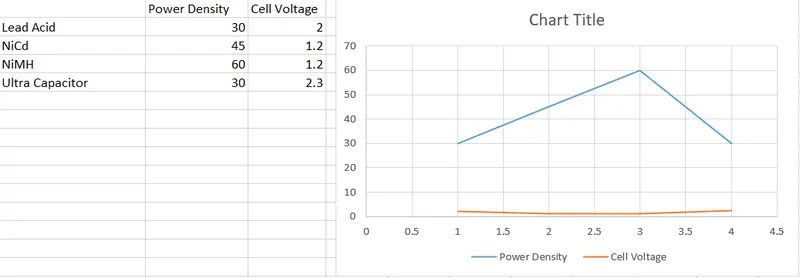
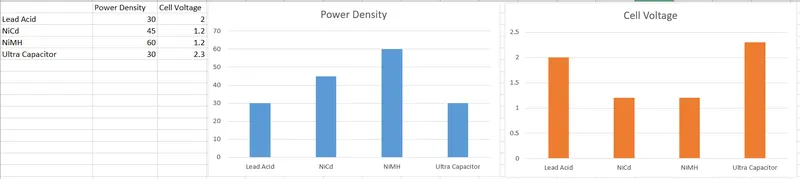
For the above-mentioned components on the same plot (retain the previous plot) created in the previous
Create a plot with power density on the X axis and cell voltage on the Y axis.
ANSWER:-
Question 4:
Consider the following scenario:
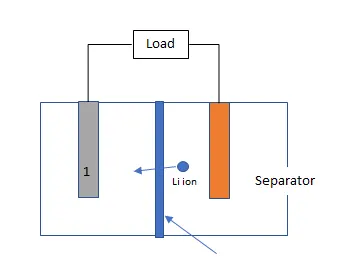
A battery has just been manufactured in the battery and has been connected to a charger for the first time. The electrode marked as (1) in the picture below is the negative electrode.
- True
- False
ANSWER:-
FALSE.Ions move from -ve terminal towards the positive.
How Does A Lithium-ion Battery Work?
The Components
 Lithium-ion batteries are available in many different shapes and sizes. Inside, however, they typically look the same. To understand how a lithium-ion battery works, it’s important to know the role that individual parts play.
The Cell
A lithium-ion battery is made up of several parts. The cell, serving as the workhorse of the battery, is the most critical component of the battery.
The cell is comprised of the following battery materials:
- Electrodes are the two battery ends. One is the anode and the other is the cathode.
- The anode stores the lithium and is typically made from carbon.
- The cathode also stores the lithium and is made from a chemical compound that is a metal oxide.
- The separator blocks the flow of negative and positive electrons inside the battery but allows for ions to pass through.
- The electrolyte liquid sits between the two electrodes. It carries the positively charged lithium ions from the anode to the cathode and vice versa depending on whether the battery is charging or discharging.
The Battery Pack
The battery pack, which holds the lithium-ion cells, operates much like a computer. It contains the following:
- At least one temperature sensor to monitor the battery’s temperature.
- A voltage converter and regulator circuit that focuses on keeping the voltage and current at safe levels.
- A Euro connector, which allows power and information to move in and out of the battery pack.
- The cell tap, which oversees the cells’ voltages in the battery pack.
- A battery monitoring system, a small computer that oversees the whole battery and ensures safety to the user.
Movement in the Cell
So how does the cell provide power to the equipment?
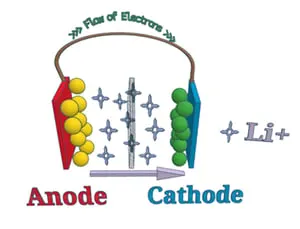 When you plug a lithium-ion battery into a device or piece of equipment, the positively-charged ions move from the anode to the cathode. As a result, the cathode becomes more positively charged than the anode. This, in turn, attracts negatively-charged electrons to the cathode.
A separator in the cell includes electrolytes that form a catalyst. This promotes ion movement between the . The movement of ions through the electrolyte solution is what causes the electrons to move through the device the battery is plugged into.
Lithium-ion batteries are rechargeable. When recharging, the lithium ions go through the same process, but in the opposite direction. This restores the battery for additional use.
The overall design of a lithium-ion battery provides many benefits for equipment users:
- Run times dramatically increase with their use compared to other battery types.
- Fast-charging capabilities provide less downtime for shift workers, and greater productivity.
- They feature flat discharge curves and provide higher constant power. This means no more annoying sluggishness in equipment as the battery charge level decreases.
Battery Management System (BMS)
The management system plays an integral role in making sure the battery cell works at its highest levels. It also impacts how the battery functions, offering several protections and features.
For example:
- The BMS maintains cell temperatures in the ideal operating range to prevent overheating or freezing.
- The BMS monitors currents and voltage to keep both at safe levels. Dendrites begin to form in the cell if voltages drop too low which can short the cell, so it is important that a lithium-ion battery pack has a system to monitor this.
- There is no “memory” built into the pack, so partial discharges do not hurt the battery. Lithium-ion batteries can charge and discharge during the times that are most convenient for equipment operators.
- Built-in controllers prevent overcharging, in order to prevent from forming that can cause significant damage to lithium-ion batteries.
- Cell balancing is monitored so that equalization charges are never needed. Because lithium-ion batteries do not need equalization charges, they do not release dangerous gasses.
- The battery management system also allows managers to track the battery health of their fleet through onboard computers that send vital data to through cloud-based services.