Week 5 Challenge
Q.1
In the scenario of an aggressive driver accelerating rapidly and braking harshly in city driving, a battery is generally a better choice to supply power than an internal combustion engine (ICE) using fossil fuels. Therefore, the statement "True" is correct.
Here's why:
1. Instant Torque: Electric vehicles (EVs) powered by batteries provide instant torque, which means they can deliver power to the wheels more quickly compared to ICE vehicles. This is advantageous for quick acceleration and responsive maneuvering in city driving situations, where rapid changes in speed may be necessary.
2. Regenerative Braking: EVs equipped with batteries have regenerative braking systems. When the driver applies the brakes, the electric motor acts as a generator, converting kinetic energy into electrical energy, which is stored back in the battery. This feature helps in recovering some of the energy that would otherwise be wasted as heat during braking. It increases overall efficiency and extends the driving range.
3. Lower Noise and Emissions: Electric vehicles produce significantly less noise and have zero tailpipe emissions since they don't burn fossil fuels. In a city environment with high pedestrian and residential activity, reduced noise and pollution levels contribute to a better living environment.
4. Smoother Driving Experience: Electric vehicles often provide smoother acceleration and deceleration due to their precise control over power delivery. This can result in a more comfortable and less jerky driving experience, especially in stop-and-go city traffic.
While aggressive driving practices may not be ideal for safety or energy efficiency, an electric vehicle with a battery is generally a more suitable choice in such scenarios compared to an internal combustion engine vehicle.
***************************************************************************************************************
Q.2
Energy Density: It is the measure of how much energy a battery contains in proportion to its weight. This measurement is typically presented in watt-hours/kilogram. The higher the energy density, the longer the runtime.
Lead Acid batteries:
Lead-acid batteries have relatively low energy density.
Nickel-Cadmium Battery:
Nickel Cadmium has a much higher energy density compared to lead-acid batteries.
Nickel-Metal Hydride Battery:
Ni-MH batteries can have two to three times the capacity of NiCd batteries of the same size, with high significance and also much less than lithium-ion batteries.
Lithium-ion battery:
Lithium-ion batteries have a high energy density.
Ultracapacitor:
Energy density is more in ultracapacitors compared to capacitors.
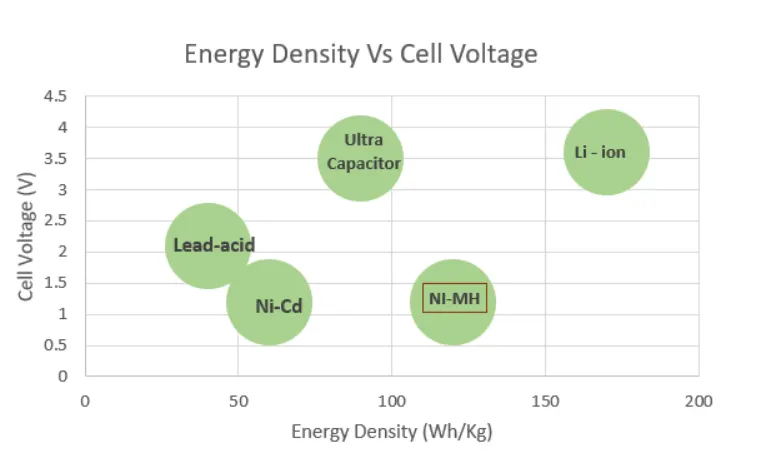
The values of energy densities of different batteries and cell voltage are shown in the below table and also the same is represented in the X-Y plot shown below.
|
Battery name |
Energy density |
Cell voltage |
|
Lead-acid battery |
35-40 |
2.1 |
|
Nickel Cadmium |
40-60 |
1.2 |
|
Nickel Metal Hydride |
60-120 |
1.2 |
|
Lithium-ion |
100-265 |
3.6/ 3.7/ 3.8/ 3.85 |
|
Ultracapacitor |
89.6 |
3.5 |
*************************************************************************************************************
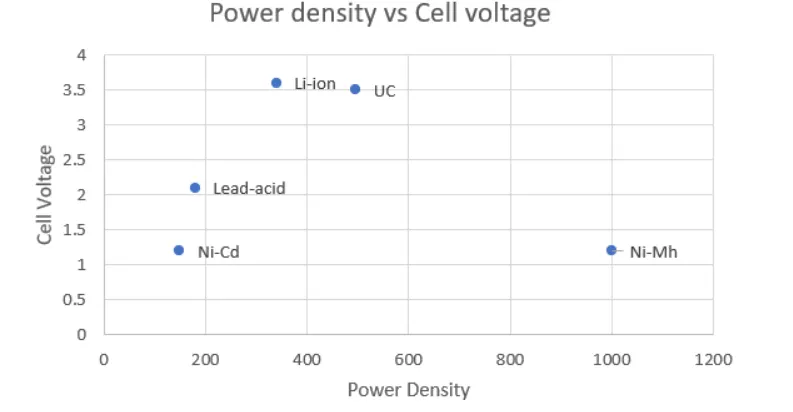
Q.3 The power density of the above set of batteries is as shown below.
|
Battery name |
Power density (W/Kg) |
Cell voltage (V) |
|
Lead-acid battery |
180 |
2.1 |
|
Nickel Cadmium |
150 |
1.2 |
|
Nickel Metal Hydride |
1000 |
1.2 |
|
Lithium-ion |
340 |
3.6 |
|
Ultracapacitor |
496 |
3.5 |
The power density plot of the batteries is shown below in the plot.
Q4
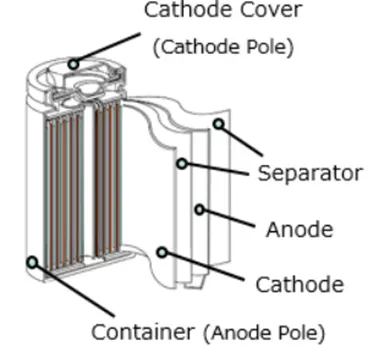
True. The number indicated as 1 is a -ve electrode.
Lithium-ion batteries generate DC power by utilizing chemical reactions.
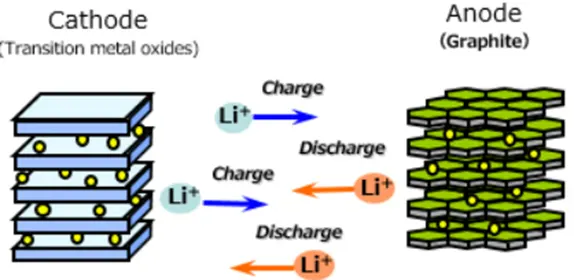
- During discharge, lithium ions from the -ve anode move through the electrolyte to gets intercalate the +ve cathode.
- During charging, electrons move from anode to cathode in the external circuit.
- Electrons flow to balance the cell voltage.
- During the electrochemical process, the anode is -ve and the cathode is +ve.
- At the first time charging, the lithium-ion from the cathode gets attached to anode and it forms the inseparable layer on the anode.
- A solid Electrolyte Interface (SEI) is formed at the anode. Anode gets decomposed if it comes in contact with the electrolyte. SEI protects the anode.
Summary:
A battery has just been manufactured in the industry and has been connected to a charger for the first time. The electrode marked as (1) in the picture below is the negative electrode. this is true