Week 5 Challenge
Question 1:
Consider a scenario where an aggressive driver is accelerating very rapidly and braking
harshly in a city driving. Is battery better a choice to supply power than UC in this
scenario?
1. True
2. False
Answer:
False-
There is possibility in hybrid electric vehicle that charged ultracapacitor can help battery to give
extra power to electric motor during every high acceleration apart from helping battery in such
situation of aggressive driving.
This is because compared with batteries ultracapacitors have following charecteristics:
1) Ultra-low series equivalent resistance, power density is dozens of times that of lithium-ion
batteries, suitable for high-current discharge (a 4.7F capacitor can release more than 18A of
instantaneous current).
2) Ultra-long service life, Ultracapacitor can be charged and discharged for more than 500,000
times, which is 500 times that of Li-Ion batteries and 1,000 times that of Ni-MH and Ni-Cd batteries.
If the ultracapacitor is charged and discharged 20 times a day, they can be continuously used for
68 years.
3) It can be charged with high current, the charging and discharging time is short, the requirements
for the charging circuit are simple, and there is no memory effect.
4) Maintenance-free and sealable.
5) The temperature range is wide: from -40℃ to +70℃, and that of the general battery is -20℃~
60℃.
6) Ultracapacitor can be connected in series and parallel to form a ultracapacitor module, which
can withstand pressure and store higher electric charges.
Advantages of ultracapacitor in practical applications:
1) Ultracapacitor are different from batteries and may be superior to batteries in some
applications. Sometimes a combination of the two is a better approach, combining the power
characteristics of a capacitor with the high energy storage of a battery.
2) The ultracapacitor can be charged to any potential within its rated voltage range, and can be
discharged.
The battery is limited by its own chemical reaction to work in a narrow voltage range, and it may
cause damage if it is over-discharged.
3) The state of charge (SOC) and voltage of a ultracapacitor constitute a simple function, while
the state of charge of a battery includes various complex conversions.
4) Ultracapacitor can store more energy than their comparable conventional capacitors, and
batteries can store more energy than their comparable sized ultracapacitor. In some applications
where power determines the size of energy storage devices, supercapacitors are a better approach.
5) Ultracapacitor can transmit energy pulses repeatedly without adverse effects, on the contrary, if
the battery repeatedly transmits high-power pulses, its service life is greatly reduced.
6) Ultracapacitor can be charged quickly whereas batteries can be damaged by rapid charging.
7) Ultracapacitor can be repeatedly cycled hundreds of thousands of times, while battery life is
only a few hundred cycles.
Question 2:
Consider the following components.
1) Lead acid battery 2) Nickel cadmium battery 3) Nickel Metal hydride battery 4) Lithium
ion (specify chemistry) battery 5) Ultra Capacitor
Note: In case of a range of energy density, take the average value for the plot.
Create a plot with energy density on the X Axis and cell voltage on the Y axis.
Comment on the capabilities of these batteries based on the plot created.
Answer:
1) Lead acid battery
A lead acid battery, also known as a lead storage battery is the oldest kind of rechargeable battery.
The battery is common as an energy storing device. The lead acid battery was invented in the year
1859 by Gaston Plante, who was a French physicist. There are still many applications that make use
of lead-acid batteries. These find wide usage in vehicles where the battery can provide high current
for winding power.
Even though the lead-acid batteries are highly reliable, these have a minimal life. These are also
heavy to ship and composed of many toxic materials that require some unique methods of removal
at the end of their life. The response time is good, and the power density of this kind of battery is
moderate. Depending on the technology of power conversion, the lead-acid batteries can accept or
supply energy almost instantaneously. Lead-acid batteries get affected by the temperature, and this
is why they need maintenance to maximize their life expectancy.
2) Nickel cadmium battery
Nickel-cadmium battery is a source for DC voltage. Due to its properties and advantages, it is taking
over lead-acid-based batteries and gaining popularity in recent times. It is small, compact, easily
traveled from one place to another. General uses of this battery are toys, calculators, small DC
motors, etc. Principle wise it is the same as lead accumulator based batteries. A metal is rolled with
cadmium and separator layers and kept in redox so that the chemical reaction produces the DC
voltage. Batteries have been popular for a long, and in an effort to increase the efficiency of the
battery more and more chemical elements are used. This makes the construction compact.
3) Nickel Metal hydride battery
A nickel metal hydride battery (NiMH or Ni–MH) is a type of rechargeable battery. The chemical
reaction at the positive electrode is similar to that of the nickel-cadmium cell (NiCd), with both
using nickel oxide hydroxide (NiOOH). However, the negative electrodes use a hydrogen-
absorbing alloy instead of cadmium. NiMH batteries can have two to three times the capacity of
NiCD batteries of the same size, with significantly higher energy density, although much less
than lithium-ion batteries.
They are typically used as a substitute for similarly shaped non-rechargeable alkaline batteries, as
they feature a slightly lower but generally compatible cell voltage, and are less prone to leaking and
explosion.
4) Lithium ion (specify chemistry) battery
A lithium-ion battery or Li-ion battery is a type of rechargeable battery composed of cells in which
lithium ions move from the negative electrode through an electrolyte to the positive electrode
during discharge and back when charging.
Li-ion batteries are a popular choice of rechargeable battery for use in many applications like
portable electronics, automobiles as well as stationary applications for providing uninterruptable
power supply. State of Charge (SoC) and State of Health (SoH) are important metrics of a Li-ion
battery that can help in both battery prognostics and diagnostics for ensuring high reliability and
prolonged lifetime. The ML algorithms available in the literature for SoC and SoH prediction involves
use of various derived features rather than directly measurable features making it difficult for
industrial applications. In this work, we use battery data obtained from different batteries to develop
supervised models that can be used for the on-line estimation of SoC and SoH. This work involves
two parts: a) developing a classifier based on SoH b) dynamic prediction of battery SoC given the
past operational data of current, voltage, and temperature of the battery which are easily
measurable. Random forest algorithm is used for battery site classification based on the SoH data
available from the manufacturer. The battery SoC estimation is performed using a random forest
algorithm and Neural network-based NARX model.
5) Ultra Capacitor
Ultracapacitor which is also known as a supercapacitor is an electrical device that stores charge
in large amounts. It is called ultra because it has a higher capacitance value than regular
capacitors. These capacitors have low voltage limits and they have become a better choice over the
common capacitors.
An ultracapacitor is an energy-storing component that stores a large number of charges. The
capacitor is the simplest device that consults of two matte lip plates and insulating material between
them which is also known as the dielectric material. Capacitors stock energy in the shape of the
electric field because of their capability to accumulate charge. Storage of charge depends on the
applied voltage to the capacitor. Storage charge is directly proportional to the applied voltage.
An ultracapacitor is a special type of capacitor manufactured to stored a larger charge due to this its
plate size is large and the distance between them is small. A normal capacitor uses solid insulating
material but an ultracapacitor used a liquid dielectric substance which makes it an electrochemical
component.
Though it is a category of electrochemical expedient, there is no chemical reaction that occurs in it
to store of charge.
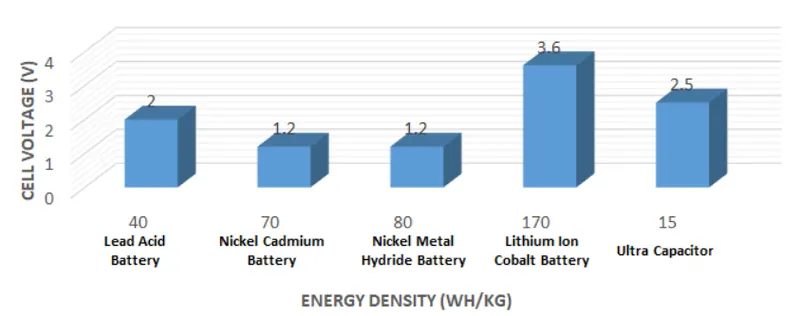
From the plot it can be seen that lithium ion based batteries have the greatest energy density and
cell potential, which is why they are currently the most preferred battery choice. Toyota uses NiMH
batteries in its Prius HEV and its Mirai 2021 FCEV, possibly because it is more durable and carries
lower risk of thermal runaway than lithium ion.
The lead-acid battery represents the oldest rechargeable battery technology. Lead-acid batteries can
be found in a wide variety of applications, including small-scale power storage such as starting,
lighting, and ignition power sources for automobiles, along with large, grid-scale power systems.
Ultracapacitors are always used as a supplement to a battery but become the primary power source
during transient states for better load management for the battery and the overall powertrain
system, since its ability to charge and discharge quickly is unparalled in the battery world currently.
Question 3:
For the above-mentioned components on the same plot (retain the previous plot) created
in the previous Create a plot with power density on the X axis and cell voltage on the Y
axis.
Answer:
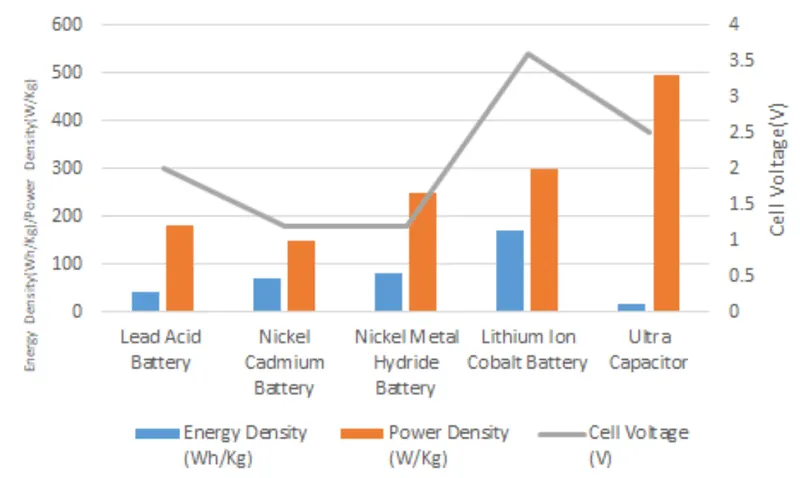
The power density of a capacitor is the amount of power it can produce for a given volume. For
instance, capacitors have a greater power density than batteries as they are able to deliver energy
much faster than batteries can. A small capacitor can have a much higher power density than a
large battery, even though a battery may have a higher energy density. In other words, power is
the rate of using energy. The power density of a capacitor is usually expressed as potential energy
per gram or per unit volume.
When it comes to power density, this graph demonstrates why UCs currently do so well as a
secondary power option coupled with batteries in xEVs today. They become the primary choice of
power generation and regenerative braking during transient states like rapid acceleration or
deceleration due to their high power density and high C rate for charging and discharging.
Ultracapacitors have several distinct advantages, the first of which is their high energy storage.
Ultracapacitors possess energy density that is several times higher than that of traditional
capacitors. Compared with batteries, they also possess a low internal resistance (ESR), furthering
their high power-density capabilities.
This works well with batteries since they have a slow charge/discharge cycle but have a high
energy density. Working together they are not only efficient but capable of handling peak power
demands and long discharge cycles.
Question 4:
Consider the following scenario:
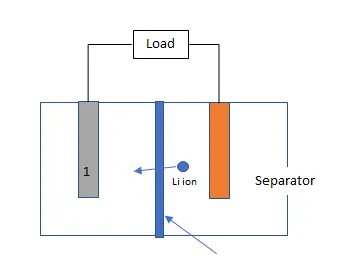
A battery has just been manufactured in the industry and has been connected to a
charger for the first time. The electrode marked as (1) in the picture below is the
negative electrode.
1. True
2. False
Answer:
True-
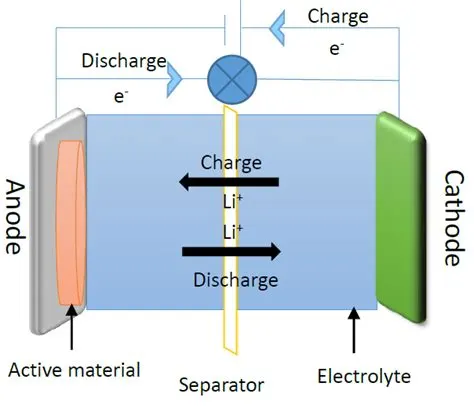
The charging and discharging process of lithium-ion batteries is the process of Li+ intercalation and
deintercalation in the positive and negative materials accompanied by the absorption and release of
energy. Charge the lithium-ion battery: Li+ is deintercalated from the positive electrode material,
reaches the negative electrode through the electrolyte, absorbs electrons, and is embedded in the
negative electrode material to form a higher energy intercalation compound.
Lithium-ion battery is a kind of rechargeable battery, which mainly depends on the movement of
lithium ions between the positive and negative electrodes to work. During the charging and
discharging process, Li+ intercalates and deintercalates back and forth between the two electrodes:
when recharging the battery, Li+ deintercalates from the positive electrode and inserts into the
negative electrode through the electrolyte, and the negative electrode is in a lithium-rich state; the
opposite is true during discharge. Generally, batteries that use materials containing lithium as
electrodes are representative of modern high-performance batteries.
The charging and discharging process of lithium ion batteries is the process of intercalation and
deintercalation of lithium ions. In the process of intercalation and deintercalation of lithium ions, it is
accompanied by the intercalation and deintercalation of electrons equivalent to that of lithium ions
(the positive electrode is usually represented by intercalation or deintercalation, and the negative
electrode is denoted by insertion or deintercalation). During the charging and discharging process,
lithium ions are intercalated/deintercalated and intercalated/deintercalated back and forth between
the positive and negative electrodes, which is vividly called the rocking chair battery.
When the battery is charged, lithium ions are generated on the positive electrode of the lithium ion
battery, and the generated lithium ions move to the negative electrode through the electrolyte. The
carbon as the negative electrode has a layered structure. It has many micropores. The lithium ions
reaching the negative electrode are embedded in the micropores of the carbon layer. The more
lithium ions are inserted, the higher the charging capacity. Similarly, when the battery is discharged,
the lithium ions embedded in the carbon layer of the negative electrode are released and move back
to the positive electrode. The more lithium ions returned to the positive electrode, the higher the
discharge capacity.
Principles of Lithium Ion Battery Charging and Discharging
The working principle of a lithium-ion battery refers to its charging and discharging principle. When
the battery is charged, lithium ions are generated on the positive electrode of the battery, and the
generated lithium ions move to the negative electrode through the electrolyte. The carbon as the
negative electrode has a layered structure. It has many micropores. The lithium ions that reach the
negative electrode are embedded in the micropores of the carbon layer. The more lithium ions are
inserted, the higher the charging capacity.
It is not difficult to see that during the charging and discharging process of lithium-ion batteries,
lithium ions are in a state of movement from positive electrode to negative electrode to positive
electrode. If we compare the lithium ion battery to a rocking chair, the two ends of the rocking chair
are the two poles of the battery, and the lithium ion is like an excellent athlete running back and
forth on both ends of the rocking chair. Therefore, the experts gave the lithium-ion battery a lovely
name, rocking chair battery.
Li-ion battery charge and discharge requirements
1. Charging of Li-ion battery
The maximum end-of-charge voltage of a single-cell lithium-ion battery is 4.2V, and it cannot be
overcharged, otherwise the battery will be scrapped due to the loss of too much lithium ions in the
positive electrode. When charging lithium-ion batteries, a dedicated constant current and constant
voltage charger should be used. First, charge with constant current until the voltage at both ends of
the lithium-ion battery is 4.2V, then switch to constant voltage charging mode; when the constant
voltage charging current drops to 100mA When, charging should be stopped.
2. Discharge of Lithium Ion Battery
Due to the internal structure of lithium-ion batteries, all lithium ions cannot move to the positive
electrode during discharge, and a part of lithium ions must be retained in the negative electrode to
ensure that lithium ions can be inserted into the channel smoothly during the next charge.
Otherwise, the battery life will be shortened. In order to ensure that some lithium ions remain in the
graphite layer after discharge, it is necessary to strictly limit the minimum discharge termination
voltage, which means that the lithium ion battery cannot be over-discharged.
Therefore,During discharging, the intercalated lithium ions travel from anode (negative) to cathode
(positive). So during charging, those lithium ions need to be transferred back from cathode to anode
to increase the cell potential. Especially during the first charge, there will be little to no lithium ions
present at the graphite anode, so they certainly need to travel to the anode to intercalate between
the graphite layers to load up on charge.