Week 5 Challenge
Question 1:
Consider a scenario where an aggressive driver is accelerating very rapidly and braking harshly in a city driving. Is battery better a choice to supply power than UC in this scenario?
- True
- False
Why?
False, Battery is not a better choice in the given driving scenario,to explain whether battery is better choice to supply power than ultracapacitor to aggressive driver who accelerates and brakes harshly.
The aggressive driver accelerates rapidly and brakes harshly
This requires the instantaneous high power to meet this condition
Battery pack has less specific power capacity than ultracapacitor
For this instantaneous high power for short duration of time, it is not efficient to increase the battery pack
But ultracapacitor has ten times high specific power than battery,specific power is about 10kW/kg
the sudden load can be used to meet sudden acceleration and braking,Sudden braking produces high regenerative current. This current can be used to charge the battery but it is not efficiently used
Question 2:
Consider the following components.
1) Lead acid battery 2) Nickel cadmium battery 3) Nickel Metal hydride battery 4) Lithium ion (specify chemistry) battery 5) Ultra Capacitor
Note: In case of a range of energy density, take the average value for the plot.
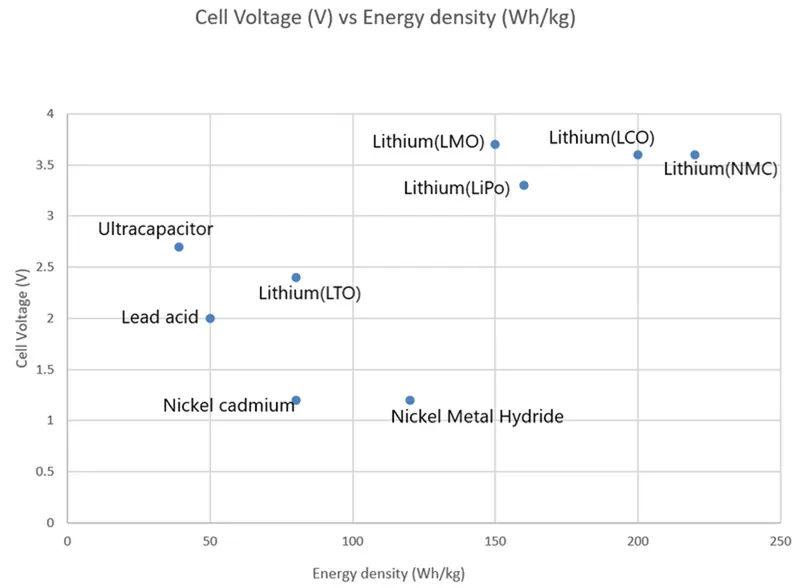
Create a plot with energy density on the X Axis and cell voltage on the Y axis.
Comment on the capabilities of these batteries based on the plot created
Cell Type Cell Voltage(V) Average Energy density(Wh/Kg)
Lead acid 2 40
Ni-Cd 1.2 62.5
Ni-MH 1.2 90
Li-ion(LMO) 3.8 117.5
Ultracapacitor 3 10
Lead acid batteries can be used in IC engine vehicles to supply the auxillary 12V system load and in emergency lighting because of low energy density, simple construction and stable operation
Nickel cadmium batteries has less cell voltage and little higher energy density than lead acid hence it is can be used in toy cars, calcul
Nickel Metal Hydride batteries can be used in wide electronic devices because of high energy density. Voltage is less hence it is sufficient to power electronic devices such as computers, cellular phone
Lithium - ion batteries have high energy density and high cell voltage. Lithium is also light in weight and hence it can be used in Battery Electric Vehicle, Smartphones, Laptop
Y axis values are cell voltage and X axis values are Energy density and column 1 shows type of battery
Question 3:
For the above-mentioned components on the same plot (retain the previous plot) created in the previous
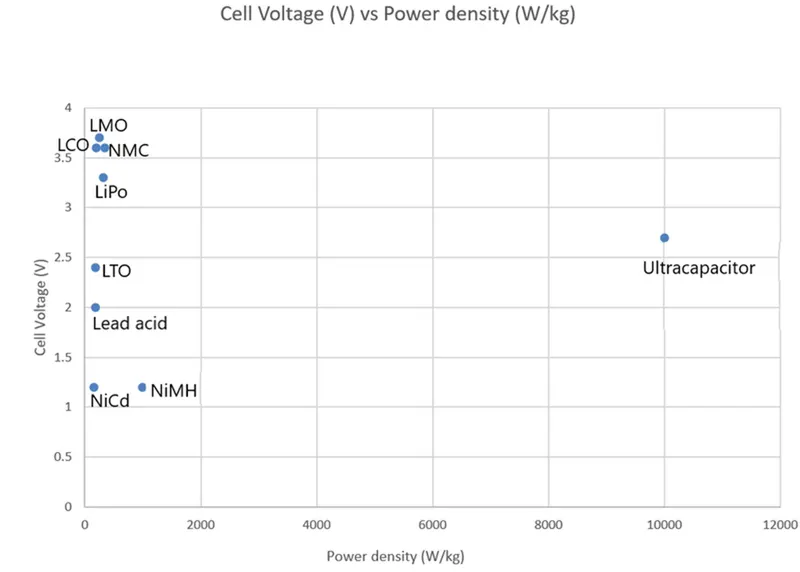
Create a plot with power density on the X axis and cell voltage on the Y axis
Lead acid, Nickel Cadmium, Lithium titanate, Lithium manganese oxide and lithium cobalt oxide has low power density. Hence these can be operates for low power application
Nickel metal Hydride has high power density than other batteries hence it can be used in HEV’s and portable power tools where high power is required
Lithium Nickel Manganese Cobalt battery has comparatively high power density than other batteries except NiMH. Hence it is used for high power and high energy requiring system
Ultracapacitors have far high power density than any other source of energy storing element,have ten times higher power density than lithium-ion batteries,it can be used to supply power to peak load without any tension
Consider the following scenario:
A battery has just been manufactured in the industry and has been connected to a charger for the first time. The electrode marked as (1) in the picture below is the negative electrode.
- True
- False
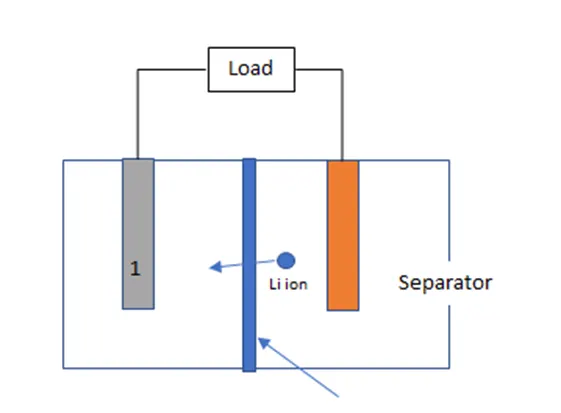
True. The number indicated as 1 is a -ve electrode.
Lithium-ion batteries generate DC power by utilizing chemical reactions.
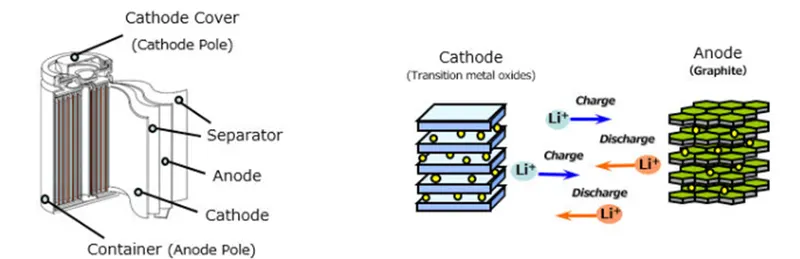
During discharge, lithium ions from the -ve anode move through the electrolyte to gets intercalate the +ve cathode.
During charging, electrons move from anode to cathode in the external circuit.
Electrons flow to balance the cell voltage.
During the electrochemical process, the anode is -ve and the cathode is +ve.
At the first time charging, the lithium-ion from the cathode gets attached to anode and it forms the inseparable layer on the anode.
A solid Electrolyte Interface (SEI) is formed at the anode. Anode gets decomposed if it comes in contact with the electrolyte. SEI protects the anode.
Components of lithium-ion battery:
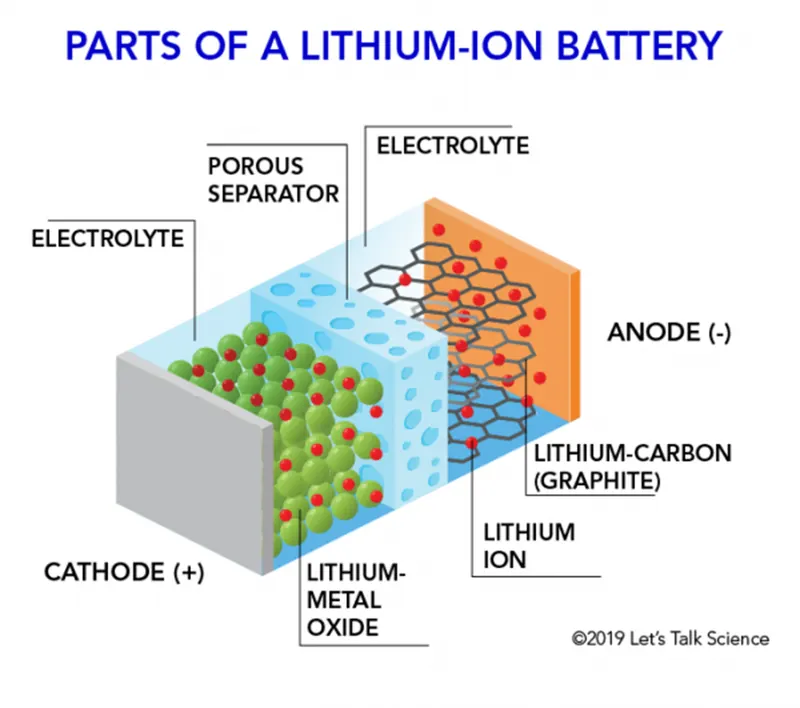
A battery is made up of several individual cells that are connected to one another. Each cell contains three main parts:
positive electrode (a cathode),
negative electrode (an anode) and
liquid electrolyte.
Separator.
Reactions involved in lithium-ion batteries
Inside a lithium-ion battery, oxidation-reduction (Redox) reactions take place.
Reduction takes place at the cathode. There, cobalt oxide combines with lithium ions to form lithium-cobalt oxide (LiCoO2). The half-reaction is:
CoO2 + Li+ + e- → LiCoO2
Oxidation takes place at the anode. There, the graphite intercalation compound LiC6 forms graphite (C6) and lithium ions. The half-reaction is:
LiC6 → C6 + Li+ + e-
Here is the full reaction (left to right = discharging, right to left = charging):
LiC6 + CoO2 ⇄ C6 + LiCoO2
How does recharging a lithium-ion battery work?
When the lithium-ion battery in your mobile phone is powering it, positively charged lithium ions (Li+) move from the negative anode to the positive cathode. They do this by moving through the electrolyte until they reach the positive electrode. There, they are deposited. The electrons, on the other hand, move from the anode to the cathode.When you charge a lithium-ion battery, the exact opposite process happens. The lithium ions move back from the cathode to the anode. The electrons move from the anode to the cathode.A battery has just been manufactured in the industry and has been connected to a charger for the first time. The electrode marked as (1) in the picture below is the negative electrode. this is true