Week 5 Challenge
Q1.
NO It is false.
As Ultra capacitor has high power density and batteries have high energy density and batteries cannot provide such sudden peak demand. So in conclusion we can say that ultra capacitors are for facing such sudden change in consumption rate as well as the energy generated through regenerative braking can\ be stored more fast in comparision to any other batteries or energy storage device as of now.
On the down side if we consider such a battery which can meet such sudden power demand that it will be a lot costlier to design such a power pack.
Q2&3.
Lead acid battery
Nickel cadmium battery
Nickel Metal hydride battery Lithium ion (spocity chemistry) battery
• Ultra Capacitor
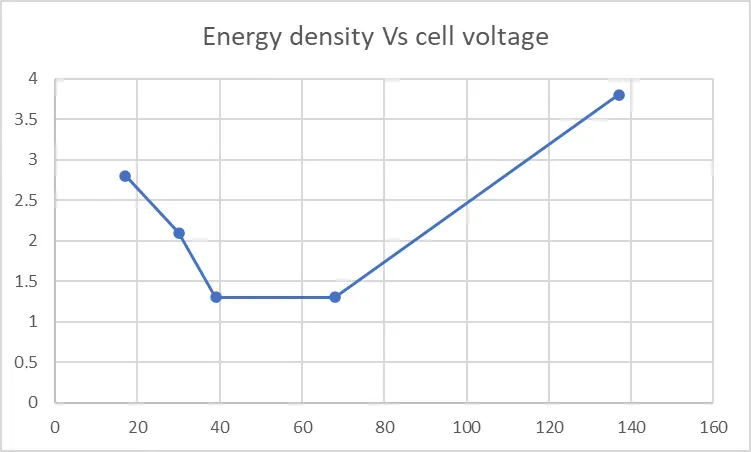
Lithium-ion: There are many types of lithium ion battery. They are mainly classified on the basis of cathode material used cause anode remains same in all the cases in plot we have shown the average energy density of it. Now li-ion is widely used in EVs, mobile phones and many more applications. They rule the above plot, cause they have high energy density and high cell voltage as well amongst all
tead-acid: LA batteries has low energy density as compared to MH and NiCd but cell voltage value is high. Lead
acid batteries are used in emergency lighting and to power sump pumps in case of power failure. They were the first
choice of energy in BEV. But now they have been replaced by other batteries cause they require frequent
maintenance
Ultracapacitor: it can be seen that UC can't be used for high energy demanding applications its voltage is greater than that of Lead acid NiCd and NMH. They are widely used in Electric or hybrid vehicles-to provide a quick burst of acceleration over short distances, or to start the main motor. NiMH & NiCd: Nickel metal hydride and Nickel cadmium have almost similar cell voltage value but energy density of
NMH is very high than NiCd NMH batteries are highly recommend in applications that call for long duration but not a
high omp lood. Nicd are best suitable for portable power application.
plot of Energy density Vs. cell voltage is shown below:

Q4.
the statement is true
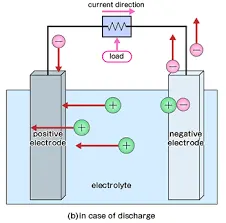
because as we know from the battery chemistry the positive electrode (cathode) loses the electron and this electron travels to the anode as a reverse voltage is apllied to the battery. We shold remember that in almost all the electronics devices cathode is -ive and anode is +ive but battery being the active material has cathode termed as +ive and anode as negative. Thats why behaviour of electrodes in batteries is explained in two ways i.e while charging and discharging. Below fig represents what has been theoretically said.