Week 5 Challenge
SOLUTION1
The above assertion is incorrect. The driving pattern of the driver can be summarised as short power transients. The driver is accelerating, and we all know how the power demand spikes during acceleration, though only for a brief period of time. As shown in the graph below. Pa stands for the acceleration power. This power is only required while we are moving quickly. Even if we only require this power for a brief period, it remains dominating among all.Although batteries can meet this demand, the cost of producing them is prohibitively expensive. Ultracapacitors, on the other hand, store a large amount of energy that can be released on demand and can be charged quickly. Because of its high power density, the Ultracapacitor is an excellent power source for such transitory power demands.
SOLUTION3
Ultracapacitor: As can be seen, UC is not suitable for high-energy applications. It has a higher voltage than lead acid NiCd and NiMH batteries. They're commonly seen in electric and hybrid vehicles, where they're utilised to deliver a burst of acceleration over short distances or to start the main motor.
Nickel metal hydride and nickel cadmium have nearly identical cell voltage values, but NiMH has a far higher energy density than NiCd. In applications that require a long duration but not a large amp load, NiMH batteries are highly recommended. Nicd are ideal for use in portable power applications. Lead-acid batteries have a lower energy density than NiMH and NiCd batteries, but their cell voltage is higher.
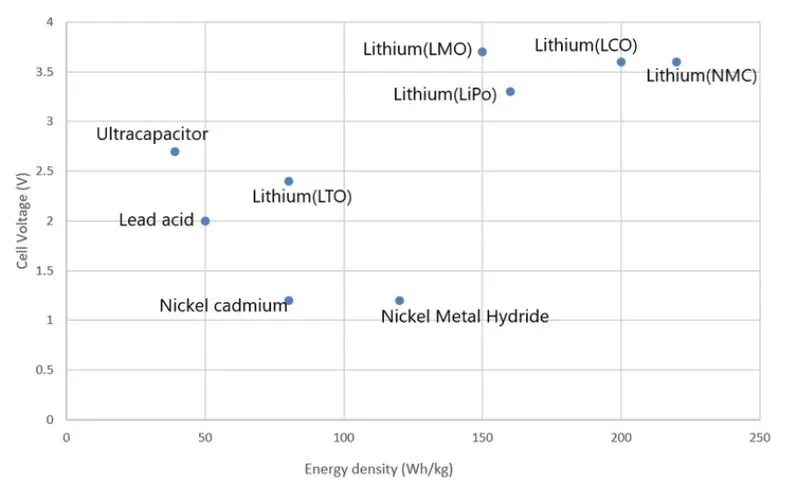
Lead-acid batteries have a lower energy density than NiMH and NiCd batteries, but their cell voltage is higher. In the event of a power outage, lead-acid batteries are utilised to operate emergency lighting and sump pumps. They were the energy source of choice for BEVs. However, because they require constant maintenance, they have been replaced by alternative batteries.
Lithium-ion batteries come in a variety of shapes and sizes. Because the anode is the same in all situations, they are mostly categorised based on the cathode material employed. We've plotted the average energy density of it. Li-ion is now widely employed in electric vehicles, mobile phones, and a variety of other applications. They dominate the above plot due to their high energy density and cell density.
SOLUTION4
The above statement is correct. Because the positive electrode (cathode) loses an electron during the charging process, the electron goes to the anode as a reverse voltage is applied to the battery. We must remember that in practically all electronic devices, the cathode is -ive and the anode is +ive, but in batteries, the cathode is positive and the anode is negative. As a result, the behaviour of electrodes in batteries can be explained in two ways: during charging and while discharging. The diagram below depicts what has been hypothetically stated.