Simulation to study Battery characteristics using a Drive Cycle
Generic Battery Model
The Battery block implements a generic dynamic model that represents the most popular types of rechargeable batteries.
Equivalent Circuit Cell Modelling
To understand the battery behaviour we need to model the phenomenological analogues using common electrical circuit elements, thus building the equivalent circuit.
Simple Equivalent Circuit of Battery
A battery is considered as an ideal voltage source in this analogy.
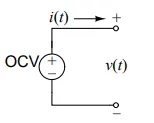 where OCV stands for Open Circuit Voltage
In the above model, the voltage is not a function of current or past battery usage(SOC) and the voltage remains constant.
This model is inadequate but considering the batteries do supply voltage and the cell voltage is fairly predictable when the cell is unloaded and is in complete equilibrium.
Thus the ideal voltage source will be an element in the equivalent circuit model of a battery.
State of Charge Estimation
The cell voltage is higher when it is fully charged than when it is discharged, so to improve the battery model we dependence on SOC (`z(t)`).
The fully charged cell SOC, `z=100%` and `z=0%` for fully discharged.
The total capacity of a cell `Q`, can be defined as the amount of charge taken while discharging from `z=100%` to `z=0%`.
Now the can be given as
`dotz(t)=-i(t)/Q`
`dot(z)(t)=z(t_0)-1/Qint_(t_0)^ti(t) dt`
where `dotz=(dz)/(dt)` and the sign of `i(t)` is positive on discharge.
For a discrete-time, we assume that the current is constant over sampling time `Delta t`
`z(k+1)=z(k)-(i(k)Deltat)/Q`
Considering the coulombic efficiency of cell as n(k) the above equation can be written as
`dotz(t)=-(i(t)eta(t))/Q`
`z(k+1)=z(k)-(i(k)eta(k)Deltat)/Q`
The value of `eta(k)<=1` while charging as some charge is lost due to unwanted reactions(as electrical energy is stored in chemical form) and `eta(k)=1` while discharging.
The coulombic efficiency is of lithium is considered about 99% and is equal to the ratio of charge out by charge in.
`eta`=charge out/charge_in
Energy efficiency and coulombic efficiency are not the same as energy efficiency is the energy given out to energy given to the cell. The energy efficiency is close to 95%. The energy may be lost in the form of resistive heating but the loss of charge is considered negligible.
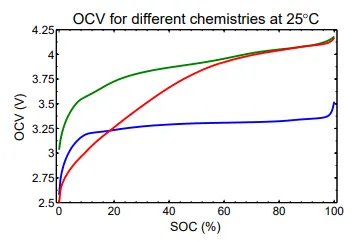
OCV can be plotted as a function of SOC and further detailed model can also include dependency upon temperature
`OCV(z(t),T(t))`
OCV as a function of SOC for different cell chemistries at constant temerature
Linear Polarisation
Polarization refers to any difference between the measured terminal voltage of this cell and the cell's internal open-circuit voltage due to the passage of electrical current. Example, the voltage of the cell drops when under a load.
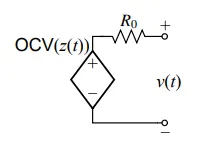
The model represents the ideal voltage and series resistance to represent the voltage drop due to the load. The voltage across the terminals of the battery is now given by `v(t)`.
`v(t)=OCV(z(t))-i(t)R_0`
Note v(t)>OCV(z(t)) while charging and v(t)<OCV(z(t)) while discharging.
This implies that the energy is dissipated in form of heat by the resistor and the energy efficiency of the system is decreased.
Cell behaviour upon Impulse Loading
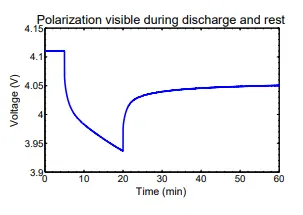
The above model only represents the instantaneous voltage drop but the real behaviour of the battery differs with time. This dynamic behaviour of the is caused by the phenomenon called diffusion, so we will refer to this slowly-changing voltage as a diffusion voltage.
Diffusion Voltage
The slow relaxation of voltage is caused by slow internal diffusion of lithium from one part of the battery cell to the other where concentration gradients build-up while the cell was being discharged and they have to slowly relax back to their equilibrium values by diffusion. Diffusion is a process, it does not happen instantly, the voltage of the cell does not change instantly.
To capture this dynamic behaviour of the cell we add a parallel resistor-capacitor branch in series with the current path of the battery cell. To increase the accuracy of the dynamic path that is for better curve fitting we can increase the number of parallel resistor-capacitor sub-circuits.
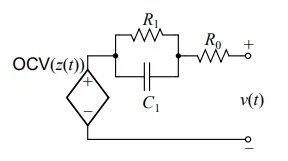
The cell voltage v(t) can be written as
`v(t)= OCV(z(t)) − v_(C1)(t) − i(t)R_0`
It becomes simpler if we write this expression in terms of element currents
`v(t)= OCV(z(t)) − R_1i_(R_1)(t) − R_0i(t)`
To find an expression for the `i_(R_1)(t)`, we recognize that the summation of current through R1 and the current through C1 must be equal to i(t).
For the capacitor, we can write `i_(C1)(t) = C_1dotv_(C_1)(t)`
Now `i(t)=i_(R_1)(t)+C_1dotv_(C_1)(t)` as per Kirchoffs current law
Also `v_(C_1)(t) = R_1i_(R_1)(t)` as per Kirchoffs current law and substituting this in the above equation
`i_(R_1)(t)+R_1C_1(di_(R_1)(t))/(dt)=i(t)`
`(di_(R_1)(t))/(dt)=(i(t))/(R_1C_1)-(i_(R_1)(t))/(R_1C_1)`
Generic Battery Matlab Equivalent Circuit
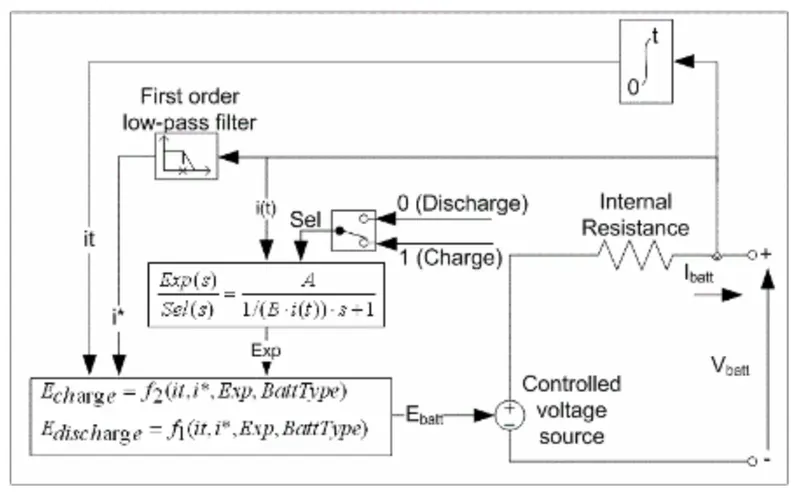
Equations for Lithium-Ion Battery Model
Discharge Model `(i^ast > 0)`
`f_1(it,i∗,i)=E_0−K*Q/(Q−it)*i∗−K*Q/(Q−it)*it+A⋅exp(−B⋅it)`
Charge Model (`i^ast < 0`)
`f_2 (it,i∗,i)=E 0 −K⋅ Q/( it+0.1⋅Q) ⋅i∗−K⋅ Q/(Q−it )⋅it+A⋅exp(−B⋅it)`
State of Charge Calculation
`SOC=100(1−1/Qint_0^ti(t) dt)`
Limitations
- The minimum no-load battery voltage is 0 V and the maximum battery voltage is equal to `2 × E_0`.
- The minimum capacity of the battery is 0 Ah and the maximum capacity is `Q_(max)`.
Assumptions
- The internal resistance is assumed to be constant during the charge and discharge cycles and does not vary with the amplitude of the current.
- The parameters of the model are derived from the discharge characteristics. The discharging and charging characteristics are assumed to be the same.
- The capacity of the battery does not change with the amplitude of the current (there is no Peukert effect).
- The self-discharge of the battery is not represented. It can be represented by adding a large resistance in parallel with the battery terminals.
- The battery has no memory effect
Drive Cycle: FTP-72 (UDDS)
The US FTP-72 (Federal Test Procedure) cycle is also called the Urban Dynamometer Driving Schedule (UDDS). The cycle simulates an urban route of 7.5 mi (12.07 km) with frequent stops. The maximum speed is 56.7 mph (91.25 km/h) and the average speed is 19.6 mph (31.5 km/h).
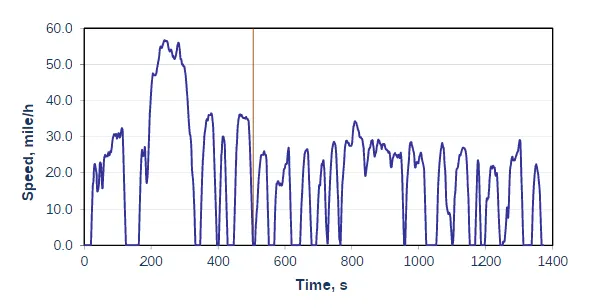
The cycle consists of two phases: (1) 505 s (5.78 km at 41.2 km/h average speed) and (2) 867 s. The first phase begins with a cold start. Weighting factors of 0.43 and 0.57 are applied to the first and second phase, respectively. Emissions are expressed in g/mile or g/km.
Matlab Model for discharging the battery with UDDS drive cycle data
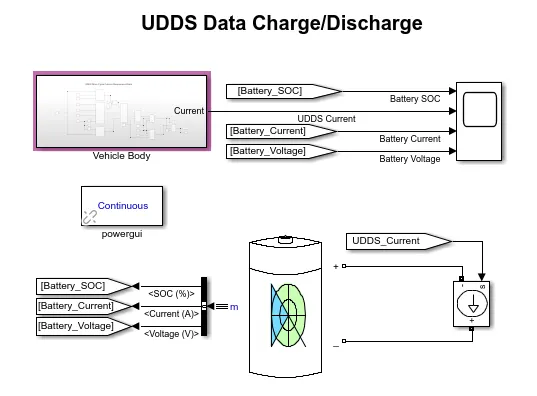
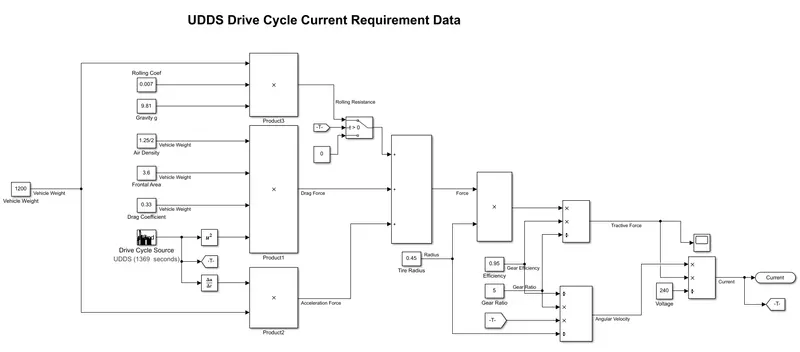
Vehicle Body Sub System
The vehicle body subsystem calculates the vehicle torque requirement based on the assumed weight of the vehicle and the drive cycle speed. All the forces acting on the moving vehicle such as Rolling Resistance, Air Drag and Acceleration forces are calculated and the torque requirement from the motor is calculated by assuming the tire size and the geat ratio. The torque and the angular velocity is used to found the power requirement and by fixing the system voltage to 240V we can find the current requirement form the battery.
Battery Parameters
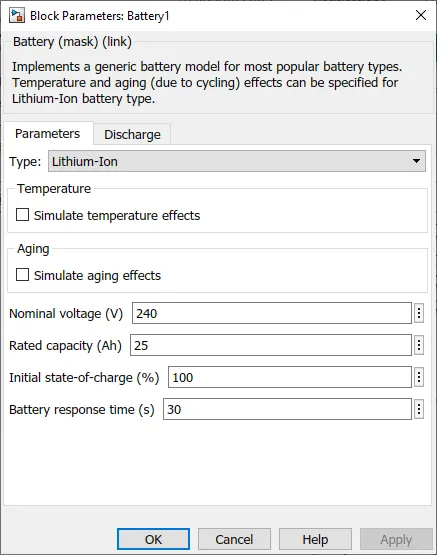
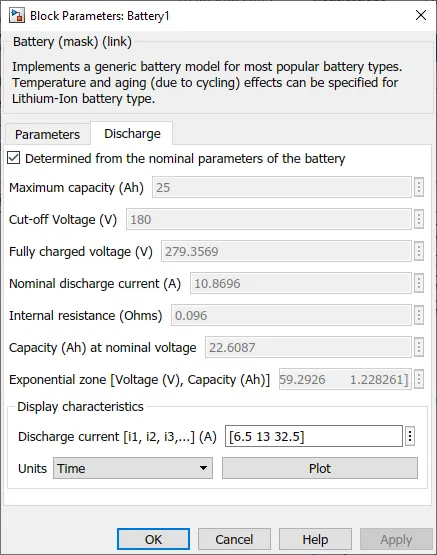
The nominal voltage of the battery is to 240V and the capacity of the battery is 25Ah. The initial state of charge is 100%.
Result
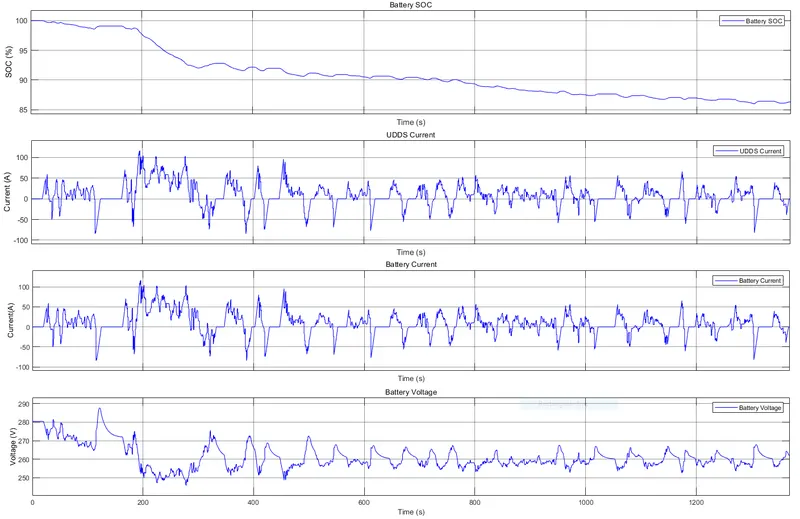
The battery shows the typical behaviour, as the SOC of the battery is decreased by drawing current the voltage of the battery is decreased and vice-versa is observed when the battery is being charged. At the end of the UDDS cycle, the SOC of the battery is reduced to about 86%.
References
1. https://in.mathworks.com/help/physmod/sps/powersys/ref/battery.html
2. http://mocha-java.uccs.edu/ECE5710/ECE5710-Notes02.pdf
3. https://www.mdpi.com/2313-0105/5/1/31/pdf
4. https://www.hindawi.com/journals/isrn/2013/953792/
5. https://www.mdpi.com/2079-9292/9/3/397/htm