Week 4 Session 5
(NOTE : HERE WHAT I UNDERSTAND THE CONCEPT THAT'S MENTIONED AND MORE CLARIFICATION PURPOSE I ADDED SOME ARTICLES DETAILS REFERENCE FROM ONLINE)
QUESTION :
Explain the various applications of Power converters in an Electric vehicle. For Example what type of converter will you use for Horn which requires DC and less than 10V. Likewise come up with different applications
ANSWER :
POWER CONVERTER :
A power converter is an electrical circuit that changes the electric energy from one form into the desired form optimized for the specific load. A converter may do one or more functions and give an output that differs from the input. A power converter is an electrical circuit that changes the electric energy from one form into the desired form optimized for the specific load. A converter may do one or more functions and give an output that differs from the input. It is used to increase or decrease the magnitude of the input voltage, invert polarity, or produce several output voltages of either the same polarity with the input, different polarity, or mixed polarities such as in the computer power supply unit.
The static power converters perform these function of power conversion.
The Power Electronic Converter can be classified into six types:
- Diode Rectifier.
- AC to DC Converter (Controlled Rectifier)
- DC to DC Converter (DC Chopper)
- AC to AC Converter (AC voltage regulator)
- DC to AC Converter (Inverter)
- Static Switches.
Four Types of Power converter commonly used,
- AC to AC converter
- AC to DC converter
- DC to DC converter
- DC to AC converter
AC to AC converter :
AC is convert to again into AC.it is not commonly used in Automotive or Electric Vehicles. A switching converter that changes an ac supply to the ac supply with a different voltage, frequency, phase, or shape is called an AC/AC converter
So we have concentrate here last 3 types of power converters
Which is DC to DC converter , AC to DC converter, DC to AC converter
DC to DC converter :
DC is convert again into DC .The Input DC which we are going to process inside power converter will be Unregulated form and DC signal or DC current which comes out power converter will be in Regulated form
Unregulated DC to DC-DC converter to Regulated DC
Example :
Laptop charger. it’s looked Adapter. In this specification I/P = (100 to 240)v and O/P =20v
When plug it ON the AC supply which means 230v,50Hz will be convert into DC form so this DC will be again of 230v in this on Unregulated DC form why it has unregulated DC because the load in which laptop Battery doesn’t need to 230v.it’s only need to 20v as per specification. Now this 230v DC has to converted to 20v DC using power converter where both input and output signal are in DC form this is how DC-DC converter work.
So 230v Unregulated DC to DC-DC converter to 20v Regulated DC
How this is happening with help of Different types of power converter. It has several category of DC-DC converter
- Non-Isolated converter - Buck, Boost, Buck-Boost
- Isolated converter – Fly back , Forward, Half Bridge, Full Bridge
- Resonant converter – Different family or DC-DC converter, used for High Power Conversion.
Isolated converter or those DC-DC converter in which there input side& output side are electrically isolated meaning that input polarity or output polarity are not mean influence by the input polarity contactor usually it use transformer in between input& output side.(i.e),
Isolated converter :
Fly back converter , Forward converter, Push-Pull converter, Half Bridge converter and also Full Bridge converter
Non-Isolated converter :
Buck converter, Boost converter, Buck-Boost converter
In this case where will use in laptop charger it just 230v to 20v meaning that ,it has reduce DC level that is called step down operation. The converter which is used step down operation is called Buck Converter. The converter which is helping to step up operation(voltage level) is called Boost converter.
In case it has battery 48v we want to connect to 60v then how this implements by using DC-DC converter which Boost type converter. Now 48v will be converted (transform) step up into 60v DC and then load can be connected to desired level output.
Likewise, Buck-Boost converter can be Buck operation and Boost operation also implemented with help function of power MOSFET.
These are major category of DC-DC converter which commonly seen power electronics.
Resonant converter :
It is usually used for high power conversion. A resonant converter is a type of electric power converter that contains a network of inductors and capacitors called a "resonant tank", tuned to resonate at a specific frequency. They find applications in electronics, in integrated circuits.
There are multiple types of resonant converter:
- Series Resonant Converter
- Parallel Resonant Converter
- Class E Resonant Converter
- Class E Resonant Rectifier
- Zero Voltage Switching Resonant Converter
- Zero Current Switching Resonant Converter
- Two Quadrant ZVS Resonant Converter
- Resonant dc-link inverter
Why EVs need to DC-DC converter :
- Delivering power to auxiliary load operating at different voltage(load side)
- Battery to charge station compatibility
- HV battery and LV battery link
- Using low voltage(less costly)battery with high voltage motor systems
- Battery+ Ultra-capacitor& Battery+ Fuel cell combination as energy storage solution.
There are 3 major part where it is using DC-DC converter
Charger setup charging it takes place AC-DC(AC current should be converter into DC current) but again transformation battery will be higher level it is using traction battery 600v or 400v.The AC current is 230v it has been converter into 230v DC and then it has been step up 600v or 400v.There it need to DC-DC converter
- Powering up Auxiliary load
Auxiliary load :
Inside vehicle,
- Air-Conditioning system
- Music system
- Head lights
- Dimmer
These are called auxiliary load of vehicle.
If it want to power up these auxiliary loads. The power is not directly coming from traction battery.it has in auxiliary battery powering into up so this auxiliary battery will be providing required power level for operation these devices
DC-DC converter also Applied for delivering power to Auxiliary loads.
HV battery and LV battery Link :
High voltage battery & Low voltage battery link suppose it has low voltage and that has be connected. DC-DC charging setup there also it need to Dc converter to step up / step down voltage between to energy sources.
Low voltage Battery with High voltage load :
Using low voltage battery where it is connecting high voltage load, it has 12v battery and it want connect motor which it is of 48v how does happen again it has step up the voltage level that is also it has used to DC-DC converter
Battery+ Ultra-capacitor& Battery+ Fuel cell combination as energy storage solution :
When it has multiple energy storage devices, it has battery , Ultra-capacitor& battery ,Fuel cell now each energy system/ each energy storage devices will give to different power level.
Accumulating Different Energy Sources to give the desired output :
Accumulating it has connect to this energy source to give desired output such way that there also it need to DC-DC converter
These are major application where it used to DC-DC converter inside Electric Vehicle.
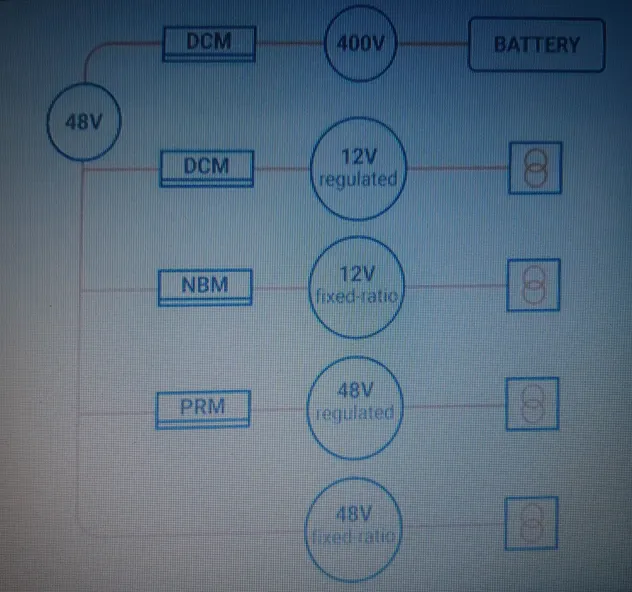
- Voltage Translator(converter)
- Voltage Regulator(controller)
Here it has 48v DC and it has traction battery 400v by using Discontinuous Mode Operation power converter it can be just stepped up 400v and give to output or desired voltage level to the battery(traction).
Different load there let’s assume that head light , A/C system, Music system each system will be operating it’s voltage level.
48v will be converted to 12v regulated and then provided to load
48v will be converted to 12v fixed-ratio voltage also give into different load
Here also same 48v without any power fluctuation or without any change power level provided to 48v regulated and then provided to different load
- DCM – Discontinuous Mode
- PRM – Power Regulation Module
- NBM – Non-Bus Isolated Module
These module is used along with DC-DC converter in order to make sure that the load receiving required power level voltage translator or DC controller can be used as voltage translator in other words it can be used as converter there(i.e.) 48v to 400v also it can be used as voltage regulator (i.e.) 48v to 48v this is all above DC-DC converter Application inside in Electric Vehicle.
A non-isolated power converter has a single circuit in which current can flow between the input and output. Isolation describes the electrical separation between the input and output of a dc-dc converter. An isolated dc-dc converter uses a transformer to eliminate the dc path between its input and output. In contrast, a non-isolated dc-dc converter has a dc path between its input and output. Non-isolated dc-dc converter designs usually employ ICs specifically intended for that purpose.
The buck converter is a step-down, the boost a step-up while the buck-boost is both step-up and step-down. All these are non-isolated and use the inductor as the energy transfer element and are mostly used in board level power conversion and regulation.
The isolated dc to dc converters use a transformer to provide the isolation, multiple outputs, a different voltage level, or polarity depending on the turns ratios and directions of the windings.
They are based on the non-isolated topologies but with the inclusion of a transformer. The commonly used types are, the full bridge, the half bridge, forward and the push pull converters, which are the isolated versions of the buck; and the fly back which is the isolated version of the buck-boost converter.
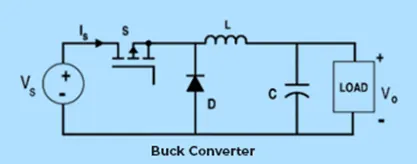
- Buck Converter:
The buck converter is a step-down converter and produces a lower average output voltage than the dc input voltage.
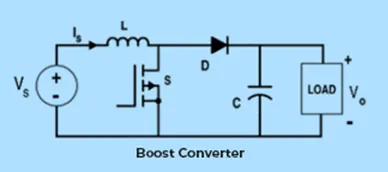
- Boost converter:
In the boost converter, the output voltage is always greater than the input voltage.
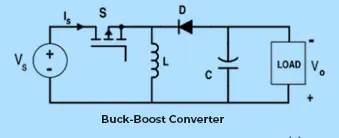
- Buck-Boost converter:
In a buck-boost converter, the output voltage can be either higher or lower than the input voltage.
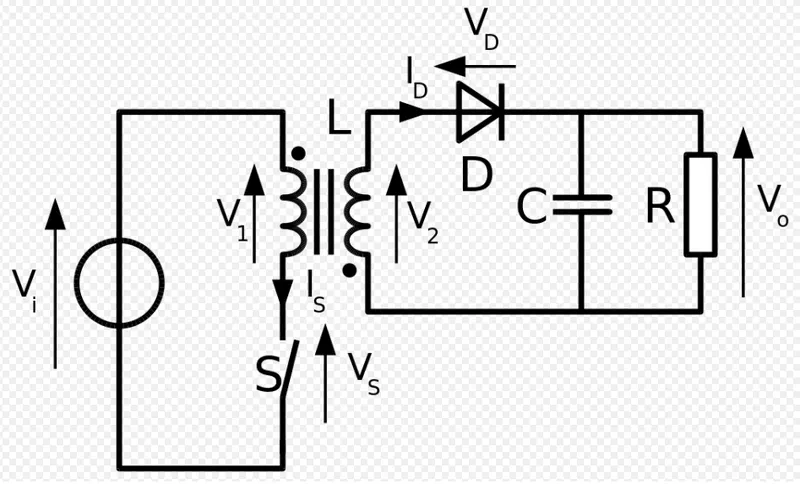
Fly back converter :
The fly back converter is used in both AC/DC, and DC/DC conversion with galvanic isolation between the input and any outputs. The fly back converter is a buck-boost converter with the inductor split to form a transformer, so that the voltage ratios are multiplied with an additional advantage of isolation. When driving, for example, a plasma lamp or a voltage multiplier, the rectifying diode of the boost converter is left out and the device is called a fly back transformer.
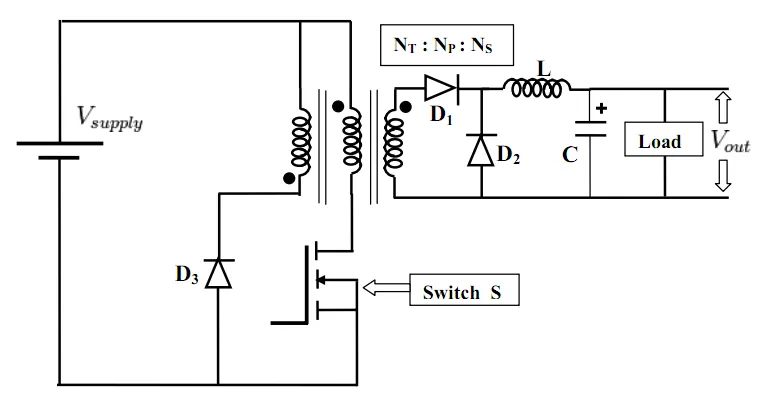
Forward converter :
The forward converter is a DC/DC converter that uses a transformer to increase or decrease the output voltage (depending on the transformer ratio) and provide galvanic isolation for the load. With multiple output windings, it is possible to provide both higher and lower voltage outputs simultaneously.
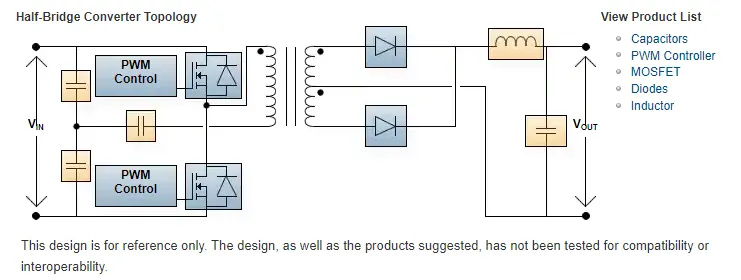
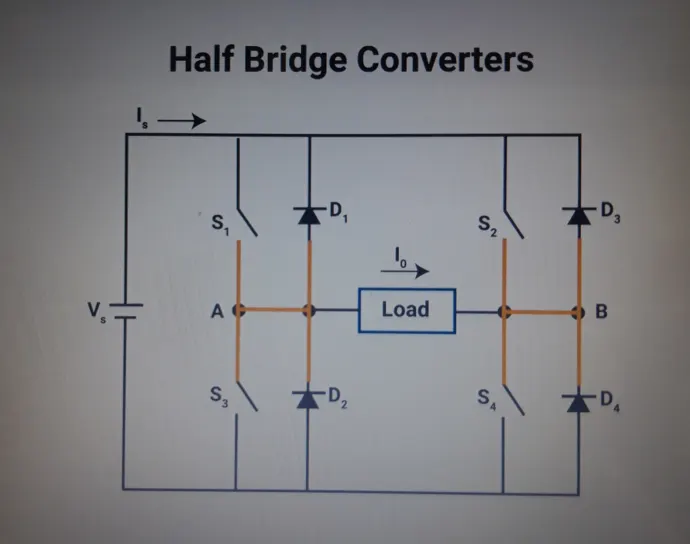
Half-Bridge converter :
A half-Bridge converter is a type of DC-DC converter that, like fly back and forward converters, can supply an output voltage either higher or lower than the input voltage and provide electrical isolation via a transformer.
Half-Bridge can refer to:
- A single-direction configuration of an H-Bridge motor controller
- A form of DC to DC converter switched-mode power supply.
- One of a pair of devices that connect to perform the Bridging (networking) function of a computer network
Full Bridge converter :
A full bridge converter is one of the commonly used configurations that offer isolation in addition to stepping up or down the input voltage. Other functions may include reversing the polarity and providing multiple output voltages simultaneously. Bridge converter has three main stages: The Square wave generator.
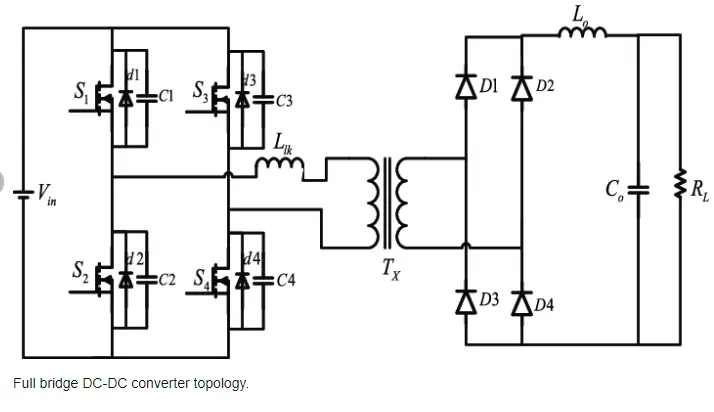
DC to DC conversion:-
The DC to DC converters are converted by using of chopper the devices used for converting are POWER MOSFET,POWER BJT, SCR, IGBT Choppers are the switching converters which convert the unregulated dc input voltage into regulated controlled dc output at a desired voltage with the little power loss.
According to input /output voltage levels:
1.Buck converter :- output voltage is less than the input voltage
2.Boost converter :- output voltage is greater than the input voltage
3.Buck Boost converter :- output voltage is less than as well as greater than the input voltage
Applications:
1.Dc drives
2.SMPS
3.Battery driven vehicles
4.Led lightning
5.Induction heating
DC to AC converter :
- Commonly called as inverters
- Can control both magnitude and frequency of output AC voltage
- Widely seen in control of AC motors
- 1 phase vs. 3 phase
DC to AC converter otherwise called as inverter where it using inverter in Electric vehicle as know DC is converter to AC so battery is giving DC current that’s be connected to power converter it get regulated DC there. Now this DC has to be convert to AC. when it is using Electric Motor which is of AC type(Induction machine).Induction motor there is purpose of converter this DC into AC form.it can be 3 phase or 1 phase induction motor it can use traction inverter for controlling purpose so inverter will help to control the motor speed. here AC can be two components one is magnitude and other frequency. DC can be one component so inverter also make sure that magnitude and frequency are also regulated the output load or load requirement is status field that’s above the DC to AC converter(Inverter) part.
DC to AC conversion (INVERTER):-
The dc to ac is converted by using the inverters, the devices used for converting are IGBT,POWER MOSFET, SCR, GTOSCR, POWER BJT Inverter converts dc power into ac power at a desired output voltage and frequency.
According to type of source:
1.Voltage source inverter(vsi)
2.Current source inverter (csi)
According to circuit arrangement:
1.Bridge inverter (half and full bridge )
2.Parallel inverter
3.Series inverter
According to output voltage:
1.Single phase inverter
2.Three phase inverter
Applications:
1.Ac drives
2.Electric vehicles
3.Solar and wind energy systems
4.Ups systems
5.HVDC transmission
AC to DC converter :
- Commonly called as rectifier
- Widely seen in battery charging
- Rectifier with power factor correction are popular in industry
It is AC to DC converter otherwise called rectifier. It’s do rectifies AC.AC is fluctuating.it has frequency and magnitude.it just rectifies and make it form of Direct Current
Example : mobile charger, Laptop charger.
So AC to DC conversion take place in the charging part. there when plug in the vehicle and AC is been converted into DC part
This is about type of converter usually used inside Electric Vehicle
AC to DC conversion (Rectification):-
The AC to DC converters are converted by using of the POWER DIODE , IGBT (INSULATED GATE BIPOLAR TRANSISTOR) , SCR (SILICON CONTROLLED RECTIFIER) and the input of the converter equipment is ac and the output of the converter equipment is dc.
Based on Supply voltage type, Rectifiers can be classified as
1.Single phase Rectifiers.
2.Three phase Rectifiers.
Based on controllability, Rectifiers can be classified as
1.Uncontrolled Rectifiers (Diode rectifiers)
2.Fully controlled Rectifiers (SCR / other controllable switches-based rectifiers)
3.Semi Controlled or Half Controlled Rectifiers (Combination of diodes and SCRs)
Applications :
1.Mobile Chargers
2.DC Drives
3.Front end rectifiers
4.UPS system
5.Battery Charging
Power Electronics in Day to Day Application :
- Mobile charger(AC-DC)
- Laptop charger(AC-DC and DC-DC)
- Locomotive Engine train in India(25KV AC to AC and then DC to AC)
- Home Inverter and UPS(DC-AC)
Laptop charger AC to DC and also happening DC to DC
Train will receive from over head line which is of AC then it’s converts into DC using AC to DC rectifier then it also has traction inverter converts the power DC to AC
Home Inverter when there is power shutdown we have inverter in house. inverter is helping other domestic applied function there inverter has a battery when there is power. when battery is get’s charging from AC and then discharging back to the AC form that’s home inverter and UPS is best example, DC to AC converter.
Types of Power converter :
- Rectifier (AC-DC)
- Chopper(DC-DC)
- Inverter(DC-AC)
DC-DC Converter :
1.DC-DC converter is an electronic circuit that converts DC voltage from one voltage level to another. It can be step up or step down of voltage.
2.This type of converter is also known as chopper.
3.The electric components inside the vehicle vary in their voltage requirements, with most running on much lower voltage. This includes radio, dashboard readouts, air conditioning, and in-built computers and displays.
4.It can be unidirectional or bidirectional.
5.Most of the components are bidirectional, allowing power to go from the battery to the inverter, which rotates the motor.
6.When decelerating, the vehicle's momentum turns the motor, which is now acting as a generator, drives power back through the inverter and charges the battery.
7.DC-DC converter converts higher voltage DC power from the traction battery pack to the lower-voltage DC power needed to run vehicle accessories and recharge the auxiliary battery.
DC-AC Converter :
1.DC-AC converter change a dc input voltage to a symmetric ac output voltage of desired magnitude and frequency.
2.This type of converter is also known as inverter.
3.The inverter can change the speed at which the motor rotates by adjusting the frequency of the alternating current.
4.When the vehicle has to be accelerated, the accelerator pedal sends a signal to the controller which adjusts the vehicle's speed by changing the frequency of the AC power from the inverter to the motor.
AC-DC Converter :
1.AC-DC converter takes a harmonic AC input and converts it to a DC output.
2.These converters are also known as rectifiers.
3.Inverters are used in EV mainly for the on-board charging purpose. Since the charging stations use AC power to charge the vehicle and the battery stores DC power, rectifiers are used to convert AC-DC.
For Example what type of converter will you use for Horn which requires DC and less than 10V?
In this application, we are using a buck converter because of low voltage applications likewise Head lights and Back lights.
Air conditioner load, and airbag Ext.., in this all, we are using the DC-DC converter as per load operation voltage we are using step-up converter or step-down converter
Different Application of power converter in Electric Vehicle above mention.