Week 4 Session 5
Explain the various applications of Power converters in an Electric vehicle. For Example what type of converter will you use for Horn which requires DC and less than 10V. Likewise come up with different applications
Answer:-
Power converters play a vital role in electric vehicles (EVs) by converting and regulating electrical power from one form to another. Here are several applications of power converters in an electric vehicle:
-
DC-DC Converter: A DC-DC converter is commonly used in electric vehicles to step down or step up the voltage levels as needed. Some applications of DC-DC converters in an EV include:
a. Horn: A horn in an electric vehicle typically requires a DC power supply at a voltage of less than 10V. A DC-DC converter can step down the higher voltage from the vehicle's battery to provide the appropriate voltage for the horn.
b. Auxiliary Systems: Various auxiliary systems in an electric vehicle, such as lighting, infotainment systems, and instrument clusters, often operate at different voltage levels. DC-DC converters are employed to convert the high-voltage battery power to lower voltages required by these systems.
-
On-Board Charger (OBC): The on-board charger is responsible for converting AC power from an external charging station or home outlet into DC power to charge the electric vehicle's battery. It typically includes power factor correction (PFC) and DC-DC conversion stages.
-
Inverter: Inverters are critical components in electric vehicles as they convert the DC power from the battery into AC power to drive the electric motor. Inverters utilize power electronics to control the frequency, voltage, and waveform of the output power, allowing for precise speed and torque control of the motor.
-
Regenerative Braking Converter: During regenerative braking, the kinetic energy of the vehicle is converted into electrical energy and fed back into the battery for storage. A regenerative braking converter is used to control and convert this electrical energy into the appropriate form for battery charging.
-
Active Battery Balancing: In EVs with multiple battery cells, it is crucial to maintain a balanced state of charge across all cells to ensure optimal battery performance and longevity. Power converters are employed to actively balance the charge levels of individual battery cells, improving overall battery efficiency and lifespan.
-
Motor Drive Control: Power converters are used to regulate and control the power delivered to the electric motor, ensuring precise motor speed, torque, and direction control. They provide the necessary voltage and current levels to the motor, adjusting them according to the driver's input and operating conditions.
-
Energy Management System: Power converters play a role in the energy management system of electric vehicles. They assist in monitoring and controlling the flow of power between the battery, motor, and other components, optimizing energy utilization and maximizing the vehicle's range.
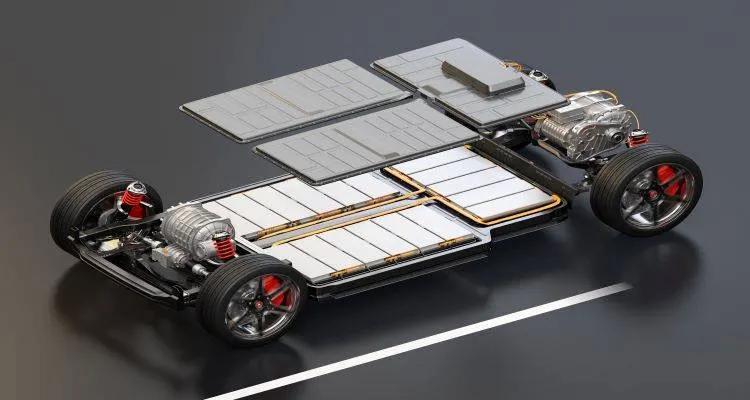
With the focus on vehicular technology shifting towards replacing mechanical, hydraulic, or pneumatic systems with electrical systems, power electronic circuits (PECs) have gained a lot of importance in the last decade. Increasing vehicular loads such as utility, entertainment, luxury, and safety loads have increased the demand for compact and efficient PECs. The electric components inside the vehicle vary in their voltage requirements, with a majority of them running on lower voltages. This includes the radio, dashboard readouts, air conditioning, and in-built computers and displays.
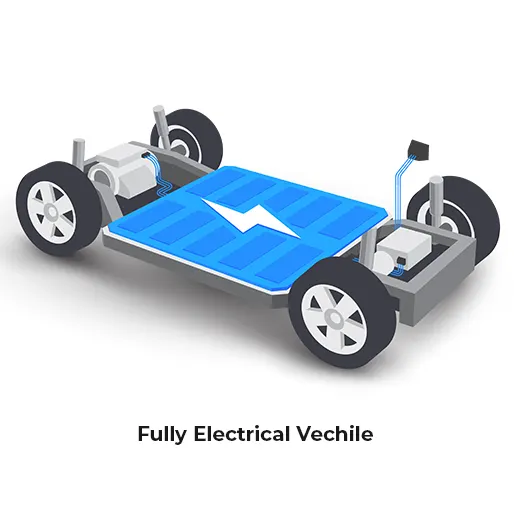
Types of Power Converters in Electric Vehicles
Commercial electric vehicles may be broadly classified as:
- Battery electric vehicles (BEVs),
- Hybrid electric vehicles (HEVs) and
- Fuel cell vehicles (FCVs).
BEVs are purely electric vehicles (EVs), whereas HEVs combine EVs and internal combustion engines (ICEs). FCVs use power from both the battery and fuel cell stack.
The different configurations of EV power supply show that at least one DC/DC converter is necessary to interface the FC, the battery, or the supercapacitors module to the DC-link.
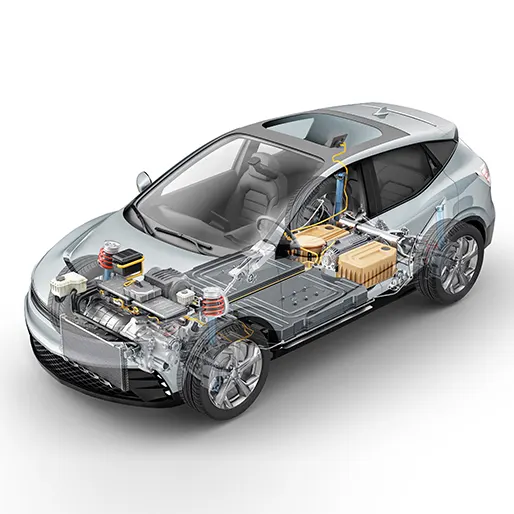
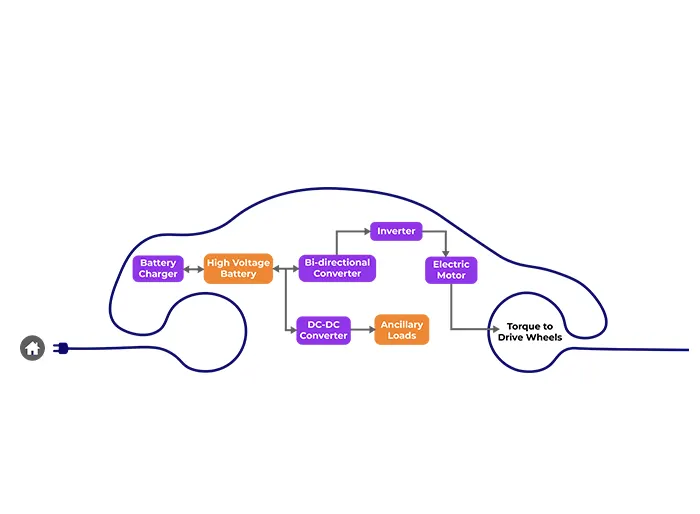
The main components of an Electric Vehicle are a DC-AC inverter, a DC-DC converter, a battery, and an electric motor.
There are two major power electronic units in the general configuration
- DC-DC converter
- DC-AC inverter
Usually, AC motors are used in HEVs or EVs for traction and they are fed by an inverter and it is fed by a DC-DC converter.
An Overview of DC-DC Converters
DC-DC converters in an electric vehicle may be classified into unidirectional and bidirectional converters. Unidirectional DC-DC converters cater to various onboard loads such as sensors, controls, entertainment, utility, and safety equipment. They are also used in DC motor drives and electric traction. Bidirectional DC-DC converters find applications in places where battery charging, regenerative braking, and backup power are required. The power flow in a bidirectional converter is usually from a low voltage end such as a battery or a supercapacitor to a high voltage side and is referred to as boost operation.
During regenerative braking, the power flows back to the low voltage bus to recharge the battery (buck mode). As a backup power system, the bidirectional DC-DC converter facilitates the safe operation of the vehicle when ICEs or electric drives fail to drive the motor. Due to the aforementioned reasons, high-power bidirectional DC-DC converters have gained a lot of importance in the recent past.
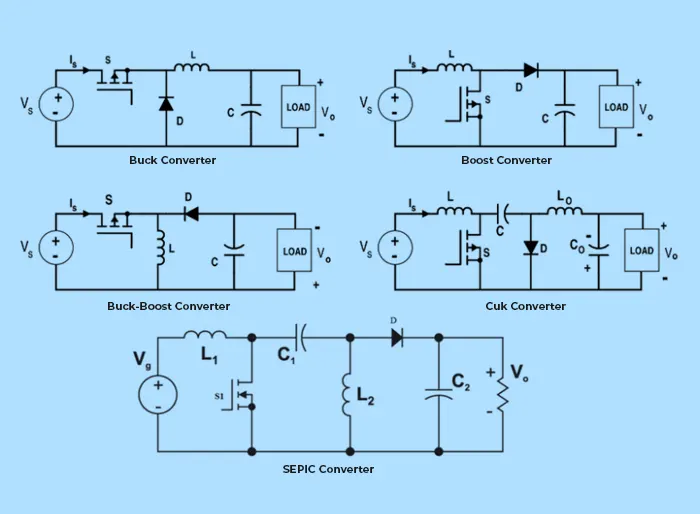
The converter topologies are classified as:
- Buck Converter:
The buck converter is a step-down converter and produces a lower average output voltage than the dc input voltage.
- Boost converter:
In the boost converter, the output voltage is always greater than the input voltage.
- Buck-Boost converter:
In a buck-boost converter, the output voltage can be either higher or lower than the input voltage.
- Cuk converter:
The output voltage can be either higher or lower than the input voltage providing some advantages over buck-boost (like a continuous current, less current ripple etc.)
- SEPIC converter:
The output voltage can be either higher or lower than the input voltage (with no polarity reversal compared to Buck-boost or Cuk converter).
- Isolated DC-DC converter:
In this type, the input and output stages are separated and there is a presence of a transformer which can further reduce (or increase) the output voltage apart from being done by the duty cycle. Forward, Flyback, Half bridge, Full bridge, and Push-pull converters fall under this category.
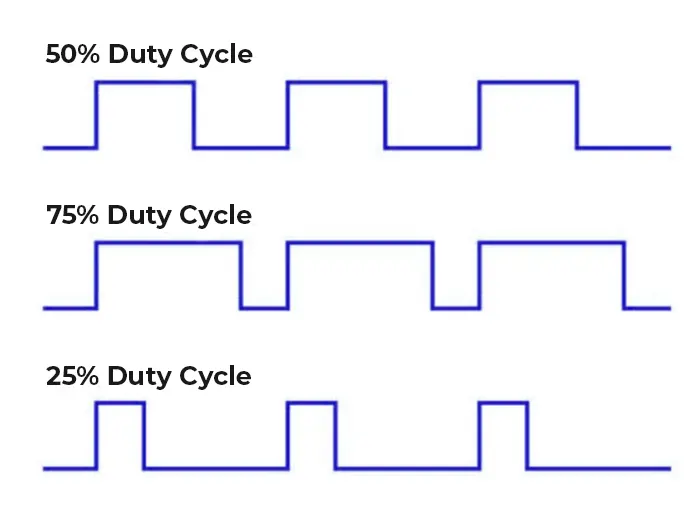
The amount of power flow between the input and the output can be controlled by adjusting the duty cycle (ratio of on/off time of the switch). Usually, this is done to control the output voltage, the input current, and the output current or to maintain constant power.
The Importance of DC/DC Converters
While DC/DC converters can be based on several different designs, the underlying function remains the same. A step-up converter, which turns a low-voltage input into a high-voltage output, or a step-down converter, which does the exact opposite.
In electric vehicles that use a DC motor, the running motor can use up to three times the voltage provided by the battery. With the help of the right converter, we can bridge this gap without having to use a larger, heavier battery.
DC-AC converters (Inverters)
An inverter is a device that converts DC power from the battery to AC power in an electric vehicle motor. The inverter can change the speed at which the motor rotates by adjusting the frequency of the alternating current.
The Significance of DC/AC Converters
The use of inverters can increase or decrease the power or torque of the motor by adjusting the amplitude of the signal.
It plays a significant role in capturing energy from regenerative braking and feeding it back to the battery. The key component is that it has a direct impact on on-road performance, driving range, and reliability of the vehicle also as a consequence of their weight and size.
The output voltage waveform of ideal inverters should be sinusoidal. However, the waveform of practical inverters is non-sinusoidal and contains certain harmonics.
For Example what type of converter will you use for Horn which requires DC and less than 10V. Likewise come up with different applications:-
For a horn in an electric vehicle that requires DC and a voltage less than 10V, a suitable converter that can step down the higher voltage from the vehicle's battery to the desired level can be used. One common type of converter for such applications is a Buck Converter or Step-Down Converter.
A Buck Converter is a type of DC-DC converter that efficiently steps down the input voltage to a lower output voltage. It consists of an inductor, a diode, a switch (typically a MOSFET), and a control circuit. The control circuit regulates the duty cycle of the switch to maintain a stable output voltage.
In the case of the horn application, the Buck Converter would take the higher battery voltage (e.g., 12V or 48V) and step it down to the required voltage below 10V for the horn to operate. The control circuit of the Buck Converter would be set to maintain the desired output voltage by adjusting the duty cycle of the switch.
Here are a few other examples of power converter applications in an electric vehicle:
-
LED Lighting: Electric vehicles often use LED lighting systems. A DC-DC Boost Converter can be employed to step up the battery voltage to the required level for powering LED lights, which typically operate at higher voltages (e.g., 24V or 48V).
-
Charging Port: The charging port of an electric vehicle requires power conversion to convert AC power from an external source (such as a charging station) to the appropriate DC voltage and current for charging the vehicle's battery. An AC-DC Converter, such as a rectifier and a DC-DC converter, is used in the charging system.
-
Motor Drive: As mentioned earlier, an inverter is used to convert DC power from the battery to AC power for driving the electric motor. The inverter employs various power converters, such as DC-DC boost converters and bridge converters, to regulate and control the voltage and current supplied to the motor.
-
Power Steering: Electric power steering systems in vehicles require a stable and controlled power supply. A DC-DC Converter can be used to convert the battery voltage to the desired voltage level suitable for powering the power steering system.
-
On-Board Entertainment Systems: On-board entertainment systems, such as audio amplifiers, screens, and multimedia devices, may operate at different voltage levels. DC-DC converters are used to convert the vehicle's battery voltage to the required voltage levels for powering these systems.