Week 4:- Pin Unit Design Challenge
I.REPORT:
Abstract: This report presents an analysis of a Fixed Pin Unit (FPU) designed with various components, including different types of pins, a riser, a blade, and a block. The purpose of the FPU is to study the effects of these components on its functionality and performance. The study involves understanding the design, function, and potential applications of each component, as well as the interactions among them within the FPU system. The report also discusses potential advantages, challenges, and areas for future research.
1. Introduction: Fixed Pin Units (FPUs) are mechanical systems used in various industrial applications, such as manufacturing, assembly, and material handling. They consist of several components that work together to achieve specific tasks. This report focuses on a particular FPU configuration comprising different types of pins, a riser, a blade, and a block.
2. Components of the Fixed Pin Unit:
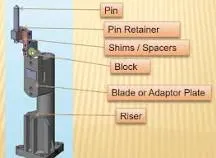
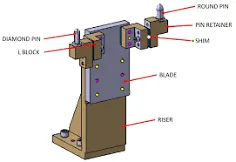
2.1 Pins: The pins are the fundamental elements of the FPU and come in various shapes, sizes, and materials. They are designed to interface with the workpiece or object being manipulated. The choice of pin type influences the gripping, rotation, and translation capabilities of the FPU.
2.2 Riser: The riser is a vertical structure that supports the other components of the FPU. It often incorporates the mechanism responsible for pin actuation, which can be pneumatic, hydraulic, or electric. The riser's design affects the overall stability, precision, and control of the FPU.
2.3 Blade: The blade, also known as the base plate, provides the foundation for the FPU's operation. It may have features like guiding grooves or slots for the pins, which determine their movement and positioning during operation. The blade's precision and surface characteristics are critical for accurate and reliable performance.
2.4 Block: The block is the part of the FPU that holds and secures the workpiece or object. It interacts directly with the pins and facilitates the transfer of forces and motions. The block's design impacts factors such as gripping strength, alignment, and adaptability to different workpieces.
3. Functionality and Interactions: The interaction between these components determines the FPU's functionality. The riser controls the actuation of pins, causing them to engage with the workpiece. The blade provides a reference surface for pin movement, while the block secures the workpiece. Different combinations of pin types, riser actuation mechanisms, and block designs enable various operations, such as lifting, rotating, or transferring objects.
4. Applications: The FPU with its diverse components can be applied in numerous industries. Examples include assembly lines, material sorting, quality control, and laboratory automation. The versatility of the FPU arises from the ability to customize the pin types, riser configurations, and block adaptations to suit specific tasks.
5. Advantages and Challenges:
5.1 Advantages:
- Versatility in handling various workpieces.
- Precise control over gripping, rotation, and translation motions.
- Potential for automation, reducing manual labor.
- Increased efficiency and accuracy in industrial processes.
5.2 Challenges:
- Design complexity due to the integration of multiple components.
- Maintenance and potential wear of moving parts.
- Potential limitations in handling irregularly shaped or fragile objects.
- Integration with existing systems and control interfaces.
6. Future Research: Further research in this area could focus on:
- Developing advanced actuation mechanisms for improved precision and speed.
- Exploring materials and surface treatments to enhance pin grip and durability.
- Investigating adaptive block designs for enhanced compatibility with diverse workpieces.
- Designing modular FPUs that can be easily reconfigured for different tasks.
7. Conclusion: The Fixed Pin Unit with Different Pins, Riser, Blade, and Block is a versatile mechanical system with a range of potential applications. The combination of various components allows for precise manipulation of workpieces in industrial settings. Understanding the design and interactions of these components is crucial for optimizing performance and exploring innovative applications in the future.
II.REPORT:
Abstract: This report presents a comprehensive analysis of two distinct retractable pin unit designs, each featuring different types of pins, a riser, a blade, a cylinder, and a block. The study aims to explore the intricacies of the design, functionality, and potential applications of these units. By comparing and contrasting the two designs, insights into their advantages, challenges, and potential areas for improvement are highlighted.
1. Introduction: Retractable Pin Units (RPUs) are specialized mechanical systems commonly employed in industrial automation and precision tasks. These systems consist of multiple components working collaboratively to enable controlled pin movement for tasks such as gripping, positioning, and transferring objects. This report examines two distinct RPU configurations, each with varying components.
2. Components of the Retractable Pin Units:
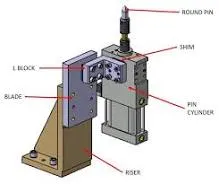
2.1 Pins: The pins within the RPUs come in different shapes, sizes, and materials to suit specific applications. The choice of pin type significantly influences the unit's gripping strength, precision, and adaptability to various workpieces.
2.2 Riser: The riser provides structural support to the RPU assembly and usually houses the actuation mechanism for pin movement. The design of the riser impacts the unit's stability, accuracy, and overall performance.
2.3 Blade: The blade, or base plate, serves as the foundation for pin movement and positioning. It often incorporates guiding features that aid in precise pin alignment and manipulation.
2.4 Cylinder: The cylinder is an essential component responsible for the retraction and extension of the pins. It utilizes pneumatic or hydraulic pressure to control pin movement and is closely tied to the unit's speed, force, and reliability.
2.5 Block: The block holds and secures the workpiece during pin engagement. It directly interfaces with the pins and transfers forces and motions to the object being manipulated. The block's design influences the gripping capability and alignment accuracy of the RPU.
3. Design and Functionality: Both RPU designs operate based on the same fundamental principle of retractable pins for gripping and manipulation. The riser houses the cylinder and pin actuation mechanism, which, when triggered, extends or retracts the pins. The pins engage with the block, securing the workpiece. The blade provides a reference surface for pin movement and ensures precision.
4. Comparative Analysis:
4.1 Design 1:
- Utilizes pneumatic cylinder for pin actuation.
- Employs specialized tapered pins for improved gripping on irregular surfaces.
- Riser incorporates precise linear bearings for smooth movement.
- Blade features integrated guiding grooves for pin alignment.
- Block design facilitates accurate object positioning.
4.2 Design 2:
- Utilizes hydraulic cylinder for pin actuation.
- Employs spring-loaded spherical pins for versatile gripping.
- Riser integrates rotary encoder for feedback control.
- Blade has customizable attachment points for varied pin configurations.
- Block design emphasizes adaptability to differently shaped objects.
5. Advantages and Challenges:
5.1 Common Advantages:
- Precise manipulation of workpieces for intricate tasks.
- Enhanced automation and reduced manual intervention.
- Potential for improved efficiency and accuracy in industrial processes.
5.2 Design 1 Advantages:
- Specialized tapered pins offer excellent grip on irregular surfaces.
- Linear bearings provide smooth and controlled pin movement.
5.3 Design 2 Advantages:
- Spring-loaded spherical pins offer versatility in gripping various shapes.
- Rotary encoder feedback enhances precision and control.
5.4 Common Challenges:
- Maintenance requirements for the cylinder and moving parts.
- Compatibility with a wide range of workpiece shapes.
- Integration with existing automation systems.
6. Future Enhancements: Possible areas for future research and development include:
- Integration of advanced sensors for real-time object detection.
- Exploration of new materials for improved durability and grip.
- Incorporation of adaptive AI algorithms for autonomous object handling.
- Development of user-friendly interfaces for configuration and control.
7. Conclusion: The comparative analysis of two retractable pin unit designs highlights the diversity in components and functionalities that can be achieved within this category of automation systems. Both designs demonstrate the versatility and potential advantages of retractable pin technology in precision industrial applications. Understanding the design nuances and trade-offs between the components provides valuable insights for optimizing performance and exploring innovative applications in the future.