Week 4 - Genetic Algorithm
Aim- Write code in MATLAB to optimize the stalagmite function and find the global maxima of the function and explain the concept of genetic algorithm in your own words and also explain the syntax for ga in MATLAB in your report.
Introduction about Genetic algorithm
Genetic Algorithm is a method of solving both Constrained and Unconstrained optimization problems based on a natural selection process that mimics biological evolution. The algorithm repeatedly modifies the population of individual solutions. At each step, the genetic algorithm randomly selects individuals from the current population and uses them as parents to produce the children for the next generation. Over successive generations, the population "evolves"towards an optimal solution.
Genetic algorithm is used to solve optimization problems across many industries like engineering, logistics and transportation. There are many optimization tools but the genetic algorithm (ga) is widely used because of its simplicity and easy application to a wide range of optimization problems.
Genetic Algorithm Generates a population of points at each iteration. The best point in the population approaches an optimal solution and also Selects the next population by computation which uses random number generators.
Syntax
matlab code-clear all
close all
clc
%def search space
x=linspace(0,1,200);
y=linspace(0,1,200);
%creating 2-d
[xx yy] = meshgrid(x,y);
%evaluating the staligmate function
for i = 1:length(xx)
for j = 1:length(yy)
input_vector(1)=xx(i,j);
input_vector(2)=yy(i,j);
f(i,j) = stalagmite(input_vector);
end
end
%assinging population size
tic
for i=1:150
[inputs,fopt(i)] = ga(@stalagmite,2,[],[],[],[],[0;0],[1,1],[],[])
xopt(i) = inputs(1);
yopt(i) = inputs(2);
end
total_time=toc
%plotting
figure(1)
subplot(2,1,1)
hold on
surfc(x,y,f)
shading interp
plot3(xopt,yopt,-fopt,'marker','o','markersize',5,'markerfacecolor','r')
subplot(2,1,2)
plot(-fopt)
axis([0 100 0.4 0.6])
xlabel('iterations')
ylabel('function maxima')
% bounded outputs with upper and lower limts
tic;
for k=1:150;
[inputs,fopt(k)]=ga(@stalagmite,2,[],[],[],[],[0;0],[1;1]);
xopt(k)=inputs(1);
yopt(k)=inputs(2);
end
study_time2 = toc
figure(2);
subplot(2,1,1) ;
surfc(xx,yy,-f);
hold on;
shading interp;
plot3(xopt,yopt,-fopt,'Marker','o','Markersize',5,'Markerfacecolor','r');
subplot(2,1,2);
plot(-fopt);
xlabel('No of iterations');
ylabel('Function maximum');
title('bounding Condition');
% incresing ga iterations
tic
options = optimoptions('ga');
options = optimoptions(options,'populationsize',200);
for k=1:150
[inputs,fopt(k)]=ga(@stalagmite,2,[],[],[],[],[0;0],[1;1],[],[],options);
xopt(k)=inputs(1);
yopt(k)=inputs(2);
end
study_time3 = toc
figure(3);
subplot(2,1,1);
surfc(xx,yy,-f);
hold on;
shading interp;
plot3(xopt,yopt,-fopt,'Marker','o','Markersize',5,'Markerfacecolor','r');
subplot(2,1,2);
plot(-fopt);
xlabel('No of iterations');
ylabel('Function maximum');
title('Increasing GA Iterations');
Staligmite function code-function [fx_y] = stalagmite(input_vector)
x=input_vector(1);
y=input_vector(2);
f1_x=(sin((5.1*pi.*x)+0.5)).^6;
f1_y=(sin((5.1*pi.*y)+0.5)).^6;
f2_x=exp(-4*log(2).*(((x-0.0667).^2)/0.64));
f2_y=exp(-4*log(2).*((y-0.0667).^2)/0.64);
fx_y = -(f1_x.*f1_y.*f2_x.*f2_y);
%(-ve sign)to calculate maxima
endthe stalagmite function is created from the equations and formulaes provided and later called upon in the main code. we have used -ve sign here as ga always returns the minima of the function but here we needed the maxima. so the -ve sign will return the opposite of minima i.e maxima of the function.Results-
Study-1: Unbouded Condition
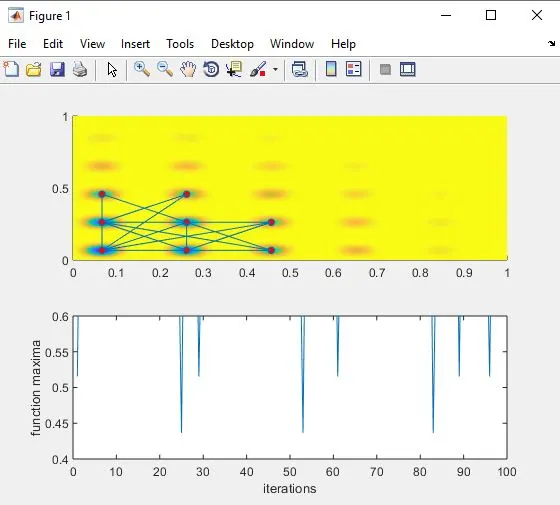
time taken =11.89sec.
Study-2: upper and lower bound condition
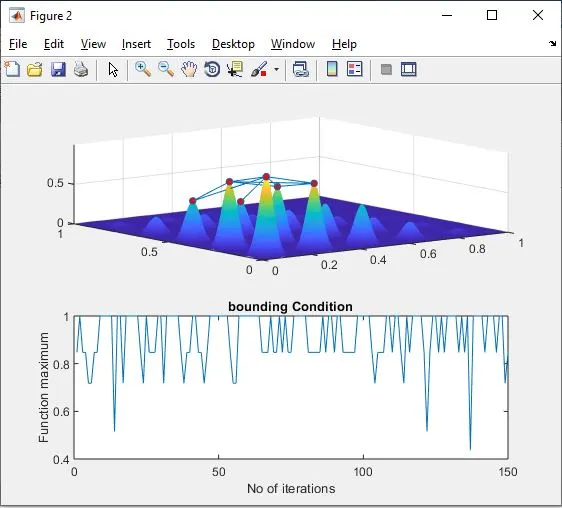
time taken 10 sec.
Study 3:Increasing the ga iterations
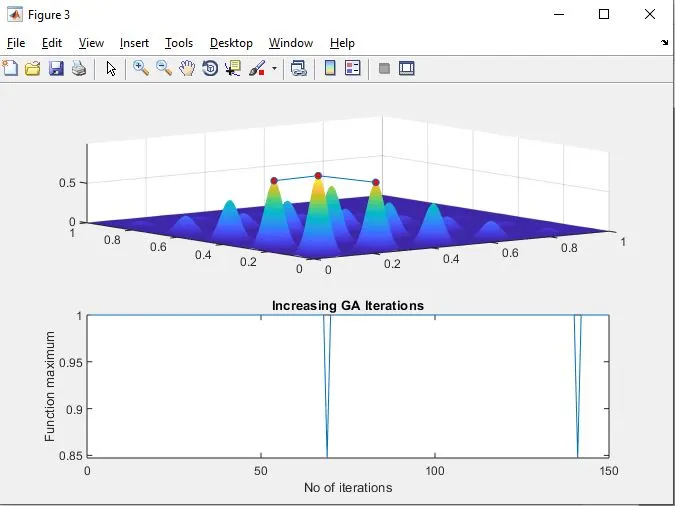
time taken=36.28sec.
Output-
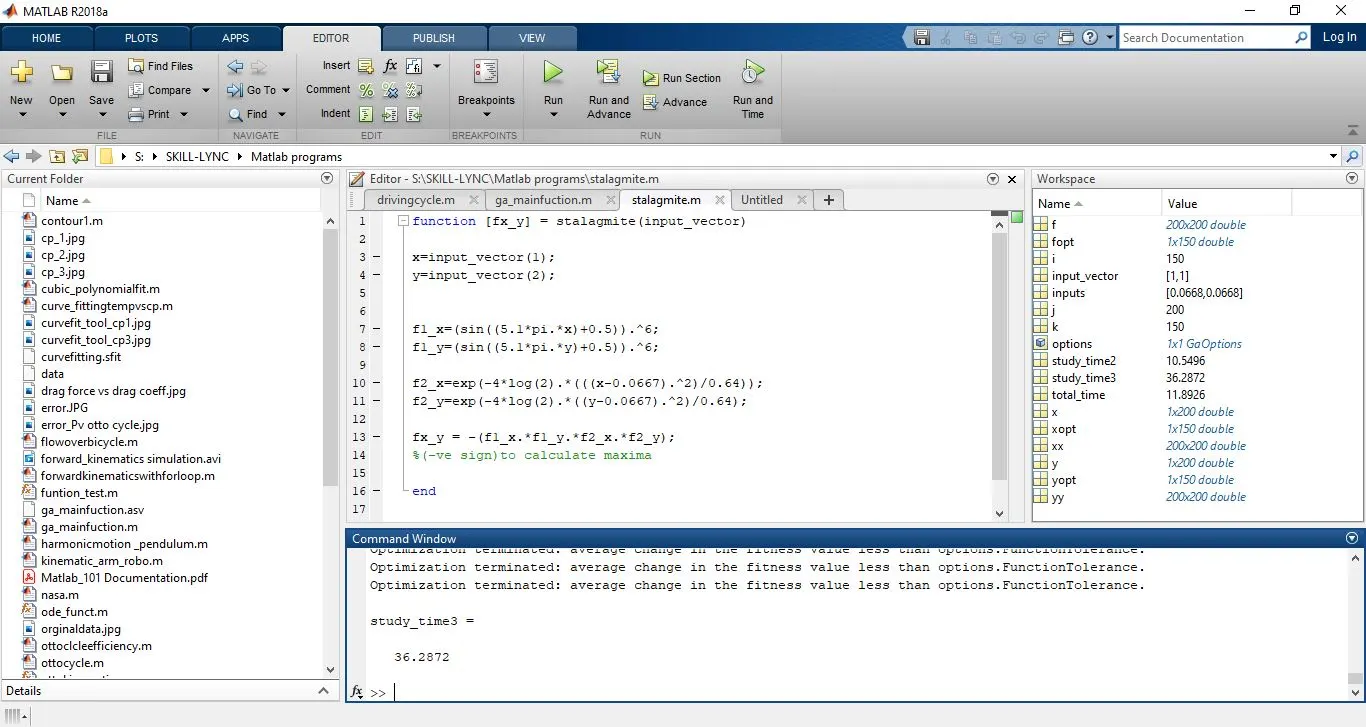
Conclusion- The ga in Matlab gives Minimum value of a function we need to convert it to maximum value by -ve sign.
We can also see the difference in time by various conditions given for the genetic algorithm.