Week - 4 - Crash Box Simulation
Aim:
The Aim of this Challenge is to perform the Crashbox Simulation. The Input.k file is provided which contains the Informations about nodes & Elements.
Description:
The Following Steps are followed inorder to complete the simulation.
- Material Defnition
- Part Defnition
- Rigid wall Creation
- Contact Defnition
- Boundry Condition Defnition
- Control Cards Defnition
- Output Defnition
- Results Discussion
Material Defnition:
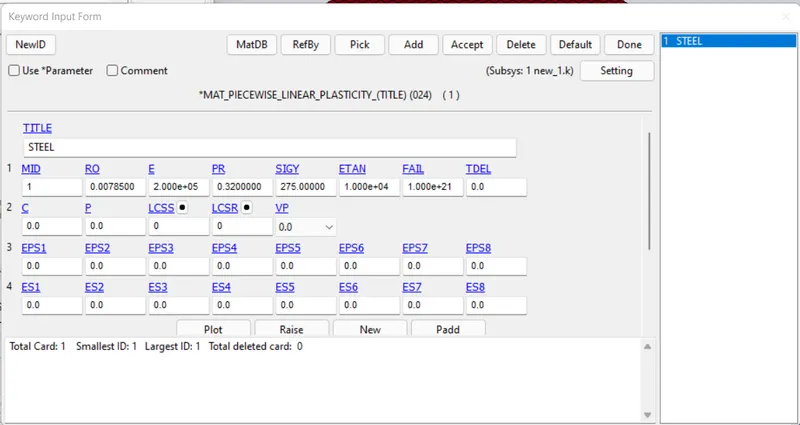
The material to be defined for the simulation is steel. The unit convention to be followed is gg/mm/ms. The material model used in this simulation is MAT-024_PIECEWISE_LINEAR_PLASTICITY. The values of material properties are given in gg/mm/ms unit conventions. The material Card is attached below for reference.
Part Defnition:
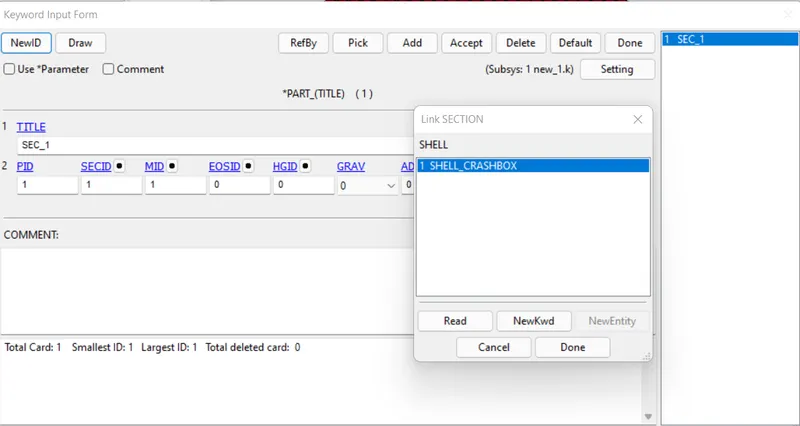
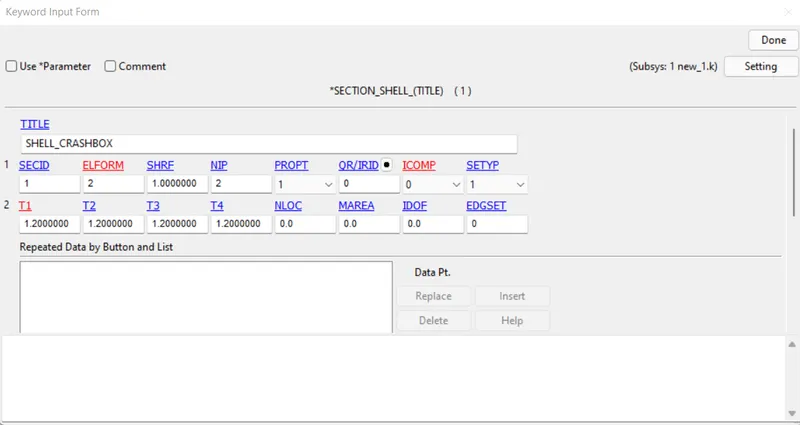
The part can be defined in ls-dyna by defining Material_ID & Section_ID. The section_ID is created for the Crash box as 1.2mm thick shell Elements.
Rigidwall Creation:
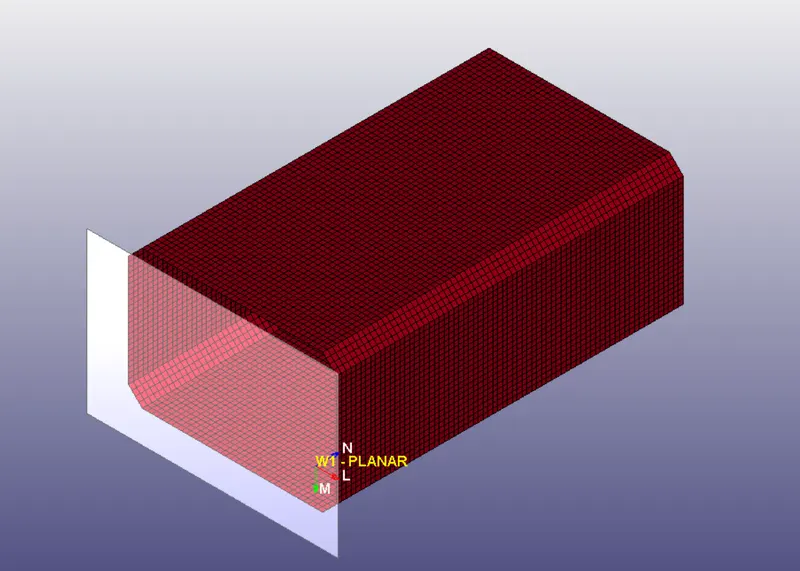
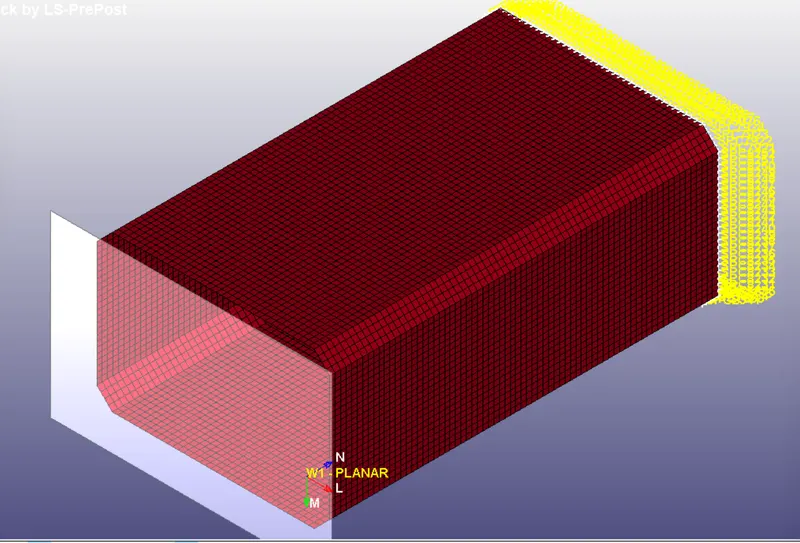
The Rigid wall is created using the RIGIDWALL keyword option. The Normal of the Rigid wall is positioned facing the Part. The Rigid wall is positioned at 15mm from the Crashbox.
Contact Defnition:
AUTOMATIC_SINGLE_SURFACE_CONTACT is used to simulate the model as it would be enough. When using the Single surface contact it is enough to specify the slave Part.
Boundary Condition Defnition:
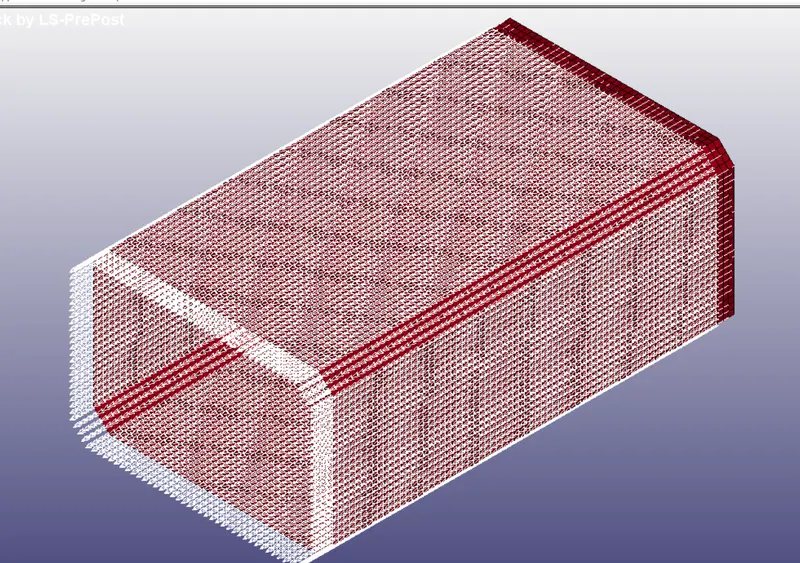
The Initial Velocity is specified in x-direction as 13.88mm/ms for all the nodes of the Crashbox.
SPC CONSTRAIN:
The Crash box is fixed between the Bumber & Front Rail of the Automobile. Inorder to simulate the Fixation of Front rail of the automobile the SPC constrains are applied to the Nodes as shown below, Hence the simulation is more conservative approach than the Real life situation. The Nodes are constrained in all direction except the x-direction.
Control Defnition:
The Termination time is set to 6ms in the CONTROL_TERMINATION Card.
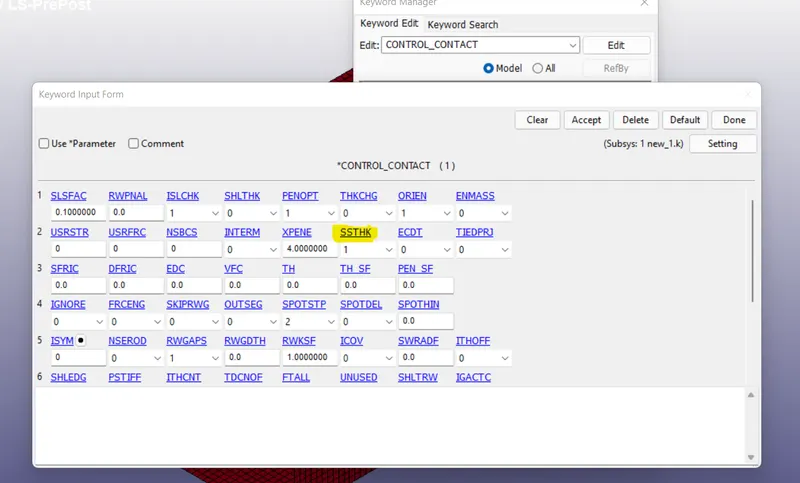
The Actual Shell thickness is considered during the Contact by setting SSTHK Value to 1 in CONTROL_CONTACT card.
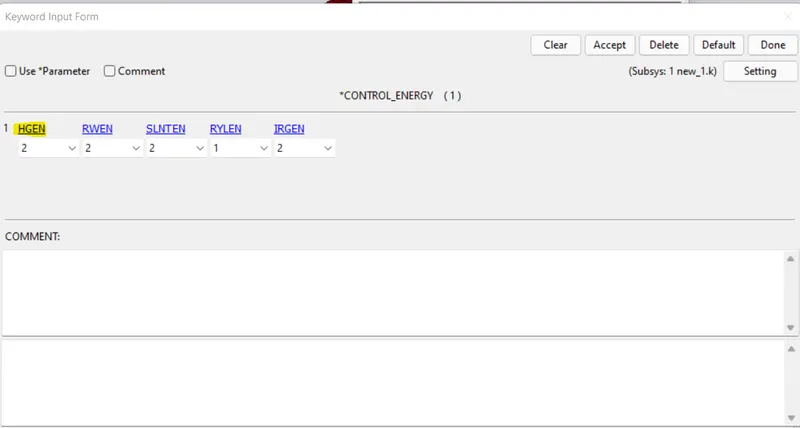
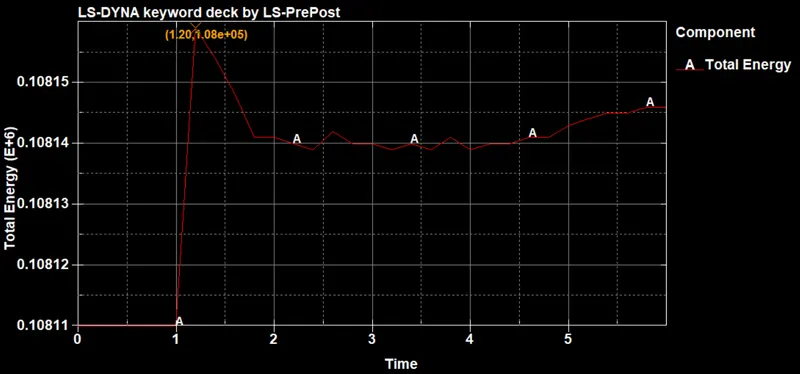
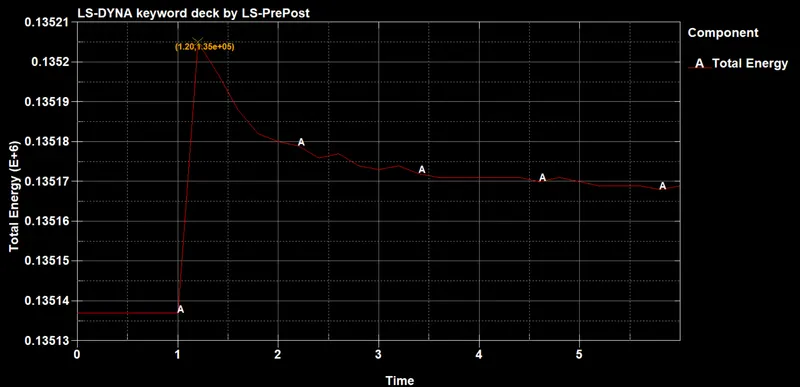
The Hourglass Energy is included in the Energy balance by setting HGEN equals to 2 in "CONTROL_ENERGY" Card.
Output Defnition:
The GLSTAT, MATSUM, SECFORCE, SLEOUT,SPCFORCE are the ASCII Outputs writted for every 0.2ms. The Cross Section is defined for Extracting the Cross-Sectional Force using DATABASE_CROSS_SECTION_PLANE.
Result Obtained:
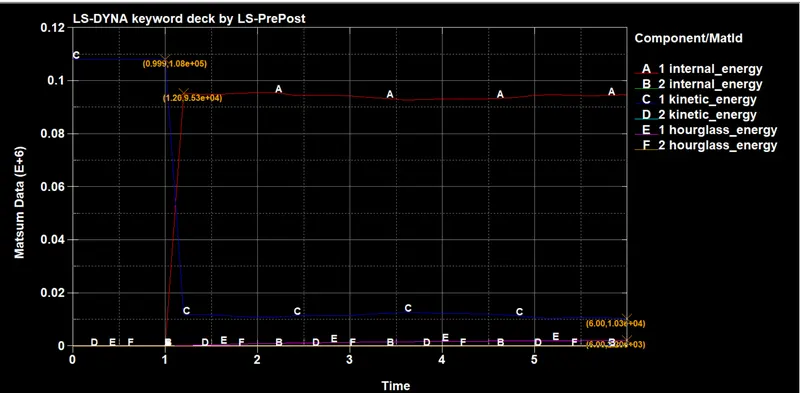
Energy Plot-1.2mm shell thickness:
From the Energy Plots we can clearly see that the Kinetic Energy of the Crash box is reduced after contact with rigidwall.
The decrease in Kinetic Energy of the Crashbox = 97.7Joules.
Increase in Internal Energy = 95.53Joules.
Energy Plot-1.5mm shell thickness:
Decrease in Kinetic Energy =119Joules
Increase in Strain Energy = 120 Joules
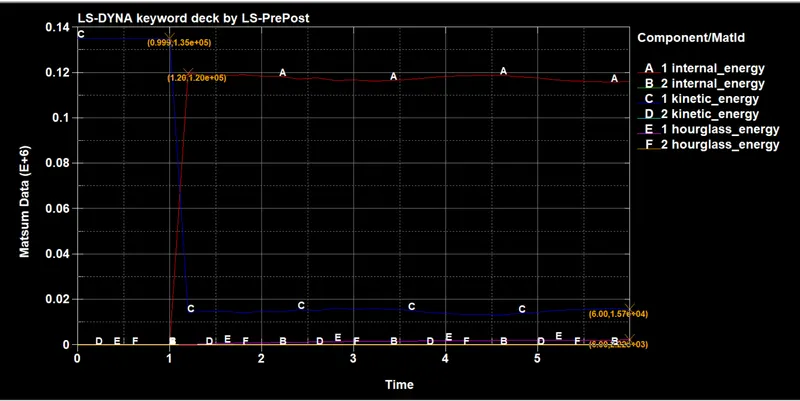
It is clear that, Crashbox with thickness of 1.5mm absorb the Impact Energy more when compared to Crashbox with thickness of 1.2mm.
Total Energy Plot-1.2mm Shell Thickness:
Total Energy Plot-1.5mm Shell thickness:
Effective Plastic Strain:
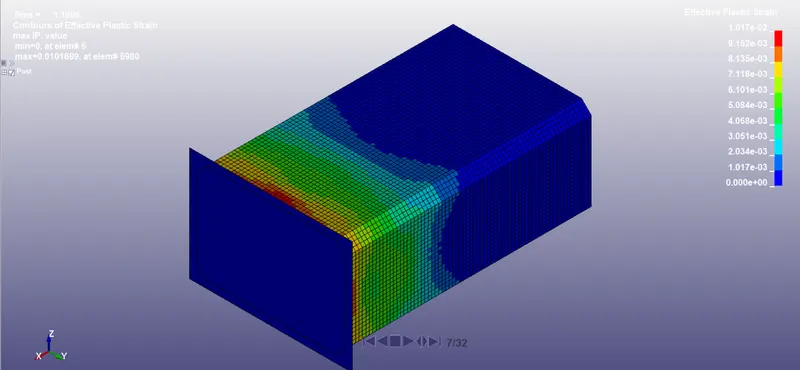
The Effective Plastic Strain of the crashbox of thickness 1.2mm due to the impact is shown below, the maximum effective plastic strain is 1.017e-2.
The Effective Plastic Strain of the crashbox of thickness 1.5mm due to the impact is shown below, the maximum effective plastic strain is observed to be 1.028e-2.
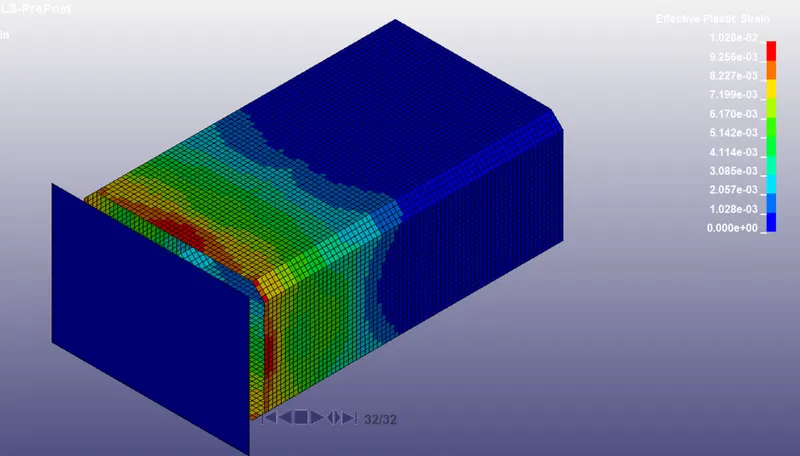
From the Plots of Effective Plastic Strain, it is well understood that the Crashbox with 1.5mm thickness undergoes more plastic deformation and hence absorbing the more impact energy. The Kinetic Energy of Crashbox is converted into the Strain Energy and thereby reducing the kinetic energy of Crashbox. The Positive Values of plastic effective strain indicates the material is actively yielding and the state of stress is on the yield surface.
Directional Stress:(X-stress)
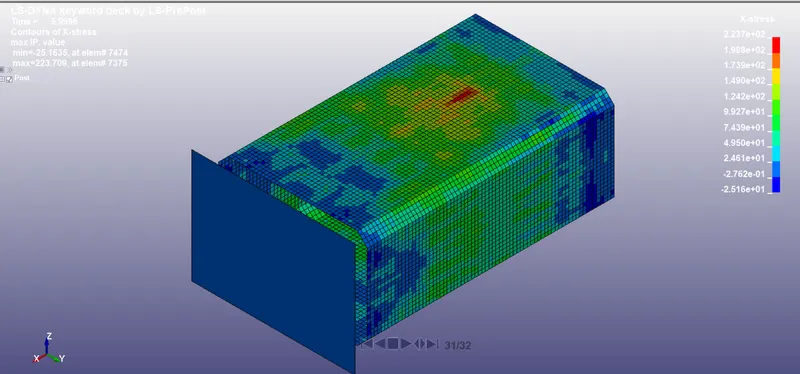
The Maximum x-directional stress occurs at 6ms, with the Value of 237Mpa(Tensile) for shell thickness of 1.2mm.
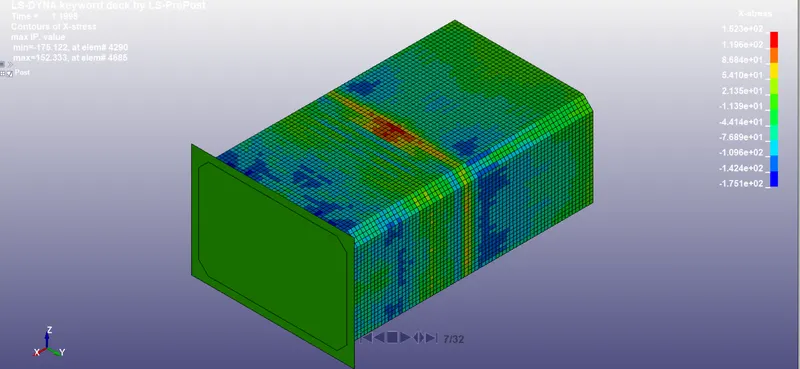
The Maximum Directional Compressive Stress experienced at time of Contact The Value is 175Mpa for shell thickness of 1.2mm
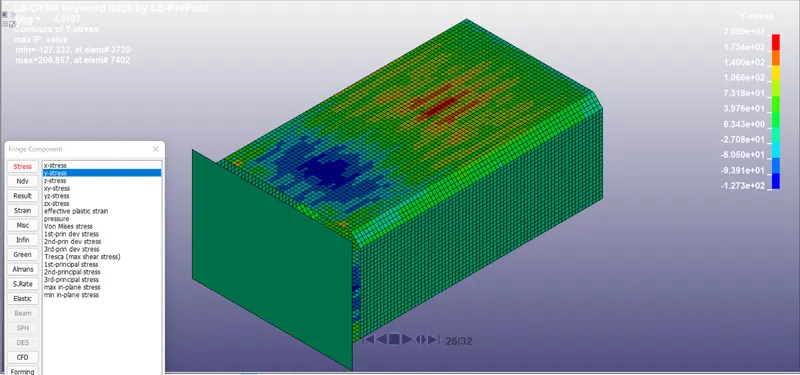
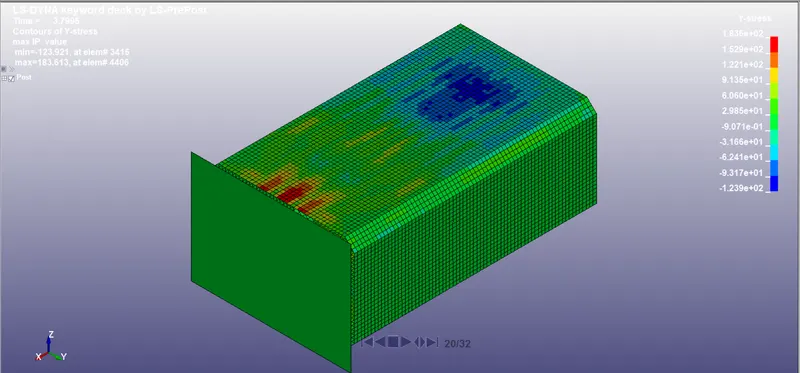
The Maximum Directional Compressive Stress in Y-axis, occurs at 5ms with the value of 127Mpa.
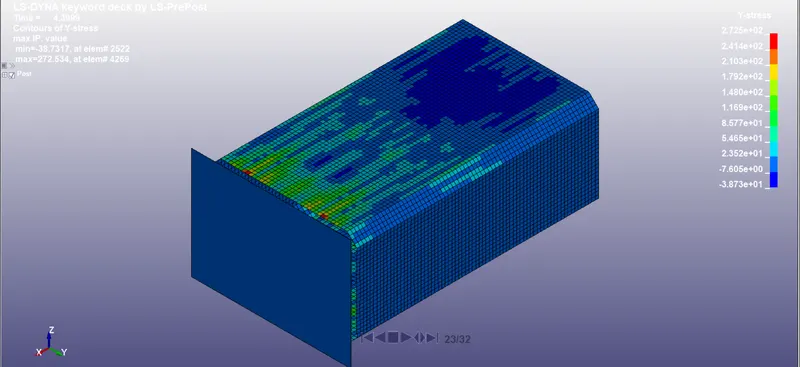
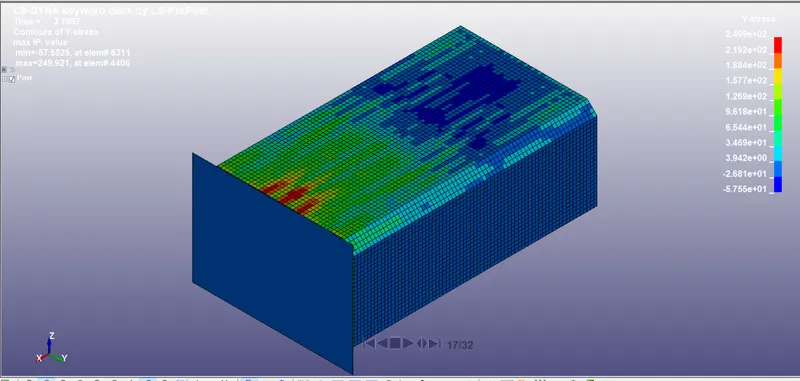
The Maximum Directional Tensile Stress in Y-axis occurs at 4.4ms with 272Mpa.
Directional Stress_1.5mm Shell Thickness:
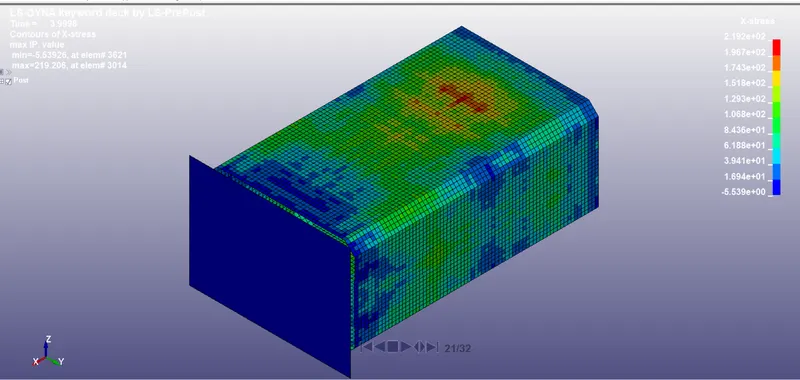
The maximum x-directional stress (Tensile) occurs at 4ms with Stress Value of 219Mpa.
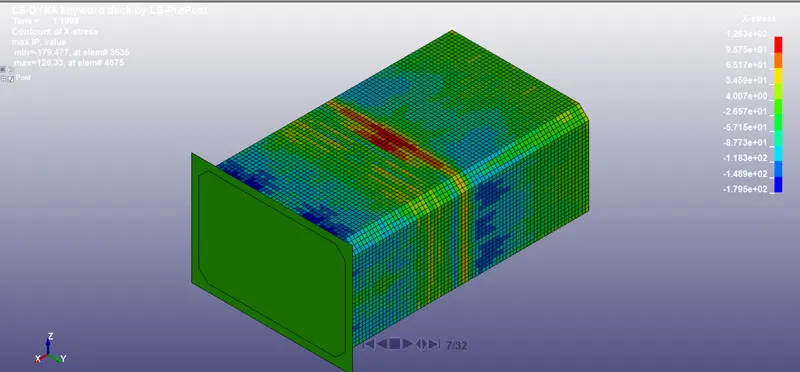
The maximum x-directional stress (Compressive) occurs at time of contact with the Value of 179Mpa.
The maximum Tensile stress in Y-direction is 249Mpa at 3.2ms.
The maximum Compressive Stress in Y-direction is 124Mpa at 3.8ms.
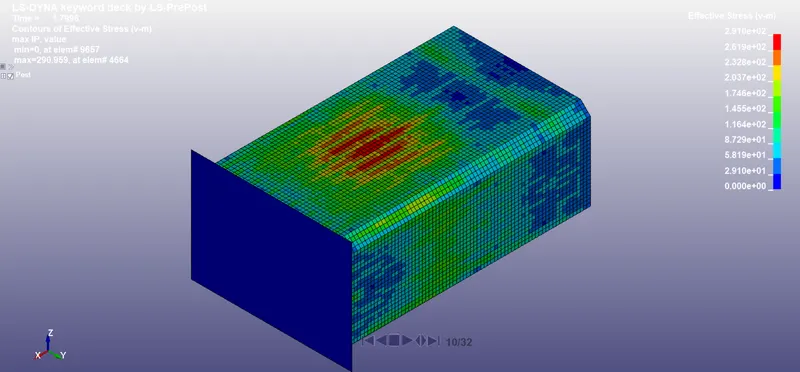
Maximum Equivalent Von-Misses Stress for 1.2mm Shell Thickness:
The maximum equivalent Von-misses stress occurs at 1.8ms. The maximum stress is291Mpa which is above the Yield Criteria.
Maximum Equivalent Von-mises Stress for 1.5mm shell thickness:
The maximum Equivalent Von-mises stress is 262Mpa at the time of Contact.
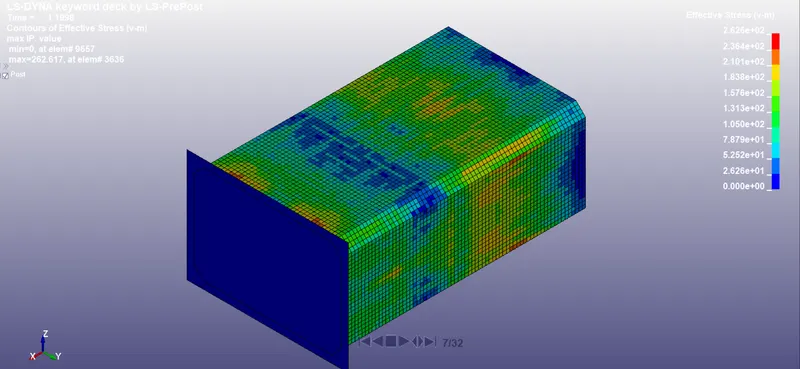
The Crashbox with Shell thickness of 1.5mm absorb more Impact energy undergoing less Stress compared to Crashbox with shell thickness of 1.2mm.
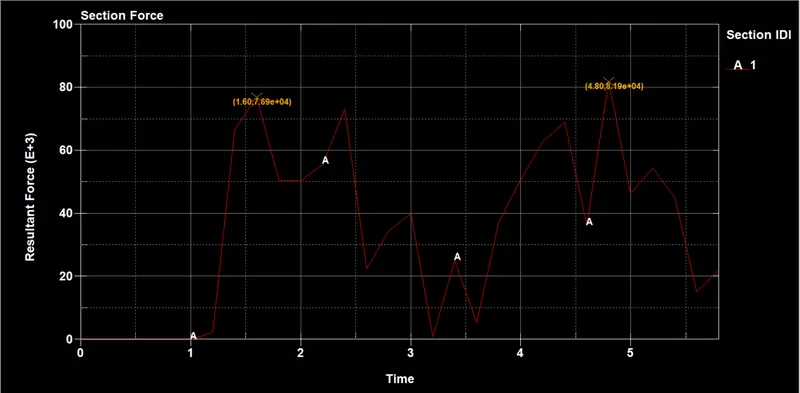
Cross_sectional Force_1.5mm Shell Thickness:
The maximum cross sectional force generated at time of contact is 76900N.
Cross_sectional Force_1.2mm Shell Thickness:
Maximum Cross Sectional force created during the time of contact is 67800N
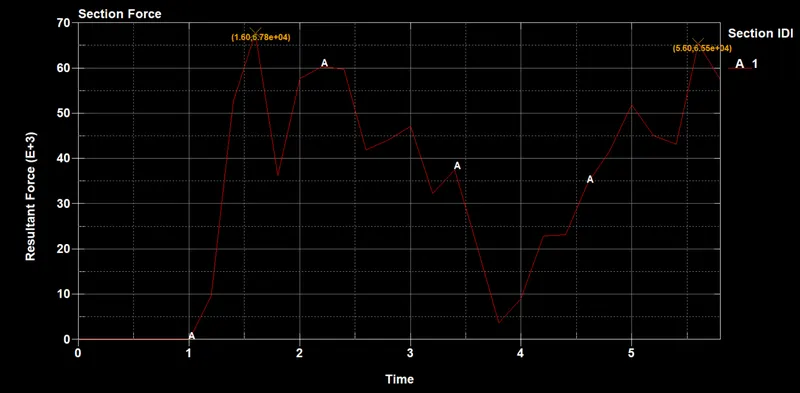
The Increase in Internal Energy is very high for Crashbox with Shell thickness equals to 1.5mm. Hence it is reflected in the Resultant Cross sectional force plot.
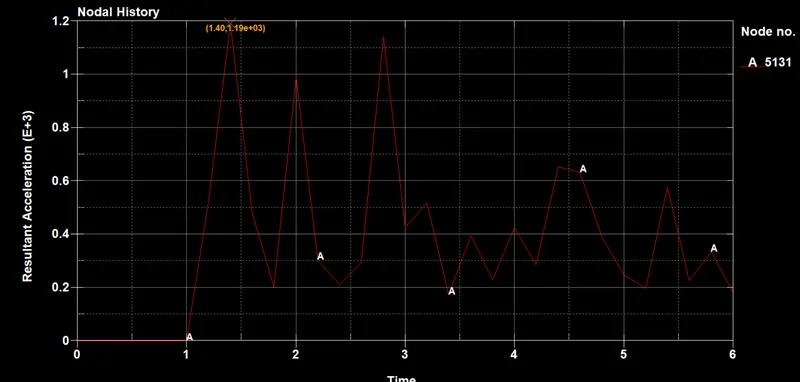
Acceleration at the Node along the Length of Crashbox-1.5mm thickness:
The Maximum resultant acceleration experienced by the node5131is 1.19e3mm/ms^2.
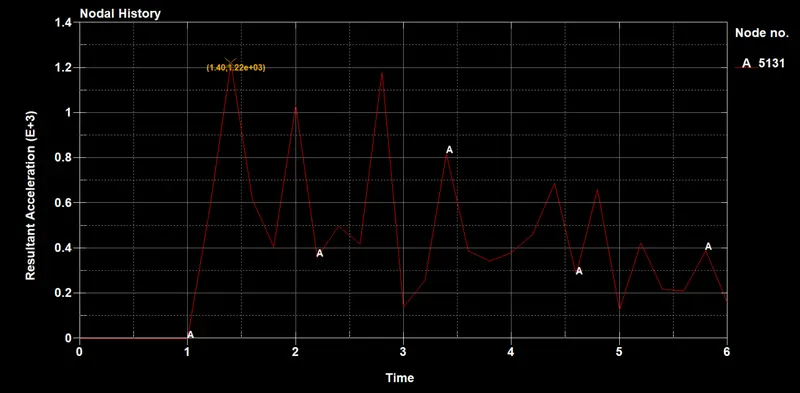
Acceleration at the Node along the Length of Crashbox-1.2mm thickness:
The Maximum resultant acceleration experienced by the node5131is 1.22e3mm/ms^2.
Conclusion:
The Crashbox with thickness 1.5mm absorb more Impact energy compared to Crashbox with thickness 1.2mm.Since the Energy absorbed is high, the nodal accelerations,Nodal Forces & Cross sectional forces experienced by the Crashbox with 1.5mm thick is high. Since the Cross Sectional Area is high for Crashbox of 1.5mm thick, the stress Experienced during the Contact is less compared to Crashbox of 1.2mm thick.