Effect of preheating temperature on combustion efficiency and AFT using Python and Cantera.
Aim:-> To observe effect of preheating temperature on adiabatic flame temperature (AFT) and combustion efficiency.
Theory:-
Industrial furnaces are used for carrying out certain processes that require heat. Heat in the furnace is provided by either Chemical energy (like fuels, coals), Electrical energy or combination of both energies. In such process after combustion flue gases gets generated which leaves the furnace at very high temperature almost at the inside temperature of the furnace. The heat energy contained in the exhaust gases is the waste energy since it gets dumped in to the environment. However, it is possible to recover some part of this energy if investments are made in waste heat recovery devices. Heat exchangers are most commonly used to transfer heat from combustion exhaust gases to air entering the furnace. Since preheated combustion air enters the furnace at a higher temperature, less energy must be supplied by the fuel.
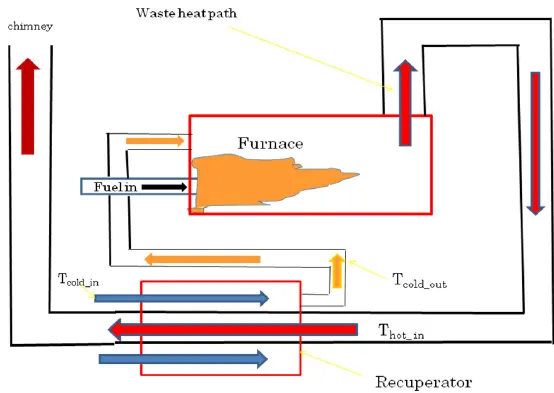 |
| Fig: Schematic diagram |
During heat exchange, the heat energy of the exhaust gases gets transferred to some other fluid medium. This exchange of heat reduces the temperature of the exhaust gases and simultaneously increases the temperature of the fluid medium. The heated fluid medium is either recycled back to the processor utilized in the production of some utilities such as steam or power generation.
Recuperator:
A recuperator is a special purpose counter-flow energy recovery heat exchanger positioned within the supply and exhaust air streams of an air handling system, or in the exhaust gases of an industrial process (like furnace), in order to recover the waste heat.
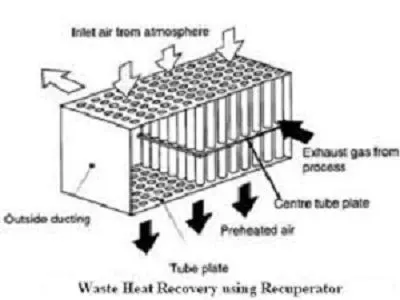 |
Generally, they are used to extract heat from the exhaust and use it to preheat air before that enters in the combustion system (combustion chamber). In this way they use waste energy to heat the air, offsetting some of the fuel, and thereby improves the energy efficiency of the system as a whole.
The combustion process of methane depends upon following stochiometric reaction-
`CH_4 +2(O_2 +3.76N_2)<=>CO_2 + 2H_2O + 7.52N_2`
Hence,
Total number of moles on reactant side for fuel is 1
Total number of moles on reactant side for oxidizer are 2
Total number of moles on product side are 10.52
`"Mole fraction of "CO_2=1/10.52`
`"Mole fraction of "H_2O=2/10.52`
`"Mole fraction of "N_2=7.52/10.52`
The initial preheating temperature varies from 298.15K to 600K.
~PART 1:-
The following code is written for observing effects of preheating temperature on adiabatic flame temperature.
Python program:-
'''
Program to observe effect of preheating on Adiabatic Flame Temperature

CH4 + 2*(H2O + 3.76*N2) <-> CO2 + 2*H20 + 7.52*N2

'''

#Importing libraries
import cantera as ct
import math
import matplotlib.pyplot as plt
import numpy as np

#Initial conditions
N = 50
T_min = 298.15
T_max = 600
P = ct.one_atm

T = np.linspace(T_min,T_max,N)

#Creating gas object with Solution class
gas = ct.Solution('gri30.cti')

temp = []

# For loop for variable preheating temperature
for i in T:

	#Air object
	air = ct.Quantity(gas)
	air.TPX = i,P,{'O2':0.21, 'N2':0.79}
	air.moles = 9.52

	#Fuel object
	fuel = ct.Quantity(gas)
	fuel.TPX = T_min,P,{'CH4':1}
	fuel.moles = 1

	#Reactant mixture (Charge)
	M = air + fuel

	#Constant enthalpy and constant pressure chamber
	M.equilibrate('HP','auto')
	temp.append(M.T)

#printing of AFT
print(temp)

#Plotting
plt.plot(T,temp,'*',color='green')
plt.xlabel('Preheating temperature in K')
plt.ylabel('Adiabetic flame temperature (AFT) in K')
plt.title('Effect of preheating temperature on AFT')
plt.grid('on',linestyle='--')
plt.show()
Output for above python program:-
[2224.4118993147463, 2227.052290666045, 2229.686010851987, 2232.313071265409, 2234.9334864606703, 2237.5472745563798,
2240.154456441664, 2242.755055937391, 2245.349099574504, 2247.936616445244, 2250.5176380605044, 2253.092198212741,
2255.660332843997, 2258.2220799187526, 2260.777479301144, 2263.326572636357, 2265.8694032358762, 2268.406015966451,
2270.93645714247, 2273.4607744215973, 2275.97901670567, 2278.491234075767, 2280.997477499697, 2283.497799153725,
2285.9922519081088, 2288.4808894547864, 2290.9637661788493, 2293.440937075806, 2295.9124576711147, 2298.3783839419384,
2300.8387722410075, 2303.293679222595, 2305.7431617704797, 2308.187276927891, 2310.6260818293663, 2313.0596336344474,
2315.4879894632163, 2317.911206333585, 2320.3293411001832, 2322.74245039895, 2325.1505906361326, 2327.553817644508,
2329.952187239504, 2332.345754538249, 2334.7345742272337, 2337.118700447778, 2339.498186747393, 2341.873086032556,
2344.2434505228175, 2346.609331706233]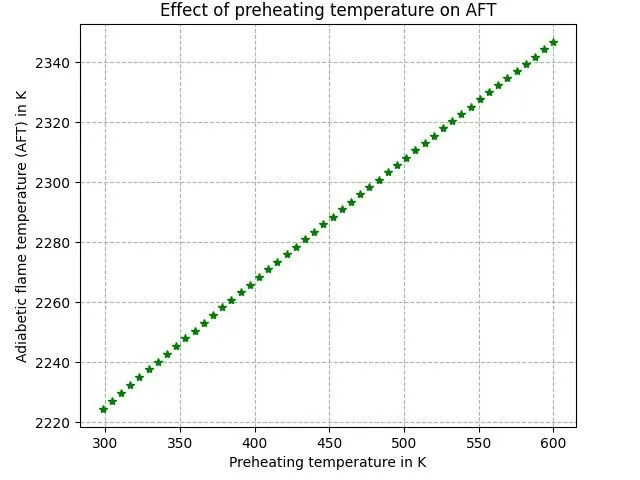
The above figure shows effect of preheating inlet charge on adiabatic flame temperature. It is seen that adiabatic flame temperature is a linear function of inlet temperature. It happens due to preheating air results increase in enthalpy which implies increase in energy of system even before starting combustion. Thus, the extra energy assist in achieving higher adiabatic flame temperature.
~PART 2:-
The LHV of the fuel is assumed to be to be 50MJ/kg. The exit temperature of the products are set to be 1700K and the products of combustion are assumed to be `CO_2,H_2O` and `N_2`.
The released after combustion can be calculated as,
`Q_("released")=(dotm_fxxh_f) + (dotm_axxh_a) - (dotm_f + dotm_a)xxh_p`
Where,
`dotm_f="Mass of fuel at reactant side"`
`dotm_a="Mass of air at reactant side"`
`h_f = "Enthalpy of fuel"`
`h_a = "Enthalpy of air"`
`h_p = "Enthalpy of product"`
The theorotical heat supplied can be calculated as-
`Q_("Supplied")=(dotm_f)xxLHV`
Where, LHV = Lower heating value
The combustion efficiency can be calculated as-
`eta=(Q_("released"))/(Q_("supplied"))`
`:.eta=((dotm_fxxh_f) + (dotm_axxh_a) - (dotm_f + dotm_a)xxh_p)/(dotm_fxxLHV)`
`:.eta=((h_f) + ((dotm_a)/(dotm_f)xxh_a) - (1 + (dotm_a)/(dotm_f))xxh_p)/(LHV)`
Here as we know, `(dotm_a)/(dotm_f) = AF`
`:.eta=((h_f) + ((AF)xxh_a) - (1 + (AF))xxh_p)/(LHV)`
So by using above formula we can get combustion efficiency.
The following code is written for observing effects of preheating temperature on combustion efficiency.
Python program:-
'''
Program to find effect of preheating on combustion efficiency

CH4 + 2*(H2O + 3.76*N2) <-> CO2 + 2*H20 + 7.52*N2

'''

#Importing libraries
import cantera as ct
import math
import matplotlib.pyplot as plt
import numpy as np

#Initial conditions
N = 50
T_min = 298.15
T_max = 600
T_exhaust = 1700
P = ct.one_atm
LHV = 50e6

T = np.linspace(T_min,T_max,N)

#Creating gas object with Solution class
gas = ct.Solution('gri30.cti')

eta = []


# Product side
'''
CO2 = (12*1 + 16*2) = 44
H2O = (1*2 + 16*1)*2 = 36
N2 = (14*2) = 28

Number of moles of CO2 = 1
Number of moles of H2O = 2
Number of moles of N2 = 7.52

Total number of moles = CO2 + H2O + N2 = 1 + 2 + 7.52 = 10.52
'''

'''
Mole fraction of molecule = (Number of moles of molecule/Number of total moles)

Mole fraction of CO2 = 1/10.52
Mole fraction of H20 = 2/10.52
Mole fraction of N2 = 7.52/10.52
'''

pro= ct.Quantity(gas)
pro.TPX = T_exhaust,P,{'CO2':1/10.52,'H2O':2/10.52 ,'N2':7.52/10.52}
pro.moles = 10.52
h_pro = pro.enthalpy_mass

# For loop for variable preheating temperature
for i in T:

	# Air object
	air = ct.Quantity(gas)
	air.TPX = i,P,{'O2':0.21, 'N2':0.79}
	air.moles = 9.52
	m_air = air.mass
	h_air = air.enthalpy_mass

	#Fuel object
	fuel = ct.Quantity(gas)
	fuel.TPX = T_min,P,{'CH4':1}
	fuel.moles = 1
	m_fuel = fuel.mass
	h_fuel = fuel.enthalpy_mass

	A_F = m_air/m_fuel
	Qs = LHV
	Q = A_F*h_air + h_fuel - (A_F + 1)*h_pro

	#Combustion efficiency
	eff = (Q/Qs)*100
	eta.append(eff)

#Printing of efficiencies
print('Efficiency obtained:',eta)

#Plotting
plt.plot(T,eta,'*',color='purple')
plt.xlabel('Preheating temperature in K')
plt.ylabel('Combustion efficiency in %')
plt.title('Effect of preheating temperature on Combustion efficiency')
plt.grid('on',linestyle='--')
plt.show()
Output for above python program:-
Efficiency obtained:
[33.87849341140674, 34.091574600846826, 34.30479383932486, 34.51815326383255, 34.73165508562964,
34.94530158761721, 35.159095121711, 35.3730381062148, 35.58713302319368, 35.80138241584738,
36.01578888588361, 36.2303550908914, 36.44508374171439, 36.65997759982419, 36.875039474693686,
37.09027222117037, 37.30567873684967, 37.52126195944825, 37.73702486417741, 37.952970461116294,
38.16910179258535, 38.385421930519534, 38.60193397384169, 38.818641045835925, 39.03554629152083,
39.252652875022896, 39.46996397694978, 39.68748279176368, 39.90521252515462, 40.12315639141378,
40.34131761080687, 40.559699406947374, 40.77830500416996, 40.99713762490374, 41.216200487045654,
41.43549680133371, 41.655029768720425, 41.87480257774606, 42.094818401911965, 42.31508039705393,
42.53559169871551, 42.756355419521306, 42.977374646550345, 43.19865243870936, 43.42019182410618,
43.64199579742298, 43.864067317289624, 44.08640930365706, 44.30902463517054, 44.53191614654305]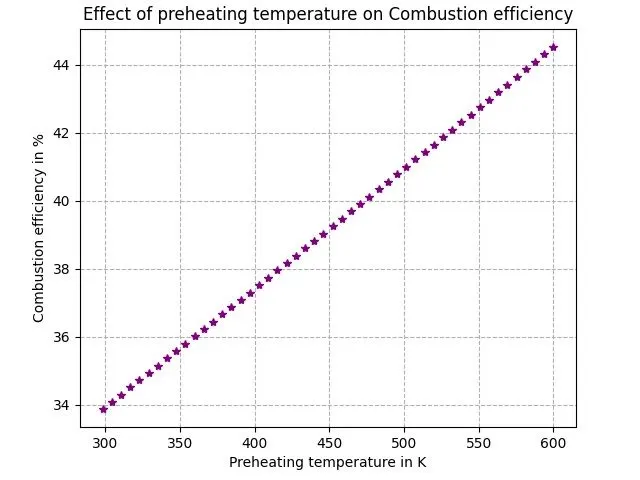
The above figure shows plot of preheating temperature v/s combustion efficiency. Here it is seen that with increase in preheating temperature, the combustion efficiency also increasing.
Que. Does preheating help with fuel saving?
Yes, preheating helps with fuel saving as preheating is almost directly proportional to efficiency. And as combustion efficiency is increasing which means the fuel consuption reduces automatically. In other words fuel get saved.
Que. Is it right or wrong to assume a fixed furnace exit (exhaust) temperature? Explain your answer.
The exhaust temperature depends upon the product temperature of the reaction which is necessary for the recuperator to preheat the air. In practical, exhaust temperature of furnace cant be kept constant as complex phenomenon occurs in combustion process and it is depend on lots of parameters. But if the exhaust temperature crosses limit of safe temperature rage it results in failure (heavy damage) of system. So it is good to assume fixed exit temperature.
Conclusion:- By observing above output data and plots we can conclude that-
- As preheating temperature increases, adiabatic flame temperature also increases.
- At pre heating temperature of 298.15k and 600k, the AFT is 2224.4119K and 2346.6093K respectively.
- Increase in preheating temperature results increment in combustion efficiency.
- At pre heating temperature of 298.15k and 600k, the combustion efficiency is 33.8785% and 44.5319% respectively.
- Increasing preheating temperature also result in increase of fuel saving.
- High recuperator temperature leads to damage of recuperator, it is necessary to maintain outlet temperature of recuperator as fixed value in limit.