Week 4 - CHT Analysis on Exhaust port
CHT Analysis on Exhaust port
Introduction:
Conjugate heat transfer analysis is based on a mathematically structured problem, which describes the heat transfer between a body and a fluid flowing over or inside it as a results of interaction between two objects. At the matching interface, the details are provided for temperature distribution and heat flex along the interface eliminating the need of calculating the heat transfer coefficient. Moreover, the heat transfer coefficient can be calculated later.
One of the simplest ways to realize conjugation is through numerical methods. The boundary condition for the fluid and solid interface is set and solved through iteration methods. There are no right guesses for the convergence expect through the hit and trial method.
Application:
The conjugate heat transfer methods have become a more powerful tool for modeling and investigating nature phenomena and engineering system in different areas ranging from aerospace and nuclear reactors to thermal goods treatment and good processing from the complex procedures in medicines to ocean thermal interaction in metrology.
CHT in recent years has significantly improved the cooling performance of electronic equipment such as the design of heat sinks and the design of heat exchangers for the waste treatment plant. One such application of CHT is the exhaust port system.
Case setup and simulation:
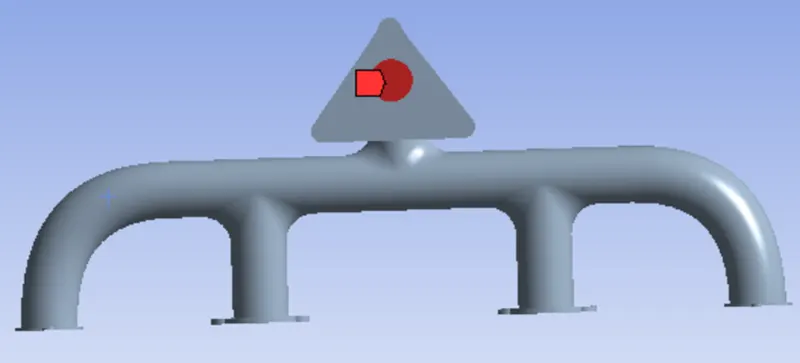
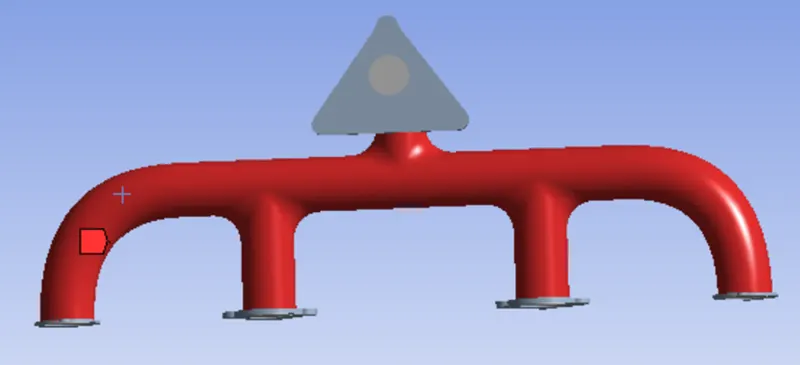
Ansys space claim was used to setup the geometry. As shown in figure, the fluid volume was extracted from the exhaust manifold geometry.
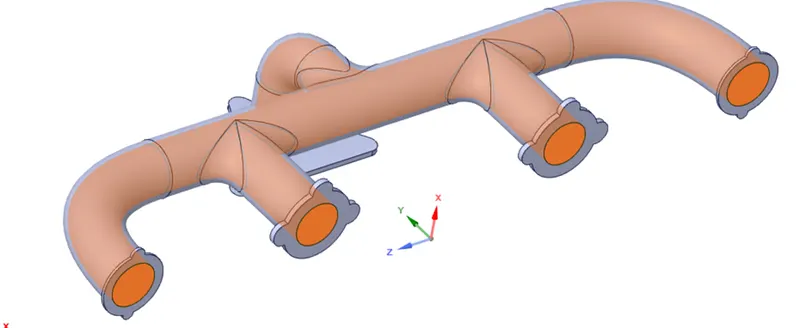
Fluid Volume
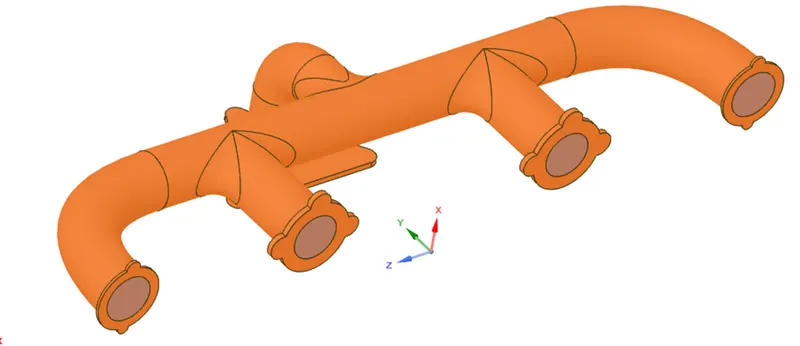
Solid volume
Also the final geometry was fixed using share option so that conformal mesh could be generated while generating the mesh between solid and fluid volume. The pink circle that the two computational body has been shared and has a single interface between them.
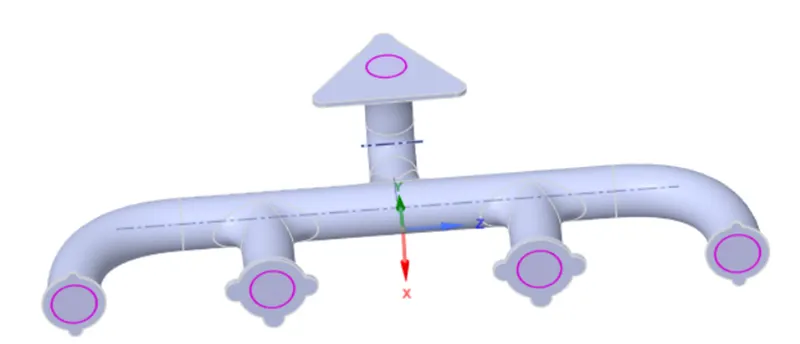
The named selection for different boundaries of the computational model.
Inlets:
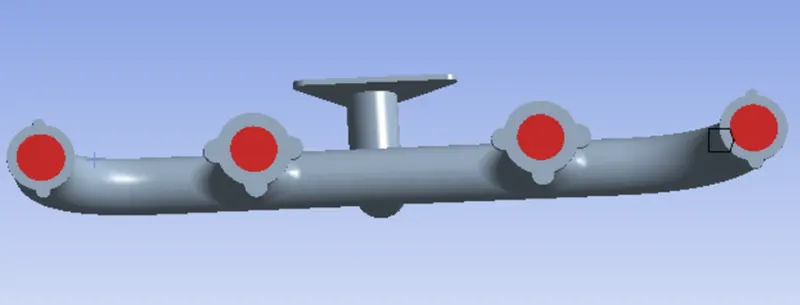
Outlet:
Outer Wall:
Baseline setup:
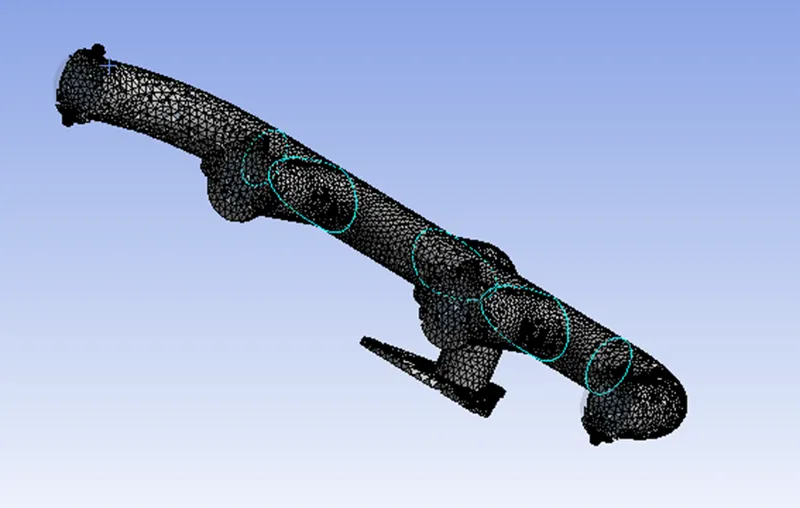
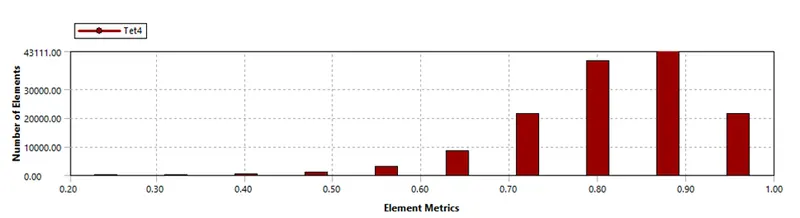
For the base line mesh setup, the mesh information is given in below table
Element size default (150mm).
Element type Tetrahedral
Total nodes 33627.
Total element 137982.
Baseline mesh
Mesh metrics graph
The information about initial conditions, required physics setup and boundary condition for this simulation is given in the table.
|
Solver |
Type |
Pressure based |
|
|
Time |
Steady state |
|
Viscous model |
K- epsilon |
|
|
Cell Zones |
Solid volume |
Aluminum |
|
|
Fluid Volume |
Air |
|
Inlet |
Velocity |
5m/s |
|
|
Temperature |
700K |
|
Outlet |
Gauge pressure |
0 |
|
Outer wall convection |
Heat transfer coefficient |
20 W/(m2-k) |
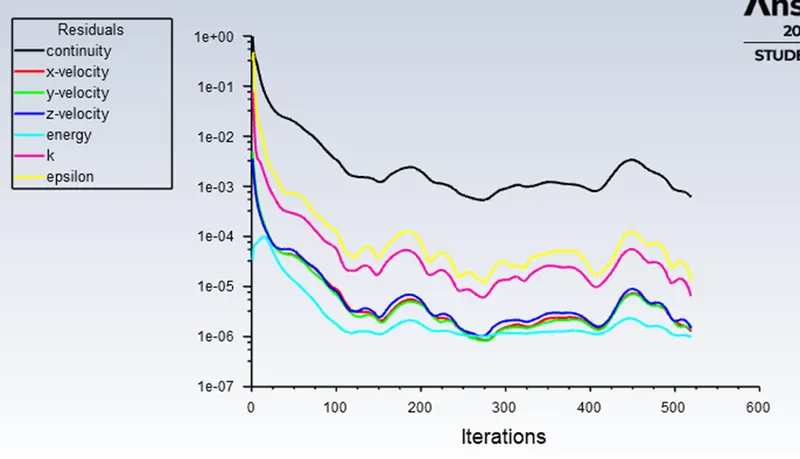
The simulation was run for 600 iteration and the solution was converged around 550 iterations as shown in figure.
Residual graph
Results:
Temperature contour;

Temperature plane:
Temperature streamline:
Velocity plane:
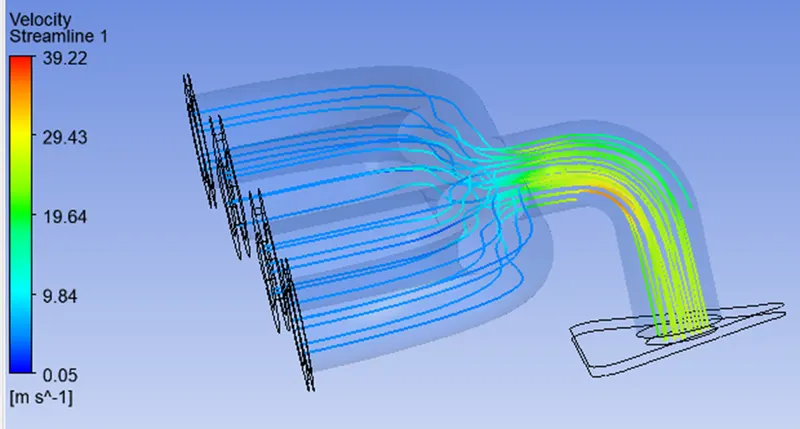
Velocity streamline:
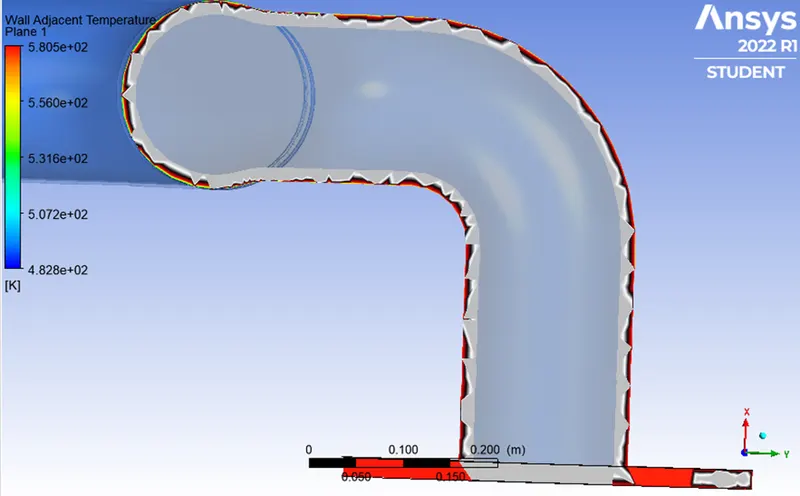
Wall adjacent temperature:
Refined mesh setup:
Mesh was further refined in the solid volume region and inflation layer was generated around the fluid volume surface as shown table the refined mesh details.
|
Element size for solid volume |
20mm. |
|
Element Type |
Tetrahedral. |
|
Inflation layer |
5 layer and 1.2 growth rate. |
|
Inflation layer total thickness |
5mm |
|
Total Nodes |
129538 |
|
Total Element |
343943 |
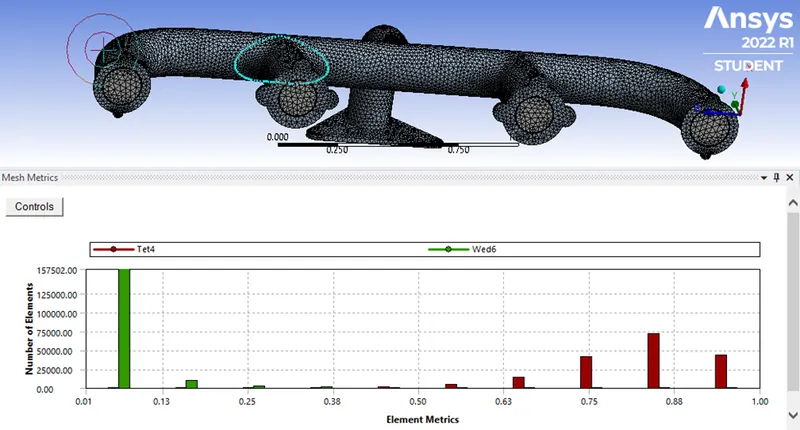
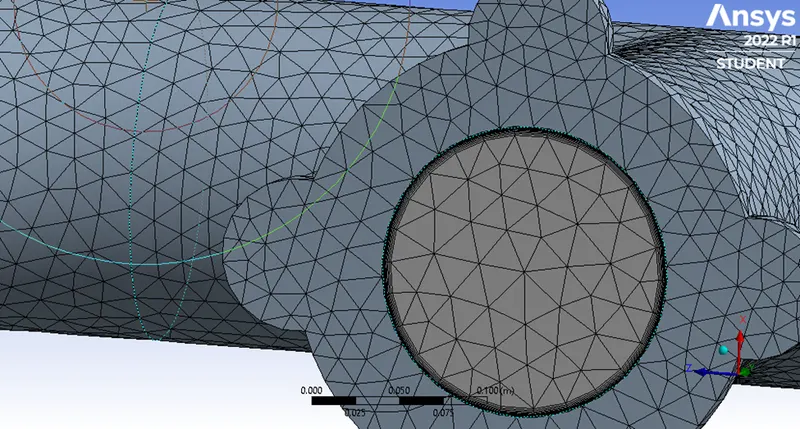
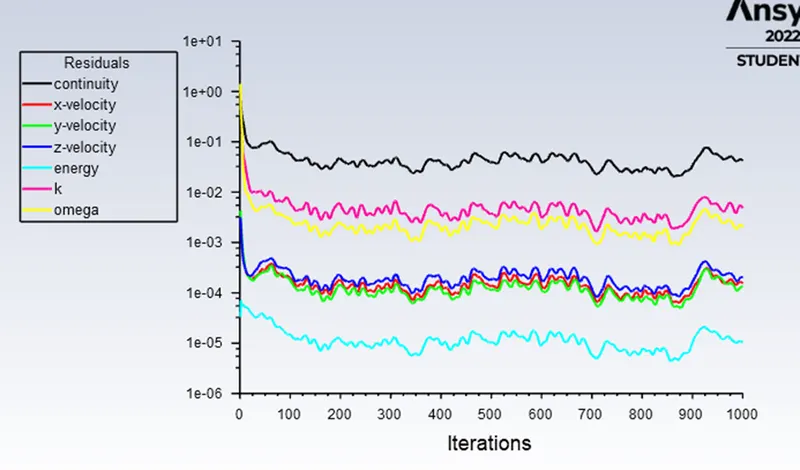
All the parameters in Ansys fluent were kept same and the simulation was run for 1000 iteration. As shown in fig the solution was converged around 600 iteration.
Residuals plot:
Results:
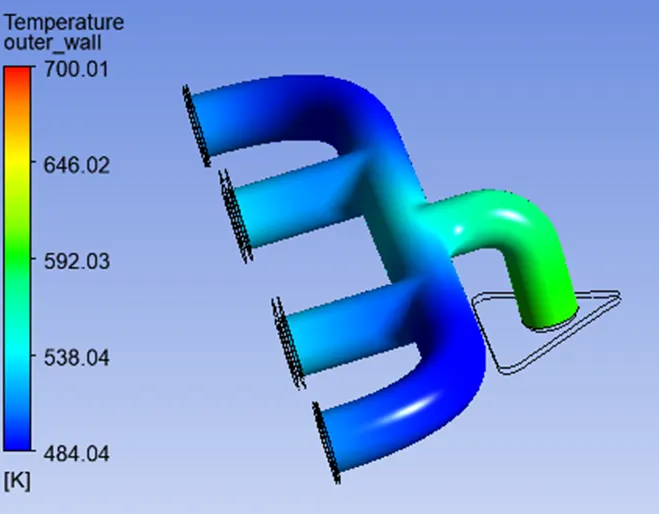
Temperature contour:
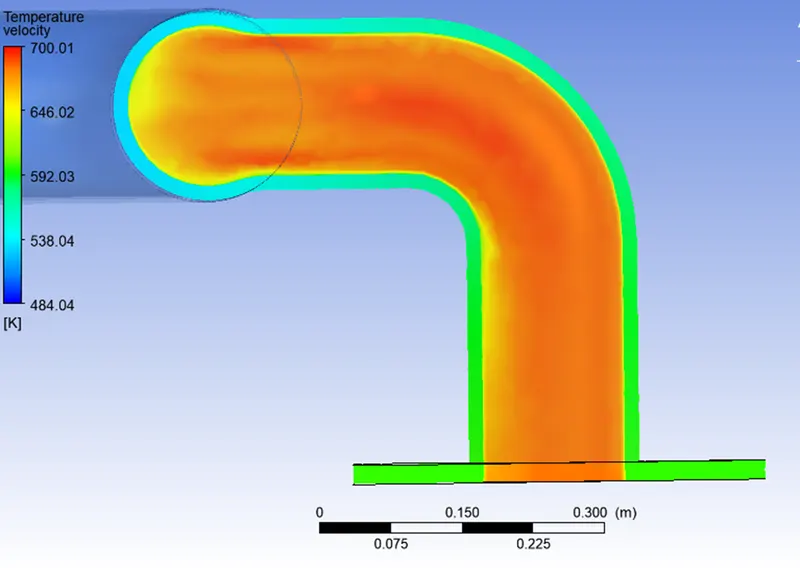
Temperature plane:
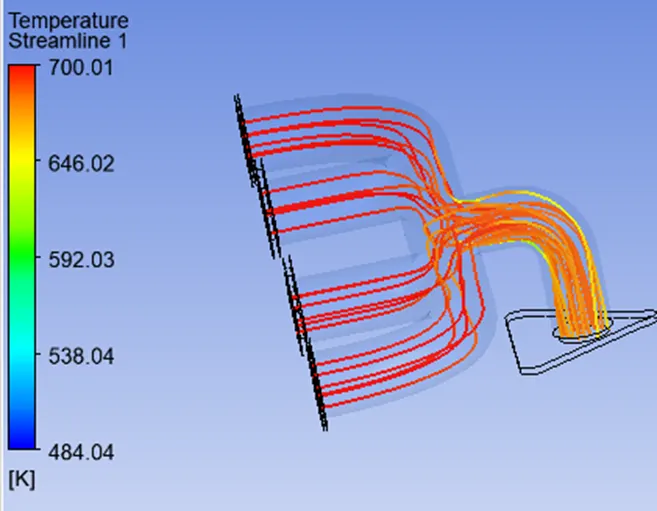
Temperature streamline:
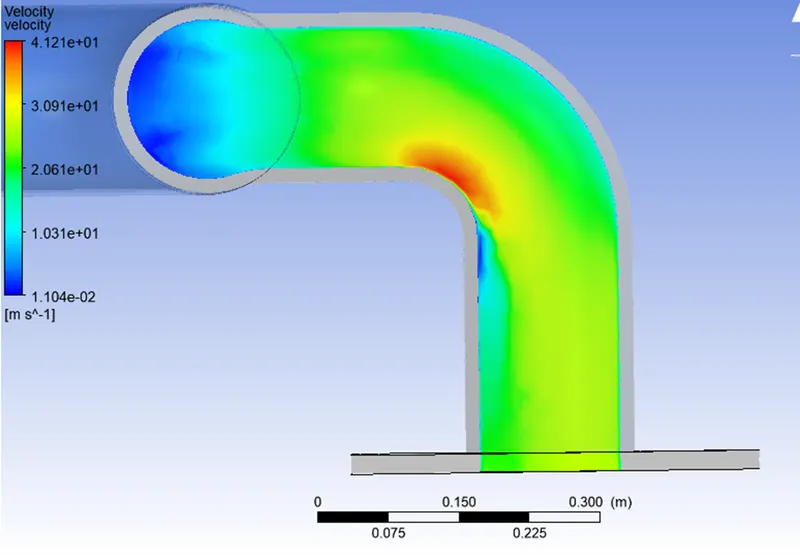
Velocity plane:
Velocity streamline:
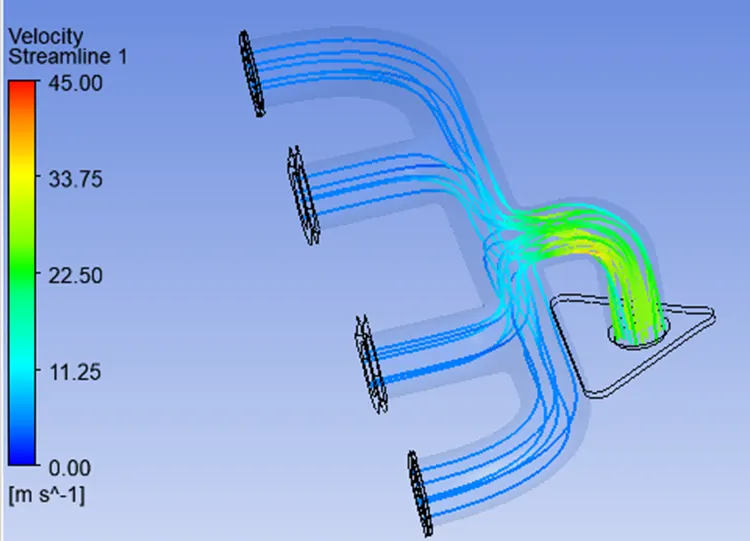
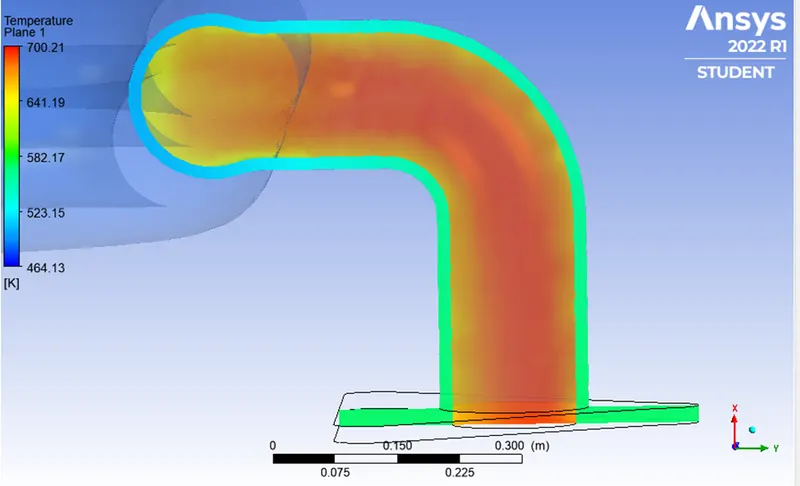
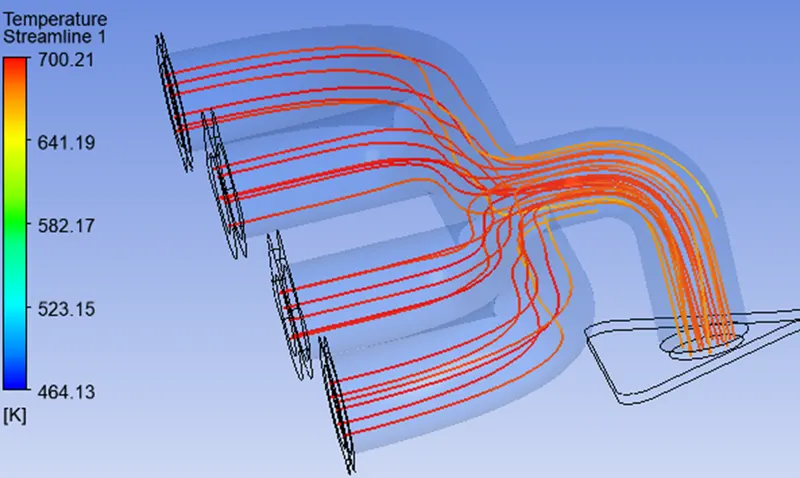
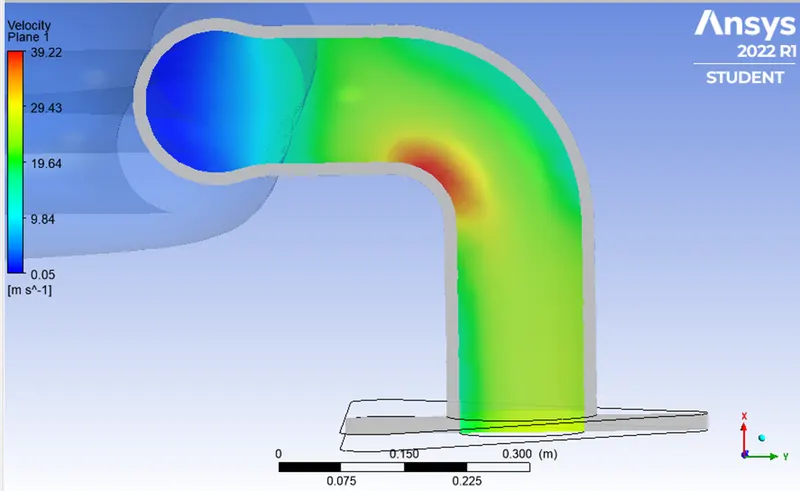
The post processing images showing in fig. has no difference graphically. It can be noticed that the magnitude of velocity did change in refined meshed setup and had slightly increased from 37.52 m/s to 41.39 m/s as maximum velocity. Also the outlet region has higher velocity than the inlets because of mass conservation law. The higher velocity results in high Reynolds number which means high heat transfer coefficient resulting in high temperature at outlet region fig shows the temperature profile which is high at outlet region. The region where the velocity is higher in the outlet region is also shown in fig.
Surface heat transfer coefficient:
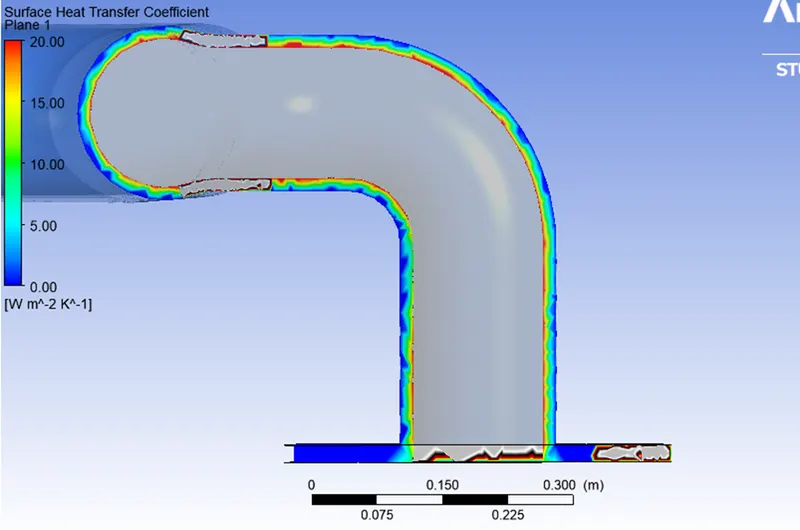
The heat transfer coefficient depends on various variable. Experience shows that convection heat transfer strongly depends on the fluid properties dynamic viscosity, thermal conductivity, density and specific heat Cp, as well as the fluid velocity. In this simulation the velocity of the fluid has been taken into account. Since the higher velocity of the fluid results in thin boundary layer at the wall. When the thickness of boundary layer (fluid film) gets less the value of heat transfer coefficient gets high according to the formula given below.
Heat transfer coefficient:
h = Kf /δ.
Where,
Kf = is thermal conductivity of fluid film.
δ = is the thickness of the fluid film.
Higher velocity of the fluid results in higher value of heat transfer coefficient. The curved surface where the velocity is higher, the heat transfer coefficient was also higher in the same region. Results shows a positive outcome about the prediction made for heat transfer coefficient in the simulation.
Conclusion:
From this conjugate heat transfer simulation, the surface heat transfer coefficient was found out to be maximum at the curved surface of the outlet region because of higher velocity at that region. Also the temperature was higher at outlet region of solid surface. More accuracy was achieved in the results after mesh refinement. Since the mesh quality could not be refined more because of the cell limitation of the Ansys student version, so the mesh quality could be improved more during the mesh refinement and more accurate results can be achieved further.