Week-4 Challenge WOT Condition Part-2
Solution to first question:
a) The mapped model of engine, motor and generator will takes the inputs from the other subsystem, gives the corresponding resposes. It doesnot have mathematical eqations of the engine or motor, the mapped model will have the lookup table data which provides the corresponding outputs mapped to the corresponding inputs.
b) Coming to the dynamic model of the engine, motor and generator the subsystems are modelled using the mathematical equations of the systems. So, using these models user will have the control to change the values of the parameters of the system and see the response of the overall system to variation of those parameters. Dynamic models will help in observing the transients present in the system and tune the parameters of the controller accordingly.
Following images shows the difference of mapped and dynamic models:
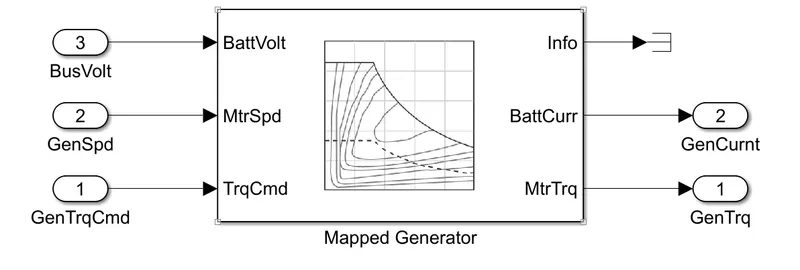
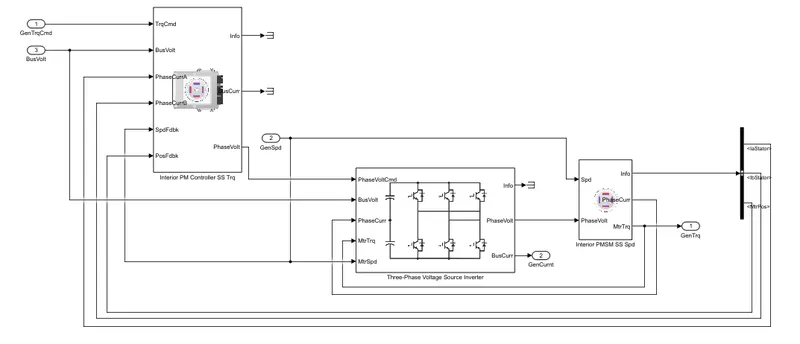
In order to change the type of the subsystem used in the model we have to go to the variant manager option available in the options and from there we can select the desired type of the model we want to use in the model. The process can be understood from the attached image:
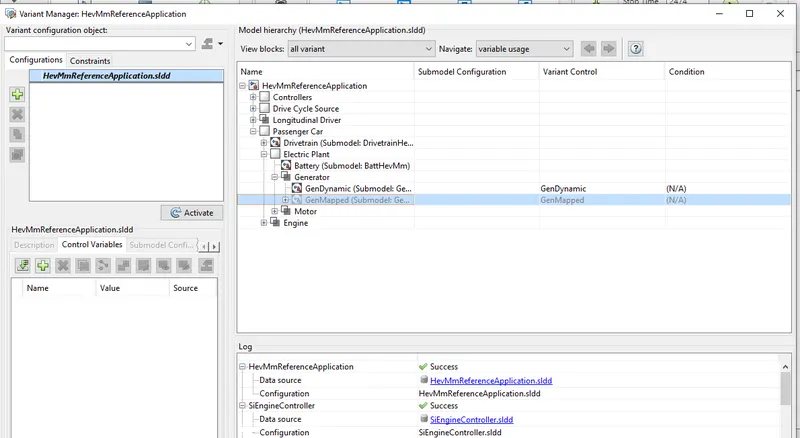
From here we can select the desired subsystem to be used. We have to right click on the subsystem and select the option set label as active choice.
2) Solution to question two:
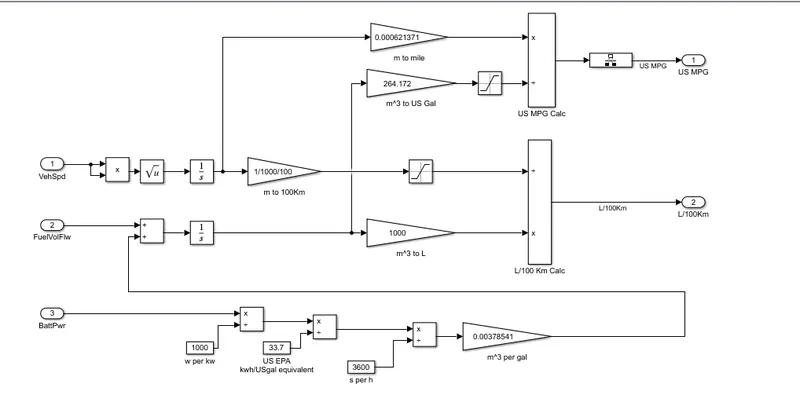
a) In the model, miles per gallon of fuel is calculated based on the inputs from the distance travelled using the fuel and also the battery power. In HEV as both engine and battery pack will be used to drive the wheel the model will calculate the distance travelled using both the sources.
b) Dividing distance traveled in miles by the number of gallons, we can get miles per gallon.
c) For HEV this gallon(gasoline-equivalent of battery power) is added with gallon used by IC engine then miles per gallon is calculated.
d) Finally the distance travelled in miles is divided by the number of gallons of fuel consumed by the vehicle in order to calculate the Miles Per Gallon calculation.
3) Solution to question three:
The HEV reference applicaiton is run with the WOT condition :
Initially a gradient of 0 is considered and the final speed is given as 50, the deceleration time is given from 40 sec and the stop time of simulation is given as 50 sec.
The result obtained as shown below (Gradient = 0):
We can see that in WOT test with gradient of zero the vehicle is able to reach the reference speed of 50 the demanded speed of vehicle is achieved at around 35 sec and during deceleration at 40sec we can see regeneration is happening. 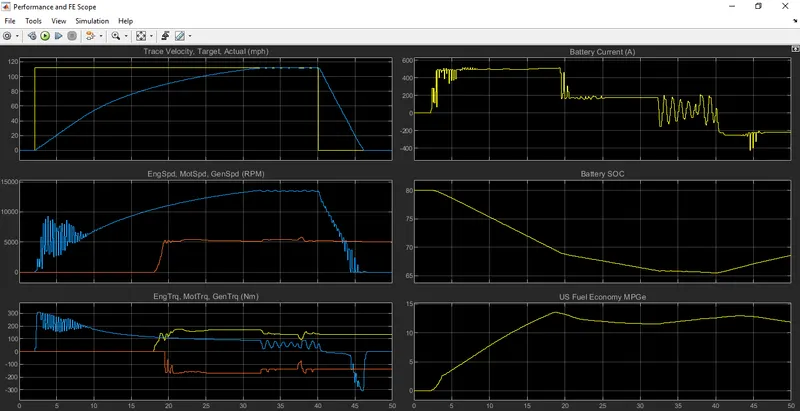
Now, let us see the same WOT test condition but with a gradient = 5 and wind = 10:
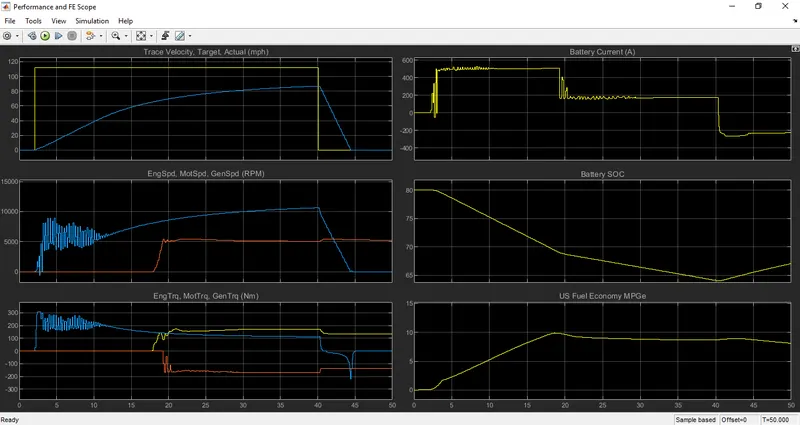
With this condition the vehicle is unable to meet the demanded acceleration. This is mainly because of the gradient of the road and also the wind force on the vehicle in the opposite direction. Also,the fuel economy is reduced.
4) Solution to question 4:
The WOT condition used in the question 3 is used for question 4 for both HEV and EV reference models and the results obtained are as shown below:
Figure 1 represents for HEV:
Figure 2 represnts the output of WOT condition for an EV with all the same input conditions:
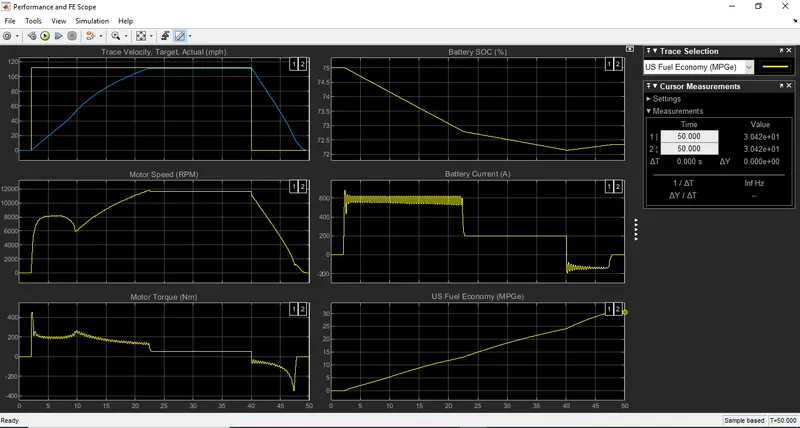
COMPARISON OF HYBRID WITH PURE ELECTRIC POWERTRAIN
1) The time taken to reach the commanded speed by EV is around 20 sec where as for HEV it is around 35 sec. With this we can understand that the initial pickup of EV is faster than HEV
2) With EV the emissions is zero where as for HEV there are emisssions
3) The fuel economy of EV is better when compared with HEV