Week-4 Challenge WOT Condition Part-2
Question 1:What is the difference between mapped and dynamic model of engine, motor and generator? How can you change model type?
Solution:
Powertrain Blockset provides two types of engine models.
Mapped and Dynamic.
Mapped Model:
- In the mapped models the data is taken from a lookup table characterises the Engine,Motor,Generator performance under certain parameters.
- Mapped engines represent macro engine behavior as a set of lookup tables like values obtained from brake torque, fuel flow, air mass flow, exhaust temperature, efficiency, and emissions as functions of commanded load and measured engine speed.
- Mapped engine models are suitable for analysis and design activities that do not require engine subsystem dynamic characteristics.
- This type of model leads to faster solving time.
Dynamic Model:
- Dynamic model combines the results of different componenets to get the dynamic effect.
- Dynamic models are used if you need a more detailed and component level data and to analyse the impact of individual engine,Motor,Generator components on the overall performance.
- Dynamic engine models are suitable for designing control, estimator, and diagnostic algorithms that depend on dynamic subsystem states.
- Dynamic engines decompose engine behavior into individual component models that account for engine dynamics, most notably intake airflow and turbocharger dynamics.
Model Type can be changed between as per need of application as follows
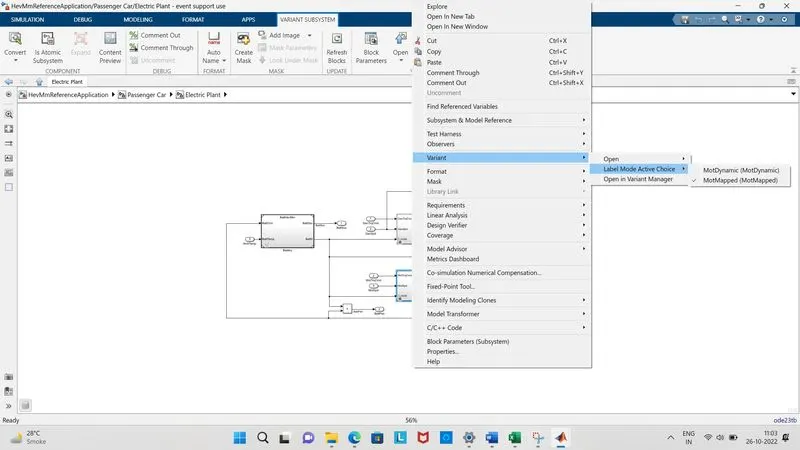
- Open the powertrain blockset and go to pasenger vehicle block and select the electric plant or engine plant.
- Next, Right click on the Engine,Motor,Generator based on vehicle model, select the varient and select label model active choice and choose mapped or dynamic for the required calculation.
xxxxxxxxxxxxxxxxxxxxxxxxxxxxxxxxxxxxxxxxxxxxxxxxxxxxxxxxxxxxxxxxxxxxxxxxxxxxxxxxxxxxxxxxxxxxxxxxxxxxxxxxxx
Question 2: How does the model calculate miles per gallon? Which factors are considered to model fuel flow?
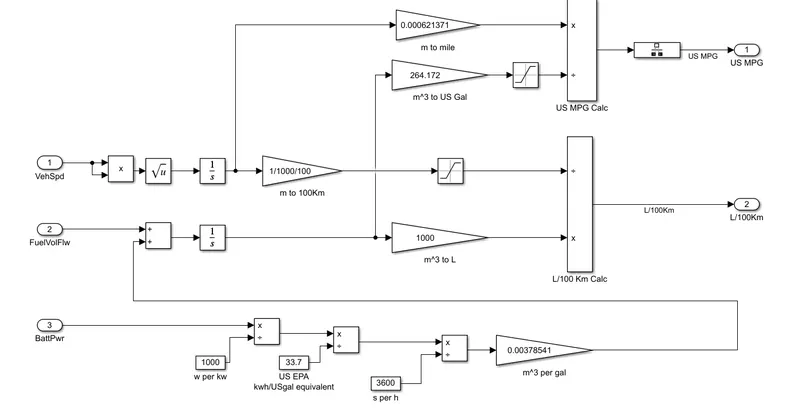
Solution: Following model is used to calculate the miles per gallon.
Factors to consider to model fuel flow
Vehicle speed
Fuel flow
battery power
we know that, 1 gallon of fuel is equivalent to 33.7 KW as per United States Environmental Protection Agency (USEPA).
The distance travelled is calculated by integrating the vehicle speed with respect to time. Then the value is converted from m to mile. Fuel volume flow is calculated by integrating it similarly with respect to time. Along with this, the battery power is converted to kW and then converted to kWh/USgallon by dividing the obtained by 33.7. This value is then converted from m^3 to US gallon. The two values are divided with each other and the miles per gallon value is obtained.
xxxxxxxxxxxxxxxxxxxxxxxxxxxxxxxxxxxxxxxxxxxxxxxxxxxxxxxxxxxxxxxxxxxxxxxxxxxxxxxxxxxxxxxxxxxxxxx
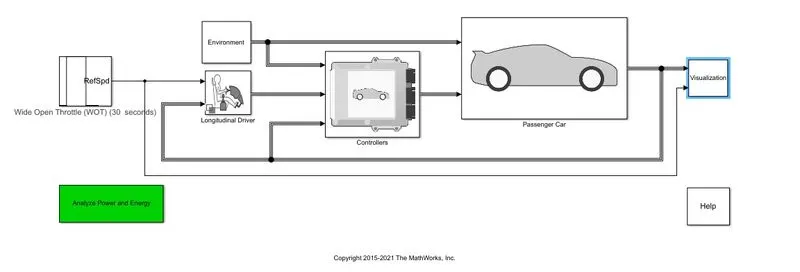
Question 3:Run the HEV ReferenceApplication with WOT drive cycle. Change the grade and wind velocity in the environment block. Comment on the results.
Solution:
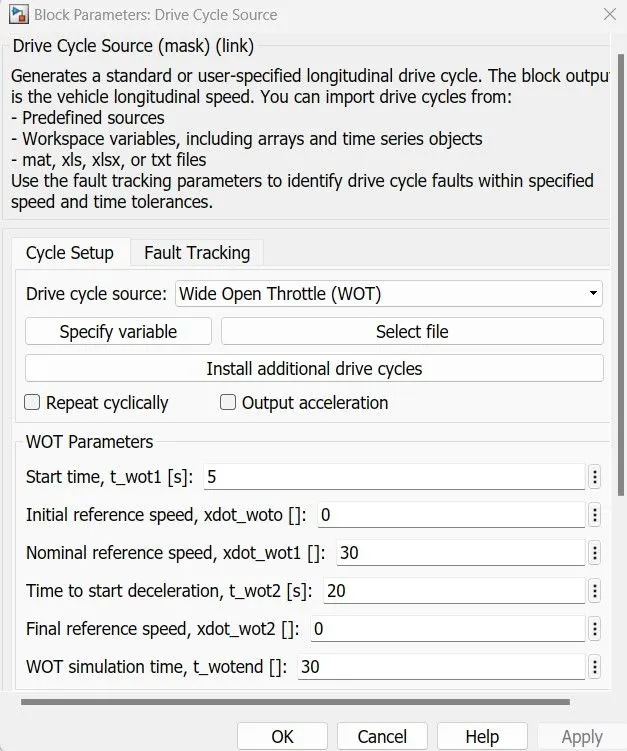
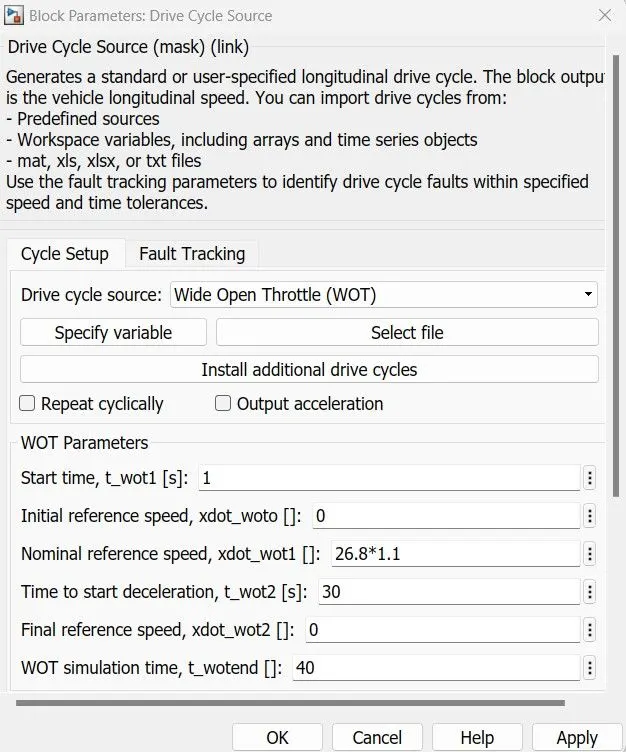
Wide open drive cycle is taken with some initial conditions
Results obtained as
1) Without changing Grade angle and wind velocity.
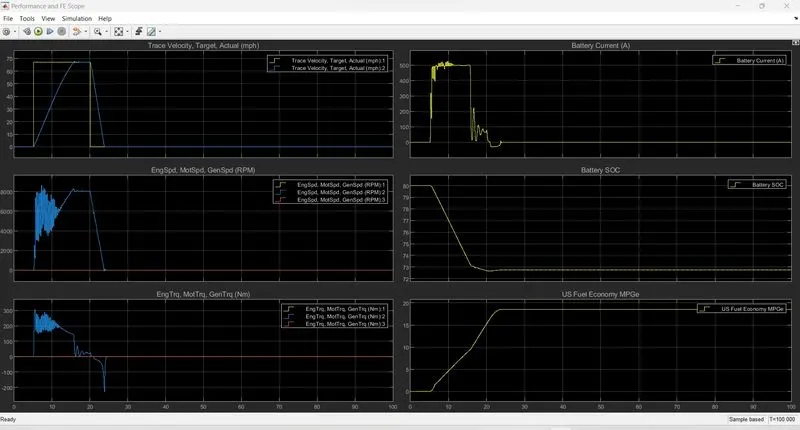
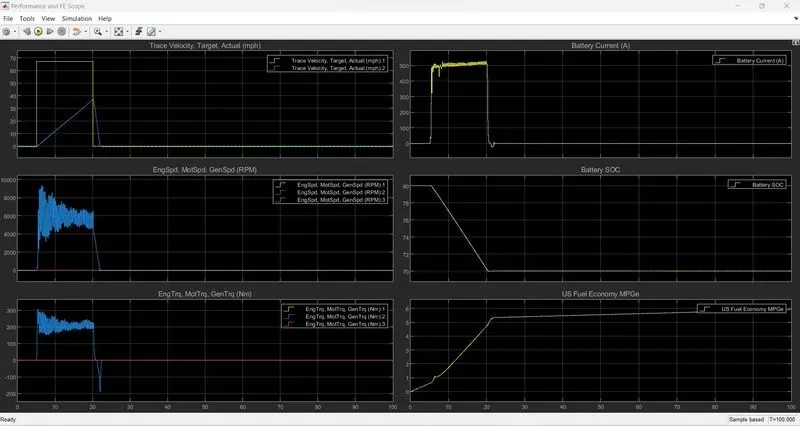
2) With Grade angle 10 Degree and wind velocity as 5 mph
Conclusion:
Graph 1: With no grading and wind speed we can see that Target sped is attained at 17 seconds and with grade angle and wind speed we can see that the maximum speed of vehicle is only 38mph due to grading angle
Graph 2: with no grading and wind speed we can see that battery SOC has steep decrese during speed asscend and during regeneration region we can see less reduction in battery SOC, but with grading angle and wind speed there is very sharp decrease in SOC as fall
Graph 3: With no grading and wind speed we can see that RPM of motor is increased for some instance and become normal but with grading and wind speed that increased RPM is helping vehicle to attain speed hence higher RPM can be seen over the time
Graph 4:With no grading and wind speed we can see that Current is positive with high value for short time and negative during regenerative operation but with grading and wind velocity current is maximum for over a time as motor draws more current to maintain speed during asscend and very less time of regenerative operation can be seen with less time of negative current
Graph 5: With no grading and wind speed we can see that torque required to achieve max speed is steep during starting then it is constant for some time but with grading angle and wind speed maximum torque is required for a period of time
Graph 6: We can see that MPG with no grading and wind speed is around 18 and with grading and wind speed becomes around 5.5 this indicates that values of MPG is depends on the environmental conditions like grading angle and wind speed.
xxxxxxxxxxxxxxxxxxxxxxxxxxxxxxxxxxxxxxxxxxxxxxxxxxxxxxxxxxxxxxxxxxxxxxxxxxxxxxxxxxxxxxxxxxxxxx
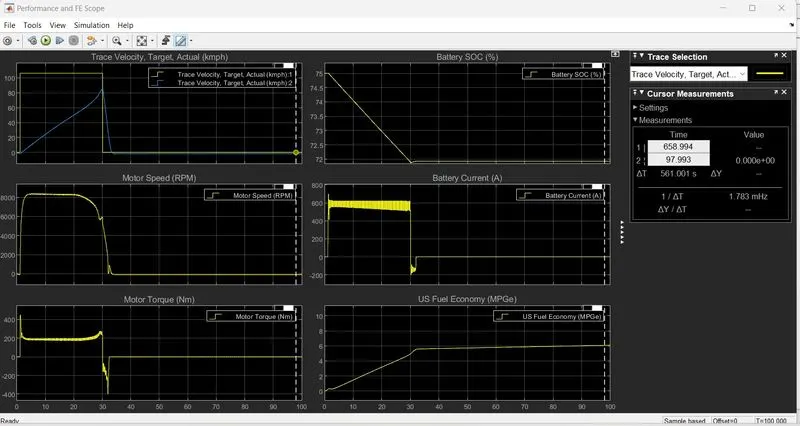
Question 4: Keeping all other parameters same, compare the simulated results of hybrid and pure electric powertrains.
Solution: WOT drive cycle is taken with 10 degree grade angle and 5 mph wind speed
1) Pure EV vehicle
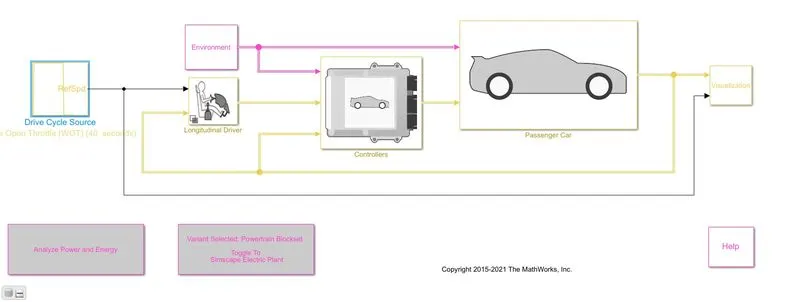
Results obtained with Pure electric vehicle
2) With HEV model
From thr Graphs we can compare following parameters
| Parameters | HEV | EV |
| SOC reduced to | 10 | 3 |
| Current Produced | around 500A | Around 210A |
| Motor Speed | Avg. 6000RPM (Fluctuate between 4000-9000 RPM) | 6000 RPM |
| Motor Torque | Fluctuates and reduced | Gradually Reduced |
| MPG | around 5.5 | 6 |
xxxxxxxxxxxxxxxxxxxxxxxxxxxxxxxxxxxxxxxxxxxxxxxxxxxxxxxxxxxxxxxxxxxxxxxxxxxxxxxxxxxxxxxxxxxxxxxxxxxxxxxxxxxx