Week-4 Challenge WOT Condition Part-2
- What is the difference between mapped and dynamic model of engine, motor and generator? How can you change model type?
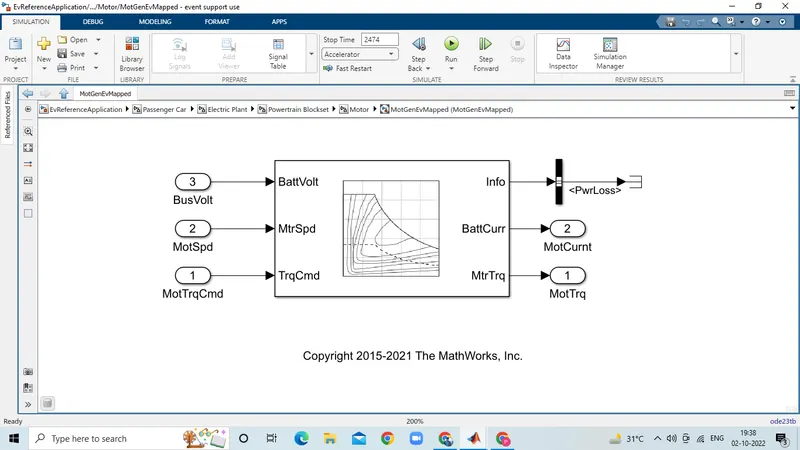
MAPPED models:
Mapped models are used when the behavior of a particular model is not of our interest and can be modeled with predefined values in the form of lookup tables.
- The engine or motor torque required is sensed and the motor or engine block generates the requiered torque output just as required simply without considering the real time motor or engine, parameters
- The output values are stored for the corrresponding given input values of the engine motor and generator.
- The accuracy of this type is not that high but the simulation will be done in much less time as it does not run by real time parameters.
DYNAMIC model:
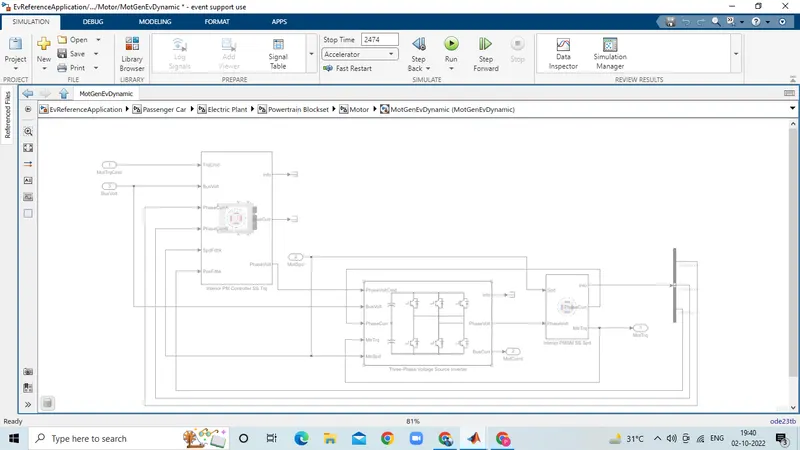
Dynamic models are used when the internal response to a model with respect to its components is needed.
* It runs by real time simulation where the required input from the drive cycle is taken and for that individiual real time simulation gets performed and summing all the results of the subsystem gives the output for the simulation.
* As per the drive cycle requirements the initial Bus voltage ,current is given along with the vehicle feedback so that it runs the actual simulation at that particuclar moment throught the drive cycle.
* The accuracy of this model is very high as it considers the real outputs from all the subsystem to generate the output.
* The simulation will take very long time to complete as it has so many individual simulations running by all the subsystem of the engine , motor/generator.
CHANGING the model type in EV powertrain blocks:
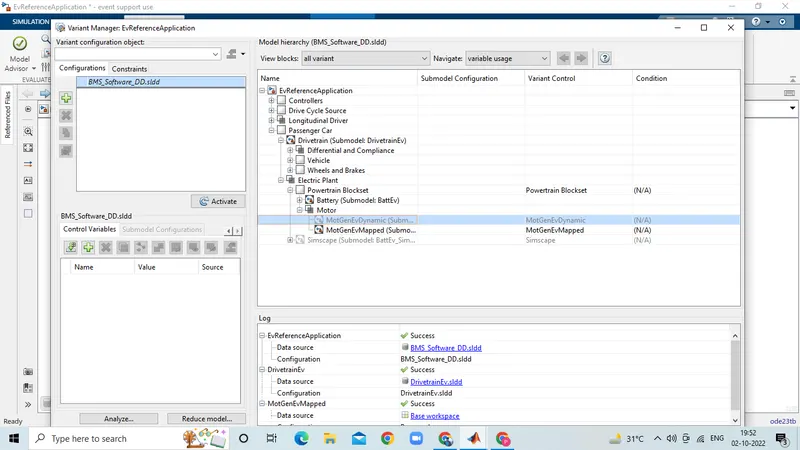
we can use the variant manager in the modeling tab to find the variant systems we have.
right-click on the model you want and use set as Label mode active choice.
2.How does the model calculate miles per gallon? Which factors are considered to model fuel flow?
Miles per gallon
- Miles per Gallon is a fuel economy rating determined by how far a car can travel on a gallon of petrol or Diesel for a Engine powered car.
- In case of an electric vehicle it tells us the energy which is equivalent that of a engine powered carto propel the car through a distance.
- The amount of Fuel Energy required to move a engine powered car through a distance is determined and then it is compared to the eqivalent amount of electric energy required to move the car throgh the same distance and is expressed as the miles per gallon.
- The powertrain blockset has a model that calculates the miles per gallon for all kinds of vehicle.
Vehicle Speed And Fuel Flow:

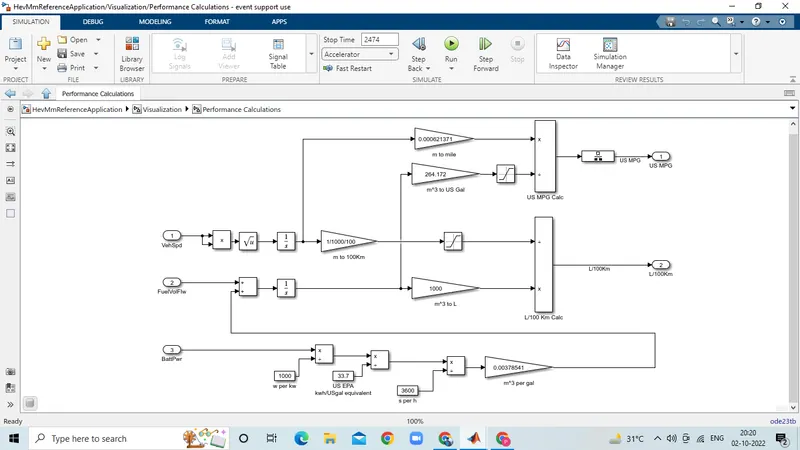
- Then the Fuel flow is expressed as the mass flow rate (i.e) the amount of fuel at each moment in Kg/Sec. Now integrating this will result in the mass of the fuel and by using this 1 we convert it to the volume and by multiply by 1000 to get it in Litres.
- By comparing the two results we can get the amount of litre consumed to Run for 100km.
Battery Power:

- Then we convert the Energy from kWh to equivalent energy in US gallon of automotive gasoline by dividing with 33.7. since we get the energy in US Gallons equal in KWh we are trying to get the energy of equivalent LIS Gallons per seconds and we do this by dividing with 3600 and we convert the hour to seconds.
- Then multiplying with 0.00378541 we convert the US Gallons per sec to the volume of the fuel flow in (mA3/ s) and then we multiply with 739 (California Phase Il Gasoline density) (i.e) mA3/s * kg/mA3 which gives the result as mass flow rate kg's.
- Then finally the Battery energy equivalent in kg/s is given as a input for the fuel flow parameter in order to find the equivalent US Gallons enegy and estimate the Miles per Gallons.
Calculating Miles Per Gallon :

- Then the inputs from the vehicle speed (i.e) the Distance we found (in meters) is taken into the calculation and it is converted to the miles by multiplying with 0.000621371.
- Then the inputs from fuel flow (Battery energy + Fuel energy) taken in mA3 and is converted into equivalent US Gallons by multiplying with 264.172.
- vehicle speed data is used to calculate the distance traveled in meters which is then converted to miles
- Battery power data is used to find power used in kWh which is then converted to gasoline-equivalent using US EPA value by dividing with 33.7
- note: As per the US environmental protection agency(EPA) 1 gallon of gasoline is equal to 33.7 kWh
- Dividing distance traveled in miles by the number of gallons, we can get miles per gallon.
- For HEV this gallon(gasoline-equivalent of battery power) is added with gallon used by IC engine then miles per gallon is calculated.
3.Run the HEV ReferenceApplication with WOT drive cycle. Change the grade and wind velocity in the environment block. Comment on the results.
Open the HEV reference application
Hybrid Electric Vehicle:
- A hybrid electric vehicle (HEV) is a type of hybrid type that combines a conventional Internal combustion engine (ICE) system with an electric propulsion system
- The presence of the electric powertrain is intended to achieve either better fuel economy than a conventional vehicle or better performance.
- Example of HEV is Toyota Prius.
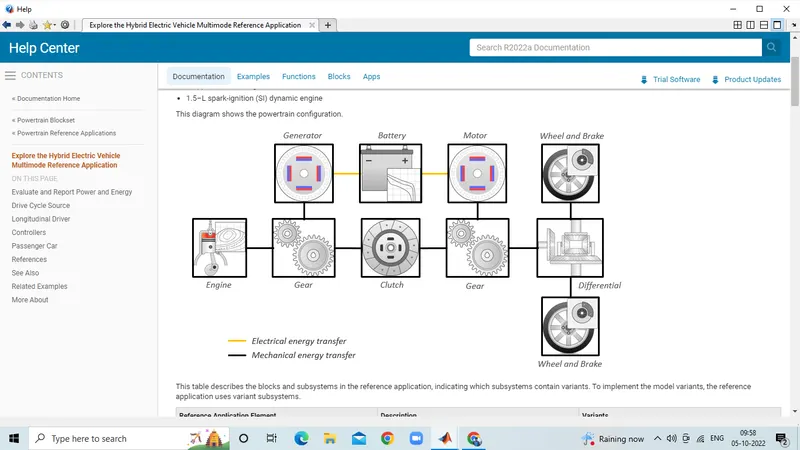
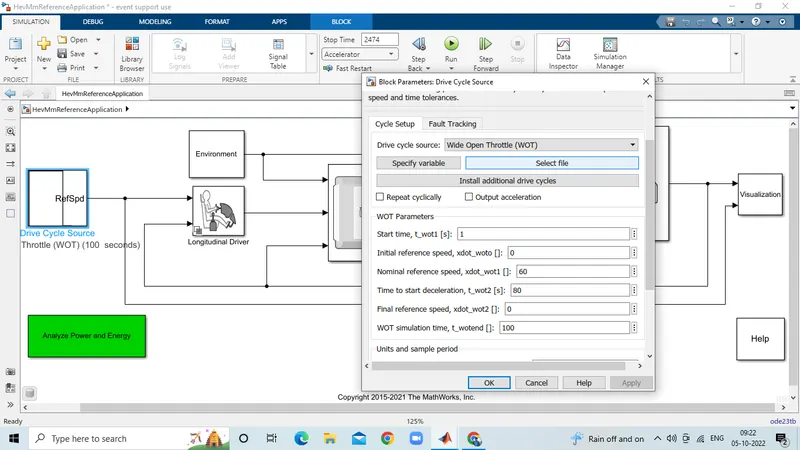
Simulation condition:
The simulation is done for Hybrid electric vehicle with Wide open Throttle Drive cycle.The Total cycle time = 100 seconds
The Top speed of this cycle = 80 mph
Time to start deceleration = 60seconds
The Grade angle = 0 degrees
The wind velocity = 0 m/s
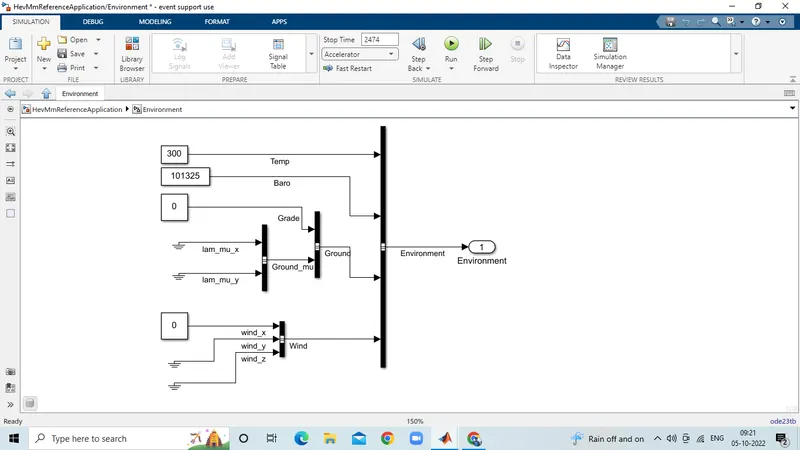
Grade - 0, wind velocity 0m/s
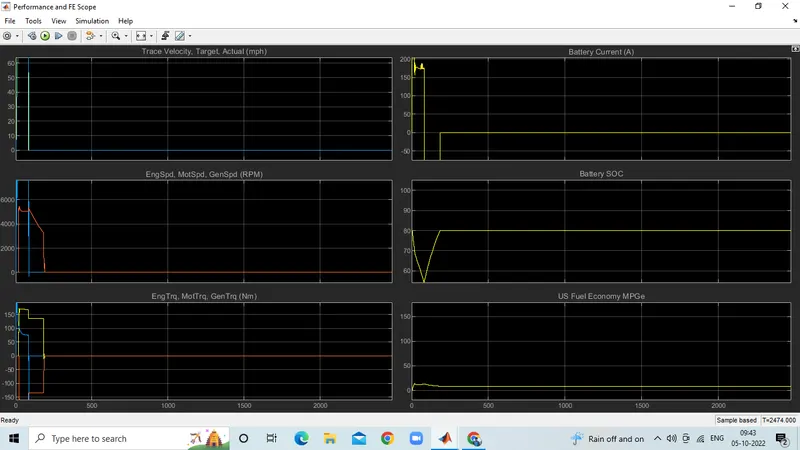
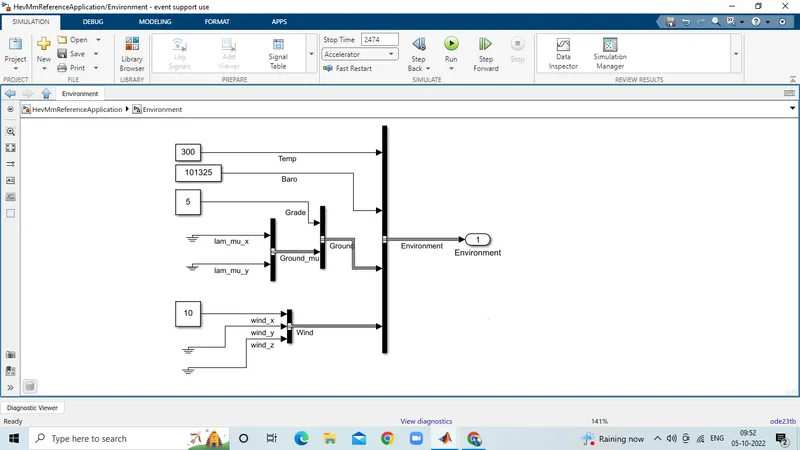
Grade - 5, wind velocity 10m/s
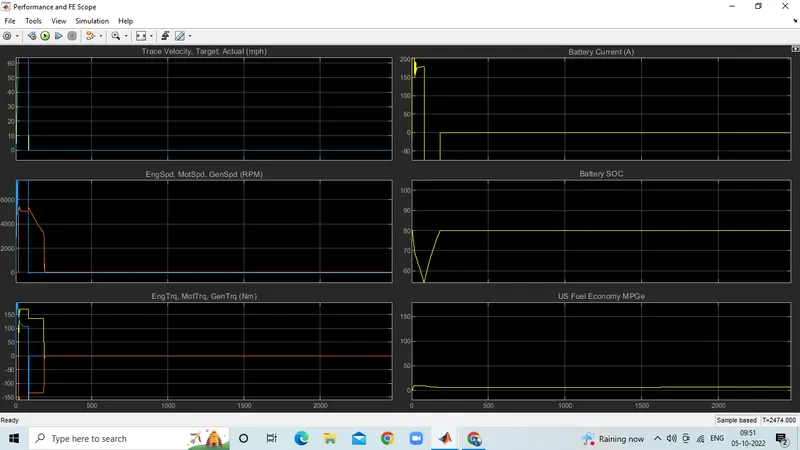
RESULTS:
with the increase in grade and wind velocity,
- peak velocity achieved is reduced as gradient force and aerodynamic force becomes dominant.
- fuel economy is also reduced because the distance traveled is reduced due to external forces.
- deceleration time is reduced so batter recharging capacity is also reduced.
- Battery SOC at the end of WOT acceleration is similar but during deceleration battery is charged more is the grade and wind velocity is less.
4.Keeping all other parameters same, compare the simulated results of hybrid and pure electric powertrains.
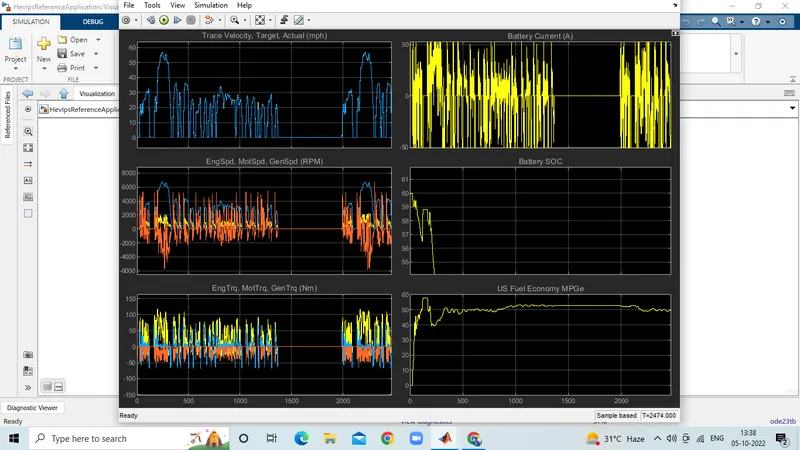
simulation is done for 50 seconds and the 40 seconds WOT drive cycle is used with wot acceleration for 0-30 seconds achieving a max speed of 26.8m/s and decelerates for 10 seconds (30-40).
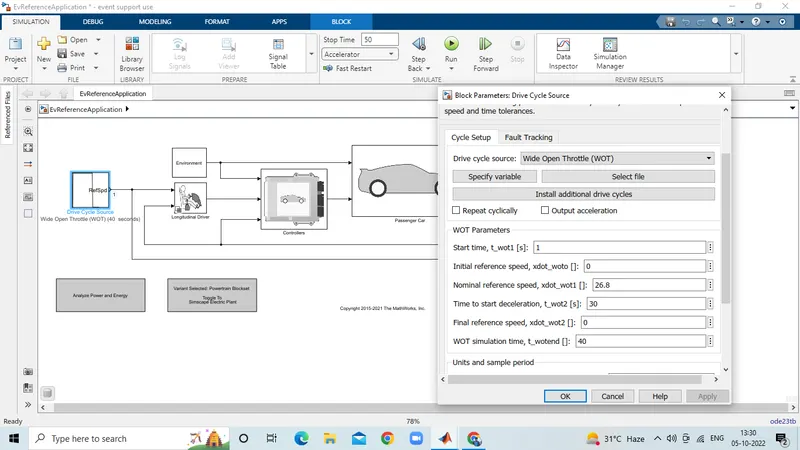
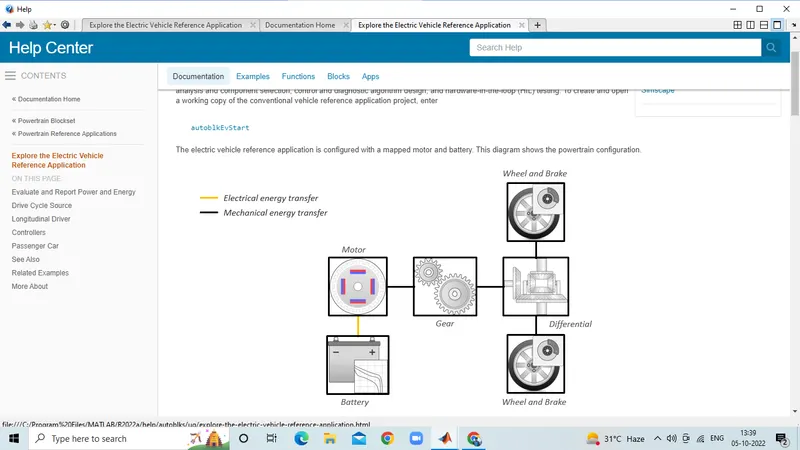
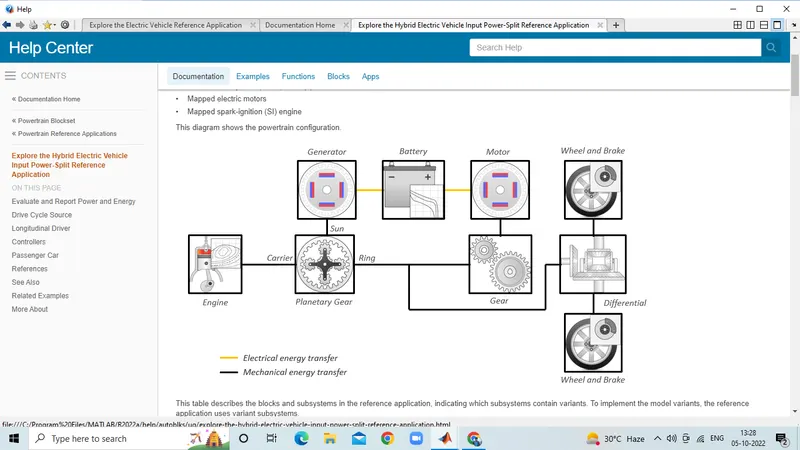
EV model powertrain configuration:
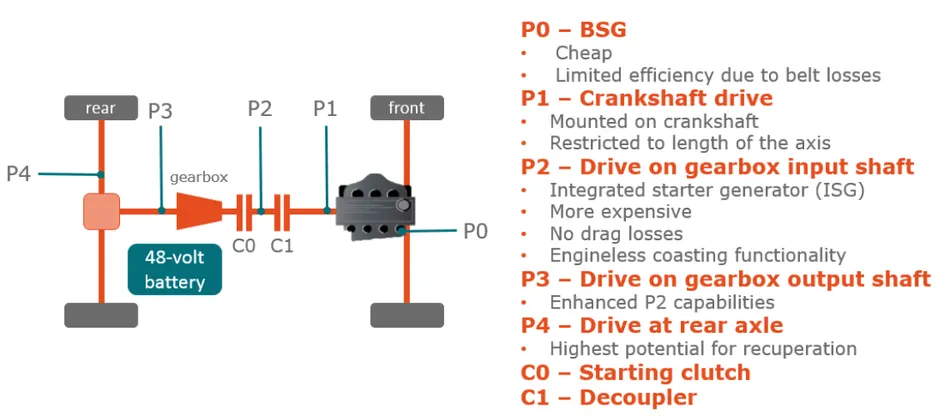
HEV p2 model:
HEV p2 model is chosen because the configuration is similar to our EV model
results
EV
HEV
SUMMARY:
- Time taken to achieve the required peak velocity is less for HEV as compared to EV
- Deceleration time is also low for HEV as it has many moving frictional parts
- fuel economy is more for an EV compared to HEV due to less no of moving parts and thus low frictional losses