Week-4 Challenge WOT Condition Part-2
1-
- Mapped models represent engine by look-up tables such as exhaust temperature, air mass flow, torque, fuel flow, etc. as functions of commanded load and measured engine speed.
- Dynamic models decompose engine behavior into individual component models that account for engine dynamics, most notably intake and turbocharger dynamics.
2-
- Each gallon of fuel has a particular amount of energy
- The energy consumed is the power exerted related to a particular amount of time
- The power comes from the speed/torque of the vehicle needs according to the drive cycle applied.
- From the mathematical model of the speed/torque/acceleration/power, the MPG is also found from a relationship between the distance and energy unit consumed the model can calculate the miles per gallon (MPGs)
The factors that may affect the miles per gallon are:
- The drive cycle
- Speed of the vehicle
- Mass
- Hill inclination
- Air density
- Air velocity
- Coefficient of air drag
- Coefficient of rolling resistance
- The efficiency of the whole powertrain system. etc.
3-
After changing the grade and the air velocity, the load increases on the motor and the engine.
The max speed achieved is less than at no grade and air velocity.
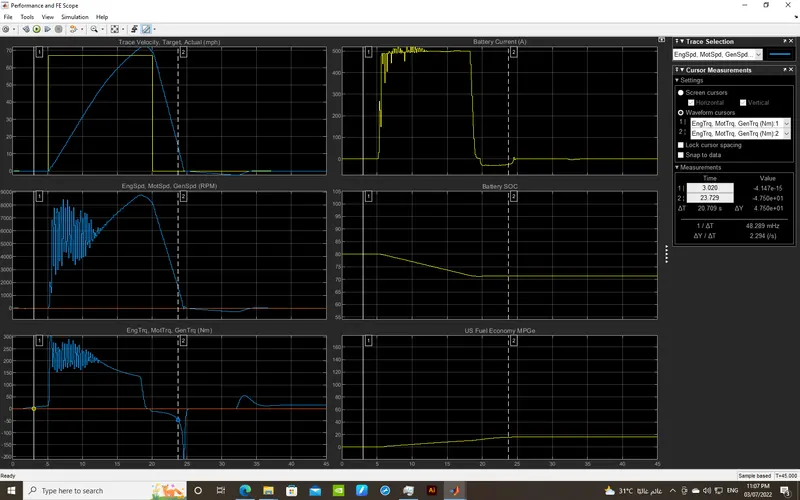
- The previous photo is for no air velocity and zero grade.
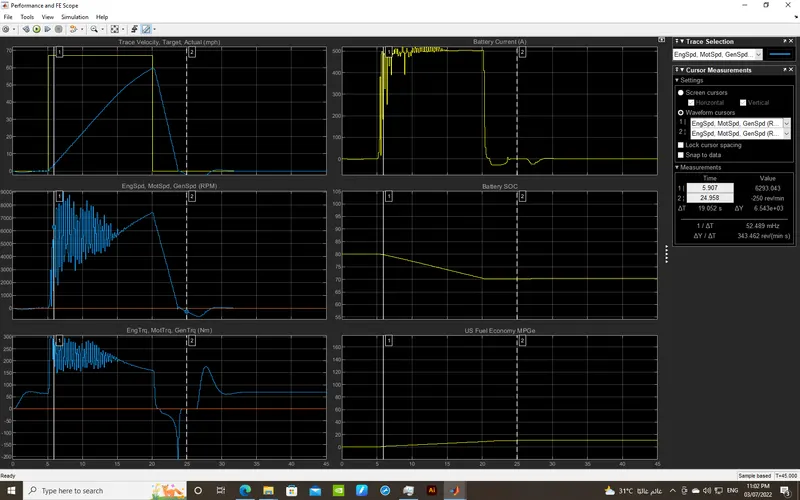
- The previous photo is for 5 deg grade and 5 m/s of air velocity.
- The starting torque for the same load as the last state increased drastically to come over the hill inclination and the air velocity.
- Also, the max speed reached in this period is less than the last state.
- Also the MPG increased for the same distance traveled.
4-
- The previous photo is for HEV it shows the difficulty to control the desired speed because of the overshoot occurred at the max speed
- The MPG is less than The MPG for a pure EV
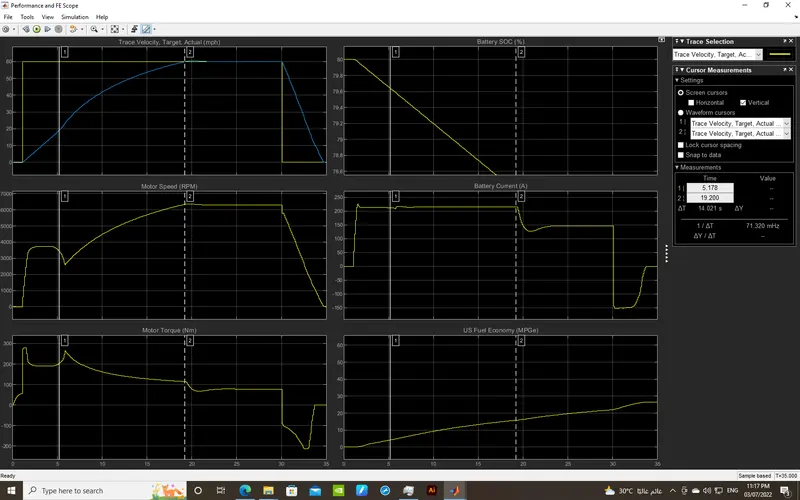
- The MPG in the case of pure EV compared to the HEV is much higher.