Week-4 Challenge WOT Condition Part-2
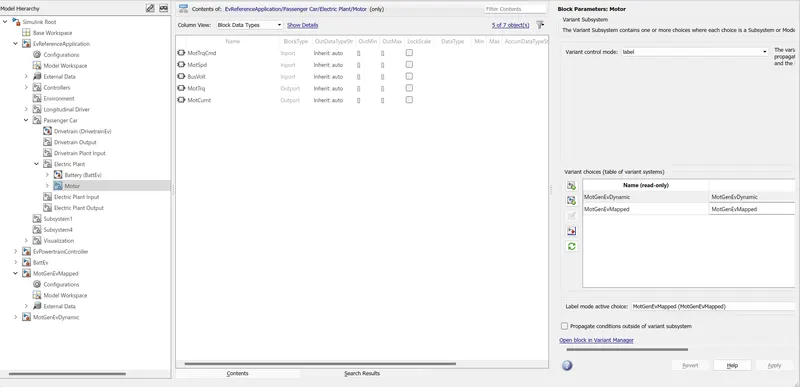
1). What is the difference between mapped and dynamic model of engine, motor and generator? How can you change model type?
Ans:-1 In mapped engine type model the values are given from the lookup table and it can run faster such as brake torque,air flow mass and engie speedand while for dynamic engine model it requires actual component such as designing estimator and algorithms.
ii) Mapped motor values are given from look up table where user doesnot have idea of inputs such as motor speed and battery voltage. For an dynamic engine model user have idea about inputs and have a real time data.
iii) Mapped generator will have diffferent parameter such as speed and torque. In Dynamic three phase source inverter and interior PMSM is used.
To change model type go to model explorer select the model which is to be used.
2). How does the model calculate miles per gallon? Which factors are considered to model fuel flow?
Ans:-2 There is visualisation, there is logic which of performance calculation which calculate the miles per gallon.
In this, the output of the battery is converted into W by dividing kw/1000 after that to convert it into MPGe divide it by 33.7 and finally by 3600 converting into Ws and output of this is multiply with gain factor 0.00378541 which will give m^3 per gallon. Now the values are added and integrate it to get power at every second. Take vehicle speed into the consideration first we square it and then square root it nd then use integrator block to achieve instantenous speed. The output of the vehicle speed is multiplied with gain factor 0.000621371 and output of fuel volume is divided by 264.172 this converts m^3 to gallons. In this way miles per gallons is calculated
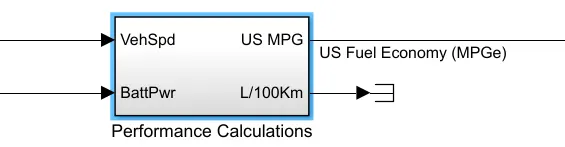
Factors considered:
1) Vehicle speed
2) battery power
3) Enviroment
4) Hilll climbing
3) Run the HEV ReferenceApplication with WOT drive cycle. Change the grade and wind velocity in the environment block. Comment on the results.
Ans:-3
Result:
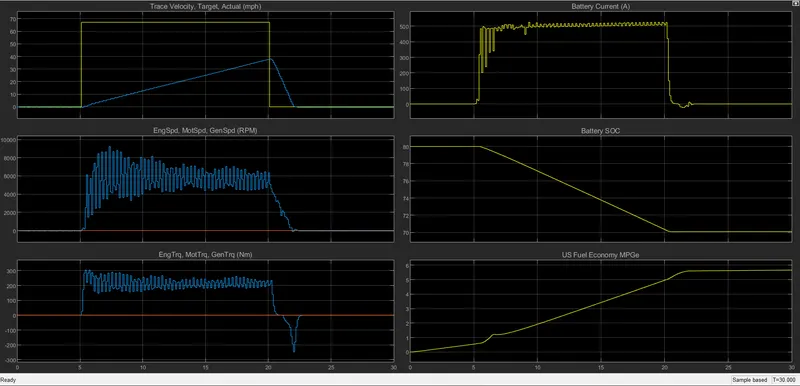
i) Gradeablity= 8
Wind = 3
As we can see from graph, Power demand is high so both engine and battery are functioning. The motor rpm increases to about 9200rpm within 7 sec and engine started at 6 sec due to high power demand. Battery SOC drops 9.7% at 20 sec and during that period engine is runing with RPM between 3500 to 5700 RPM. During that duration battery current increases to about 500 A. While SOC is depleting fuel economy is 4.4 MPGe which increases because engine is taking over during high power demand.
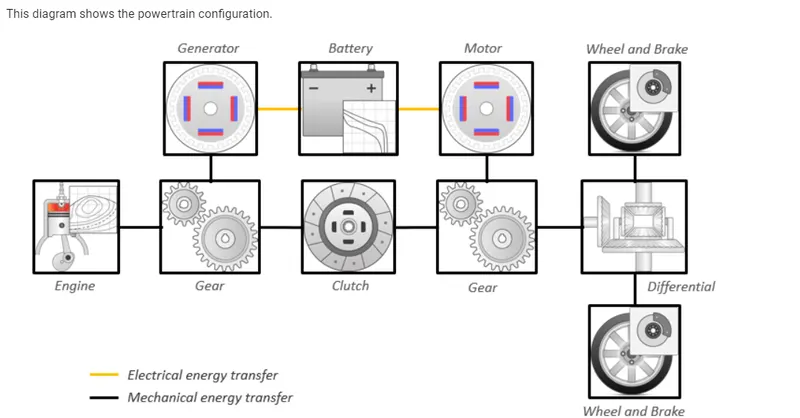
4) Keeping all other parameters same, compare the simulated results of hybrid and pure electric powertrains.
Ans:-4
Result :
Greadability=10
Wind=14
From the above graph, with the decrease in velocity from 60 mph to 0 mph in from 30 to 35 sec so when the vehicle is deccelarating and target valocity and trace velocity goes to zero so in this mode the SOC is changed slightly 0.16% while the torque also decreases for 2 sec and after that it increases and settle down to 0 Nm. At starting battery current is limited to 220 and then when deccelaration the ampere goes down to -120 and then settles to zero. It goes into regenerative mode. For motor rpm the rpm increases to 3500 for nearly 22 sec and after that goes to zero. For miles per gallon increases when soc state decreases and in this scenario engine takes over.
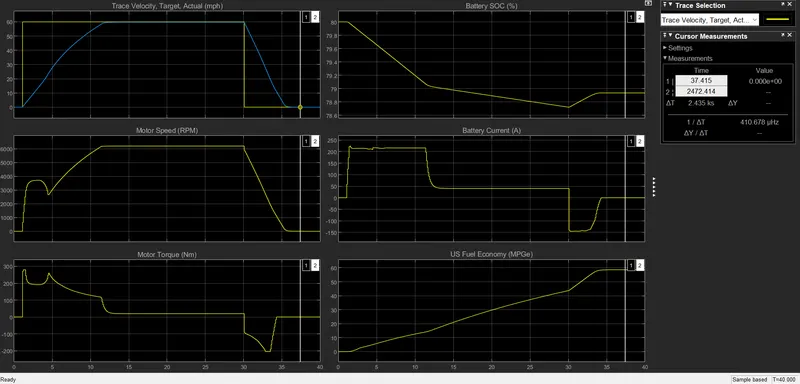
Comparison:-
1) The trace velocity graph is different as the value of gradeability and wind velocity are different
2) In HEV Motor rpm is increased at 5 sec and in EV it increases instantly.
3) The battery current in HEV is high as compared to EV as high power demand
4) In HEV battery soc is decreases when it run on engine and after that maintains at 70% but with EV battery goes to 79.8 due to regenerative braking and increases after that.
5) in EV fuel economy is nearly 60 mpg while in HEV it is nearly to 5.5. So fuel economy is better in EV than in HEV.
Conclusion
Observed the Powertrain blockset and simulated with result