Week-4 Challenge WOT Condition Part-2
Aim : What is the difference between mapped and dynamic model of engine, motor and generator? How can you change model type?
Answer :
Mapped Model:
The mapped model uses preassigned data only in lookup tables means it runs on the data which is predefined for the model and has not real-time considerations. As it runs without considering the real-time parameters, it takes less time for simulation. But the output is not as accurate as of the dynamic model. This type of model is suitable when we do not know the input values on our own. And the outputs we get correspond to given predefined input values. In the case of the engine, Mapped engines represent macro engine behavior as a set of lookup tables (brake torque, fuel flow, air mass flow, exhaust temperature, efficiency, and emissions) as functions of commanded load and measured engine speed.
Dynamic Model:
The dynamic models generate the final output by combining the output of various subsystems which is fed as an input in real-time for the simulations. The new input values for the simulation changes according to the feedback of the systems from the previous results. The simulation in the dynamic model takes a longer time than the mapped one cause there are many individual simulations that occur at the same time for different data. But the accuracy of these type of models are high as it considers the real-time output of subsystems like engine, motor & generators for the final output of the system.
For Ex, in the case of the engine, Dynamic engines decompose engine behavior into individual component models that account for engine dynamics, most notably intake airflow and turbocharger dynamics
To change the Model type:
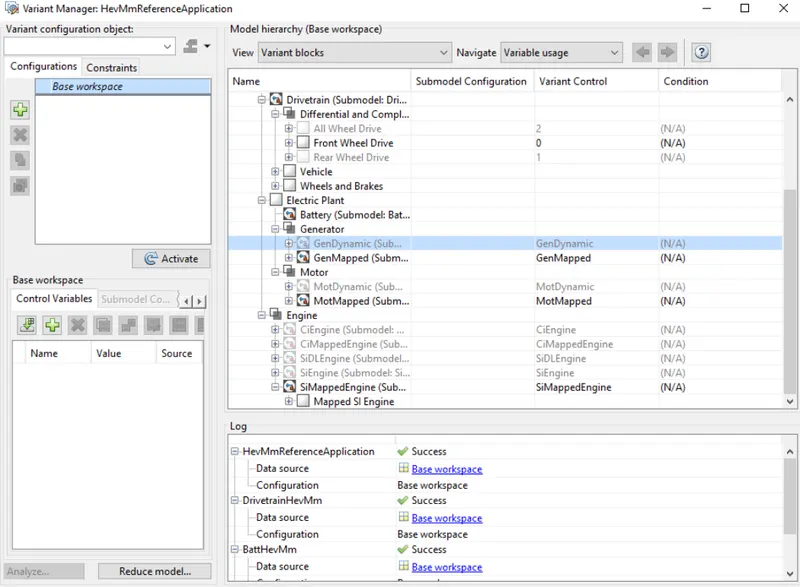
There are Many Submodels we can see.
Base workspace
Now, in the passenger car, there are submodels called Electric Plat & Engine. In the Electric plant, there are Generator & Motor submodels from which we can change from the mapped model to a dynamic.
As the default setting is the Mapped model. Just right click and click on "Set as Label Mode Active Choice" to change from the Mapped model to a Dynamic Model & vice-versa. The same method is for Engine Model also.
Aim: 2 How does the model calculate miles per gallon? Which factors are considered to model fuel flow?
MPG stands for miles per gallon. It is used to give you an indication of the fuel economy of a car or commercial vehicle i.e. it is used to show how far your car is able to travel for every gallon (or 4.55 liters) of fuel it uses. To calculate the fuel flow, vehicle speed & battery power are taken into consideration. HEV model has separate blocks to calculate the miles per gallon which are shown below
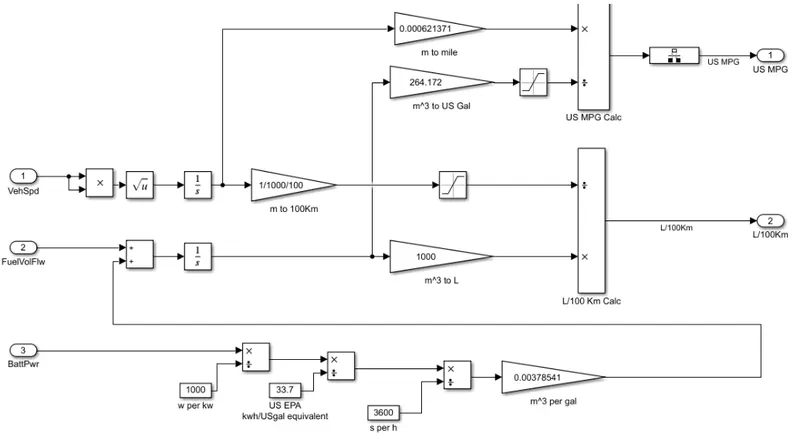
The above MPG calculations are for HEV which means it contains both fuel & battery energy.
First, we get battery power in watt which is converted in kWatt & further convert into energy in kWh.
Then it is converted into US gallon equivalent energy by dividing it by standard value 33.7. Then it is converted into US gallon per second.
It is multiplied by standard value 0.00378541 to get the volume in m² per gallon & it is added to fuel flow for total value as it is an HEV.
Further m¹ is converted into US gallon.
On the other hand, the speed of the vehicle is integrated to get distance and the distance which is in the meter is converted into miles by multiplying the standard value 0.000621371.
And finally MPG is calculated by dividing the US gallon by miles.