Week-4 Challenge WOT Condition Part-2
Simulation of Wide Open Throttle (WOT) in HEV and EV using Simulink
AIM
Understanding Powertrain Blockset in MATLAB
Objectives:
- To give difference between mapped and dynamic model of engine,motor and generator and also how to change model type.
- How does the model calculates miles per galon and what factors are considered to model fuel flow.
- Run HEV refrence model and change the grade and wind velocity parameter and comment the result.
- With same parameters compare HEV and pure EV model and comment on the result.
Power Train Blockset:
Powertrain Blockset provides fully assembled reference application models of automotivepowertrains, including gasoline, diesel, hybrid, and electric systems. It includes a component library for simulating engine subsystems, transmission assemblies, traction motors, battery packs, and controller models. Powertrain Blockset also includes a dynamometer model for virtual testing. MDF file support provides a standards-based interface to calibration tools for data import.Powertrain Blockset provides a standard model architecture that can be reused throughout the development process. You can use it for design tradeoff analysis and component sizing, control parameter optimization, and hardware-in-the-loop testing. You can customize models by parameterizing components in a reference application with your own data or by replacing a subsystem with your own model.
Key features:
• Fully assembled models for gasoline, diesel, hybrid, and electric powertrains
• Libraries of engine, transmission, traction motor, and battery components
• Basic controllers for powertrain subsystems
• Standard drive cycle data, including FTP75, NEDC, and JC08
• Engine dynamometer model for virtual calibration and testing
• MDF file support for calibration data import
Objective 1:
What is the difference between mapped and dynamic model of engine, motor and generator? How can you change model type?
| model components | Mapped model | Dynamic model |
| Engine | Mapped engine models are suitable for analysis and design activities that do not require engine subsystem dynamic characteristics, for example, in engine and transmission powertrain matching analysis for fuel economy, emissions, and performance tradeoffs. | Dynamic engine models are suitable for designing control, estimator, and diagnostic algorithms that depend on dynamic subsystem states, for example, in closed-loop AFR control algorithm development. |
| Motor | The Mapped Motor block implements a mapped motor and drive electronics operating in torque-control mode. The output torque tracks the torque reference demand and includes a motor-response and drive-response time constant. Use the block for fast system-level simulations when you do not know detailed motor parameters, for example, for motor power and torque tradeoff studies. The block assumes that the speed fluctuations due to mechanical load do not affect the motor torque tracking. | The dynamic motor model use real time or instantneous values of the motor power and torque values by the running behaviour of the motor speed. |
| Generator | The mapped generator blockset take lookup table power values from engine and saturate that values as for giving output to motors or charge the battery capacity. | The dynamic generator blockset take instantaneous power output values from the engine and gives to the transmission or it use that power to charge the battery. |
Steps to change the model type:
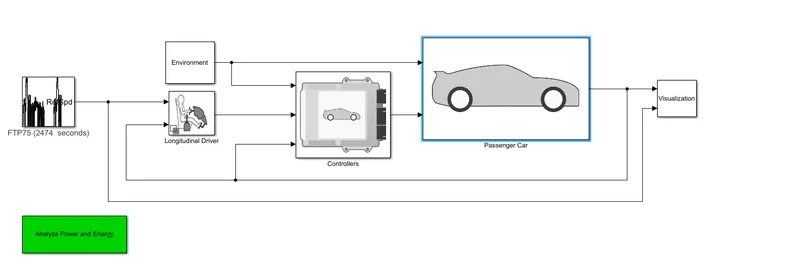
- Open the Explore the EV refrence application from getting started to powertrain blockset link, you will see EV model which contains environment block,controller block,passenger block,FTP75 block,etc.
- Open the passenger block by double click,after opening you will see many different blocks such as electric plant block,drivetrain block,electric input block,etc.
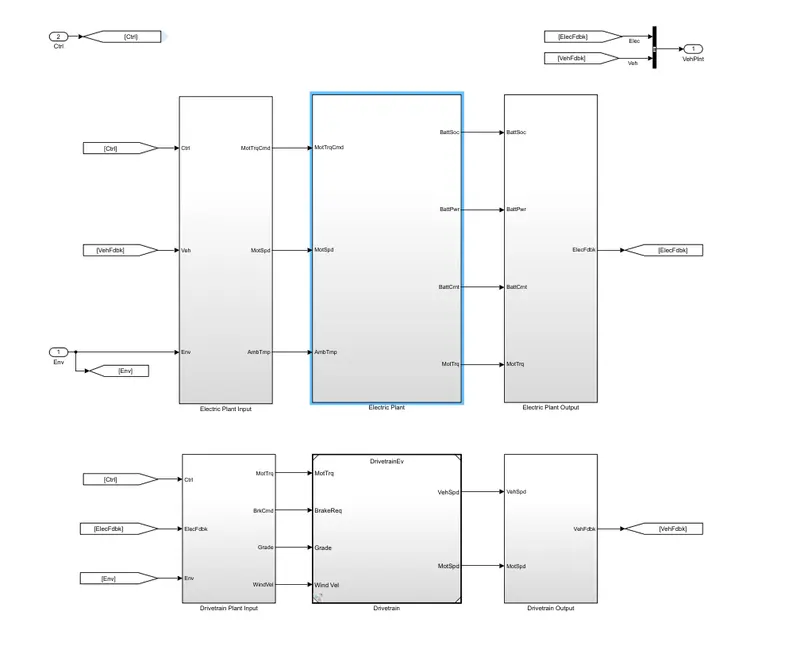
- Open the electric plant block then you will have different blocks again of motor and battery.
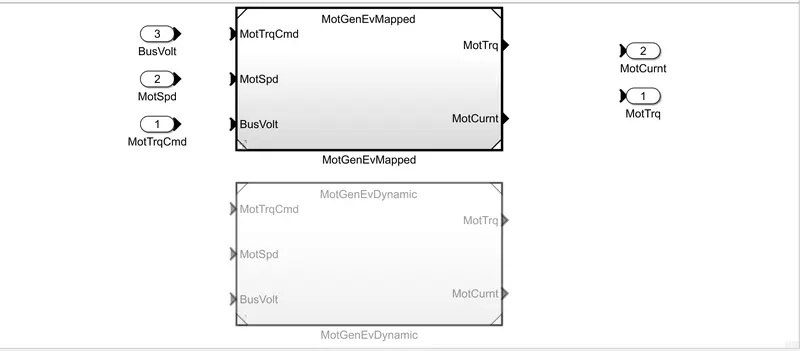
- Open the motgenEVmapped block you will see there are two block available which are motgenEVmapped and motgenEVdynamic in which mapped model is bydefaul selected as variant.
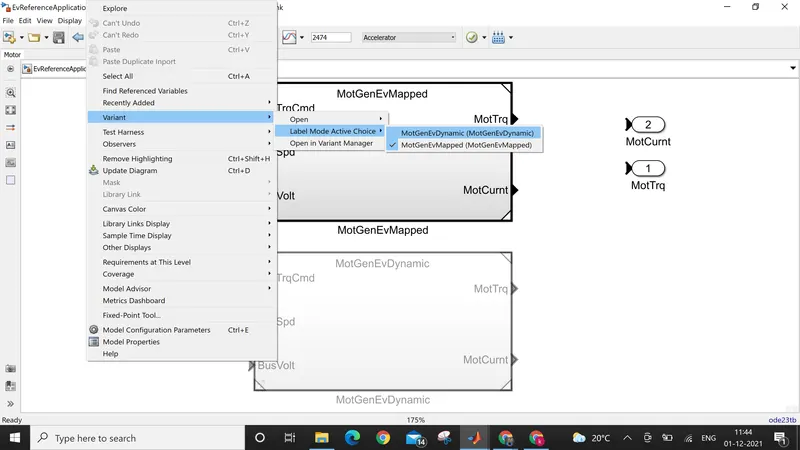
- For changing variant right click on screen slelect the varaiants option from the list of options available in that you will get another options select to label mode active choice there you can change from mapped model to dynamic model.
Steps:
1-Passenger car
2. electric plant
3. 2 options to select
4. select any one required
Objective 2: How does the model calculate miles per gallon? Which factors are considered to model fuel flow?
Miles per gallon (MPG) is a fuel economy rating determined by how far a car can travel on a gallon of gasoline or diesel. Although the metric version would be kilometres per litre, MPG is adopted in many metric-system countries
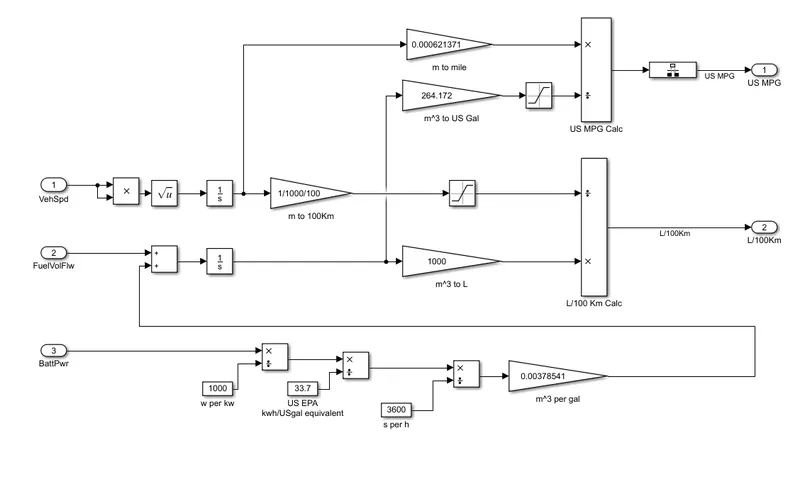
BLOCK DIAGRAM :-
MODEL CALCULATION :-
- The battery power is taken in watt (W) and then divided by 1000 to convert into KW.
- Then the power in KW is divided by 33.7 (KWh/US gal).
- The (US gal/h) value is converted in to (US gal/sec) by being divided by 3600.
- The value is multiplied by 0.00378541 to convert into (m^3/sec).
- The value is taken and added with the fuel volume flow and then integrated so that we obtain it in (m^3).
- Besides that, the vehicle speed is taken and then squared then square root is taken in order to remove the negative values then integrated to obtain speed in (m).
- The (m) value is taken and then divided by the (m^3) value to obtain speed in Miles Per Gallon (MPG).
FACTORS CONSIDERED IN FUEL FLOW :-
- Rapid Acceleration
- Braking
- Weight
- Environment Weather Conditions
- vehicle speed and battery power are the main factors taken into consideration for model fuel form.
Objective 3:
Run the HEV ReferenceApplication with WOT drive cycle. Change the grade and wind velocity in the environment block. Comment on the results
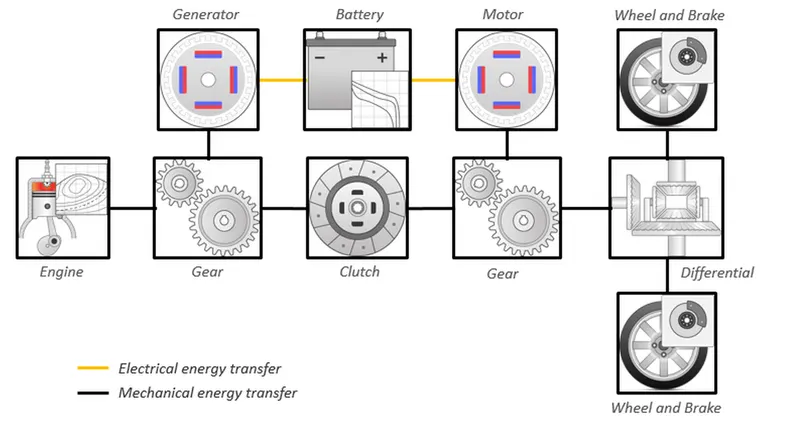
components in Hybrid Electric Vehicle (HEV) powertrain are as follows,
- Engine
- Gearbox
- Generator
- Battery
- Motor
- Differential
- Wheel and Brake
HEV Powertrain Configuration :-
Simulink Model :
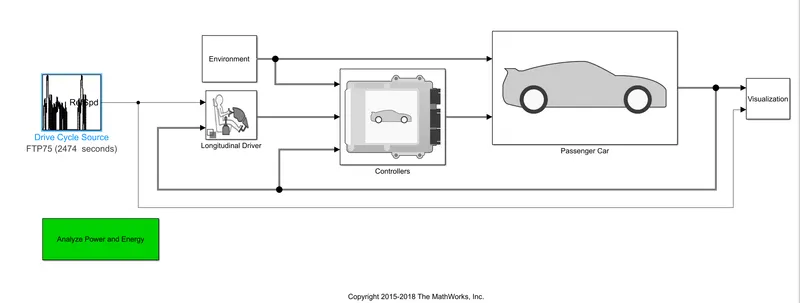
Explanation of HEV refrence model:
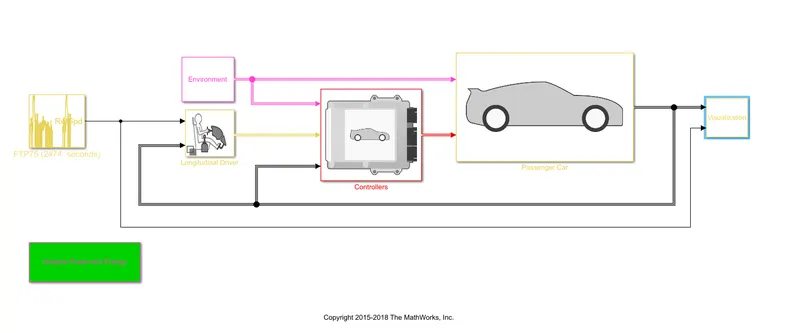
- In this model there are several blocks such as contollers,environment,passenger car block,longitudinal driver block and FTP75 block.
- Controller block consist of Power Control Module(PCM) which is master controller of the vehicle, it contains Engine Control Module(ECM) and Hybrid Control Module(HCM) which will control motor and battery management system,it will control the power supply as combination of series and parallel or series alone or parallel alone.
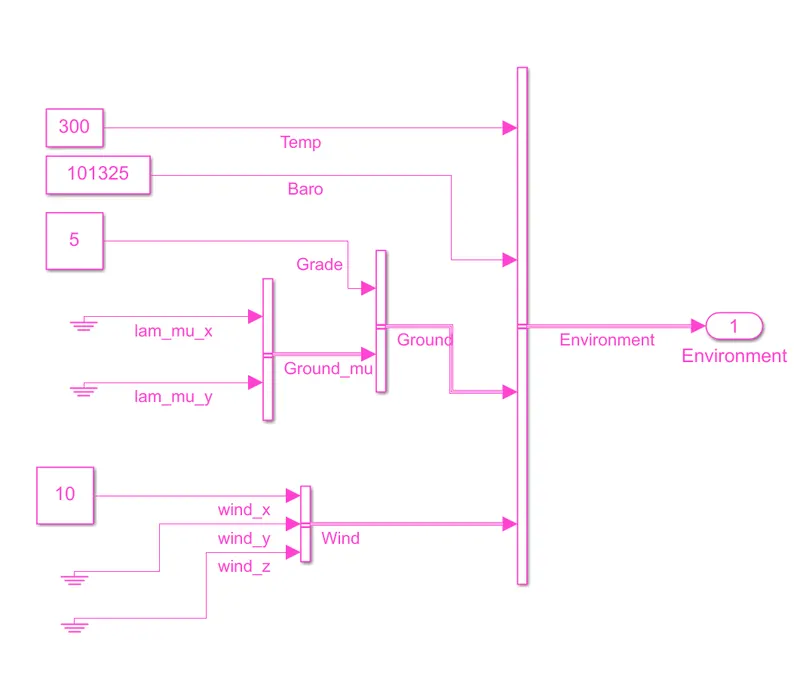
- Environment block gives the physical environment conditions (wind velocity,grade value, temprature and pressure) which will be acting on the vehicle while in motion.
- Passenger car block consist of vrious sub blocks which are engine block, engine plant block, drivetrain block.Its whole like an actual transmission block.Engine blocks will be containing mapped and dynamic models as per the driving condition.Engine plant block contains sub blocks of battery, generator and motor blocks which will control the behaviour of battery,generator and motor respectively.
- Longitudinal driver block conatin all the drvier related parameters which he will be supplying throttle gear change,braking motion all are controlled in it.
- FTP75 block is predifined drive cycle block which gives the drive cycle as per the default values given to it.We can change this blocks wit our own input values of speed variations as per the road conditions.
- Analyze Power and Energy blocks used there is so that we can solve the whole parametsers in parameters and can get outpurt in a tabular form.We can get run summary,electric plant summary drivetrain summary,overall summary.
For WOT drive cycle:
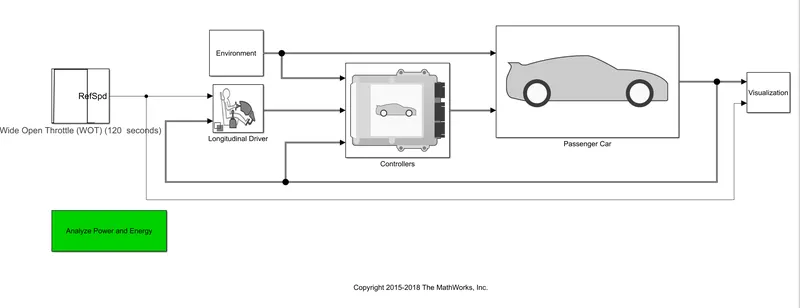
Output: For WOT drive cycle
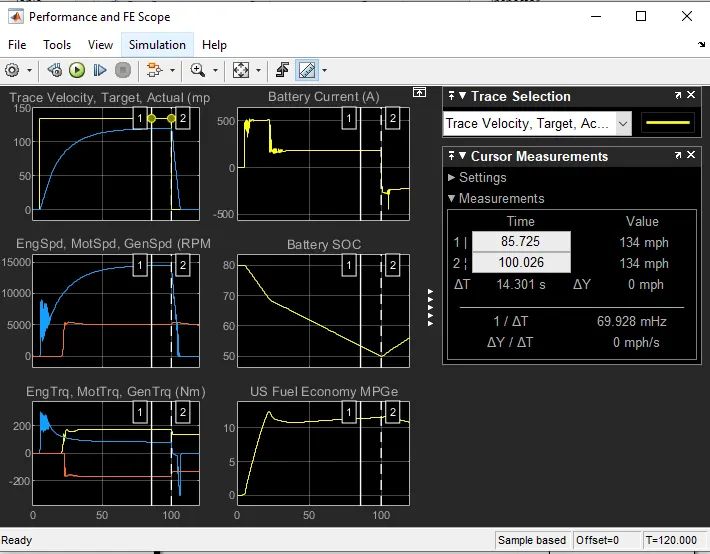
- Here in first velocity trace plot we can observe that velocity is increaisng slowly and it attains the linearity at 14 sec of time with 115mph.If we compare velocity trace and battery SOC we can observe that with increasing speed in 17 sec of time the battery SOC is been reduced to 14% and after increasing speed till it attained the linearity battery SOC decreased to 18% in 77 sec of time after when speed started to deaccelerate at 100 sec battery SOC increased with 6% in 19 sec of time.
- Battery current was utilized 31% in just 16 sec of time.
- Second plot is Engine,Motor and generator speed and 3 plot is RPM of engine,motor and generator.
For grade =5 ,wind =10
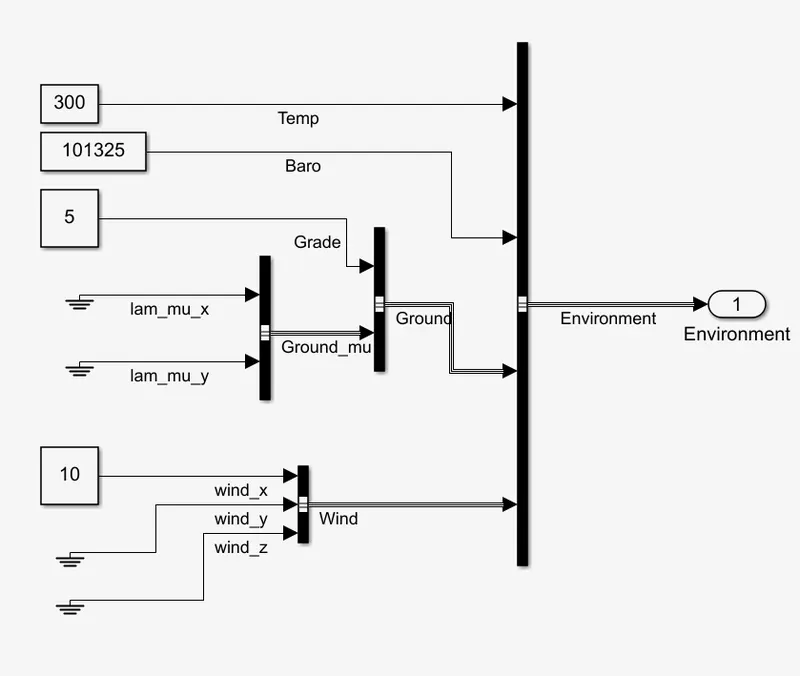
Output:
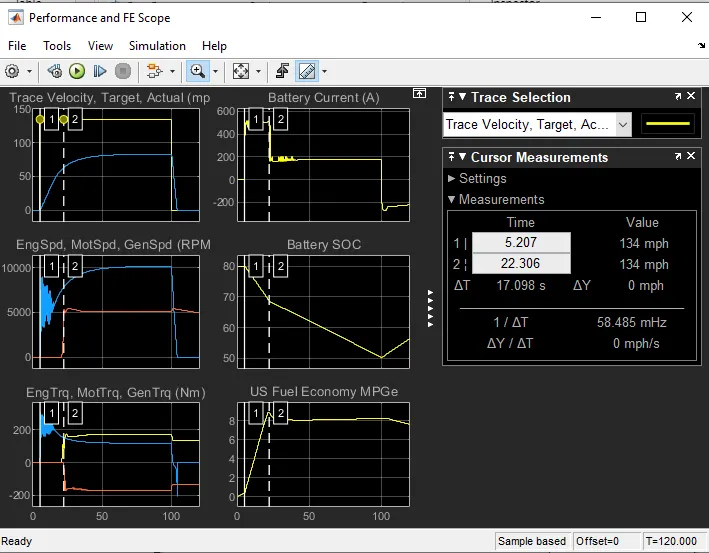
- In WOT if the grade value and wind values is changed there is chnage in velocity trace the linearity attained is 82mph of top speed is attained at 32 sec of time till 32 sec speed is been increasing slowly.
- Remaining battery SOC and current values is same.
Objective 4:
Keeping all other parameters same, compare the simulated results of hybrid and pure electric powertrains.
The components in Hybrid Electric Vehicle (HEV) powertrain are as follows,
- Gearbox
- Battery
- Motor
- Differential
- Wheel and Brake
EV Powertrain Configuration :
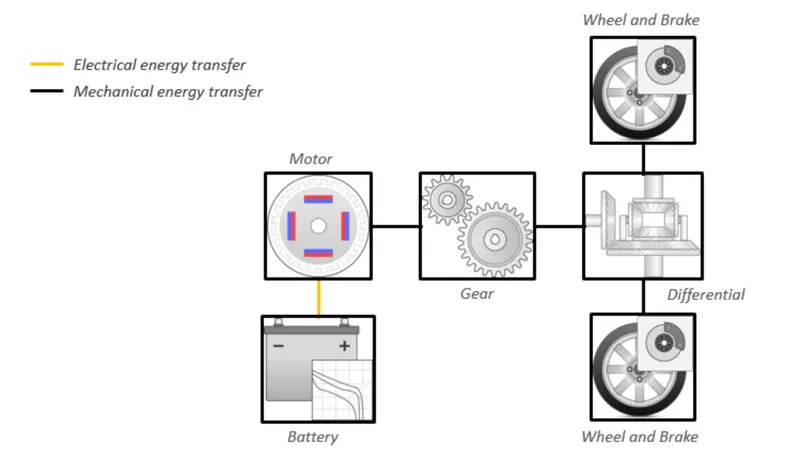
EV refrence application:
Environment Block,
Simulation Output,
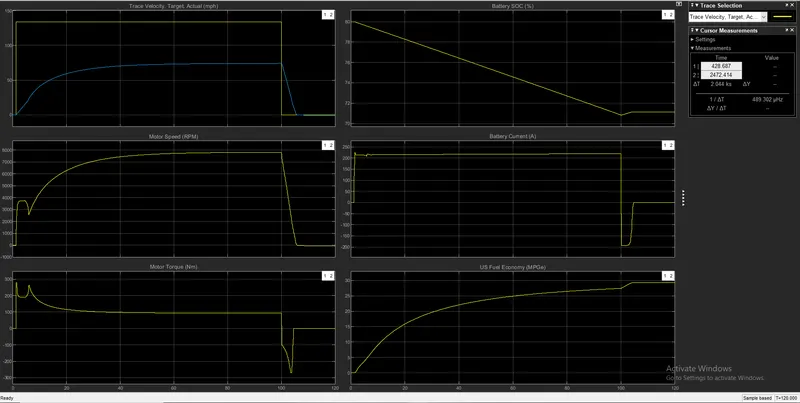
- If we compare velocity trace plot of EV refrence to HEV refrence for attending maximum velocity EV vehicle takes more time as compared to HEV vehicle.
- EV vehicle consumes about 60% of battery SOC more than HEV vehicle.
- EV vehicle consumes 30-40% more current than HEV vehicle.
- Miles per gallon of EV is 26% and HEV it was 10%.
- Motor Torque is almost same in both the Refrences.
Conclusion:
- Explained difference between mapped and dynamic model of Engine,Motor and Generator.
- Explained how model calculated Miles per gallon value and factors considerd for model fuel flow.
- Ploted the results HEV refrence for with WOT,Grade and Wind value.
- Compared the simulation result of EV and HEV vehicle.