Week-4 Challenge WOT Condition Part-2
Aim:
- What is the difference between mapped and dynamic model of engine, motor and generator? How can you change model type?
- How does the model calculate miles per gallon? Which factors are considered to model fuel flow?
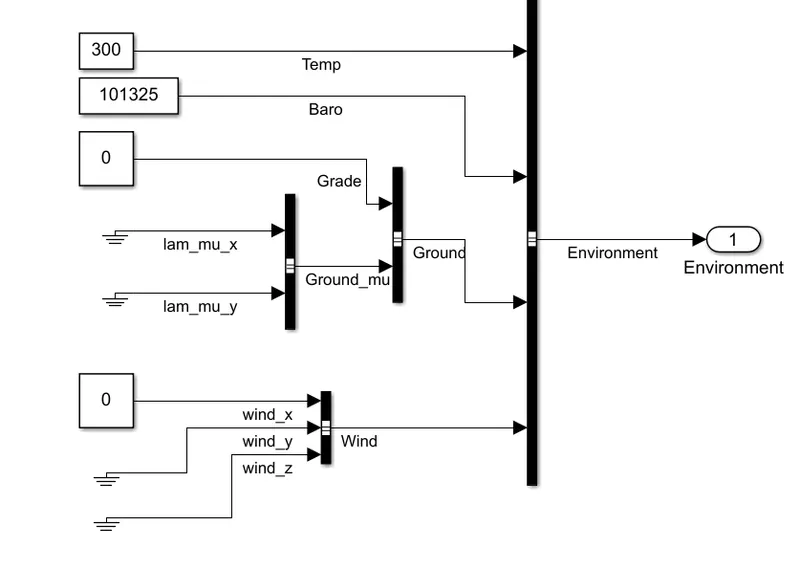
- Run the HEV Reference Application with WOT drive cycle. Change the grade and wind velocity in the environment block. Comment on the results.
- Keeping all other parameters same, compare the simulated results of hybrid and pure electric powertrains.
Objective 1:
- What is the difference between mapped and dynamic model of engine, motor and generator? How can you change model type?
Answer:
Mapped:
Here we get the simulation done from data available from look up tables, these model's behaviours are based on lookup tables. For the given input conditions the corresponding values are taken into account. This gives faster results.
1.Here Engine or Motor both get their desired output without considering the real time parameters.
2.Low accurate
Dynamic:
Here we get the simulation done from data we get from different parts, these models behave based on the components, Dynamic engine models are suitable for designing control, estimator, and diagnostic algorithms.
1.Here Dynamic model uses the output from various blocks to simulate desired output.
2.Highly accurate.
Changing Model type:
Open the model where you want to change the model,
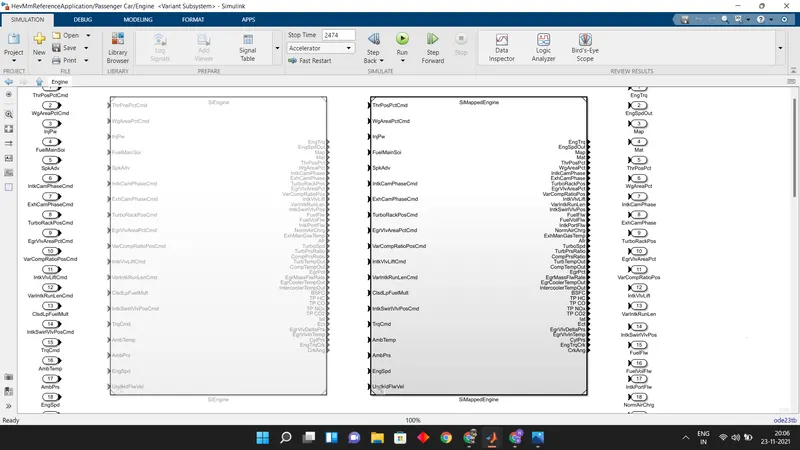
Now in modelling tab search for variant manager & open it,
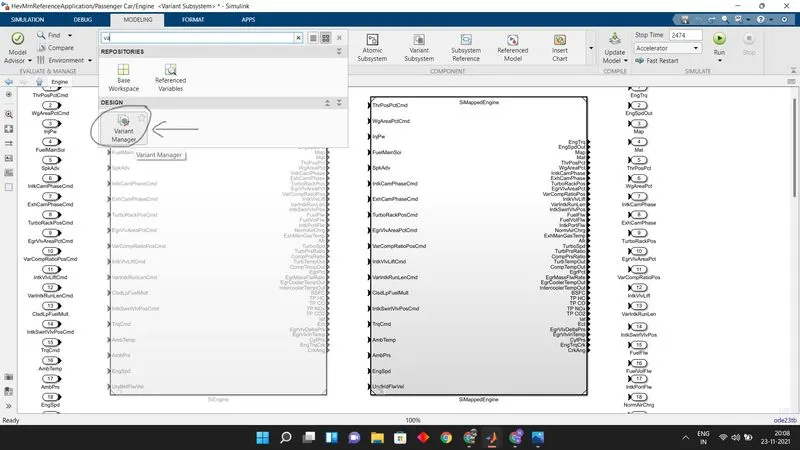
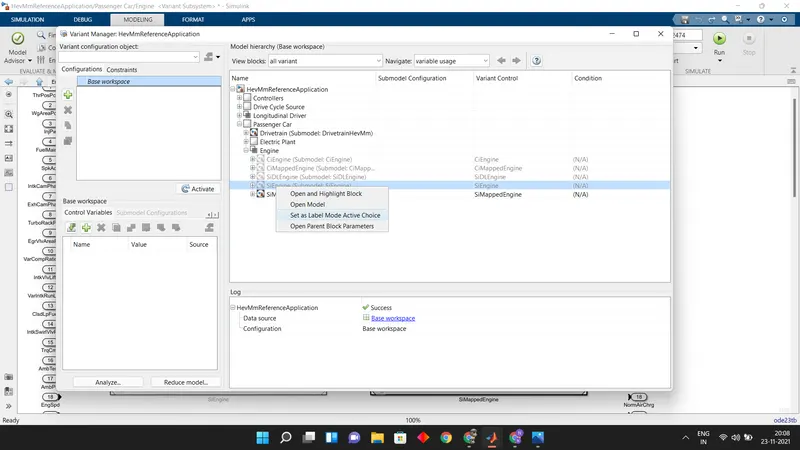
Select the model to which you want to change into and then select set as label mode active choice
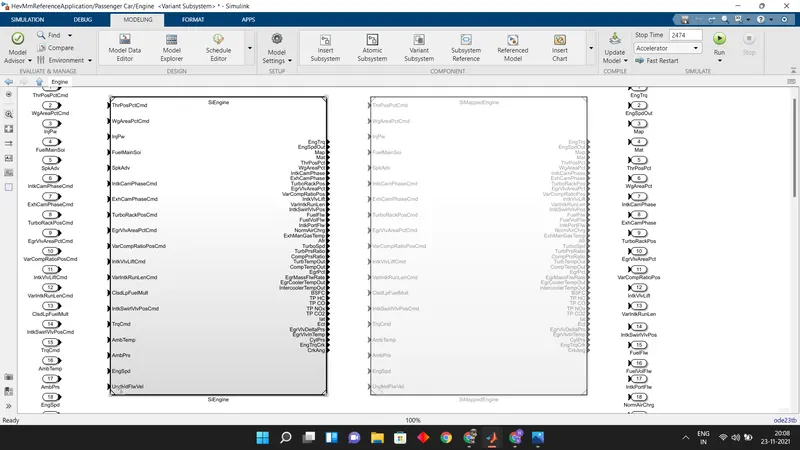
The model has been chnaged.
Objective 2:
- How does the model calculate miles per gallon? Which factors are considered to model fuel flow?
Answer:
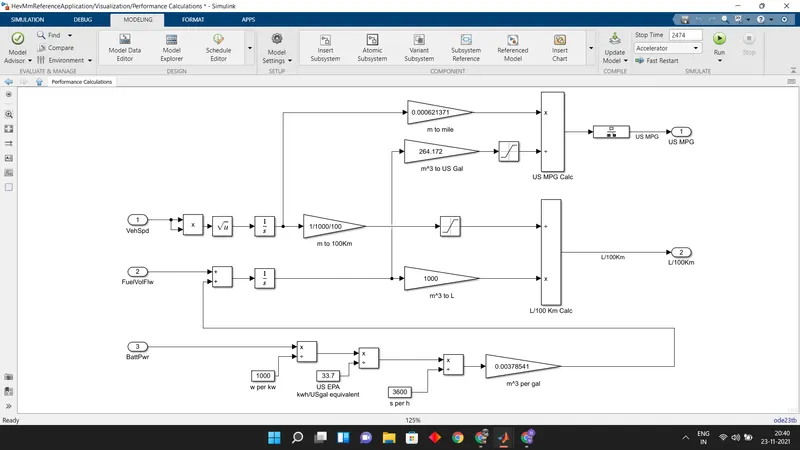
Here there are three factors to be considered,
1.Vehicle speed:
Based on vehicle speed the fuel consumption changes, it's in unit's m/s, integrating this block gives us distance, and then distance from meters converted into 100km or miles by multiplying 0.000621371.
2.Fuel Flowrate:
Flow rate units m^3/s, when integrated this gets converted into m^3, now it is converted into both galloons by multiplying with 264.17 and converted into liters by multiplying with 1000
3.Battery Power:
Battery power is in watts it is converted into fuel equivalent and then added with fuel flow block, watts are converted into kilowatts by dividing by 1000, then by dividing previous result with 33.7 and then divided with 3600 to get value in m^3, Later this value is changed into gal by multiplying with 0.00378541.
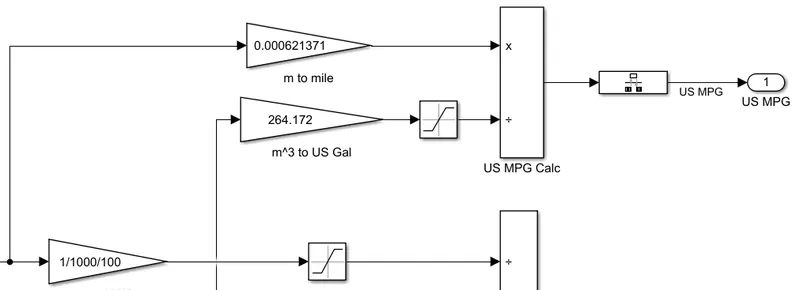
Calculation for miles per galloon = Distance covered in miles / Fuel consumed in galloons with is shown in below block diagram.
Objective 3:
- Run the HEV Reference Application with WOT drive cycle. Change the grade and wind velocity in the environment block. Comment on the results.
Answer:
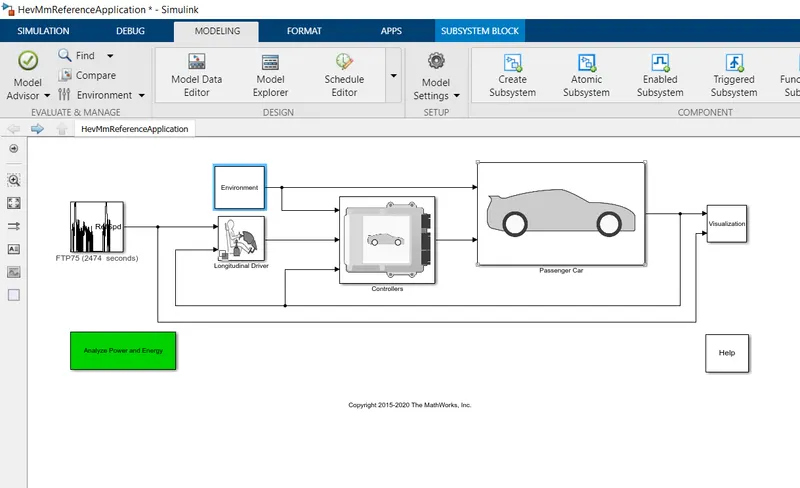
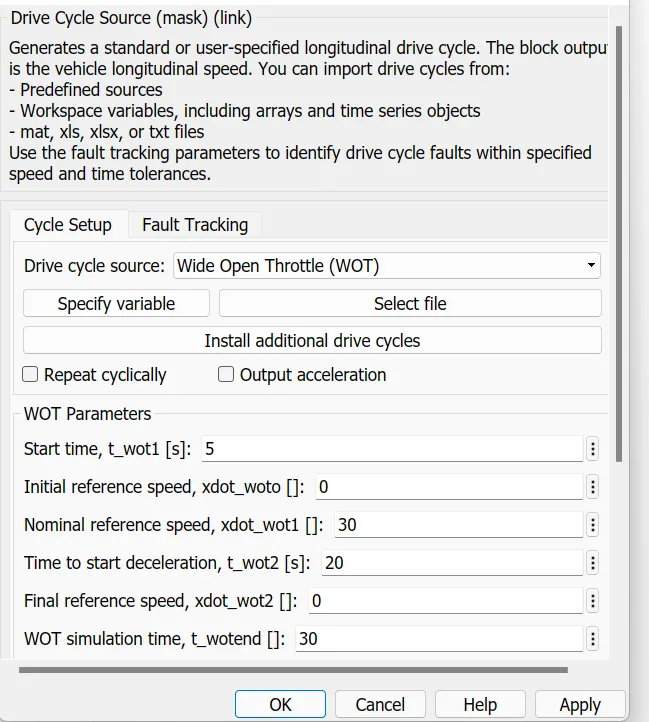
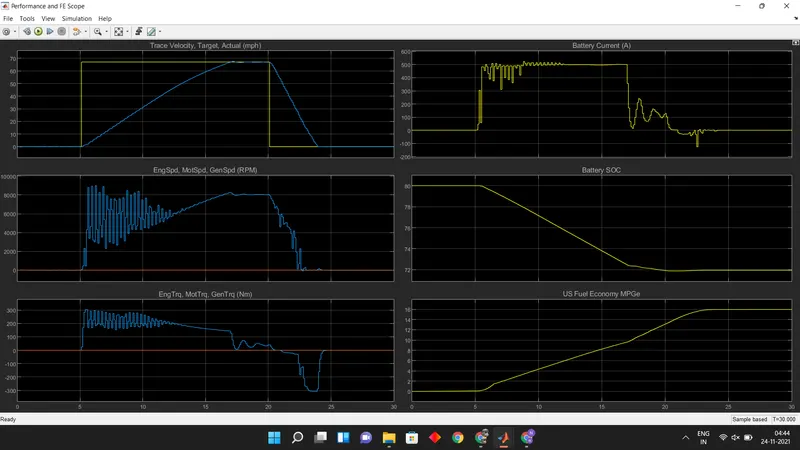
For grade angle -0
Wind speed - 0
For Grade angle - 5
and wind speed - 0
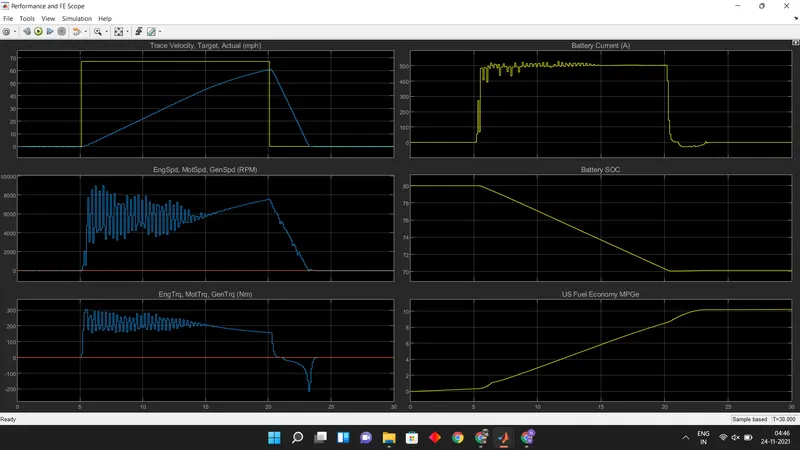
Because of increase in grade angle the max-speed gained by the vehicle is restricted to 60mph whereas in earlier case with grade angle zero the maximum speed was 70mph.
For Grade angle - 0
Wind speed - 25
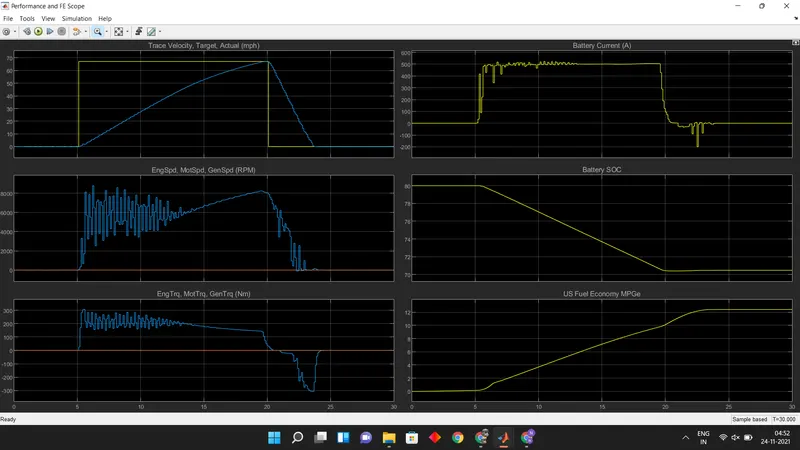
With just increase in wind speed we may not find any significance in any change of parameters compared to zero wind speed,
the vehicle gets mostly affected by grade angle.
Objective 4:
- Keeping all other parameters same, compare the simulated results of hybrid and pure electric powertrains.
Answer:
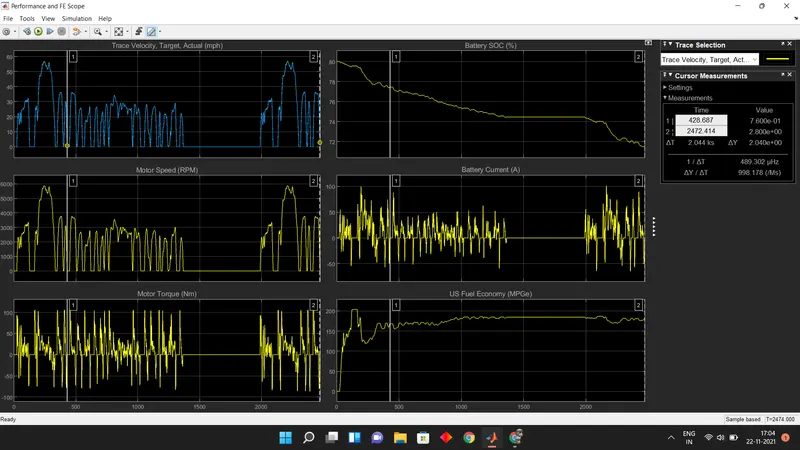
Simulated result for pure electric vehicle:
Simulated result for Hybrid electric vehicle:
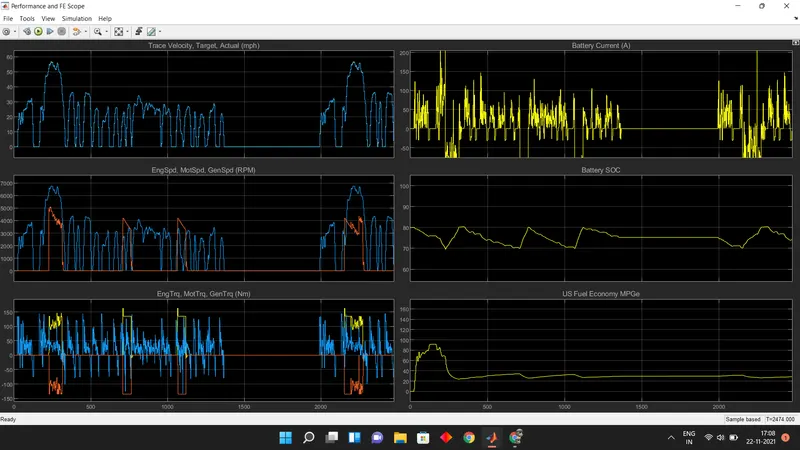
| Pure Electric vehicle | Hybrid Electric Vehicle |
| 1. Velocity Trace: NO changes between Ev and Hev | 1. Velocity Trace: NO changes between Ev and Hev |
| 2. Motor Speed: Here only single motor is seen even in peak acceleration time single motor does its job. | 2. Here There is support for engine from motor when is peak acceleration demand. |
| 3. There is no regeneration | 3. Here engine Drives generator for regeneration |
| 4.No change in battery current | 4.No change in battery current |
| 5.Continuous drain in battery can be observed over course of journey. | 5.Battery discharge and charging can be seen for entire course of journey. |
| 6.Fuel economy is greater compared to HEV. | 6. Fuel economy is not great than EV |
Conclusion:
1. Difference between mapped and dynamic model of engine, motor and generator and how to change a model is explained.
2.How miles per gallon is calculated is also explained.
3.Effect of grade angle and wind speed has been explained.
4.Comparision of simulation between EV and HEV is completed.