Week-4 Challenge WOT Condition Part-2
AIM
To study Powertrain Blockset in MATLAB
OBJECTIVE
- To understand the difference between mapped and dynamic model of engine, motor and generator.
- Fuel Economy- Miles per gallon and its calculation.
- Run the HEV Reference Application with WOT drive cycle. Change the grade and wind velocity in the environment block and compare the results.
- To compare the simulated results of hybrid and pure electric powertrains.
INTRODUCTION
POWERTRAIN BLOCKSET
Powertrain Blockset provides fully assembled reference application models of automotive powertrains, including gasoline, diesel, hybrid and electric systems. It includes a component library for simulating engine subsystems, transmission assemblies, traction motors, Powertrain Blockset also includes a dynamometer model for virtual testing. MDF file support provides a standard based interface to calibration tools for data import.
Powertrain Blockset provides a standard model architecture that can be reused throughout the development process. You can use it for design tradeoff analysis and component sizing, control parameter optimization, and hardware in the loop testing. You can customize models by parameterizing components in a reference application with your own data or by replacing a subsystem with your own model.
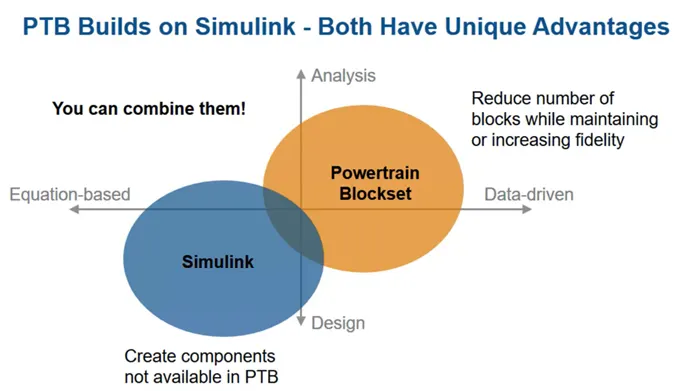
Difference between Mapped and Dynamic model of engine, motor and generator
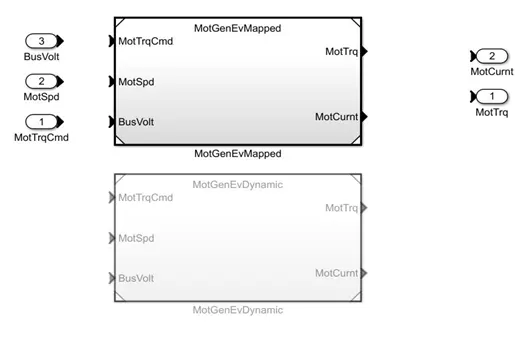
Mapped Engine and Dynamic Engine
Mapped Model
Mapped model is based on look up tables and not actual components. It is steady state model and simulation takes less time due to simplicity.
Mapped model are used when behavior of particular model is not of our interest and can be modeled with predefined values in the form of look up tables.
Advantages of mapped model:
If detailed specifications / look up table is available with us the simulation becomes easier and it gives the results on the basis of data interpreted. Also known as global based model.
Disadvantage of mapped model:
More data has to be collated and some assumptions might also have to be taken.
Dynamic Model
Dynamic model is based on actual component model. Each component is modeled separately and simulation takes more time due to complexity.
Dynamic models are used when the internal response to a model with respect to its components is needed.
Advantage of Dynamic Model:
It operates dynamically depending on the situation of operation detailed data and specifications are not required and the simulation gives the detailed analysis of the componenets simulated.
Disadvantage of Dynamic Model:
Dynamic model could not simulate as per our customized specification.
|
MAPPED ENGINE |
DYNAMIC ENGINE |
|
It is the default settings in the powertrain blockset. it is used to measure the performance parameters of the vehicle by using standard look up tables which are prefered to the system.This type of modeling is less accurate. The look up tables value are based on the values of brake torque, commanded torque and engine speed. If any other parameters like input engine temperature is selected then look up table values are also a function of the temperature parameter. The data extracted from look up tables are air mass flow, fuel flow, emission data, exhaust temperature and efficiency. The data is used to find out other parameters which are needed by the end user |
This type of model uses real time data fed by the user at run time for modeling. This model is more accurate than the mapped engine model. This type of model is used when the data of subsystem of a vehicle is required. We can calculate brake torque, fuel flow, port gas mass flow, exhaust temperature, exhaust mass flow rate and exhaust emissions. |
|
MAPPED MOTOR |
DYNAMIC MOTOR |
|
The mapped motor works in torque control mode. This type of motor is used when the user requires a faster simulation and doesn’t have the knowledge of motor parameters. The output torque and reference torque is compared and changes are made. Input torque or speed can be specified, electrical losses and maximum motor power and torque can be defined. |
It is three phase interior permanent magnet synchronous motor (PMSM) is used. The block uses three phase input voltages to regulate the individual phase currents, allowing control of the motor torque or speed. This block is used when the user knows what parameters are to be used in that particular simulation. This motor is more accurate. |
|
MAPPED GENERATOR |
DYNAMIC GENERATOR |
|
This block is also similar to other blocks. Most of the data required are taken from the look up tables corresponding to the given input parameters. Its simulation time is less |
It involves the user entering the parameters manually during the run time for their particular applications. The results take time and are more accurate. |
How can you change the model type
- Go to the modeling page. Under the design window, click on the dropdown arrow.
- Then click on the variant manager a new window will pop up.
- After selecting the GenDynamic, do the right click and select the set as label mode active case.
- How does the model calculate miles per gallon
MPG or miles per gallon is the distance measured in miles that a car can travel per gallon of fuel. MPG is also the primary measurement of a cars fuel efficiency. The higher the cars MPG the more fuel efficient it is. Although in this metric version would be kilometers per litre.
The US environmental protection agency or the EPA is the government agency responsible for certifying a vehicles MPG figures.
While it is both cheaper and better for environment to achieve a higher MPG rating, there is a curve that the EPA calls the “MPG illusion” that shows the cost benefits of increasing MPG decrease with higher rating. For example to travel 1000 miles a car that gets 10 MPG will require 100 gallons of fuel. Conversely a car that gets 15 MPG will require 67 gallons of fuels. In this case an increase of just 5 MPG cuts fuel consumption by 33 %. When a car gets 30 MPG, however increasing its mileage to 35 MPG will only save 5 gallons of fuel over 1000 miles.
Steps to calculate miles per gallon (MPG):
- As we know that 1 gallon of gas is equal to 33.7 kWh of electricity.
- So the battery power is first converted into kW then it divides by 33.7 kWh.
- The fuel equivalent of battery is added to fuel flow.
- Using vehicle speed and time the distance of travelling is calculated and then it is converted into mile by multiplying the standard value 0.000621371.
- Then as we have the fuel flow in cubic metre and distance in miles and we can calculate the fuel efficiency.
- For HEV this gallon ( gasoline equivalent of battery power) is added with gallon used by IC engine then miles per gallon is calculated.
Factors considered to model fuel flow:
The parameters considered for fuel flow are vehicle speed, fuel volume flow and battery power.
Vehicle speed is used to calculate distance travelled. Since this is hybrid vehicle, both gasoline consumption and battery consumption are considered as fuel flow.
Gasoline consumption is modeled inside mapped core engine fuel mass flow is being modeled by 2D look up table where engine speed and torque will give fuel consumption values.
Battery consumption is calculated from battery power. Both fuel consumptions are added together to get total fuel consumption.
- Run the HEV Reference Application with WOT drive cycle. Change the grade and wind velocity in the environment block. Comment on the results.
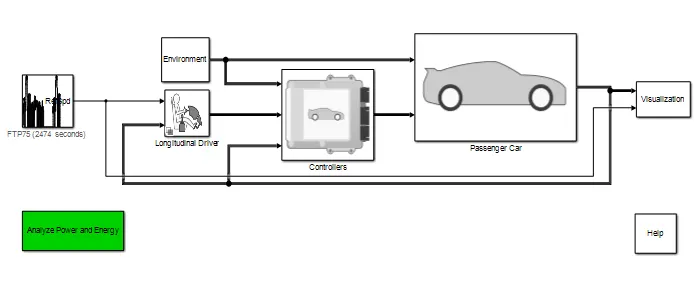
HEVmm Reference Application
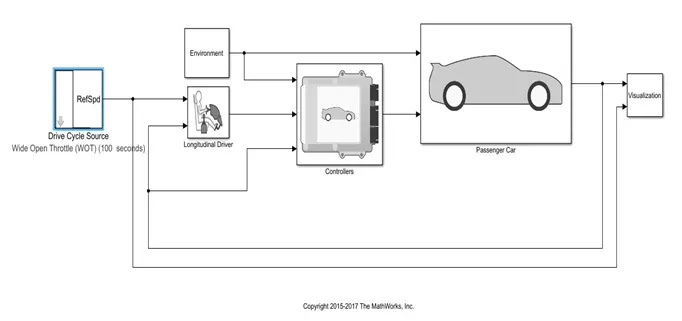
HEV Reference application with WOT (Wide open throttle) drive cycle
RESULTS
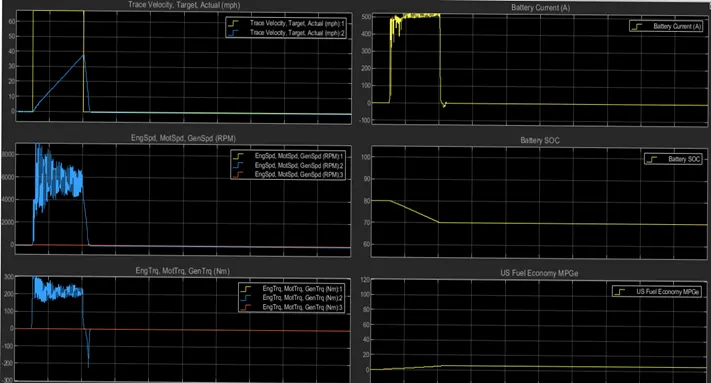
Grade=10 Wind Velocity=10
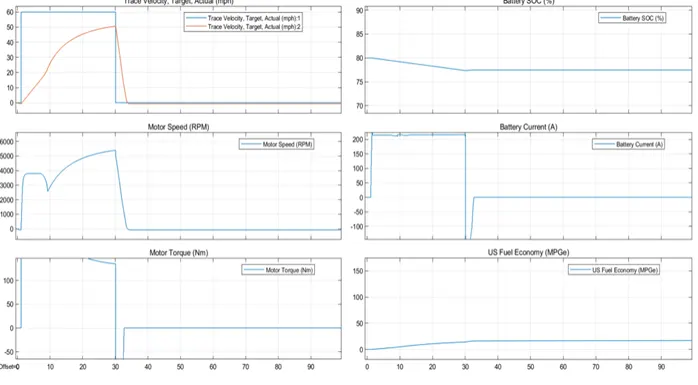
- Keeping all other parameters same, compare the simulated results of hybrid and pure electric powertrains.
EV (Electric Vehicle) Model
- A battery electric vehicle or pure electric vehicle is an EV that exclusively uses chemical energy stored in rechargeable battery packs with no secondary source of propulsion ( e.g. hydrogen fuel cell, internal combustion engine etc.) of energy.
- Battery electric vehicle use electric motors and motor controllers instead of conventional internal combustion engines for propulsion. They derive all power from battery packs.
- So they don’t produce any emission of waste gas and they are ecofriendly.
- They also have their own limitations such as range etc.
HEV (Hybrid Electric Vehicle) Model
- Hybrid electric vehicle is a hybrid type that combines a conventional internal combustion engine (ICE) system with an electric propulsion system.
- The presence of electric powertrain is intended to achieve the better fuel economy than a conventional vehicle or better performance.
RESULTS
For EV (Electric Vehicle) Model
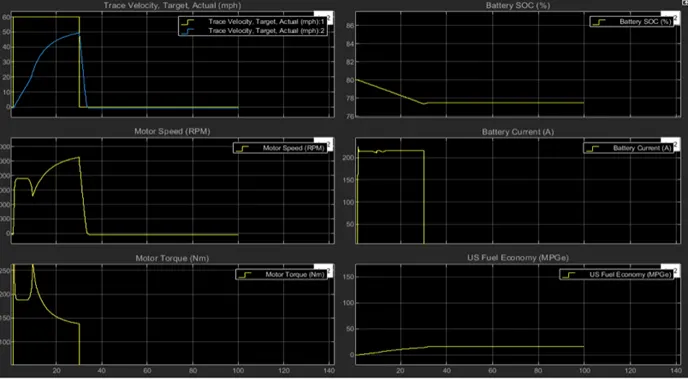
For HEV (Hybrid Electric Vehicle) Model