Week 4 Challenge
Question 1:
Define Nernst equation for fuel cell and then define what parameters affect the reaction in a fuel cell in what way.
ANSWER:-
The open circuit voltage is the maximum operating voltage (when no current is flowing) of a fuel cell and is determined by the chemical thermodynamics of the overall cell reaction. The Nernst equation provides a relationship between the standard potential ( ) for the cell reaction and the open circuit voltage [4.1]. That is to say, once the standard potential is known for the desired temperature (indicated by a subscript T), the open circuit voltage can be determined at other partial pressures of reactants and products at that temperature.
Equation (4.1) is the general form of the Nernst equation for the overall cell reaction and it can be used to determine the open circuit voltage of any fuel cell.
 (1.1)
(1.1)
where: = open circuit voltage
= standard potential of the reaction
F = Faraday’s number, 96487 C/equiv
R = universal gas constant, 8.314 J/ °K-mol
T = absolute temperature of cell, °K
 = partial pressures or activity of the species involved
n = the number of electrons involved (equiv/mol)
x, y = stoichiometric coefficients
The open circuit voltage ET of the cell by convention is measured as the potential difference between the potential drop at the cathode and the potential drop at the anode at some temperature T.
 (1.2)
(1.2)
For example, if we use the Nernst equation, Equation (1.1), for the oxygen and hydrogen reaction that occurs at the cathode and anode of a PEM fuel cell, respectively, and then take the difference using Equation (1.2), where we let  , we can see that what we get is the Nernst equation for the overall cell reaction of the PEM fuel cell which is equal to the Nernst equation if we simply applied the overall cell reaction.
Factors Affecting the Performance of Hydrogen Fuel Cell
The performance of a PEMFC can be affected by many reasons. The load current, temperature, relative humidity, membrane thickness, membrane-active area, electrode active area, corrosion, purity, pressure, and concentration of hydrogen fuel, maintenance of water inside the cell, pressure in the electrode particularly on both side of the membrane etc. are the factors.
Activation, ohmic and concentration losses make the fuel cell voltage less than before. Humid condition and thermal condition are two significant factors for PEMFC operation. The change in the temperature of a fuel cell affects the electrochemical reaction, proton exchange, and water production. The bipolar plate has two sides. On one side there is a gas flow path and on the other side, external water flow is used for temperature maintenance in the fuel cell. Rising current density accelerates the reaction process. Besides, the heat production in the fuel cell is proportional to the rate of the reaction process. In the outer part of the plate, the proton exchange membrane becomes dried because of the rising temperature. Additionally, the density of the electron flow rate becomes lower over time in the fuel cell. The density of the electron flow is higher when the supplied gas is enough. The current distribution is also an important factor and it is inversely proportional to the density of electron flow rate. The rising reactant flow rate creates a uniform current flow. Inappropriate thermal energy will decrease the performance of the proton exchange membrane.
Effect of Temperature on PEMFC
Though several factors such as operating temperature, electrolytes used, humidity, catalyst, produced heat etc. have vital effects on the performance of Hydrogen Fuel Cell, in this paper, we will discuss the effects of temperature elaborately. The effects of temperature on different parameters are shown in Table and discussed elaborately below:
Performance and Efficiency
Heat generates during the PEMFC operation. For better efficiency and consistence output there must be a cooling process either by air or fluid to get rid of the cell generated heat. The proton exchange membrane fuel cell shows better performance with the rise in temperature and pressure. Because the entropy change is small during the rise in temperature and pressure. A less chance of entropy indicates better and stable performance in a fuel cell. As the thermal energy is improved, the overall performance like current, current density, voltage, electricity production of a proton exchange membrane fuel cell improves. It has been observed in another study that fuel cell performance increased when the temperature increased to 120℃.
Normally it is considered that the efficiency of the PEMFC is increased in terms of the increase in temperature.A hydrated proton exchange membrane normally works in a range of temperatures below 100℃ and if we include some new elements in the PEMFC then the FC will operate in the temperature range higher than 100℃. A new technology has been found for high-temperature fuel cells with a temperature range from 90℃ to 200℃. At this high-temperature range from 90 to 200℃, the rate of proton exchange through the membrane becomes high and that’s why there is a rapid rise in reaction mechanism in anode and cathode. The transfer of mass positively rises with the rise of the temperature.
Table 2: Effect of Temperature on PEMFC parameters
|
Parameters |
Effect on the parameters |
|
Performance and efficiency |
Increases with the increase in temperature |
|
Humidity |
Optimum temperature maintains the required humidity |
|
Power Production |
Increases with the increase in temperature |
|
Voltage |
Increases with the increase in temperature |
|
Leakage Current |
Increases with the increase in temperature |
|
Catalyst Tolerance |
Increases with the increase in temperature |
|
Mass cross-over |
Decreases with the increase in temperature |
|
Durability |
Decreases with the increase in temperature |
Humidity
The proton exchange quality of the membrane depends on the humid condition of the membrane. The presence of water in the membrane maintains the optimum humid condition. Adequate water is required for the membrane to be hydrated and the rest of the water needs to come out of the fuel cell for better performance. Otherwise, the extra water will create additional complications inside the fuel cell. At the same time, the temperature rise is one of the reasons for water loss in the membrane. When the temperature of hydrogen fuel remains high, the membrane becomes dehydrated. As a result, less amount of proton can pass through the anode to the cathode side which will reduce the electron flow and efficiency of the PEMFC. In high temperature and high humidity, membrane crossover of the hydrogen gas rises. It is one of the reasons for PEMFC decay. After the exchange of protons through the membrane with electrochemical reaction, water is produced. Excess water production will make the membrane wet by the diffusion process. Wet proton exchange membrane is very essential for proton exchange from anode to cathode. The electrochemical reaction would rapidly rise with the increase in temperature and would produce enough water. This water will make the membrane wet and again it will increase PEMFC efficiency.
Without optimum humid conditions in the membrane, the resistance of the membrane to hydrogen ion will rise. As a result, this rise in resistance will increase the temperature. To maintain the good condition of the fuel cell operation, an optimum humid condition should be maintained either by in-vitro or in-vivo water maintenance in the fuel cell. The ion exchange is the main parameter to be observed during less humid conditions. Humidity controls the hydrogen and oxygen flow in both of the electrodes in the fuel cell. Particularly the humidity in the cathode side creates a condition for operating a fuel cell in lower temperatures. The performance and durability of the membrane directly depend on the humid condition. If the humidity in the proton exchange membrane is up to 100%, it can lead to catalyst decay from the surface of the membrane. Besides, in less humidity, the polymer electrolyte membrane turns into more brittle form and degrades faster, particularly the acid group of the membrane degrades, and the catalyst is washed away from the surface of the membrane.
The efficiency of power production
In a proton exchange membrane fuel cell, the density of power production rises by 16% for the operational temperature rise from 50℃ to 80℃. The power production efficiency of a PEMFC is increased with the increase of operational temperature. The value of dissipated power is reduced and the initiated over-potential become less due to the rising temperature which results in increased power production efficiency.
Voltage
According to the Nernst equation, the temperature is proportional to the output voltage. Higher temperature leads to faster kinetics and as a result, the voltage is also increased. This increase in voltage surpasses the voltage loss from the negative thermodynamic correlation between the open-circuit voltage and temperature. But in a study, the fuel cell was found to have worse performance due to unfortunate damage or hole in the proton exchange membrane at 70℃ operating temperature. In this case, the voltage dropped in the fuel cell as the hydrogen gas passes through the membrane. So, if the voltage does not increase with the temperature increase, there might be damage in the proton exchange membrane.
Leakage Current
The membrane of PEMFC is regarded as hydrogen impermeable and electrically insulated. But leakage current still occurs within the fuel cell. It is often supposed to be around 0.01 A.cm-2 in PEM fuel cell simulation literature. During the electrochemical reaction in the fuel cell, hydrogen gas, and electrons diffuse through the proton exchange membrane. For the diffusion process of hydrogen gas and electrons through the proton exchange membrane, a minute amount of current is produced. This current is known as leakage current. With the rise in temperature, the leakage current also increases. If the temperature rises from 50℃ to 80℃ then the leakage current density change will be 6-12 mA/cm2. The value of leakage current density will be constant with the constant value of temperature.
Catalyst Tolerance
The decay of the material of the components of the PEMFC is a very important factor in the performance of the PEMFC. The efficiency of catalyst decay over time depends on the hydrogen oxidation reaction, oxygen reduction reaction, high potential, and pH environment. Platinum catalyst plays a vital role in the performance of fuel cells. The oxygen reduction reaction in the cathode is a slow reaction process. To overcome the slowness, an effective catalyst can accelerate the oxygen reaction rate in the cathode which will improve the PEMFC efficiency rapidly. The energy conversion process in PEMFC is very efficient regarding the input hydrogen purity. Otherwise less pure hydrogen will damage fuel cell components and operation. To produce low-cost hydrogen fuel with required purity is a goal to achieve to make fuel cells more feasible to use. If the hydrogen is not pure then carbon mono oxide will be produced and associates with the surface of the catalyst. That’s why the reaction hampered in the fuel cell. However, in the HT-PEMFC this carbon mono-oxide dissociation in the catalyst surface can be solved. At high temperature accelerate the reaction kinetic in a fuel cell. In high-temperature PEM become dehydrated. As a result catalyst decay decreases, proton passes through membrane rapidly, electrochemical reaction accelerates, reaction remains active for a long time. High temperature affects the lifetime of the FC. Besides leaching of reaction acid should be maintained in HT- PEMFC. Water is produced in the chemical reaction at the anode side. This water production falls at the rise in the operational temperature range from 80℃ to 120℃. Rapid water production in the PEMFC will inundate the proton exchange membrane. A proton exchange membrane fuel cell has an efficiency of up to 60%. The tolerance level of the catalyst to the contaminants in the membrane will rise significantly with temperature. When PEMFC operates at a temperature below 100℃, CO covers the catalyst layer. As a result, the electrochemical reaction process becomes slower. The CO accumulation in the catalyst surface reduces the 50% lifetime of the fuel cell. To ameliorate the bad effect of CO, a certain type of catalyst should be selected which has no reactive mechanism to this harmful gas.
Mass Cross-Over and Concentration Over-Potential
Mass cross-over and concentration over-potential are also related to the temperature of the PEMFC. If the temperature rises, the mass cross-over falls and concentration over-potential rises. The current density becomes high. On the other hand, the activation over-potential remains static up to the 80℃. Then towards 100℃, the activation over-potential rises. It is considered that up to 80℃, the PEMFC efficiency remains in good condition. In anode and cathode, the activation over-potential decreases with the rise in temperature over 80℃. But in 120℃ the anode activation over-potential value is higher than that was between in the 80 to 100℃ range but in the cathode, the situation is opposite.
Durability
Despite the immense evolution of the proton exchange membrane, the longevity is still a concern. The durability of the catalyst, electrode plate, gas diffusion layer, the gasket is directly related to the longevity of the proton exchange membrane. Electrochemical erosion, component erosion, and thermal effect are the leading factors for the longevity of the proton exchange membrane.
The proton exchange membrane loses its water and becomes dehydrated with the rise of the temperature . As a result, the hydrogen gas crossing the dehydrated membrane will reach on the cathode side. Hydrogen in the cathode side will then damage the bipolar plate, catalyst, and gaskets. If it continues to operate at high temperatures, then over time the durability of the PEMFC will decrease. A fluid dynamic model was proposed in research with an operating temperature range from 80℃ to 120℃ and pressure range at 200000Pa. In this model, a high-temperature fuel cell showed better performance with better current density at 80℃ rather than 120℃. The water production in the anode side was found to be better than that of in cathode side. A change in temperature from 120℃ to 80℃ was found to give smooth water production. But it can directly harm the fuel cell and the durability of the fuel cell will decrease. At low thermal conditions around 100℃, there is a minute amount of water accumulation in the surface of the proton exchange membrane.24 The sulfonate part of the Nafion membrane decays at high-temperature range around 200℃ which will permit the hydrogen gas to pass through the proton exchange membrane and reaches in cathode area.
Effect of Input Hydrogen Gas Temperature
PEMFC has unique criteria such as low operating temperature & pressure, longevity, mobility and small size.The start-stop mechanism and output load stability are the major issues of PEMFC. Lack of enough input gas supply results in a rise in temperature in PEMFC. Inadequate input gas supply creates a potential pressure in the anode. As a result, the temperature of PEMFC rises and creates decay in the membrane which makes a decay path. In vehicle operation, the fuel cell temperature range is 80℃. But the stability of the PEMFC will be affected by this temperature. At changing operating temperatures such as 25℃,40℃,60℃, and 80℃ the fuel cell efficiency increased with the increasing temperature. The fuel cell efficiency increases when the start-stop round was in on mode and the stack efficiency decreased when the start-stop round was in off mode. But regardless the start-stop round was on or off with rising temperature the fuel cell can run with better efficiency.
Effect of Internally Produced Heat
If the hydrogen and oxygen flow is not enough then there will be a rise in temperature in PEMFC. As a result, the overall performance of the fuel cell will fall. Produced heat in the fuel cell during chemical reaction affects all the components (anode, cathode, gas diffusion layer, gasket, electron collector, membrane electrode assembly) and the operating condition (temperature, the humidity of the membrane, voltage, current) of the PEMFC.
Lu et al in 2016 demonstrated that the Platinum palladium-based fuel cell reaction catalyst increases performance and output energy due to enhanced ion exchange during the reaction phase. If the resistance to ion exchange is lower, then the loss would be lower and the longevity would improve. Therefore, the extra heat production due to the resistance of the ion exchange would be lower.
Question 2:
Consider the following operating points of a fuel cell during a short period of operation.
- 0.15 W/cm2
- 0.3 W/cm2
- 0.27 W/cm2
Where would these points go in the diagram below?
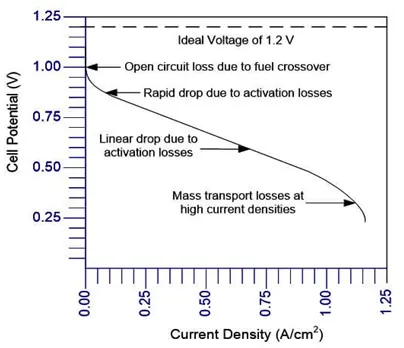
ANSWER:-
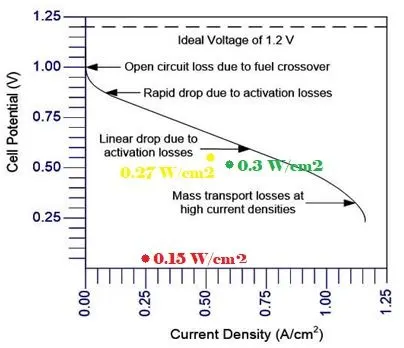
Power(P)=V*A Watts(W)
0.13W/cm^2=(0.25 A/cm^2)*(0.60 V)
0.27W/cm^2=(0.50 A/cm^2)*(0.54 V)
0.30W/cm^2=(0.60 A/cm^2)*(0.50 V)
Question 3:
Which among the three points is the best operating point and why?
ANSWER:-
0.3 W/cm^2 is the best operating point