Week-4 : Basic Calibration of Single cylinder CI-Engine
1. Compare SI & CI Engines and list down the differences:
| Sr No | SI Engine | CI Engine |
| 1 | SI Engine needs spark plug to start the ignition | CI Engine is compression ignition and the fuel self ignites under high pressure |
| 2 | Works on Otto Cycle | Works on Diesel cycle |
| 3 | In SI engine, mixture of air and fuel is injected into the combustion chamber (except in case of GDI engine where air is injected first and fuel is direclty injected into the chamber) and the mixture is compressed. | In CI engine, always air is taken into the combustion chamber and compressed. Fuel is introduced at the end of compression. |
| 4 | SI engine has a low compression ratio | CI engine has high compression ratio |
| 5 | Works at higher RPM | Works at lower RPM |
| 6 | Has lower thermal efficiency | Has higher thermal efficiency |
| 7 | Knocking is an issue in SI engine | Detonation is an issue in CI engine |
| 8 | Uses tumble motion in combustion chamber | Uses swirl motion in combustion chamber |
| 9 | Only 3 way Catalytic convertor is required for exhaust after treatment | DOC, DPF, SCR required for exhaust after treatment |
| 10 | Commonly used fuels are Petrol, CNG, LPG | Only diesel fuel is used |
| 11 | Produce lower torque | Produce higher torque |
| 12 | Major pollutants are CO & HC |
Major pollutants are CO, NOx, Soot, HC |
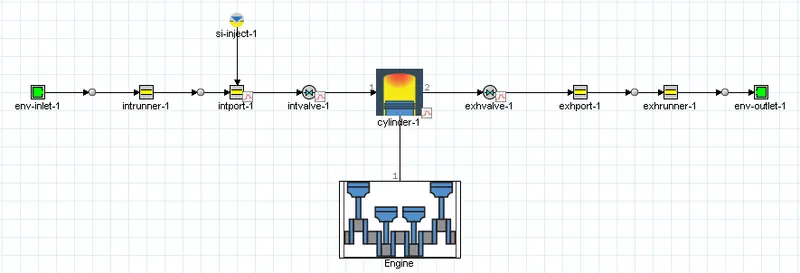
SI engine example model in GT Suite: We can see here that the fuel is injected into the intake port.
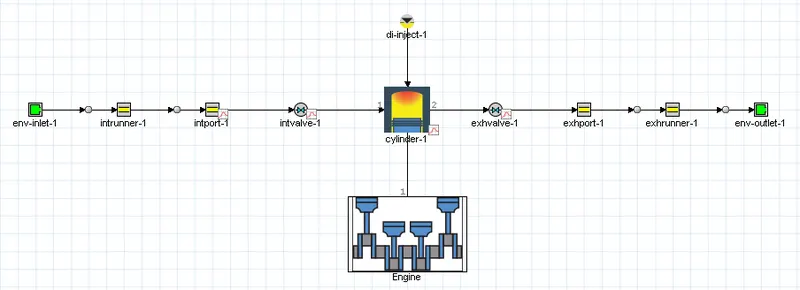
CI engine example model in GT Suite: We can see here that the fuel is injected into the combustion chamber.
2. Comments on following parameters:
BSFC:
BSFC stands for Brake Specific Fuel Consumption. It is a parameter that reflects the efficiency of a combustion engine which burns fuel and produces rotational power. The formula for calculating brake specific fuel consumption is fuel consumption divided by power.
BSFC = Fuel consumption in unit time / Brake power.
The BSFC value indicates how efficiently the fuel supplied is turned into useful power.
Exhaust Temperature:
The temperature at exhaust manifold is normally called as exhaust temperature. Exhaust temperature plays an important role in the exhaust after treatment systems. The temperature of the exhaust gases is crucial in the efficient working of DOC, SCR etc in a CI engine as well as the working of 3way Catalytic convertor in a SI engine.
A/F ratios:
Air fuel ratio is the ratio of mass of air to mass of fuel used while running the engine. Air-Fuel ratio is critical in defining the proper combustion of fuel in an IC engine. SI engines work with a rich mixture (i.e. more fuel than air) whereas CI engines work with a lean mixture (more air than fuel) due to the very nature of the combustion process. The ratio of air to fuel such that complete fuel burns without leaving any residue fuel or air is called the Stoichiometric A/F ratio.
3.Change MFB 50 and observe impact on performance:
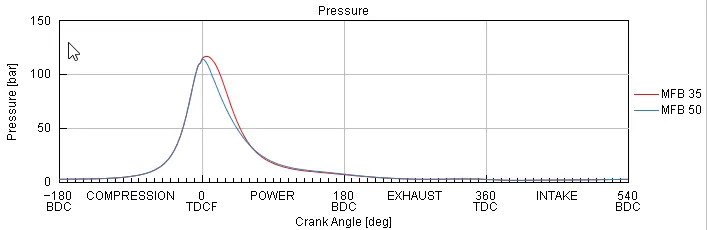
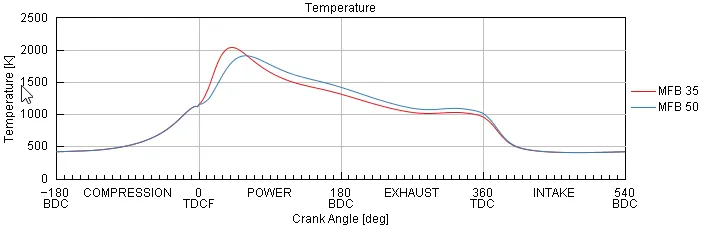
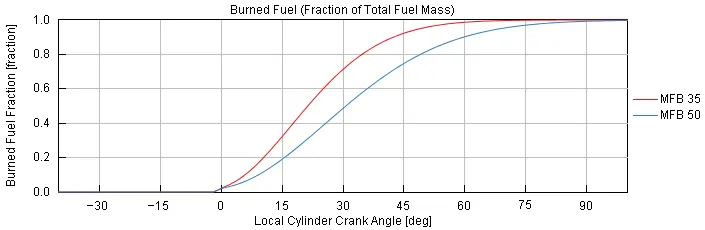
The parameter that needs to be varied is the Main Duration. Default value is 35 and the same was changed to 50 and it was run as 2 cases. The results are given below:
Performance Parameters.
| Engine Speed (end of cycle) | RPM | 3600 | 3600 |
| IMEP720 - Net Indicated Mean Effective Pressure | bar | 17.61037 | 15.4936 |
| IMEP360 - Gross Indicated Mean Effective Pressure | bar | 18.8538 | 16.77164 |
| PMEP - Pumping Mean Effective Pressure | bar | -1.24343 | -1.27804 |
| ISFC - Indicated Specific Fuel Consumption | g/kW-h | 208.2256 | 236.6739 |
| PMEP Adjusted (Shelby definition) | bar | -1.30855 | -1.3491 |
| IMEP Adjusted (Shelby definition) | bar | 18.91892 | 16.8427 |
| Intersection Pumping Integral | bar | -0.94617 | -0.9322 |
| Intersection Gas Exchange Efficiency | fraction | 0.949053 | 0.943309 |
| Intersection Power Integral | bar | 18.57153 | 16.4436 |
| Incremental Compression Work | bar | 0.016369 | 0.016421 |
| EVO Loss | bar | 0.048745 | 0.054646 |
| Indicated Efficiency | % | 40.20683 | 35.37396 |
| Average Heat Transfer | kW | 12.11468 | 11.03289 |
| Volumetric Efficiency, Air | fraction | 0.887426 | 0.887779 |
| Burned Mass Percent at Combustion Start(EGR+Resid) | % | 2.713462 | 2.560457 |
| Air-Fuel Ratio (Trapped Air/Total Fuel) | No Unit | 20.77499 | 20.78322 |
The graphs show that due to the increased burn duration, burn rate has decreased. Also since the fuel is not burning violantly, the peak temperature and pressure has reduced. Torque and power has reduced and BSFC increased due to the increased burn duration.