Week - 4
1)
STATE FLOW:
State flow provides a graphical language that includes state transition diagrams, flow charts. state transition tables, and truth tables. By using state flow to describe how MATLAB algorithms and Simulink models react to input signals. events, and time-based conditions.
CONTROL LOGIC:
Control Logic is model system logic using state machines, Flowchart and Truth tables.
EXPLANATION FOR CONTROL LOGlC OF A WASHING MACHINE USING STATE FLOW:
State Flow is a Simulink tool to implement the state machine. Here model system logic of a washing Machine using State flow has been done.
step 1: create a chart and enter the given input conditions.
Given Input Conditions:
- If the power supply Is available, the system gets activated
- If the water supply is not available, stop the process and indicate through LED.
- Soaking time should be 200s followed by washing time of l00s.
- Then rinsing happens for next 20s & dryer runs for 5Os.
After all the processes have completed turn on the finished LED.
step 2 : After entering the input conditions in the chart. Go to Symbols pane and assign the given variable. (Example: input data. Output data.etc..)
step 3: Give the input values for turning on or off for the Power supply and water Supply.
condition:
if value =1, Power and water Supply will turn On,
if value = 0. Power and water Supply will turn off.
Step 4: Use display’ block and Lamp indicator to display the results.
The simulink model is available in:https://drive.google.com/file/d/1Xrl-7X2IcvD5BHcLb4WBrhKdD1Ef2LRb/view?usp=sharing
OUTPUT:
control Logic of a washing Machine using Sate flow has been implemented.
Case-1:
If the Power source =0, water supply=1 is available and system will not activate.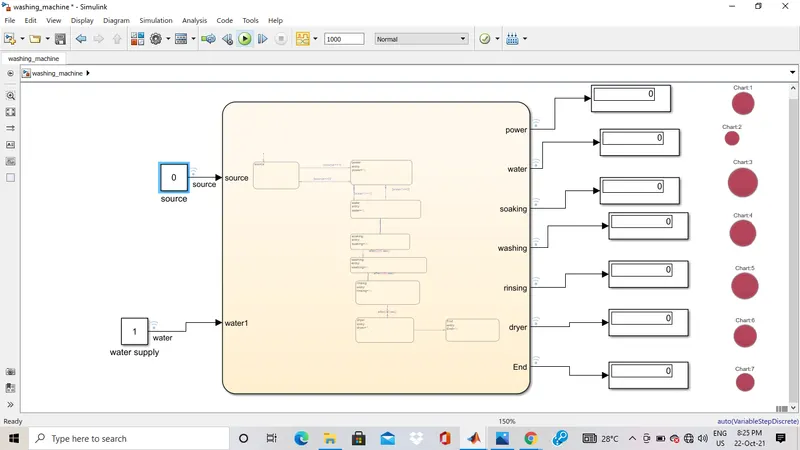
Case-2:
If the Power source = 1 and water Source = 0, then Power supply will turn on and water supply will not be available and so system will not activate.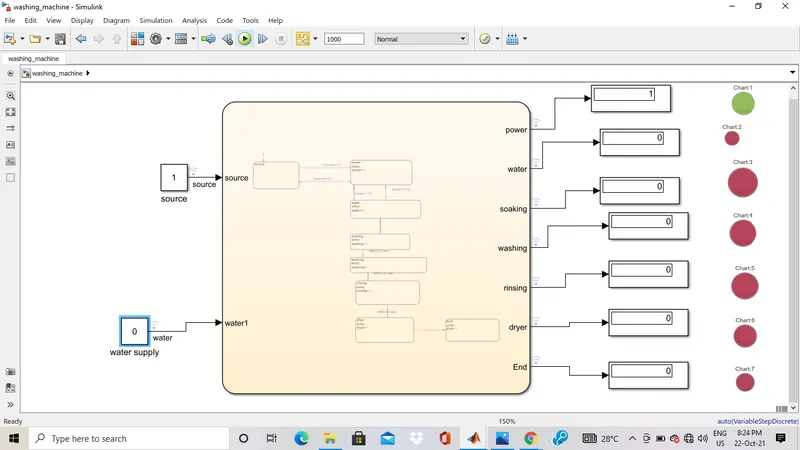
Case -3:
It the Power source = 1 and Water Source =1, then Power Supply will turn on and water supply will be available and so system will activate and after all process completed end lamp will turn on.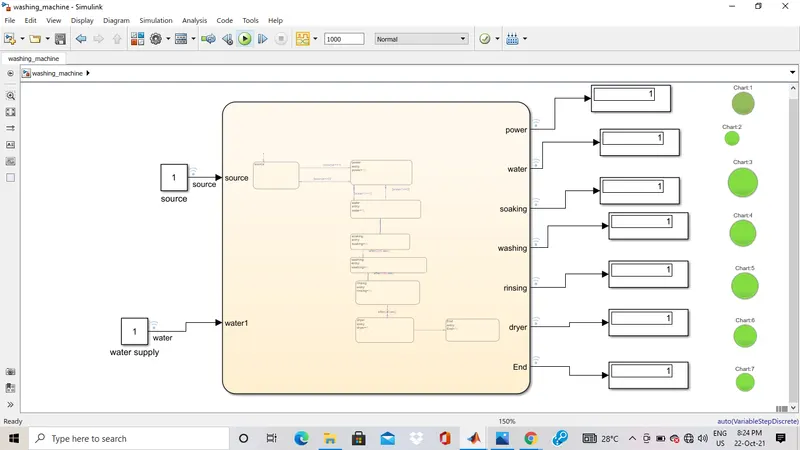
2)
GEAR SHIFTING MECHANISM:
Mechanical devices that enable the driver to engage gears in such a way as to obtain the desired transmission ratio are called shifting mechanisms.
EXPLANATION FOR GEAR SHIFTING MECHANISM USING SIMULINK:
Step 1: Create a chart and enter the given conditions for
gear shifiting.
Given Conditions:
Speed Range(kmph) Gear
O to l5 1
16 to 25 2
26 to 40 3
41 to 60 4
Above 60 5
step 2 After entering the Input conditions in the chart, Go to Symbols pane and assign the given variable. (Example: input data. Output data.etc..)
Step 3: connect the slider Gain to vary the speed whiile simulation is running.
step 4: Create Constant and giving value 1 and 0 for turning on & off.
step 5: Create Lamp to Indicate the power is on o off.
step 6: Use display Block to display the Gear position.
The simulink model is available in:https://drive.google.com/file/d/1LT5SKxVn2wqV2vxLZLGhsXL7PN2_rIqn/view?usp=sharing
Output:
Gear shifting logic has been created and by using slider Gain block, to vary the speed while running the simulation.
Case -1:
If the Key=0, then the power will turn off, Lamp indicate the Red colour and Gear shifting mechanism will not activate.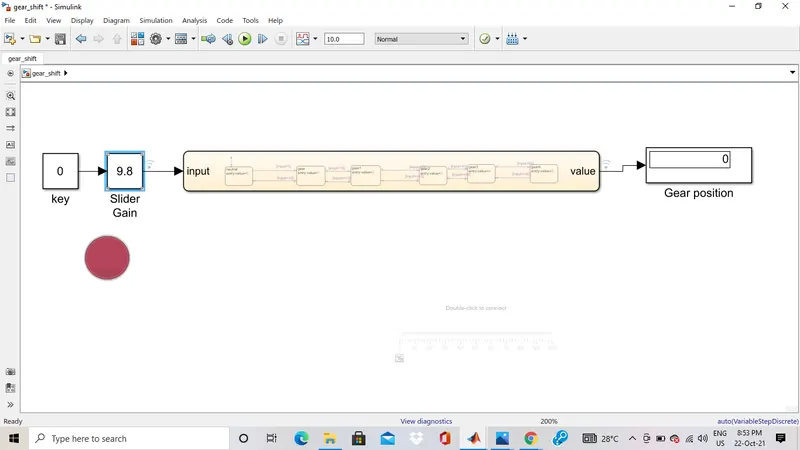
Case-2:
if the Key= I, then the power will turn on, lamp indicate Green colour and Gear Shifting mechanism will activate.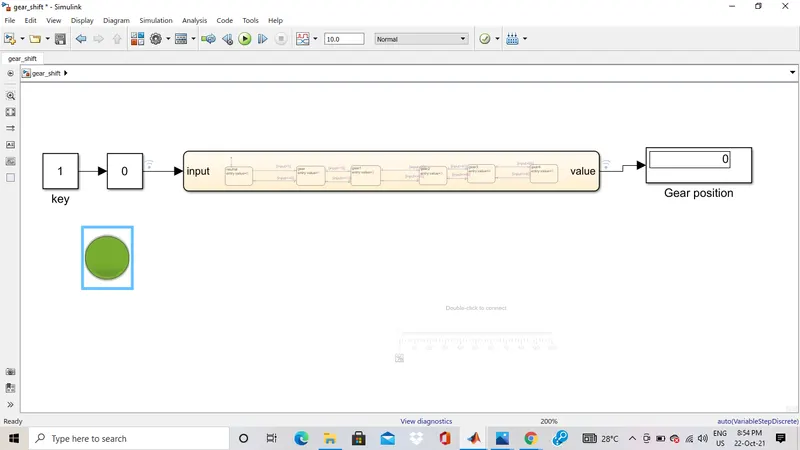
Case - 3
By varying the speed in the speedometer(Slider Gain). Gear position will change according to the given condition.
Giving Speed = 42 km/hr in the Speed meter, if the speed is between 41 km/hr -60 km/hr, 4th Gear will activate as per the given condition Gear position is displayed below in the simulink model.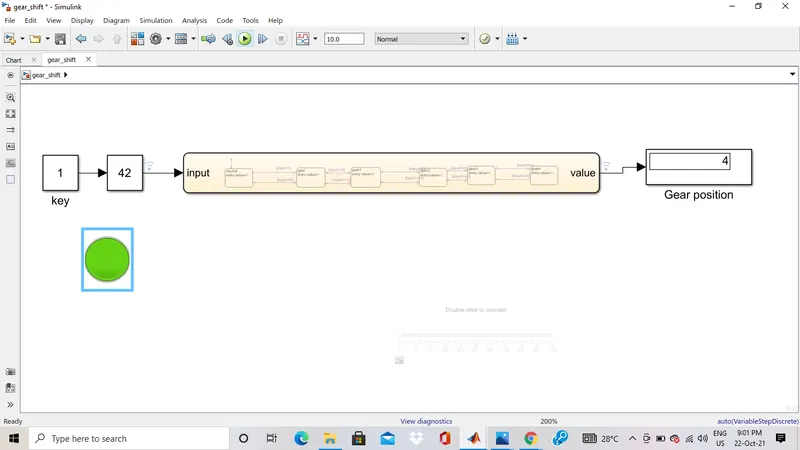
Likewise, changing the speed in the Speedometer according to the given condition, Gear position will change.