Week 4.2 - Combustion Efficiency Calculation after Preheating
Aim:
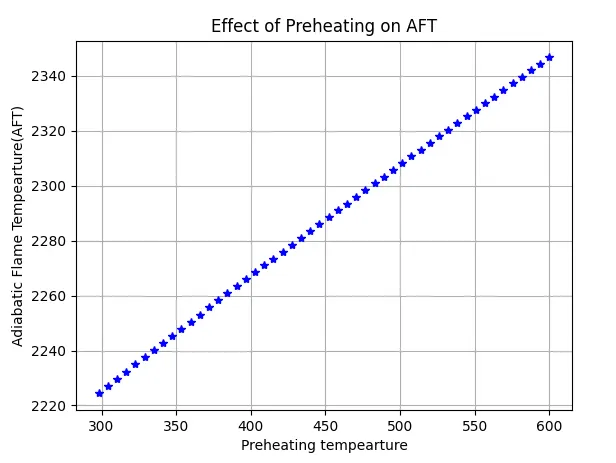
Finding the effect of preheating from 298 to 600K on AFT. The methane is mixed air and burnt in the furnace and a recuperator is connected to the furnace to recover some energy.
Recuperator:
A recuperator is a special purpose counter-flow energy recovery heat exchanger positioned within the supply and exhaust air streams of an air handling system, or in the exhaust gases of an industrial process, in order to recover the waste heat. Generally, they are used to extract heat from the exhaust and use it to preheat air entering the combustion system. In this way, they use waste energy to heat the air.
Methane and air mixture:
`CH_4 + 2(O_2 + 3.76N_2) to CO_2 + 2H_2O + 7.52N_2`
1) The Change of pre-heating effect on the adiabatic flame temperature from 298 to 600K. Methane, oxygen, nitrogen are the reactants, and carbon dioxide, water, nitrogen are the products of the methane-air mixture. From the above equation, the moles of the fuel is 1 and the moles of the air are 9.52 on the reactants side.
Code:-
import numpy as np
import cantera as ct
import matplotlib.pyplot as plt

gas = ct.Solution('gri30.cti')

fuel = ct.Quantity(gas)
fuel.TPX = 298.15, ct.one_atm, 'CH4:1'
fuel.moles = 1

air = ct.Quantity(gas)
temp = np.linspace(298,600,50)

for T_pre in temp:
	air.TPX = T_pre, ct.one_atm,{'O2':0.21, 'N2':0.79}
	air.moles = (2*3.76)/0.79

	M = fuel + air
	M.equilibrate('HP','auto')

	print(M.T)
	plt.plot(T_pre,M.T,'*',color='blue')

plt.xlabel('Preheating tempearture')
plt.ylabel('Adiabatic Flame Tempearture(AFT)')
plt.title('Effect of Preheating on AFT')
plt.grid()
plt.show()
Plot:-
2) Combustion efficiency:-
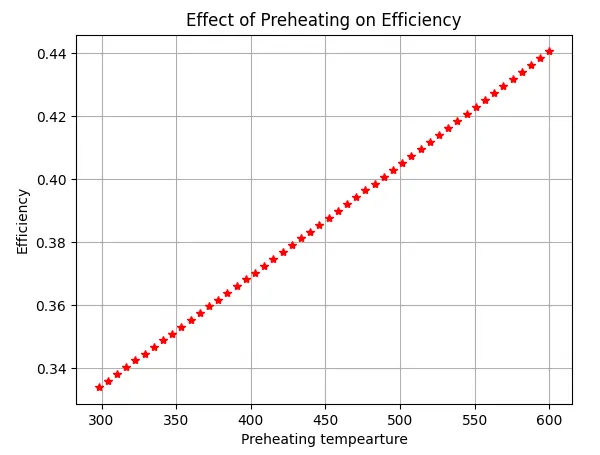
Combustion efficiency is a measure of how effectively the heat content of a fuel is transferred into usable heat. The stack temperature and flue gas oxygen (or carbon dioxide) concentrations are primary indicators of combustion efficiency. 100% combustion efficiency is not realistically achievable. Various combustion processes produce combustion efficiencies from 0 to 95%. Combustion efficiency calculations assume complete fuel combustion and are based on three factors:
- The chemistry of the fuel.
- The net temperature of the stack gases.
- The percentage of oxygen or CO2 by volume after combustion.
`eta_(combustion) =` (available heat generated /(maximum possible heat generation)
`eta_(combustion) = (Q)/(m_f*LHV)`
Available heat generated(Q) = ((air.mass*air.h) + (fuel.mass*fuel.h) - (products.mass*products.h))
From the above equation, the products are CO2, 7.52N2, 2H2O.
Total moles = 1+2+7.52 = 10.52
`CO_2 = 1/10.52 = 0.095`
`N_2 = 7.52/10.52 = 0.7148`
`H_2O = 2/10.52 = 0.1901`
Air moles(`N_2, O_2`) = 9.52
`N_2 = 7.52/9.52 = 0.79`
`O_2 = 2/9.52 = 0.21`
Code:-
import numpy as np
import cantera as ct
import matplotlib.pyplot as plt

# CH4 + 2(O2 + 3.76N2) == CO2 + 2H2O + 7.52N2

gas = ct.Solution('gri30.cti')

temp = np.linspace(298,600,50)
LHV = 50*pow(10,6)   # low heat volume

# Fuel:- CH4
fuel = ct.Quantity(gas)
fuel.TPX = 298.15, ct.one_atm,'CH4:1'
fuel.moles = 1

# products moles:- 10.52
products = ct.Quantity(gas)
products.TPX = 1700, ct.one_atm, {'CO2':0.094,'H2O':0.189,'N2':0.715}
products.moles = 10.52

# Air moles(O2, N2) = 2 + 7.52 = 9.52
for T_pre in temp:
	air = ct.Quantity(gas)
	air.TPX = T_pre, ct.one_atm, {'O2':0.21,'N2':0.79}
	air.moles = 9.52

	Q = ((air.mass*air.h)+((fuel.mass)*fuel.h-(products.mass)*products.h))/fuel.mass

	Efficiency= Q/LHV
	plt.plot(T_pre,Efficiency,'*',color='red')

plt.xlabel('Preheating tempearture')
plt.ylabel('Efficiency')
plt.title('Effect of Preheating on Efficiency')
plt.grid()
plt.show()
Result:-
Conclusion:-
From the 1st plot, we can see that the AFT increases with the increases in the preheating temperature. Combustion efficiency increases linearly with the preheating temperature. The preheating temperature depends upon the temperature of the products after combustion.