Week - 4
AIM:
1)Implement control logic of a “washing machine” using Stateflow as per given sequence:
- If the power supply is available, the system gets activated
- If the Water supply is not available, stop the process & indicate through LED
- Soaking time should be 200s followed by Washing time of 100s.
- Then rinsing happens for next 20s & dryer runs for 50s
After all the processes have completed turn on the finished LED
2) Make a Simulink chart for the “Gear shift” logic as per below conditions:
Speed Range(kmph) Gear
0 to 15 1
16 to 25 2
26 to 40 3
41 to 60 4
Above 61 5
Give speed input while the simulation is running & display the gear number.
1) WASHING MACHINE MECHANISM
THEORY:
Washing machine is the machine used to wash the various types of clothes without applying any physical efforts. With washing machine you don’t have to rub the clothes with hand or squeeze them to remove the water from them. The washing machine is also called as clothes washer or simply the washer. The washing machine enables you to wash your clothes automatically without having to supervise its operation. All you have to do is put the clothes in the machine and select the wash mode. The washing machine automatically takes in the amount of water and detergent required and it also automatically sets the timer for washing, rinsing and drying as per the selected mode and the amount of clothes.
TYPES OF WASHING MASHINE:
1) Semi-automatic washing machine: This has separate tubs or vessels for the washer and the drier. There are two separate timers that enable setting washing and drying times. To wash the clothes you have to put the clothes in the wash vessel, put sufficient quantity of the water and detergent and then set the timer. After the specified time, the washing machine will stop. You can remove the clothes and dry them in the sun or you can dry them partially in the drier vessel by setting suitable time.
2) Fully automatic machine: In fully automatic washing machine there is only one tub that serves as the washer, rinser as well as the drier. Depending on the number of clothes or the weight of the clothes, the machine takes in the sufficient amount of water and detergent automatically and sets the timer for wash and drying automatically. All you have to do is just provide the water connection, put the detergent from time-to-time in its storage space and put the clothes, the fully automatic washing machine does the rest of things automatically.
LOGIC EXPLAINATION:
1)use chart block to create logic for the washing machine.
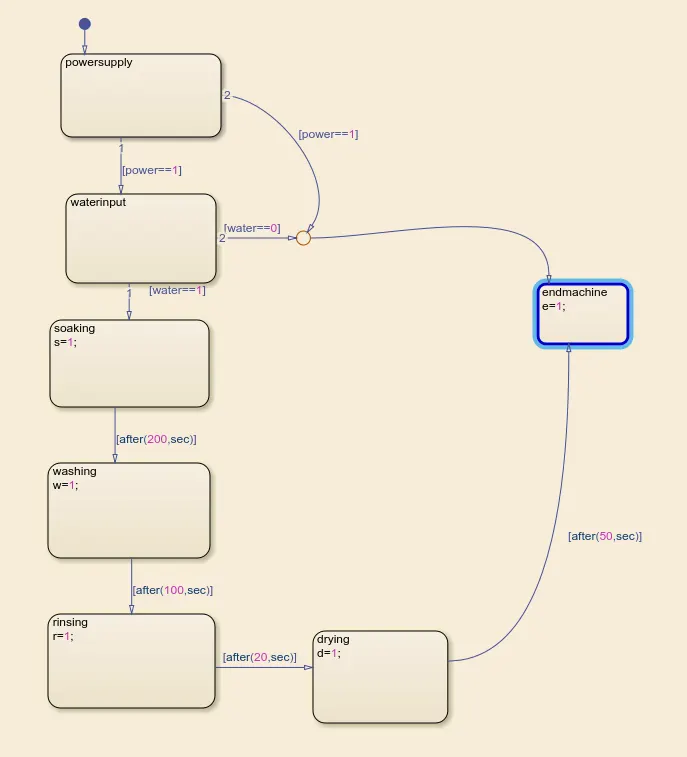
1) first state is power supply stage. this state will check if power supply . this means that, if power supply is present then only process will go to the next state.
if power supply is absent, then the process stops there itself.
2)next stage is the water input stage .in this stage , the water is filled in the washing machine tank.
this stage checks logic that if water is there i.e. if water==1, then only proceed to next stage , otherwise if water==0 then go to end machine stage.
3)if water==1, then soaking stage occues. here cloths that are placed in washing machine drum is soaked with water for 200 seconds as per question.
4) after 200sec , washing stage occurs . here in this stage , cloths are washes by revolving in clockwise and anticlockwise direction by motor.
5) as per given question , washing should be done for 100 seconds. thus after 100 seconds , rinsing stage comes.
6) in this rinsing stage , water is taken out from the drum of washing machine.as per given question , rinsing should be done for 20 seconds.
7)then comes drying stage. here cloths are dried . as per given question ,this process should occur for 50 seconds .
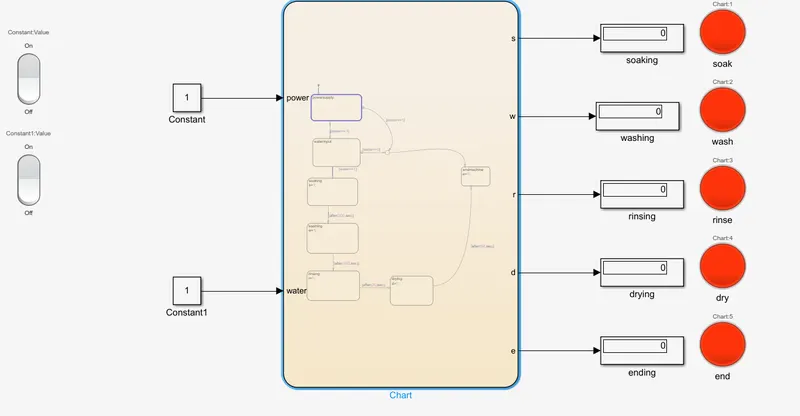
8) if we comes to the main model, we have two inputs like power and water.
9)rocket switch is used to make power and water supply on and off.
10)
if power is on, and water is on , then process starts,
a)intially, at 0 second means at starting, all lamps are red,
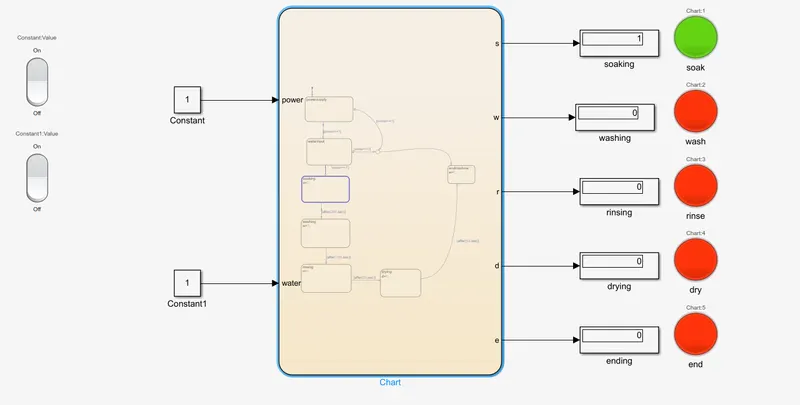
b) after 200 seconds , soaking process gets end , thus soak lamp turns green.
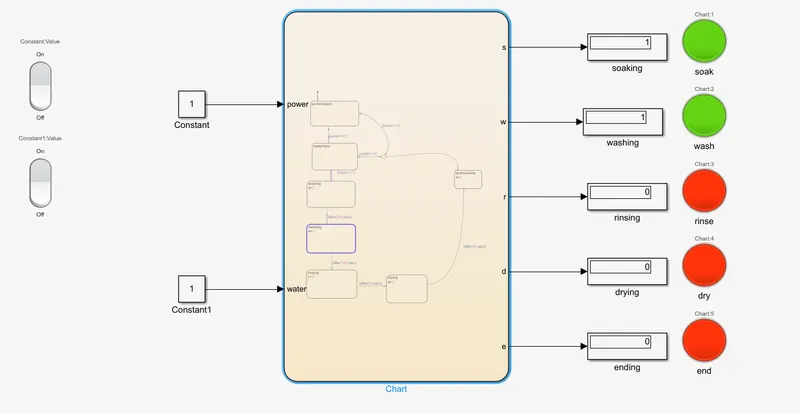
c)when soaking stage gets complete, then after 100 seconds , washing stage gets completed. thus wash lamp also turns green.
d)then when washing stage gets over , then rinsing stage appears. this rinsing stage appears for 20 seconds as per the given question.
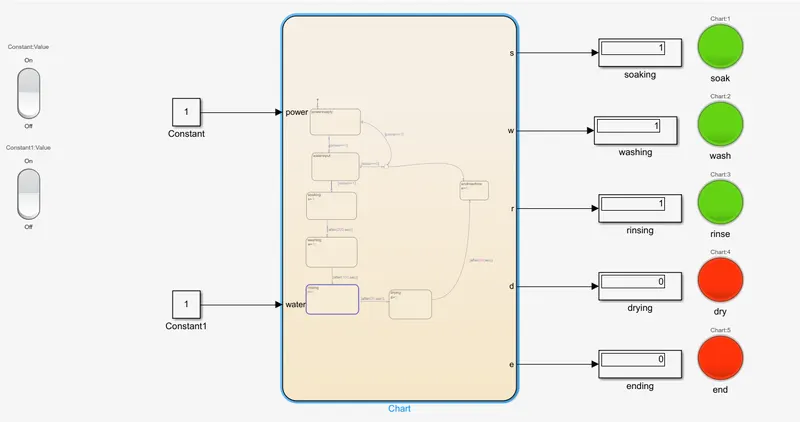
e)then after rinsing stage , there occur drying stage for 50 seconds.. thus after completion of drying stage, dry lamp glows green.
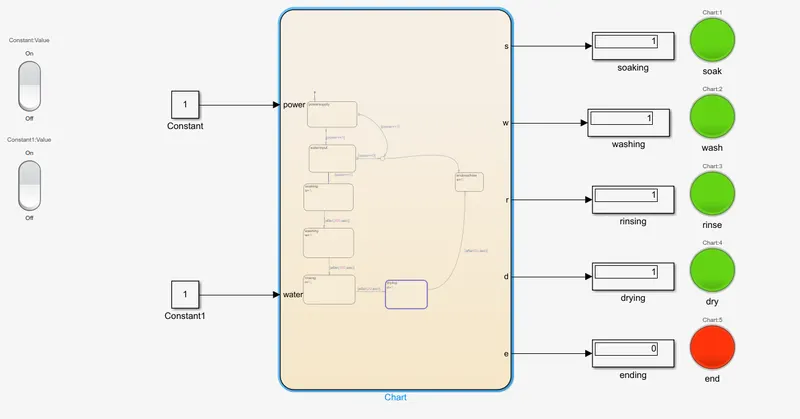
f) after completing all the process, end lamp will glows green.
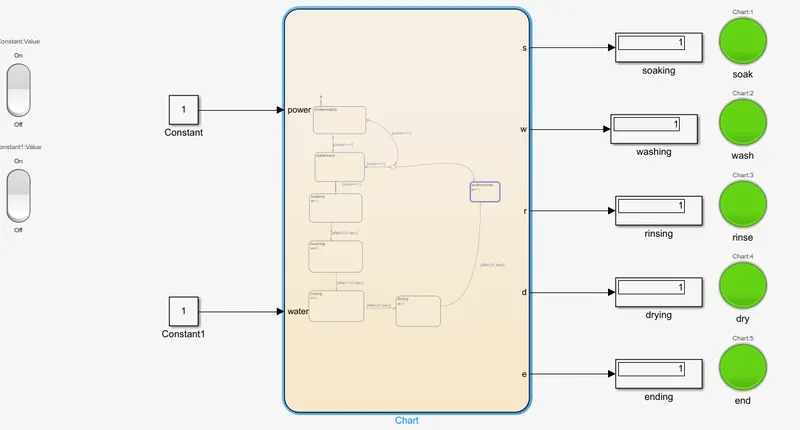
11)
if power is on , and water supply is off
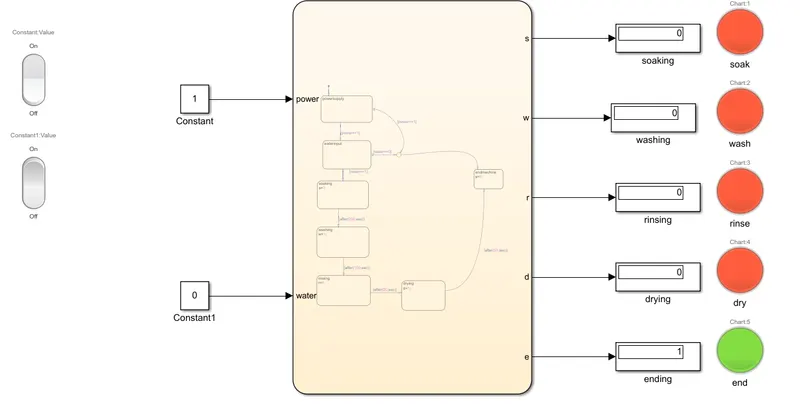
then no process occurs .directly the process comes to last end stage.
2) GEAR MECHANISM
Gear Lever
- 1. Modern cars have 5 forward gears and 1 reverse gear. Practise changing gears from the first to the fifth and backwards.
- 2. To change gears, press down on the clutch and follow the pattern of the gear lever.
- 3. Then learn to shift between gears. From 1st to 2nd, from 1st to 3rd and so on.
- 4. Shifting between gears is important when you are driving long distances or in traffic, since you have to gauge the distance from the car ahead.
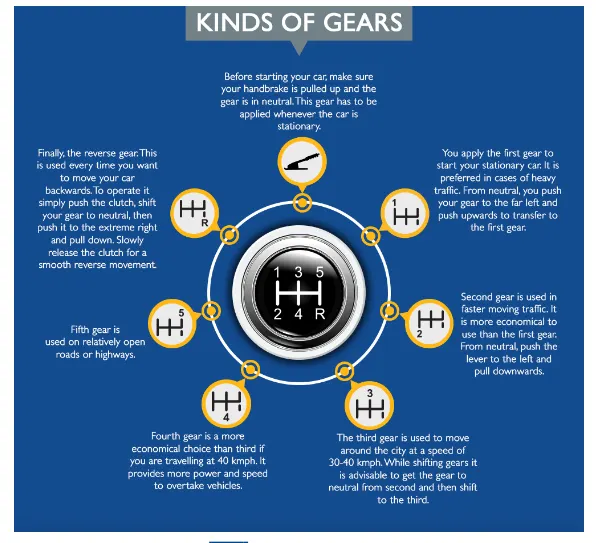
Kinds of Gears
- 1. Before starting your car, make sure your handbrake is pulled up and the gear is in neutral. This gear has to be applied whenever the car is stationary.
- 2. You apply the first gear to start your stationary car. It is preferred in cases of heavy traffic. From neutral, you push your gear to the far left and push upwards to transfer to the first gear.
- 3. Second gear is used in faster moving traffic. It is more economical to use than the first gear. From neutral, push the lever to the left and pull downwards.
- 4. The third gear is used to move around the city at a speed of 26-40 kmph. While shifting gears it is advisable to get the gear to neutral from second and then shift to the third.
- 5. Fourth gear is a more economical choice than third if you are travelling at above 41 kmph. It provides more power and speed to overtake vehicles.
- 6. Fifth gear is used on relatively open roads or highways.
- 7. Finally, the reverse gear. This is used every time you want to move your car backwards. To operate it simply push the clutch, shift your gear to neutral, then push it to the extreme right and pull down. Slowly release the clutch for a smooth reverse movement.
MODEL EXPLANATION
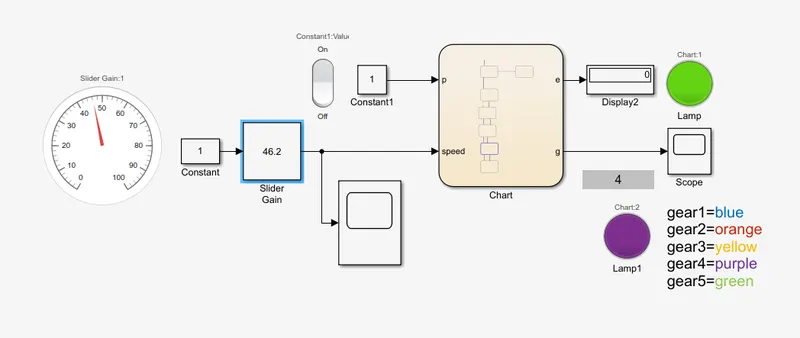
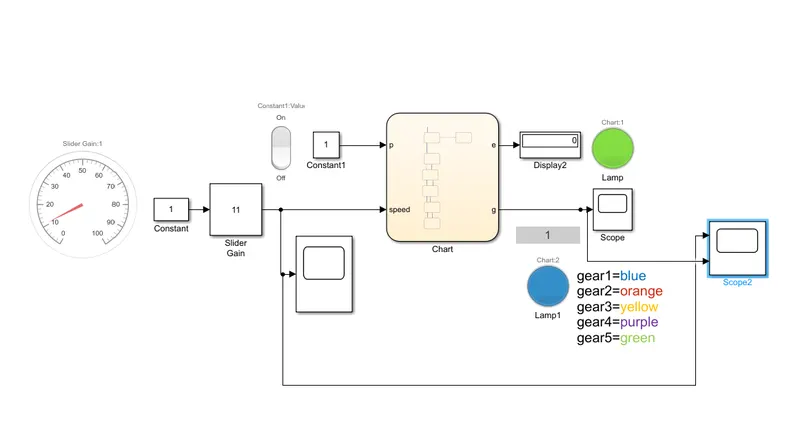
1)The model prepared is shown below:
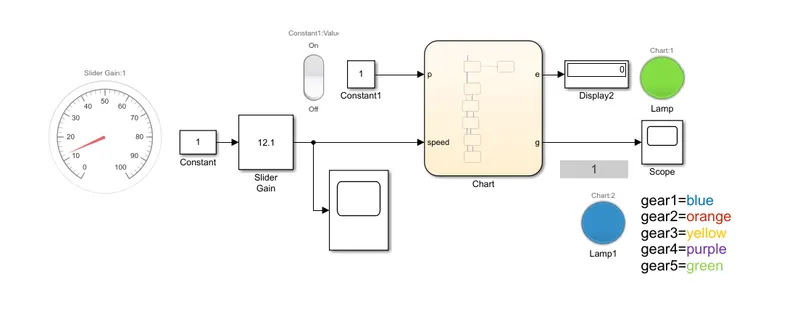
1) a chart block is used here to prepare logic.
2)slider gain is used to chnage speed input.
3)gauge is connected to display which speed is there at any particular instant.
4)lamp is connected to output g of chart block .
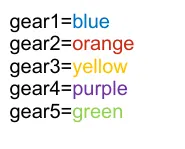
5)this lamp will give corresponding color as speed changes. the colors denoted are shown below.
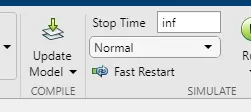
6) as given in question that we have to give speed input while the simulation is running , thus use infinte time in stop time . means write inf in stop time column .now click slider gain block and now we can change speed will simulation is running.
7) The chart block is used to prepare logic.
the logic prepared in the chart block is shown below
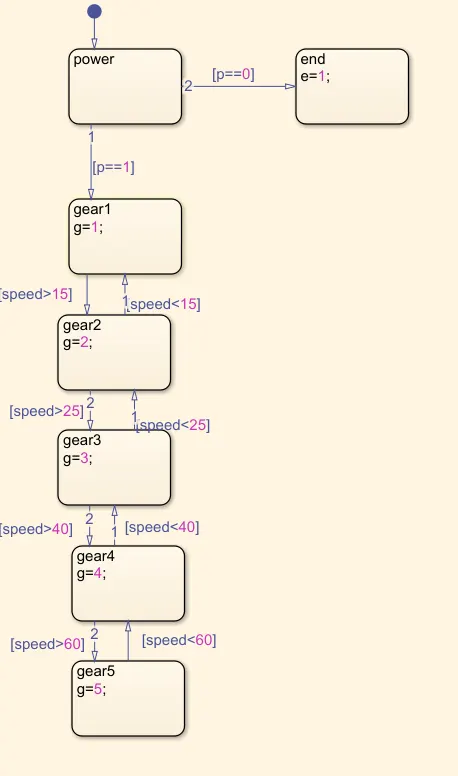
a)if power is not there, means power=0, then process will not be there and process comes to end stage.
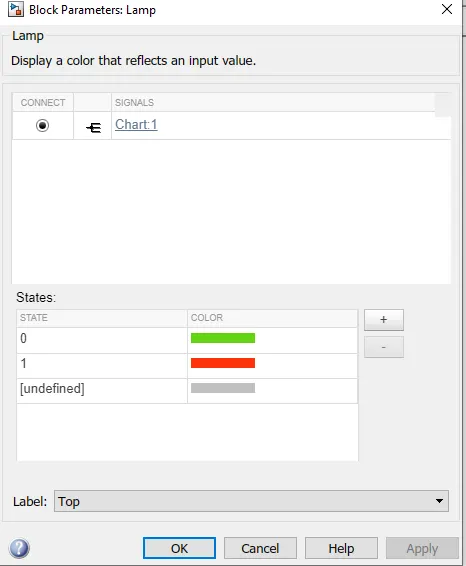
let settings in lamp block is done as shown below.
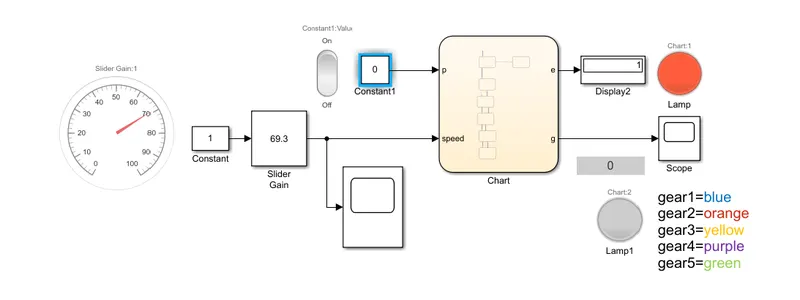
as power is not there , thus process comes directly to end stage and thus red lamp of end stage glows.
b) if power is there , means if power==1 , then only the process starts.
c)let consider power (p)==1.
thus process starts.
as per given question,
Speed Range(kmph) Gear
0 to 15 1
16 to 25 2
26 to 40 3
41 to 60 4
Above 61 5
if speed is below 15 kmph, then gear 1 should operate. if speed is between 16 to 25 kmpg, gear2 will operate. is speed is in between 26 to 40 kmph , then gear 3 will operate. if speed is between 41 to 60 kmph, then gear 4 will operate. if speed is above 61 kmph , gear 5 will operate.
OPERATION OF MODEL
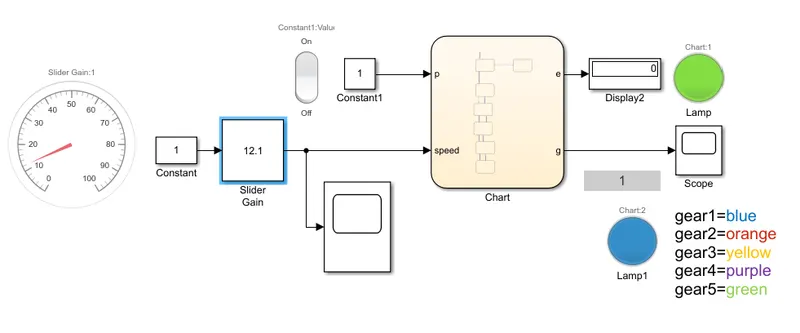
1) Let speed input from slider gain given as 12.1 kmph . as the speed is less than 15 kmph , thus gear 1 must operate. thus lamp is showing blue color.
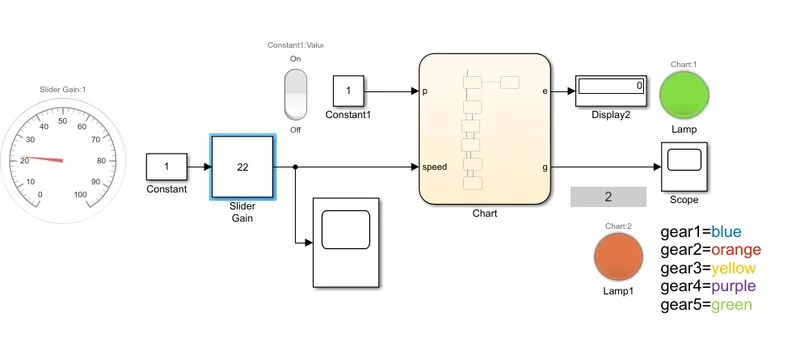
2) let speed changed to 22 kmph . as the speed is more than 15 kmph but less than 25 kmph , thus gear 2 must operate. thus lamp is showing orange color.
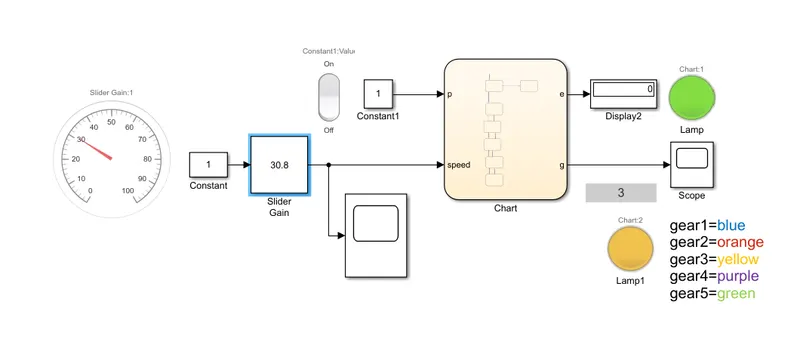
3) let speed changed to 30.8 kmph . as the speed is more than 26 kmph but less than 40 kmph , thus gear 3 must operate. thus lamp is showing yellow color.
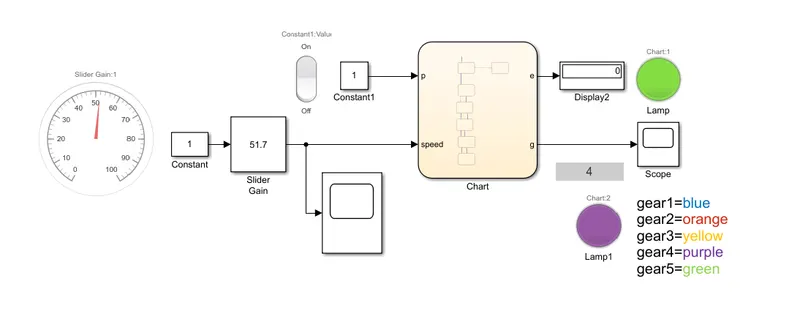
4) let speed changed to 51.7 kmph . as the speed is more than 41 kmph but less than 60 kmph , thus gear 4 must operate. thus lamp is showing purple color.
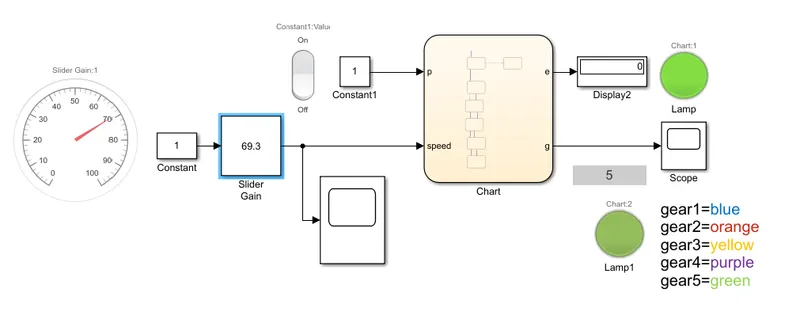
5)let speed changed to 69.3 kmph . as the speed is more than 61 kmph , thus gear 5 must operate. thus lamp is showing green color.
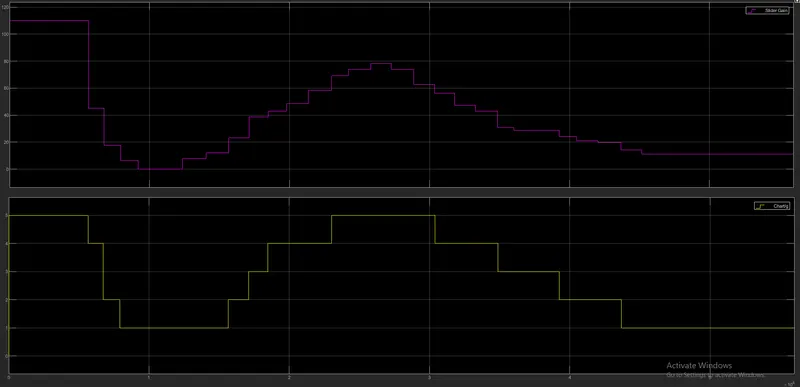
GRAPH IN SCOPE OF INPUT SPEED AND OUTPUT g
Let us give stop time as inf and let start the simulation . now click slider gain block and change speed value by changing the slide.
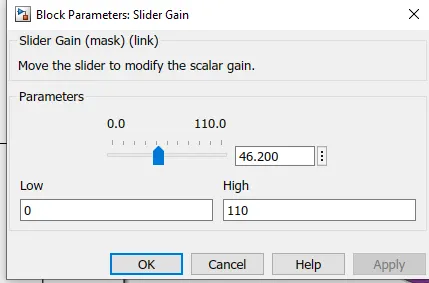
now as speed given as 46.2 , thus gear 4 operates and thus purple lamp will glow.
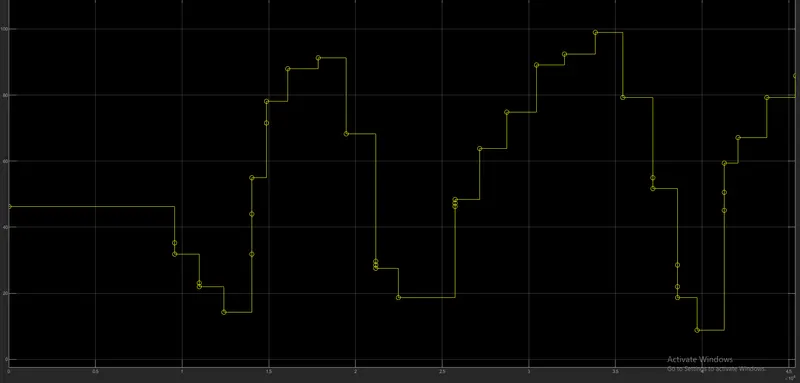
the scope of slider gain block is shown below,
the scope of corresponding output g is shown below
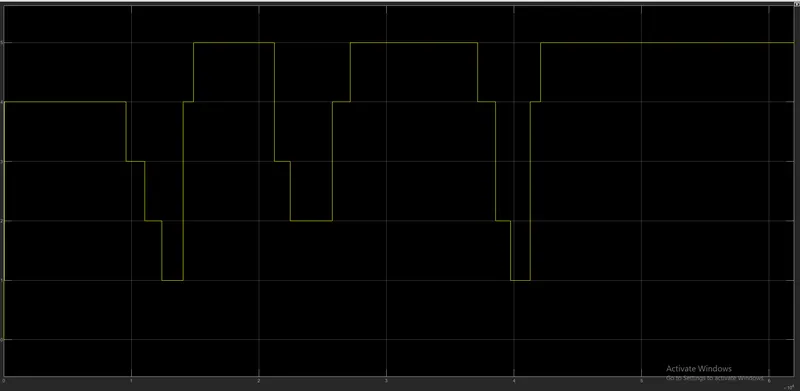
now let display this two graph in same scope. for this some arrangements is done in the model.
CONCLUSION:
thus all objectives are simulated and studied.
REFERENCES:
https://www.royalsundaram.in/blog/car-insurance/all-you-need-to-know-about-car-gears/