Week 4.1 - Genetic Algorithm
GENETIC ALGORITHM
1. AIM:
Write a code in MATLAB to optimise the stalagmite function and find the global maxima of the function.
2. OBJECTIVES:
- Clearly expalin the concept of genetic algorithm in your own words and also explain the syntax for ga in MATLAB in your report.
- Plot graphs for all 3 studies and for F maximum vs no. of iterations.
3. THEORY:
The genetic algorithm is a method for solving both constrained and unconstrained optimization problems that is based on natural selection, the process that drives biological evolution. The genetic algorithm repeatedly modifies a population of individual solutions. At each step, the genetic algorithm selects individuals at random from the current population to be parents and uses them to produce the children for the next generation. Over successive generations, the population "evolves" toward an optimal solution. You can apply the genetic algorithm to solve a variety of optimization problems that are not well suited for standard optimization algorithms, including problems in which the objective function is discontinuous, nondifferentiable, stochastic, or highly nonlinear. The genetic algorithm can address problems of mixed integer programming, where some components are restricted to be integer-valued.
4. PHASES OF GENETIC ALGORITHM:
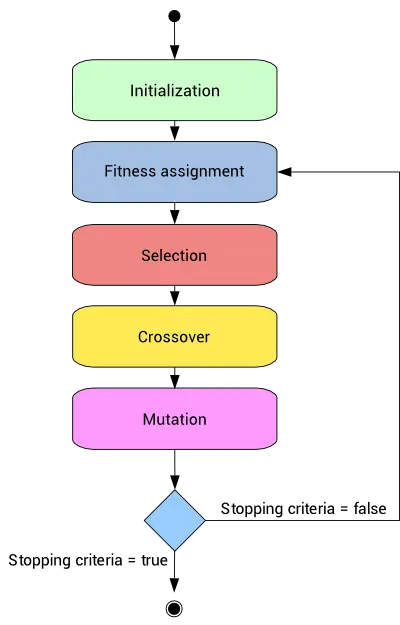
- Initialization of population:
The code generates its random population of defined size and from that population the code evaluates the fitness of the members of the population according to which it forms new population based on no. of iterations performed.
- Fitness Assignment:
It is that function which we have to optimize and its optimization is done with the help of number of generations which have been formed by the code accordance with the fitness value of each member generated, these fitness values are used for the reproduction of the children.
- Selection:
The idea of the selection phase is to select the fittest individuals and let them pass their genes to the next generation. The main goal of this phase is to find the region where the chances of getting the best solution are more. Inspiration for this is from the survival of the fittest. It should be a balance between exploration and exploitation of search space. GA tries to move the genotype to higher fitness in the search space. Too strong fitness selection bias can lead to sub-optimal solutions. Too little fitness bias selection results in unfocused search.
- Crossover:
Crossover is the most significant stage in the genetic algorithm. During crossover, a random point is selected while mating a pair of parents to generate offspring.
- Mutation:
In a few new offspring formed, some of their genes can be subjected to a mutation with a low random probability. This indicates that some of the bits in the bit chromosome can be flipped. Mutation happens to take care of diversity among the population and stop premature convergence.
- Termination:
After a number of iterations through the phases of the algorithm, the process terminates based on certain defined termination criteria. at this stage the optimal solution is reached.
Syntax for ga:
fun Fitness function
nvars Number of design variables
Aineq A matrix for linear inequality constraints
Bineq b vector for linear inequality constraints
Aeq Aeq matrix for linear equality constraints
Beq Beq vector for linear equality constraints
1b Lower bound on x
ub Upper bound on x
FORMULA USED:
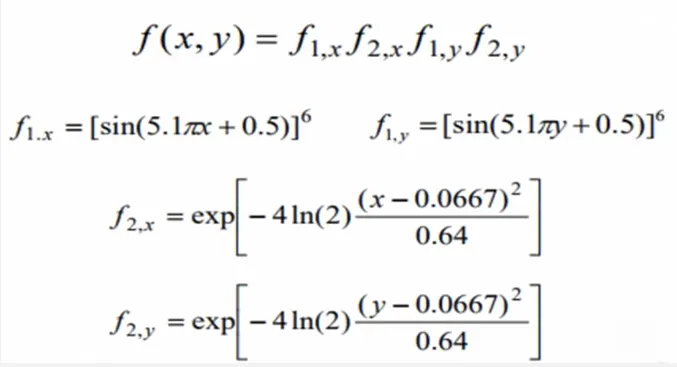
where , the above equations are used in the stalagmite function to plot the graph in the main functions.
5. PROGRAMS
code 1: Function program
function [f] = stalagmite(input_vector)
x = input_vector(1);
y = input_vector(2);
f1_x = (sin(5.1*pi*x+0.5))^6;
f1_y = (sin(5.1*pi*y+0.5))^6;
f2_x = exp(-4*log(2)*((x-0.0667)^2)/0.64);
f2_y = exp(-4*log(2)*((y-0.0667)^2)/0.64);

f = -[f1_x,f1_y,f2_x,f2_y];

end
While using the function at the end as we are using the -ve sign so that the plot will be reversed as we have to find the maxima of the given function using ga.
code 2: Main program
clear all
close all
clc
%defining our search space
x = linspace(0,0.6,150);
y = linspace(0,0.6,150);
%creating a 2D mesh
[xx yy] = meshgrid(x,y);%evaluating the stalagmite function
for i = 1:length(xx)
    for j = 1:length(yy)
        input_vector(1) = xx(i,j);
        input_vector(2) = yy(i,j);
       f(i,j) = stalagmite(input_vector); %values of function in given search space
    end
end
%study1-statistical behaviour
%calculating the time for the study by placing tic and toc
tic
num_cases = 50; %Number of itreation for which the function will evaluate the fitness

for i=1:num_cases
    [inputs,fopt(i)] = ga(@stalagmite,2); %calculating the optimized value of the function
    xopt(i) = inputs(1);
    yopt(i) = inputs(2);
end

study1_time = toc %displaying the time taken to evaluate
%plotting the graph
figure(1)
subplot(2,1,1)
hold on
surfc(xx,yy,-f)
shading interp
plot3(xopt,yopt,-fopt,'marker','o','markersize',5,'markerfacecolor','r');
title('Unbounded Inputs');
subplot(2,1,2)
plot(-fopt)
xlabel('Iteration');
ylabel('Function-Maximum');
%study2- statistical behaviour - with upper and lower bounds
tic

for i = 1:num_cases;
    [inputs, fopt(i)] = ga(@stalagmite,2,[],[],[],[],[0;0],[1;1]);
    xopt(i) = inputs(1);
    yopt(i) = inputs(2);
end

study2_time = toc
%plotting
figure(2)
subplot(2,1,1)
hold on
surfc(xx,yy,-f);
shading interp
plot3(xopt,yopt,-fopt,'marker','o','markersize',5,'MarkerFaceColor','r');
title('Bounded Inputs');
subplot(2,1,2);
plot(-fopt);
xlabel('Iteration');
ylabel('Function-Maximum');
%study3 - increasing GA iteration
tic

for i =1:num_cases;
    [inputs,fopt(i)]=ga(@stalagmite,2,[],[],[],[],[0;0],[1;1],[],[],options);
    xopt(i) = inputs(1);
    yopt(i) = inputs(2);
end

study3_time = toc
%plotting
figure(3)
subplot(2,1,1);
hold on
surfc(xx,yy,-f);
shading interp
plot3(xopt,yopt,-fopt,'marker','o','markersize',5,'markerfacecolor','r');
title('Bounded Inputs with Increase Population Size');
subplot(2,1,2);
plot(-fopt);
xlabel('Iteration');
ylabel('Function-Maximum');
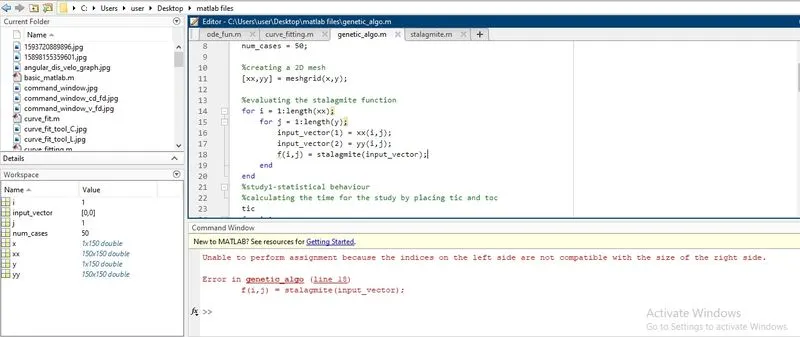
Error faced while proramming:
Reference: