Week 4.1 - Genetic Algorithm
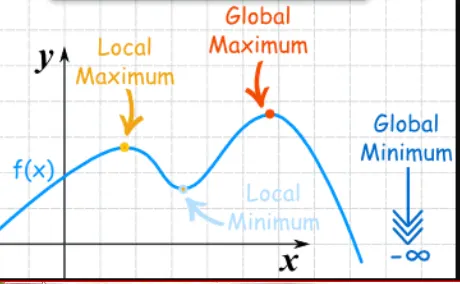
Write a code in MATLAB to optimise the stalagmite function and find the global maxima of the function.
clear all
close all
clc

 %Definng our our search space
 x=linspace(0,0.6,150);
 y=linspace(0,0.6,150);

 %Creating a 2Dimentional mesh
 [xx,yy]=meshgrid(x,y);

 %Evaluating the stalagmite function
 for i=1:length(xx)
 for j=1:length(yy)
         input(1)=xx(i,j);
         input(2)=yy(i,j);
         f(i,j)=stalagmite(input);
 end
 end

 %Converting Fitting function to change the graph upwards
 F=-f;

 %Plotting Stalagmite Function
 surface(xx,yy,F);

 %Shading interp;
 hold on;

 %Perfoming the genetic algorithm
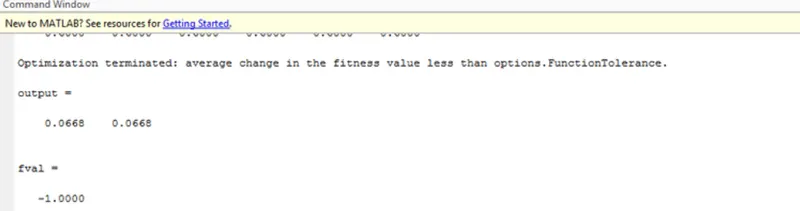
 [output,fval]=ga(@stalagmite,2,[],[],[],[],[0,0],[0,6,0.6])

 %Plotting global maxima
 x_max=output(:,1);
 y_max=output(:,2);
 f_max=-fval;
 plot3(x_max,y_max,'marker','o','markersize',5,'markerfacecolor','r');
 xlabel('X-value');
 ylabel('Y-value')
 title('Global Maxima');
 legend('STALAGMITE','GLOBAL MAXIMA')
Clearly expalin the concept of genetic algorithm in your own words and also explain the syntax for ga in MATLAB in your report
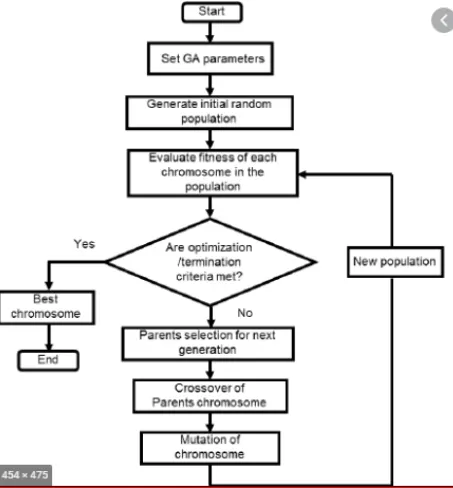
Genitic algorithm
-Inspired by Charles Darwin's theory of natural selection
-The algorithm reflects the process of natural selection where the fittest individual is selected for reproduction in order to produce offspring of the next generation.
In computer science ,operations research , a genetic algorith are commonly used to generate high-quality solutions to optimisation and search problems .
Governing equations
`f_1(x)=[sin(5.1*pi*x+0.5)]^6`
`f_1(y)=[sin(5.1*pi*y+0.5)]^6`
`f_2(x)=(e^(-4*log2*(x-0.0667)^2 ))/0.64`
`f_2(y)=(e^(-4*log2*(y-0.0667)^2 ))/0.64`
`f(x,y)=f_1(x)*f_1(y)*f_2(x)*f_2(y)`
Maximising f(x,y) is the same as minimising -f(x,y)
ga syntax
X=ga(fun,nvars,A,b,beq,lb,ub)
-first syntax gives ga takes inputs as fitting equation
-Second syntax provides bounds to ga
-Third syntax gives value for x as well as functiom minimum value.

Output
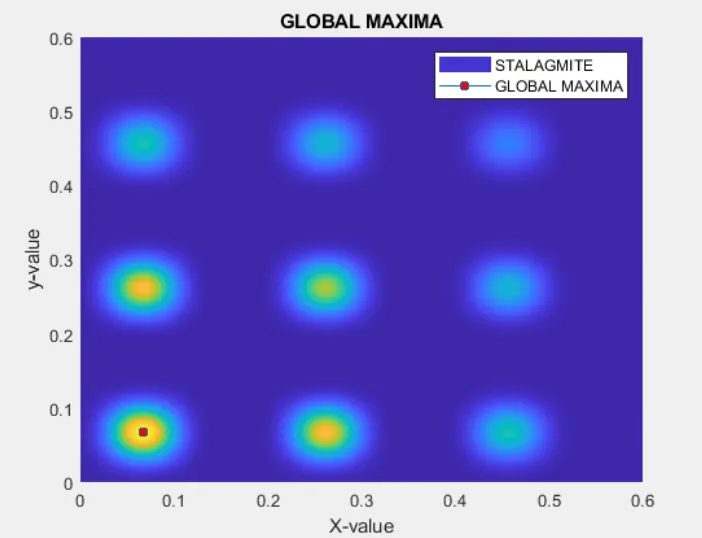
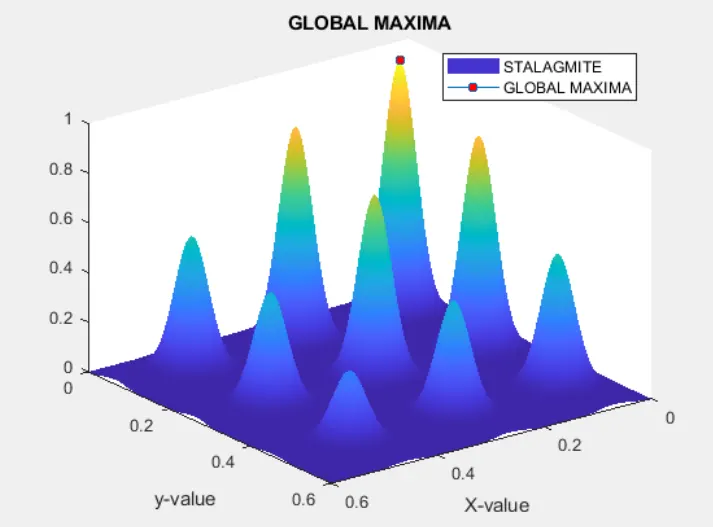
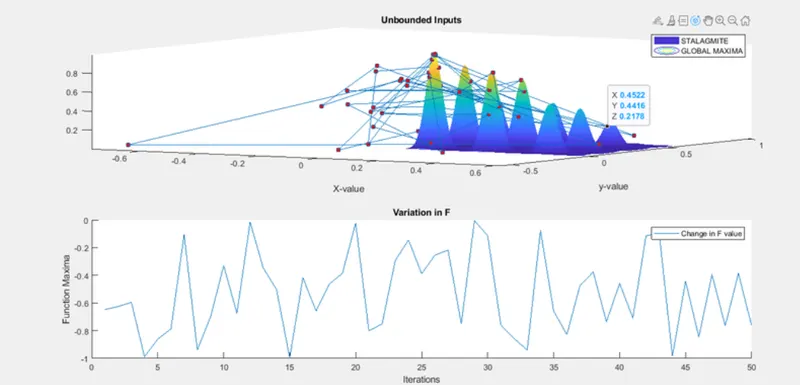
Statistical Behavior
% Statistical Behaviour
clear all
close all
clc

% Defining our Search Space

X=linspace (0,0.6,150);
y=linspace(0,0.6,150);

num_case = 50;

% Creating 2-d Array
[xx,yy] = meshgrid(x,y)

% Calculating Fitting Function

for i = 1:length(xx);
for j=1:length(yy);
input (1)= xx(i,j);
input (2) = yy(i,j);
f(i,j)=stalagmite_func (input);

end

end

% Converting Fitting Function to change the graph upwards

F = -f;
% Performing the Genetic Algorithm

tic

for k=1:num_case

[inputs, fopt (k)] = ga(@stalagmite_func,2);

xopt (k) = inputs(1);

yopt (k) = inputs(2);

end

study_time=toc

% Plotting Global Maxima And Function Values

figure(1)

subplot(2,1,1)

hold on

surfc(x,y,F)

shading interp

plot3(xopt, yopt, -fopt, 'marker', 'o', 'markersize',5, 'markerfacecolor', 'r');

xlabel ('X-value');

ylabel ('y-value');

title('Unbounded Inputs');

legend('STALAGMITE', 'GLOBAL MAXIMA')

subplot(2,1,2)

hold on

plot (fopt)

xlabel ('Iterations');

ylabel ('Function Maxima');

title('Variation in F'); legend('Change in F value')
Results