Week 3 Verification of Weld Joints
Objective:
Objective of the work is to simulate Weld joint simulation using three different materials like Stainless stell, Aluminium wrought and Copper as a material for the different geometry and carry out a static structural analysis to find out Total deformation, Equivalent strain and Maximum equivalent stress for the weld joints. After getting all the result need to analyse and compare the results of the three cases and conclude which is the optimum material selection among all for weld joints.
Experimental Procedure:
To carry out Static structural analysis on Ansys workbench, several steps has been followed.
Case-1
- Engineering Data: This is the first step, where we have to select the material on which the analysis would be carried out. For the Case-1, Stainless Steel has been chosen for all the geometry.
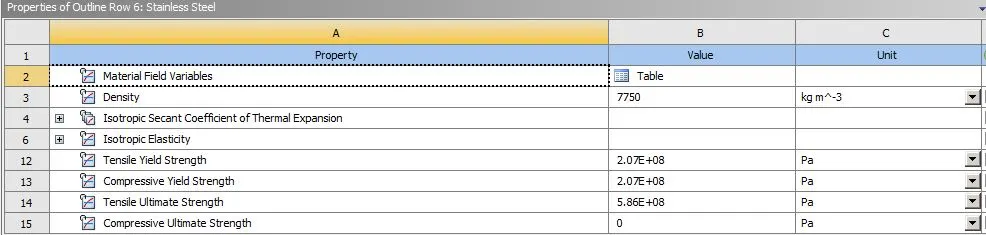
- Import Geometry: After assigning the base material of the geometry, the model has been imported in Ansys.
- Model: This step is the major step of Analysis. After importing the model, need to click on “Edit” to open the “Model Window” where we can assign several constraint and Boundary condition.
Step-1(Geometry): Under geometry click on the imported model and assign the material individually. For Case-1, all geometry should be in Stainless steel.
Step-2 (Connections): Under Connection have to insert “Contacts”, need to click Contacts group and assigned Rename based on definition and then have to assign “Frictional Contacts” to the plates and ribs and Bonded has been kept to all weld joints..
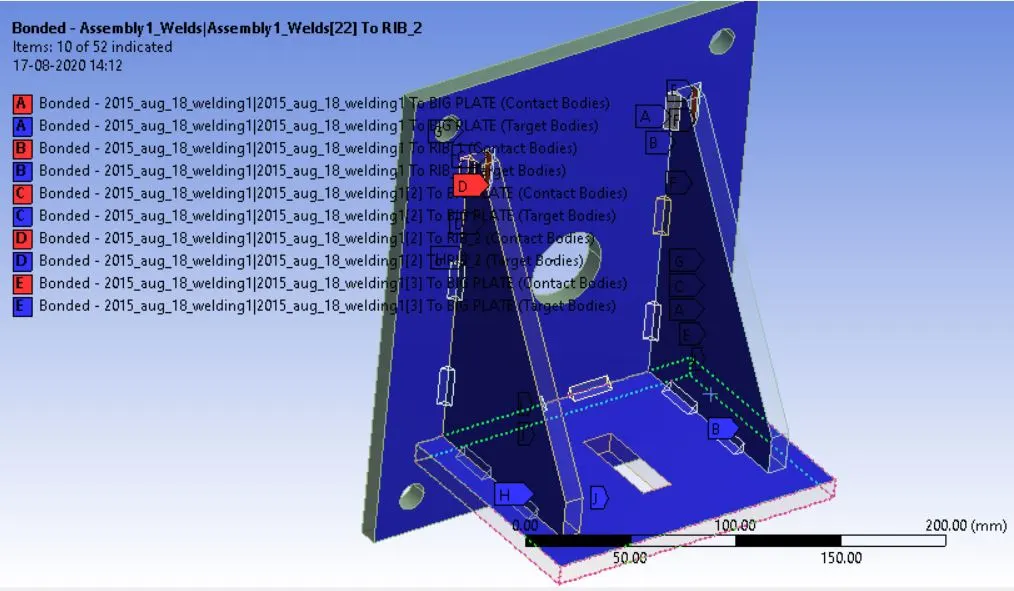
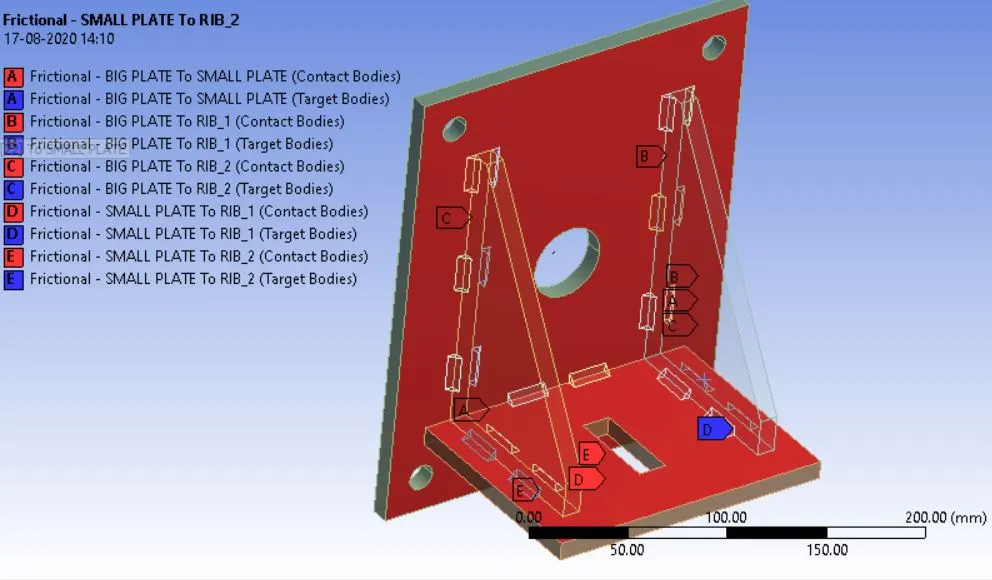
Mesh: For Global mesh setting, Element size as Default size has been chosen and Body sizing has been kept for Big & small plate
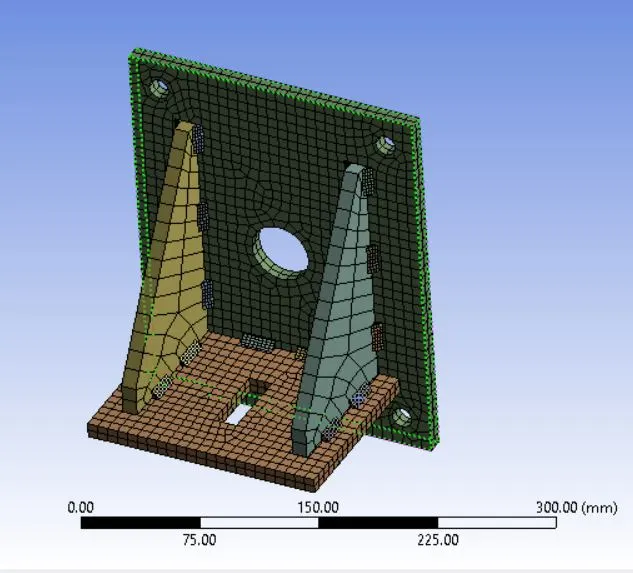
Static Structural:
Step-1 (Analysis Setting): Under Analysis setting several parameters have been modified according to the problem. No. of Steps kept as 1, Auto Time Stepping kept as off, In Solver Controls, large deflection has been kept ON and other parameters as program controlled and all output parameters also have been kept as Programmed Controlled.
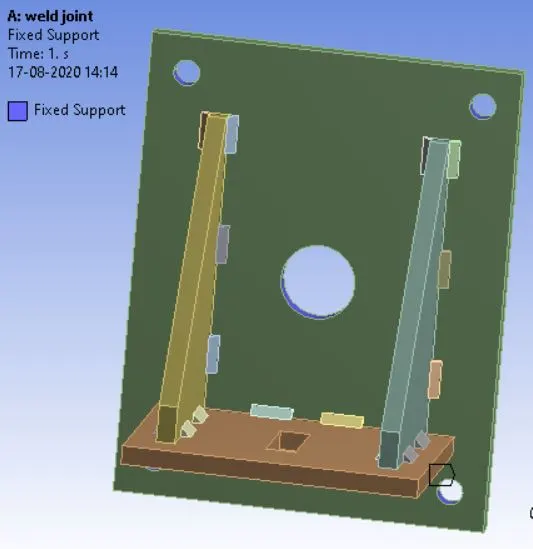
Step-2 Need to Assign the Fixed Support at all the holes in large plate.
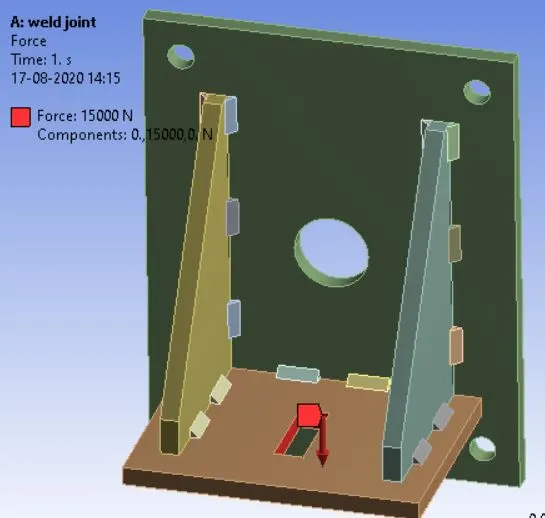
Step-3 (Contact Tool): 15000 N load has been applied at the square cut on Smaal plate. Load has been applied on Positive Y axis.
Solution: To get the result as per the objective of the work have to insert Equivalent Stress for Weld joints, Total Deformation and Equivalent strain.
- Solve: To obtain the result click on Solve.
*** The same procedure has been followed up for the Case-2 and Case-3 (Only the material has been changed according to the Case2 & Case3 requirements).
For, Case-2: Aluminium Alloy: The material has been be chosen for this case is Aluminium alloy(high strength, wrought) and for, Plate material stainless steel has been kept.

For, Case-3: Bronze: In order to simulate "Brazing", bronze has been chosen for the weld material. Stainless Steel to both plates and Copper to the "Ribs" has been kept.


Result & Discussion:
Case-1 (Material: Stainless Steel)
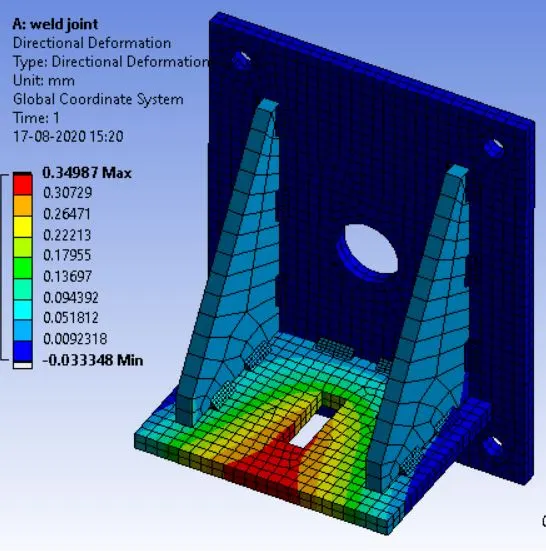
- Total Deformation: The maximum deformation result got 0.34987mm and Minimum deformation: -0.033348 mm.
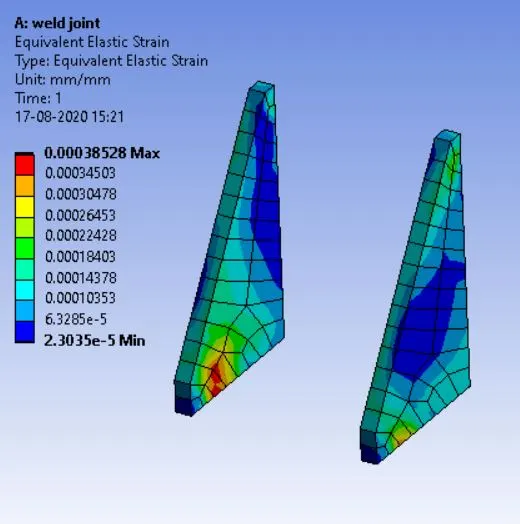
- Equivalent Strain: Maximum Strain: 0.00038528 mm/mm. and Minimum Strain: 2.3035e-5
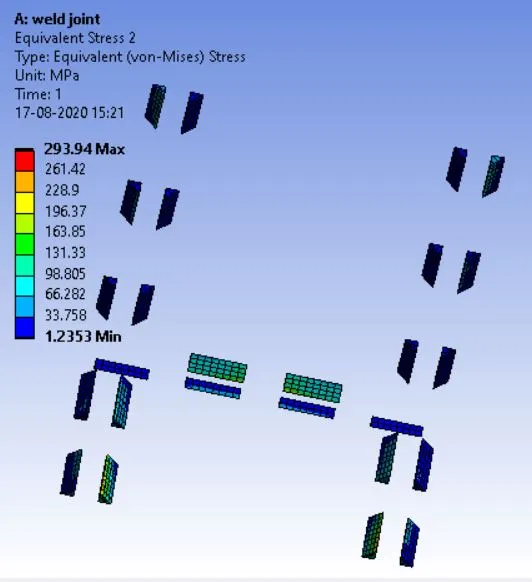
- Maximum Equivalent Stress for Weld Joints: Maximum Stress Intensity: 293.94 Mpa
Case-2 (Stainless Steel for plate & Wrought Aluminium Alloy for Ribs and welds)
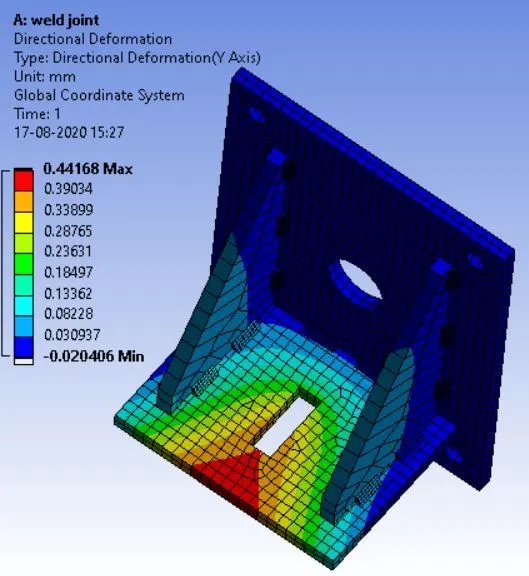
- Total Deformation: The maximum deformation result got 0.44168mm and Minimum deformation: -0.020406 mm.
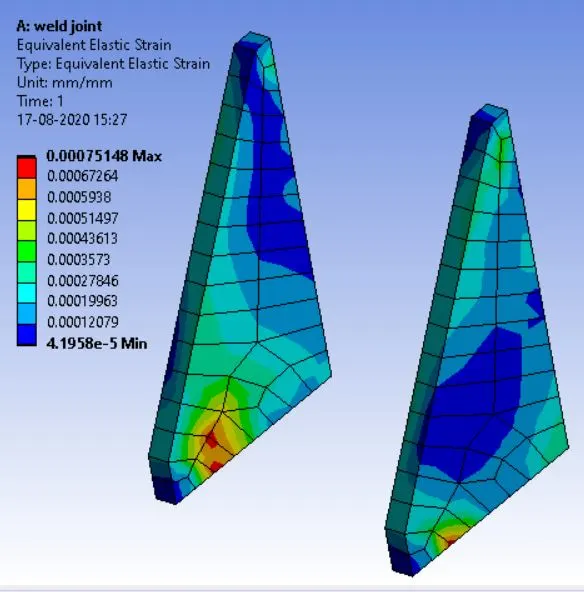
- Equivalent Stress: Maximum Strain: 0.00075148mm/mm and Minimum Strain: 4.1958e-05
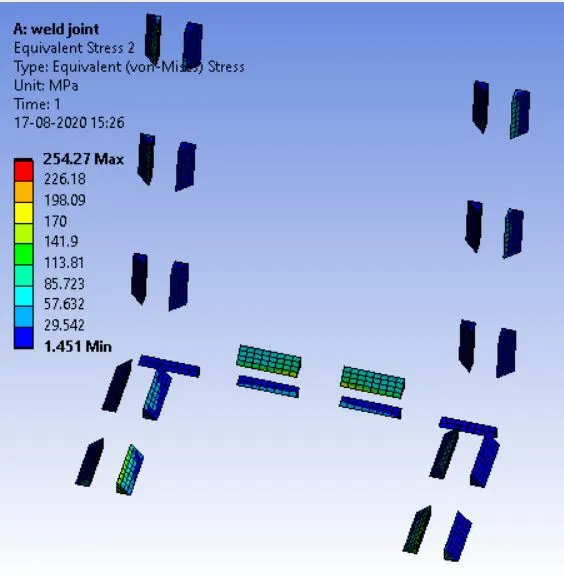
- Maximum Equivalent Stress for Weld Joints: Maximum Stress Intensity: 254.27 Mpa
Case-3 (Bronze for Welds, Stainless steel for Plates & Copper for Ribs)
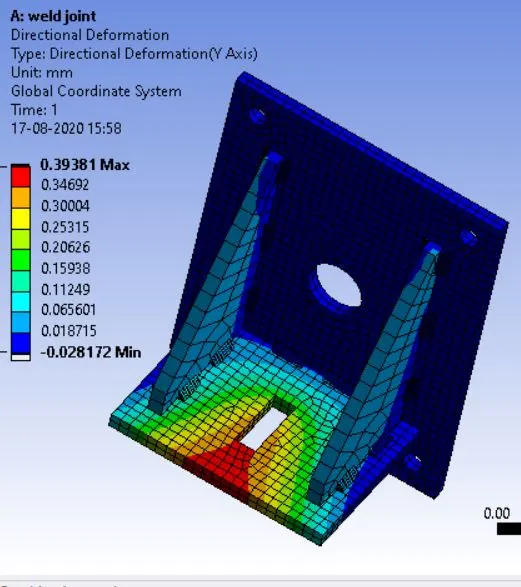
- Total Deformation: The maximum deformation result got 0.39381mm and Minimum deformation: -0.028172 mm.
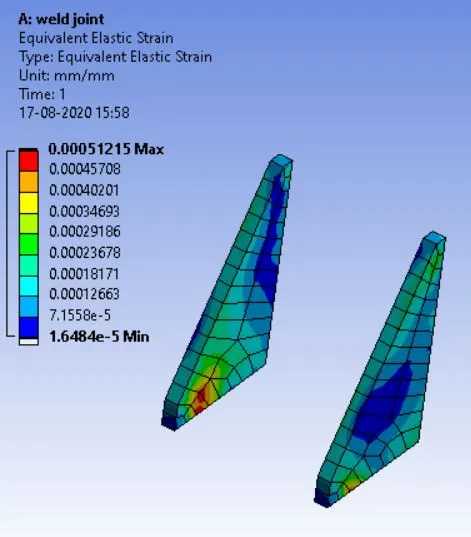
- Equivalent Stress: Maximum Strain: 0.00051215 mm/mm and Minimum Strain: 1.6484e-05
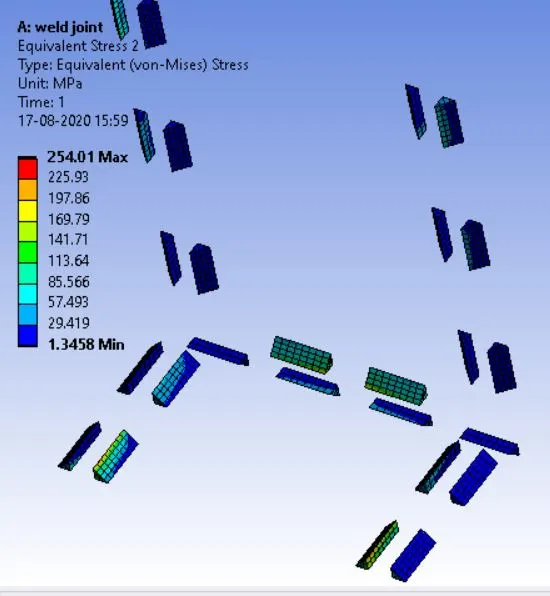
- Maximum Equivalent Stress for Weld Joints: Maximum Stress Intensity: 254.01 Mpa
Analysis on all three cases:
In all the three cases Both Big and small plate have the same material as structural steel. Only Ribs and Joints material has been changed.
- The Maximum Equivalent Elastic strain (0.00075148 mm/mm) has been found in CASE-2. The Minimum Equivalent Elastic strain (0.00038528 mm/mm) has been found in CASE-1.
- The Maximum Directional Deformation value (0.44168 mm)has been found in Case-2. The Minimum Directional Deformation value (0.34987 mm)has been found in Case-1.
- The Maximum Equivalent Stress (293.94 Mpa) for Weld Joint has been found on Case-1 and The Minimum Equivalent Stress (254.01 Mpa) for Weld Joint has been found on Case-3
Conclusion:
Though Directional deformation results and Equivalent elastic strain results are very close to each other in all three cases but the Equivalent Stress for Weld joint has been varied significantly in all three cases. But in Case-2 and Cse-3 the Equivalent stress result is almost same. Here we can see that in Case -2, for Ribs & welds Aluminium has been used and in Case-3, for Ribs as Copper and Bronze as Weld have been used, which gives almost same Stress result for weld joint. Because in both cases the materials is soft in nature and highly non linear in nature, means they have high plastic zone which can with stand more energy. But in Case-1, using structural steel as base material for all the geometry, it's subjected to more stress, because Stainless Steel is hard material compared to Aluminium, Copper and Bronze and compratively less non-linear in nature.
Stainless Steel is hard material, so it subjected more Elastic strain and Directional deformation compared to the soft material used in Case-2 & Case-3.