Week 3 - Solving second order ODEs
aim:- to attain 2nd Order ODEs of a given pendulum
A simple pendulum consists of a point mass suspended on a string or wire that has neglible mass.
if the pendulum weight or bob is pulled to a relatively small angle from the vertical and let go, it will oscillates to and fro at the regular period and frequency.
Let s(t) be the distance along the arc from the lowest point to the position of the bob at time t, with displacement to the right considered positive.
let theta(t) be the corresponding angle with respect to the vertical. The pendulum is tangential and radial components of the gravitational force on the pendelum bob. The radial components is exactelly balanced by the force exerted by the string,so th only relevant force producing the motion is tangential component of the gravitationalforce. For the moment we ignore the damping force if any.
An ordinary differential equation (ODE) is differential equation containing one or more functions of one independent variable and the derivatives of those functions.The ODE equation.
specifications
g = gravity in m/s2,
L = length of the pendulum in m,
m = mass of the ball in kg,
b=damping coefficient.
assuming the given data:-
time 0-20 sec
L=1 metre,
m=1 kg,
b=0.05.
g=9.81 m/s2.
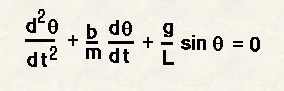 -----(a)
`theta = theta1`
i.e. dtheta/dt = dtheta1=theta2 ------(1)
d^2theta/dt = d^2theta1/dt^2 = (d/dt)(dtheta1/dt) = dtheta2/dt --------------(2)
by substuting 1 & 2 equation you will get the equation 'a'.