Week 3 Sheet metal Bending challenge
OBJECTIVE:
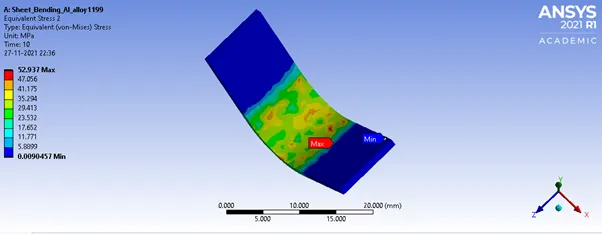
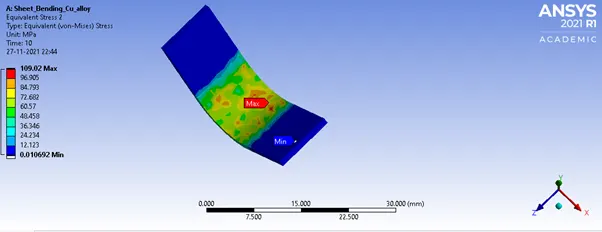
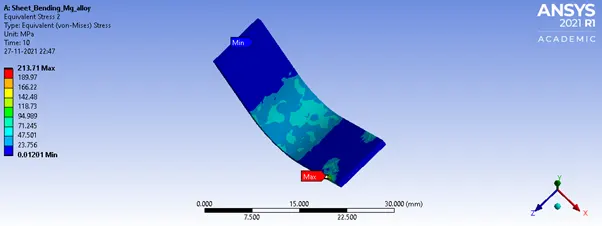
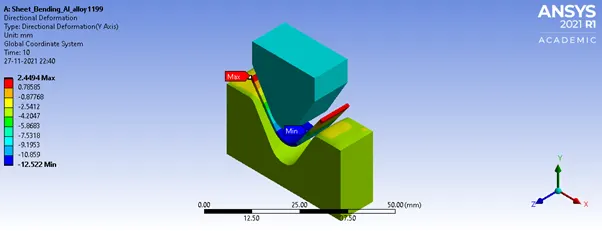
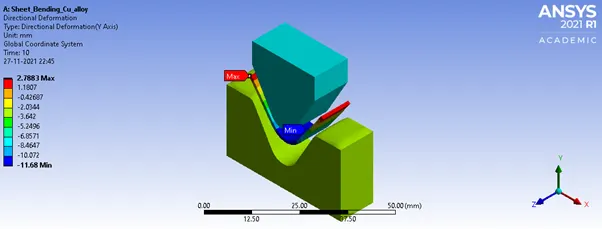
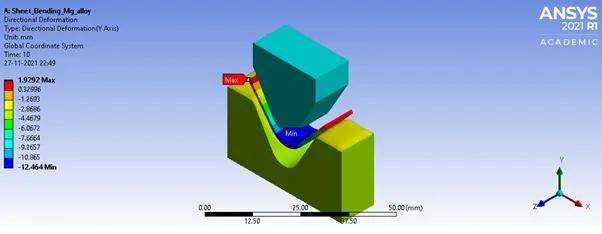
Case1: To compare the equivalent stress, equivalent elastic strain and total deformation in Y direction for sheet metal bending with three different materials: Aluminium alloy 1199, Copper alloy NL, Magnesium Alloy NL.
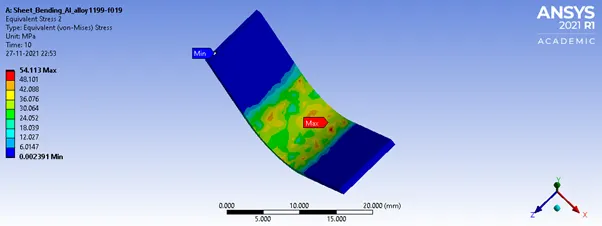
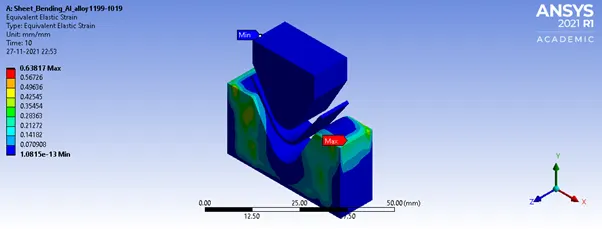
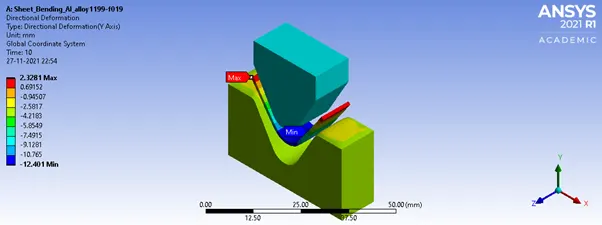
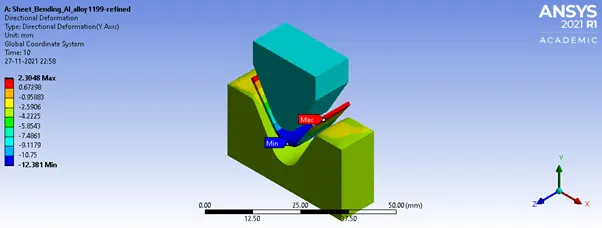
Case2: To compare the equivalent stress, equivalent elastic strain and total deformation in Y direction for sheet metal bending with Aluminum alloy 1199 with friction values of 0.1 and 0.19.
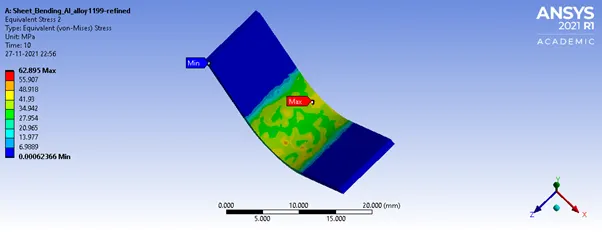
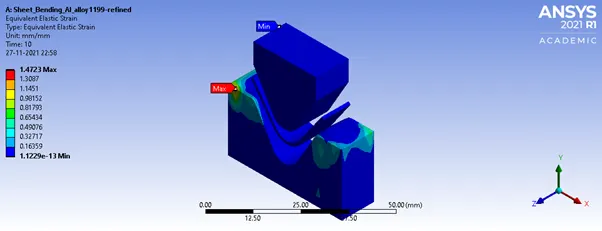
Case3: To compare the equivalent stress, equivalent elastic strain and total deformation in Y direction for sheet metal bending with Aluminum alloy 1199 with different mesh size.
ANALYSIS SETTINGS:
Steps = 10
For all steps,
Large deflection = ON
Stabilization = Constant
Energy Dissipation ration = 0.1
Solver Type = Direct
Mesh Size = 1mm for the sheet, 4mm for the punch and die, 1mm for contact faces
Punch Displacement:
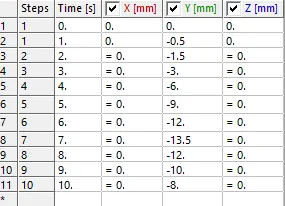
Die Displacement:
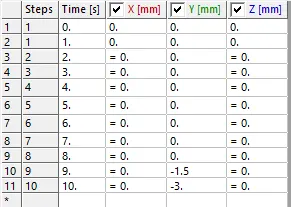
Sheet constrained in Z-direction
RESULTS:
Case1:
|
Eq. Stress (MPa) on plate |
Eq. Strain |
Y-deformation (mm) |
|
|
Aluminium alloy 1199 |
52.937 |
1.2146 |
-12.522 |
|
Copper alloy NL |
109.02 |
1.0106 |
-11.68 |
|
Magnesium alloy NL |
213.71 |
0.84413 |
-12.464 |
Equivalent Stress:
Eq Strain:
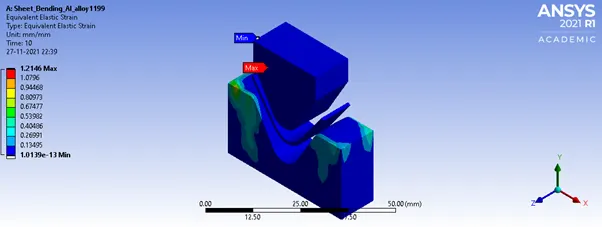
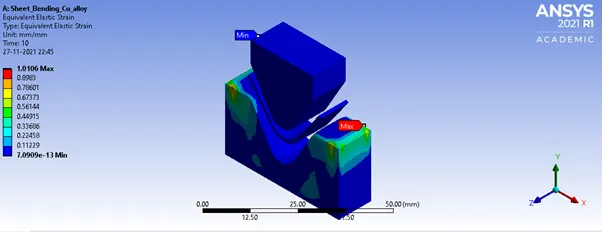
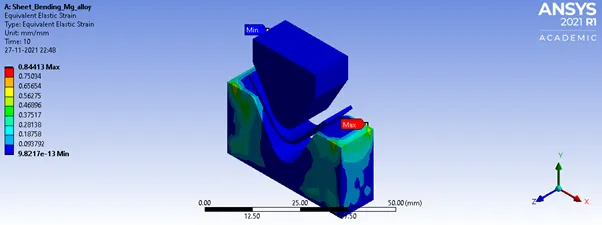
Y-deformation:
Case2:
|
Eq. Stress (MPa) on plate |
Eq. Strain |
Y-deformation (mm) |
|
|
Aluminium alloy 1199, f=0.1 |
52.937 |
1.2146 |
-12.522 |
|
Aluminium alloy 1199, f=0.19 |
54.113 |
0.63817 |
-12.401 |
Equivalent Stress:
Eq Strain:
Y-deformation:
Case3:
|
Eq. Stress (MPa) on plate |
Eq. Strain |
Y-deformation (mm) |
|
|
Aluminium alloy 1199, mesh = 1mm |
52.937 |
1.2146 |
-12.522 |
|
Aluminium alloy 1199, mesh = 0.8mm |
62.895 |
1.4723 |
-12.381 |
Equivalent Stress:
Eq Strain:
Y-deformation:
CONCLUSION:
Case1: The Y-deformation has increased from Aluminum alloy to Copper alloy to Magnesium alloy. The eq.stress is more for magnesium alloy than aluminium alloy. The young's modulus and yield strength are the major properties which affect this.
Case2: The eq stress is slightly increased and y-deformation is slightly decreased when friction is changed from 0.1 to 0.19.
Case3: The eq.stress is increased considerably when mesh size of the plate is changed from 1mm to 0.8mm. Further grid dependency test has to be performed.
NOTE: Not able to upload the result files