Week 3 Sheet metal Bending challenge
**Sheet Metal Bending anslysis using Ansys**
Objective: perform the sheet metal bending for different materials and settings.
- Case1: aluminium alloy 1199(with som changes in properties), copper alloy NL, magnesium alloy NL . find out the equivalet stress , equivalent elastic strain and total deformation in Y direction and compare the results.
- Case2: With the material as Aluminium alloy change the friction coefficient to 0.19 and run the analysis mentioned in case1 . compare the results with that in case1
- Case3: refine the mesh on the plate. With aluminium alloy as material, run the analysis in case 1 and compare the results.
Procedure:
Model:
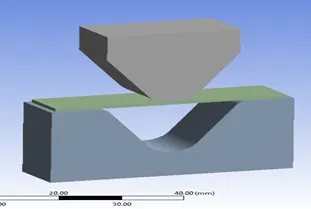
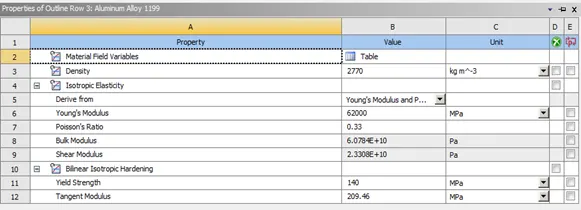
- Create the static structural analysis and in engineering data select the material AL alloy 1199 , copper alloy NL and mg alloy NL from non-linear materials and change the material properties of Aluminium alloy 1199(rename)
Aluminium alloy 1199:
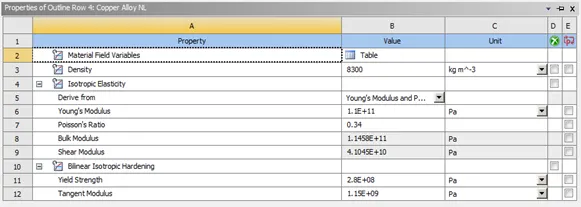
Copper alloy NL:
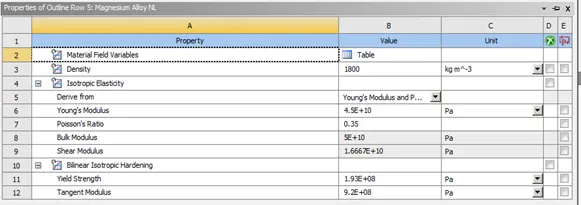
Magnesium Alloy NL:
- Importing the geometry and check in spaceclaim for any irregularities.
- The open ansys mechanical and rename the geometry and assign the material according to the cases
PUNCH – structural steel
DIE - structural steel
SHEET - aluminium alloy 1199
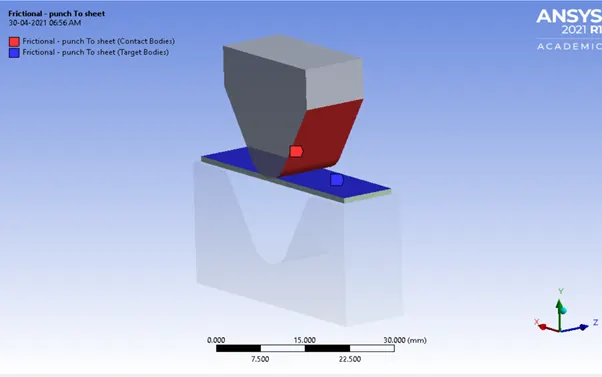
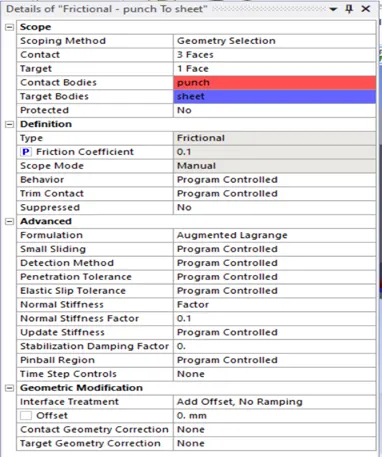
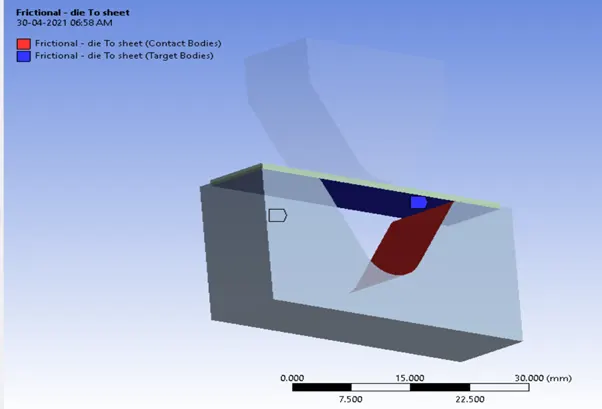
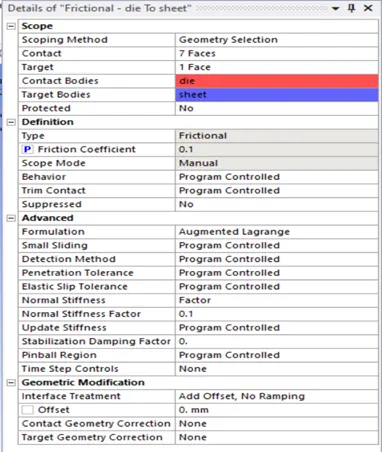
- Contacts: two contacts are created
Contact 1
Contact 2:
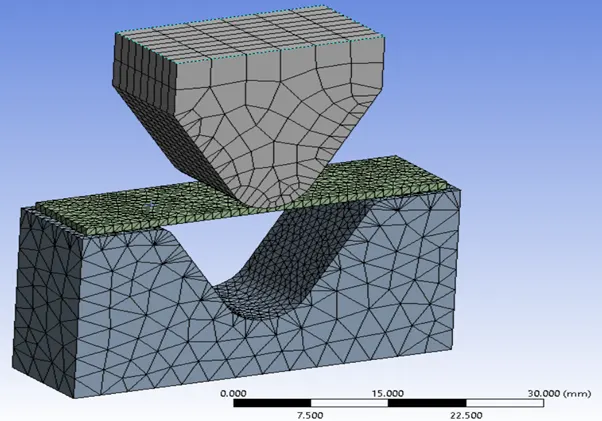
Mesh: mesh the model with different mesh options . using body size options for punch and die and meshed with 4mm element size.
Similarly for sheet the body sizing is used and mesh in element size of 1mm and patch conforming method is used for tetrahedrons meshing.
Using the face sizing option faces of punch and die are meshed with 1mm of element size.
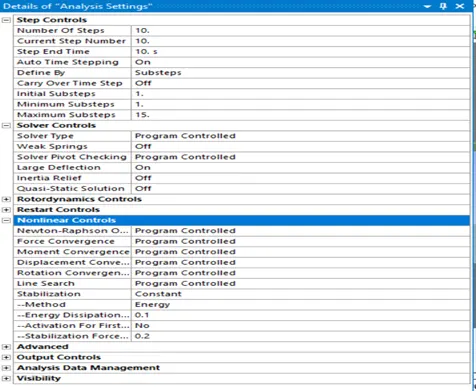
Analysis settings: increased the maximum substeps to 15 to avoid errors and get the results.
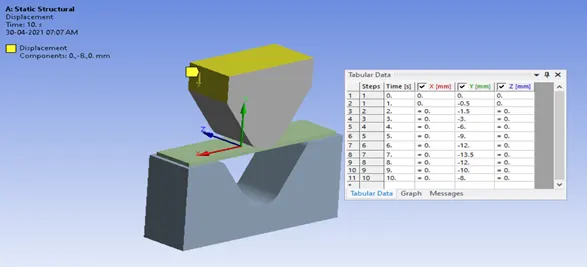
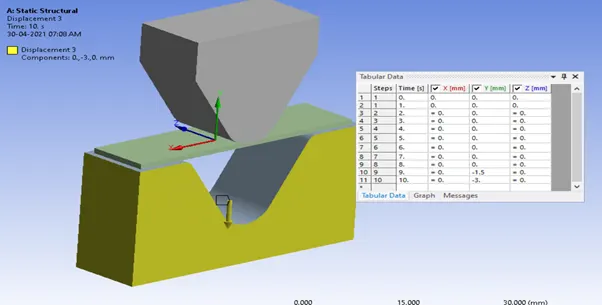
Three displacements are added for the model for the 3 parts.
Displacement 1 to punch: x, y and z are given with tabular components , given 0 as value in x and z direction because of deformation only in y direction.
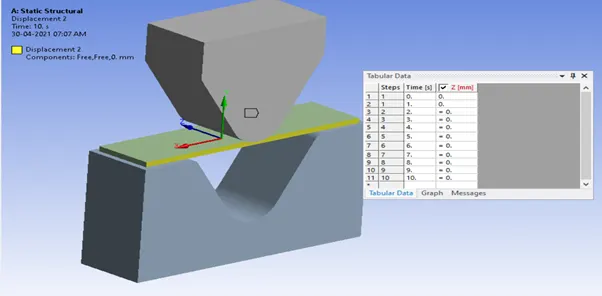
Displacement 2 to sheet side faces in z direction: x and y are given as “ free” and z is given as tabular values and given zero for all to not deform in z direction. Sheet is free to move in x and y directions.
Displacement 3: given to the die surfaces expect to the top surface, shown in fig.
RESULT:-
Case 1:
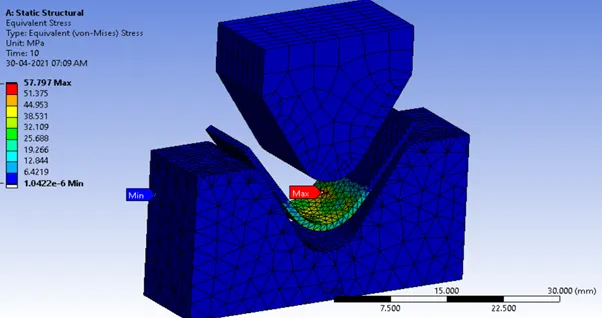
alloy aluminium 1199
equivalent stress max _57.797 MPa
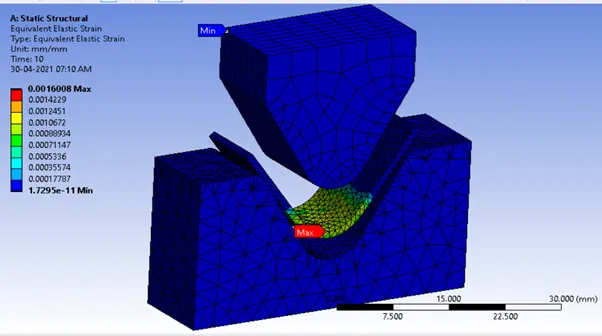
Equivalent elastic strain max _0.0016008 mm/mm
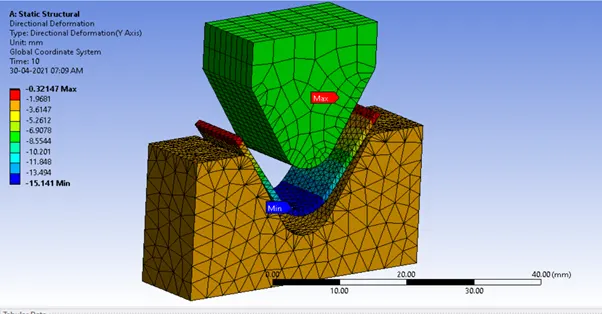
Total directional deformation _ -0.32147mm
Copper alloy NL :-
Equivalent stress_ 118.03MPa
Equivalent elastic strain_ 0.0017859mm/mm
Total deformation(y-direction)_ 6.3828mm
Magnesium Alloy NL:-
Equivalent stress_ 77.027MPa
Equivalent elastic strain_ 0.0028333mm/mm
Total deformation(y-direction)_ 5.8548mm
PARAMETERS TABLE:-

CASE 2:-
With the material as aluminium alloy 1199 change the friction coefficient to 0.19 and with case 1
As shown in the parameters table
Equivalent stress_ 58.616MPa
Equivalent elastic strain_ 0.0015953mm/mm
Total deformation (y-direction)_ -0.4274mm
Case3:-
Refine the mesh on the plate with Aluminium alloy as material. The mesh size is reduced to 0.6mm in the place of 1mm. and the results are shown in the parameters table.
Equivalent stress_ 77.557MPa
Equivalent elastic strain_ 0.0016875mm/mm
Total deformation (y-direction)_ -0.32338mm
Conclusion:-
Case1:-
For all the materials Aluminium alloy 1199 developed stress , strain and deformation are lower as compared to the other materials like copper alloy NL and Magnesium alloy NL.
so among the materials Aluminium alloy 1199(change in properties ) is the best one to choose.
Case2:-
Using Aluminium alloy 1199 with friction coefficient of 0.19 the developed stress , strain and deformation are almost equal when compared to friction coefficient of 0.1 .
Case 3:-
The developed stress is more when the mesh size is reduced to 0.6 mm in place of 1mm for aluminium alloy 1199. So the more we decrease the mesh size the more accurate results we get but the time taken will be more. The strain and deformation values are almost same with slight variation.