Week-3 Challenge: ADVISOR Tool
As we have seen in previous week 1 and 2 and learnt that there are factors which affects the dynamics of vehicle and parameters.
like rolling resistance , drag coefficient, greadibility and many more involves in performance of a vehicle during the trip.
The National Renewable Energy Laboratory (NREL) has developed an advanced vehicle simulator called ADVISOR (Advanced Vehicle Simulator) that can help engineers, researchers, and designers to evaluate the performance and fuel efficiency of various vehicle technologies.
ADVISOR is a MATLAB/Simulink-based software that uses a set of mathematical models to simulate the performance of conventional, hybrid, electric, and fuel cell vehicles. It takes into account the vehicle specifications, drive cycle, and operating conditions to predict the energy consumption, range, emissions, and overall performance of the vehicle.
The ADVISOR software includes a graphical user interface that allows users to input various vehicle and environmental parameters, including vehicle mass, aerodynamic drag, rolling resistance, and road grade. The simulator then calculates the vehicle's energy consumption and emissions based on these inputs and provides users with detailed outputs such as vehicle speed, powertrain efficiency, battery state of charge, and fuel consumption.
ADVISOR is widely used by researchers, engineers, and designers in the automotive industry to evaluate and compare the performance of different vehicle technologies and to optimize vehicle designs for fuel efficiency and emissions reduction. It has also been used in academic research to study the impact of various policies and regulations on the adoption of alternative fuel vehicles.
Overall, ADVISOR is a powerful tool for vehicle analysis and optimization that can help accelerate the development and deployment of advanced vehicle technologies.
QUESTION 1
in advisor tool we choose EV_defaults_in file which is pure electric vehicle with all default parameters except additional cargo mass of 500Kg results in total mass of 1508
question is does vehicle with these parameter make it possible to move 45 km
let's see
in simulator
SSTEP 1
select parameters and specification
we can see in given snapshot 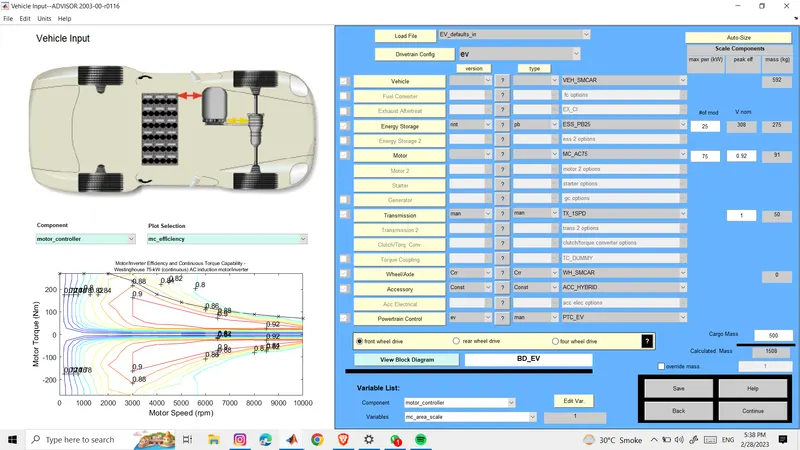
now let it continue and run
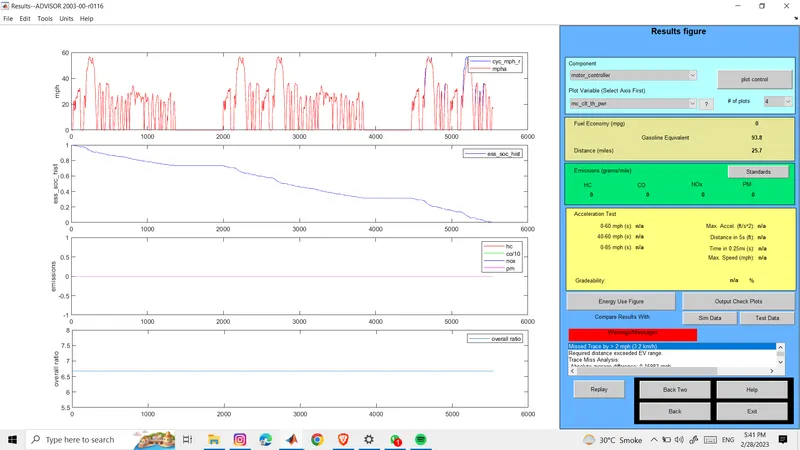
we can see the vehicle runs for 41.36 km which is 25.7 miles <less than 45km because
in second plot of state of charge
there is degradation of the plot till 5460 seconds and the battery life of vehicle goes to 0 at this time and vehcile will gonna be stop at this time and 41.36 km till this point.
QUESTION 2
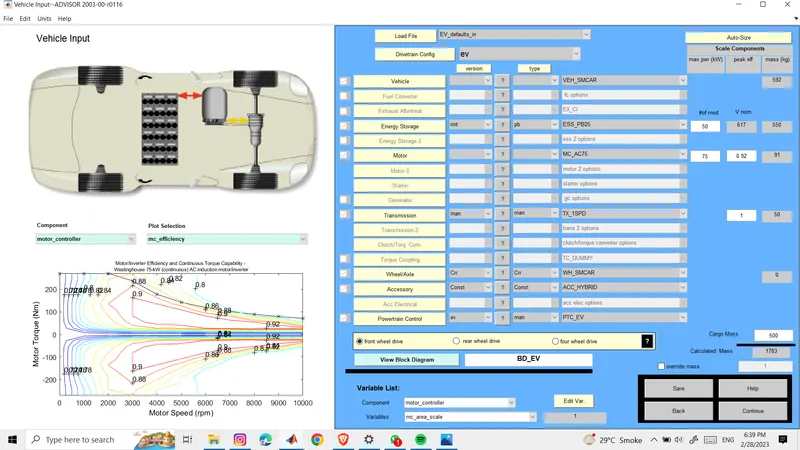
now the task has been changed little bit , we have to double the battery module keeping all values in question 1 same
if we double the value from 25 to 50 lets see what would happen , in given snapshot
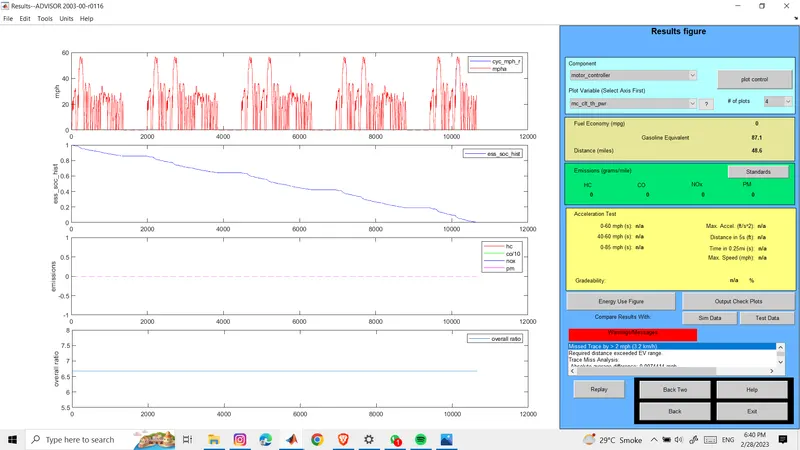
after continue and run we find that vehicle cleared the distance of 48.6 miles or 78.21412km which more than 45 km which is almost the double of distance with 25 battery module.
and the battery goes down to 0 in 10700 seconds which also roughly double and this data can be seen in given screen shot
QUESTION 3
here we check the gradeability of vehicle PRIUS_jpn_defaults_in
but then question arises what is gradeability :
GRADEABILITY TEST: Gradeability test is a type of test performed on a vehicle to determine its ability to climb steep slopes or grades. The test is typically conducted on a slope with a specific angle or gradient, and the vehicle is driven up the slope at a consistent speed until it can no longer maintain forward motion. The gradeability test is useful for evaluating the performance of vehicles that are used in hilly or mountainous terrain, such as trucks, buses, and off-road vehicles.
or the vehicle runs at standard speed of 55miles or 88.5 km with maximum grade percent on slope or inclination
for it we introduce different speed like of 100, 66, 55, 44, 33 mph
for 100 miles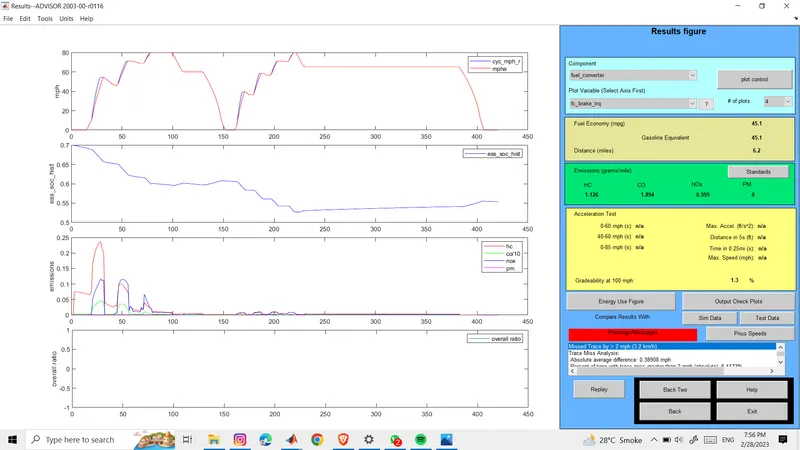
the grade percentage is 1.3%
now for 66 miles
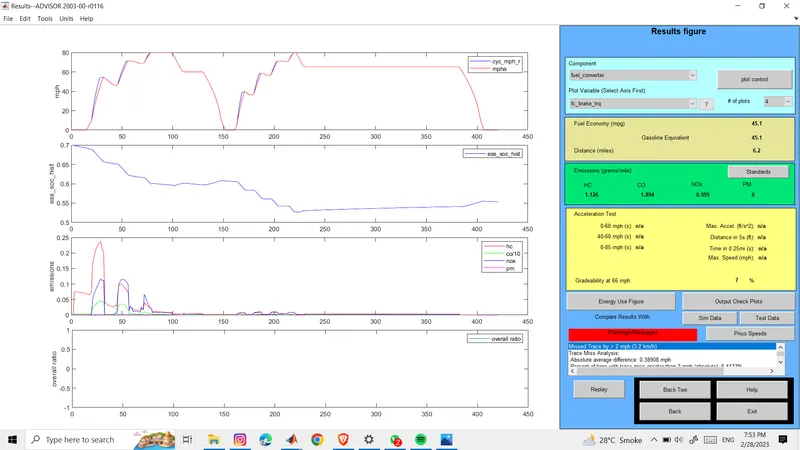
the grade percentage is 7%
now for 55 miles 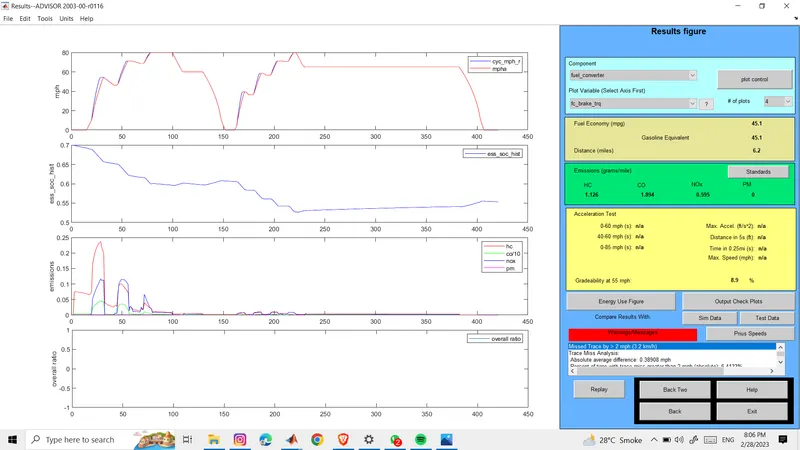
the grade percentage is 8.9%
for 44 miles
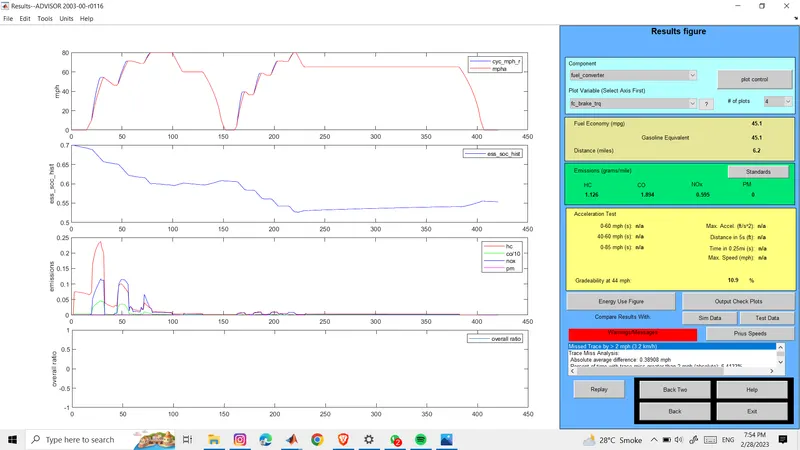
the grade percentage is 10.9%
for 33 miles
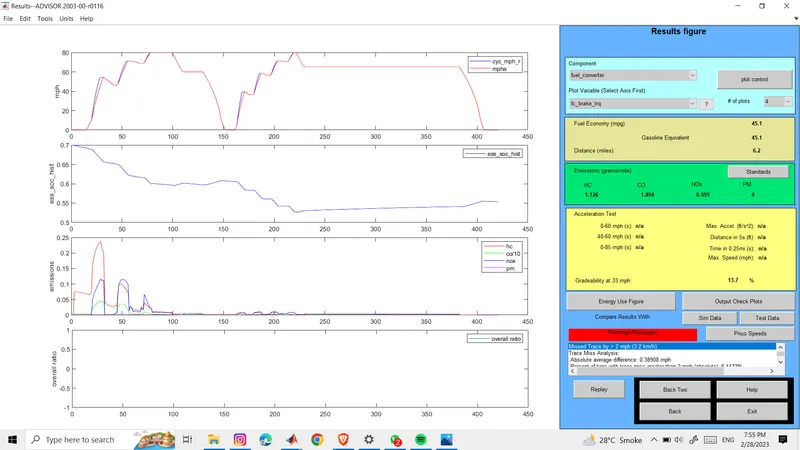
the gradeability is 13.7%
speed(mph) gradeability%
100 1.7%
66 7%
55 8.9%
44 10.9%
33 13.7%
Based on the information provided, it seems that the gradeability of a vehicle decreases as its speed increases.
At 100 miles per hour, the gradeability is 1.7%, which means that for every 100 units of distance traveled horizontally, the vehicle can climb 1.7 units vertically. This is the lowest gradeability value provided.
At 66 miles per hour, the gradeability increases to 7%, indicating that the vehicle can climb 7 units vertically for every 100 units of distance traveled horizontally. This is higher than the gradeability at 100 mph.
At 55 miles per hour, the gradeability increases further to 8.9%, indicating that the vehicle can climb 8.9 units vertically for every 100 units of distance traveled horizontally.
At 44 miles per hour, the gradeability increases again to 10.9%, indicating that the vehicle can climb 10.9 units vertically for every 100 units of distance traveled horizontally.
Finally, at 33 miles per hour, the gradeability reaches its highest value of 13.7%, indicating that the vehicle can climb 13.7 units vertically for every 100 units of distance traveled horizontally.
Therefore, we can conclude that the gradeability of the vehicle decreases as its speed increases, and the optimal speed for climbing steep grades is around 33 miles per hour.