Week-3 Challenge: ADVISOR Tool
1. For EV_defaults_in file, if cargo mass is 500 kg with all other default conditions, can the vehicle travel for 45 km with FTP drive cycle? Conclude your observations.
Consider the case for an typical EV, let's simulate EV_default_in, an Electric vehicle with following speifications
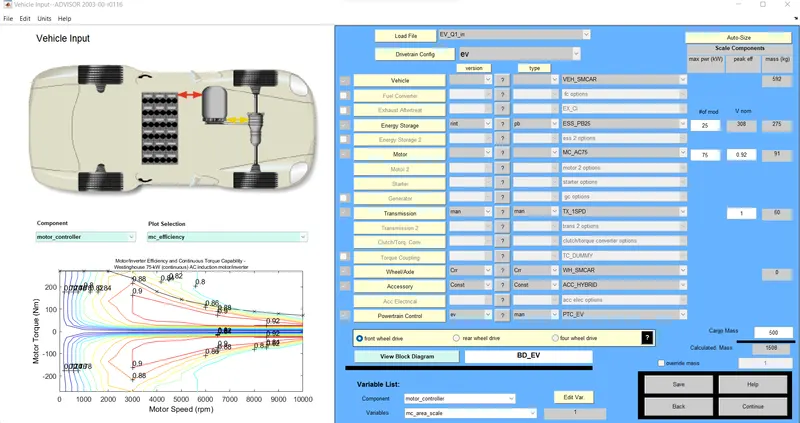
In the above example Battery electrical vehicle is modelled with following specifications
Energy storage : Lead acid battery with 25 modules having 308 V as nominal voltage with 0.92 motor efficiency.
Motor : AC induction motor with 75kW
Transmission : manual
Drive : front wheel drive
Cargo mass : 500g
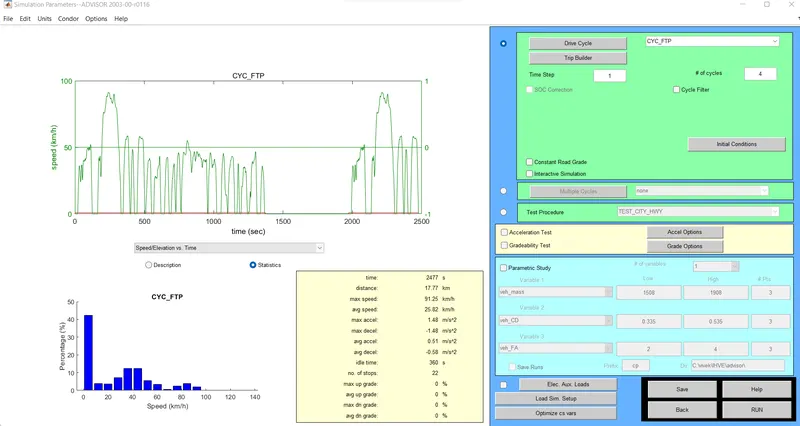
Next,we input the drive cycle called CYC_FTP Which is 17.7 km long in distance. Hence inorder to batterycompetely to SOC=0%
for calculating range of the vehicle,4 drive cycle are repeated, so that the vehicle will travel 70.8km in total and we can find out at what distance
the SOC is 0.
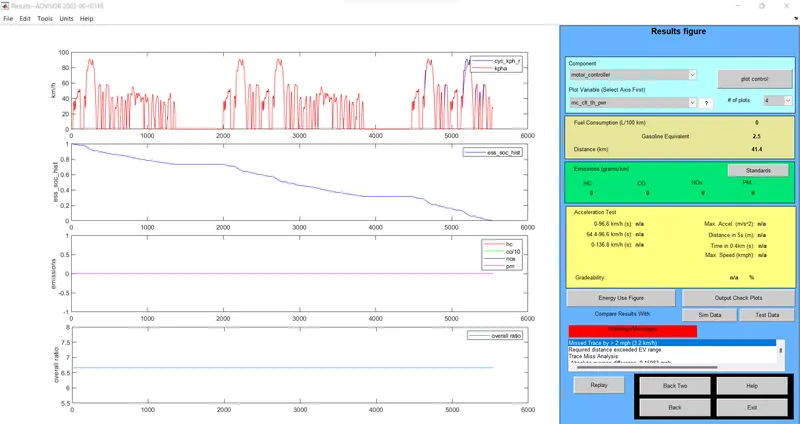
In the above fig.frist plot shows the drive cycle for which vehicle has travelled, the second plot shows th SOC fail with time,, the third and the
fourth graph show th power output according to the throttle condition
Hence, After running the simulation, we can see that , the SOC becomes zero aproxomately 2.5 drive cycles. As shown at the right hand side the
distance travelled by vehicle is 41.4km.Hence the vehicle cannot travel 45km in a signle charge .

2. In the above case, try changing the battery capacity and repeat the simulation.
In this case the same default conditions are taken that are intiate in question1 and battery capacity will charged for accelerating the vehicle
that will increase the vehicle distance travel km.
-Incrasing the battery capaity of vehicle
So, inorder to achieve a range of 45m,3more modules of batteries have been added making the total modules to28 and nominal voltage
to 345 V.
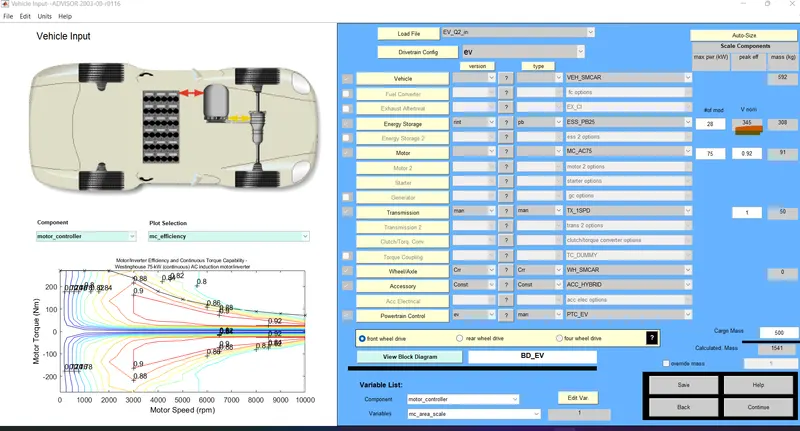
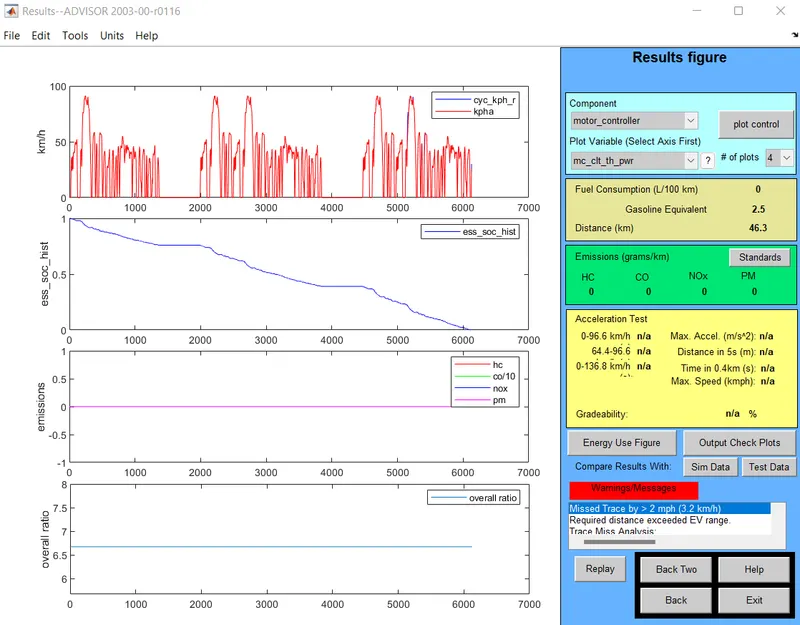
In the above image, the vehicle travels a distance of 46.5km. Hence 28 number of battry modules are suffiient to satisfy a range of 45km
according the problem description.
3. Perform gradeability test with PRIUS_Jpn_defaults_in file
Compare your results in table and conclude.
This is the model of Toyota Prius parallel hybrid vehicle. It uses battery and an IC engine to power the wheels. As can seen from the firgre. The differential is connected to motor and it is also conneted to an IC engine via a device called as a power split device . power split split the power accoridng to the throttle demands keeping the engine in maximum efficiency zone , providing additional power via battery and engine during aggressive conditions, charging the battery via a generator during conditions such as regenerative braking and preserving the energy efficiently.
Vehicle Specifications:
Power produced by IC engine : 43kW With fuel convertor efficiency of 0.39
Battery Capacity : NMH (Nickel metal Hydrive ) batteries have been used with 40 modules producing a nominal voltage of 308 V
Generator (Regenerative):15kW
Motor : Induction motor producing power of 15kW with 0.84 efficieny
Transmission : CVT
Drive : Front wheel Drive
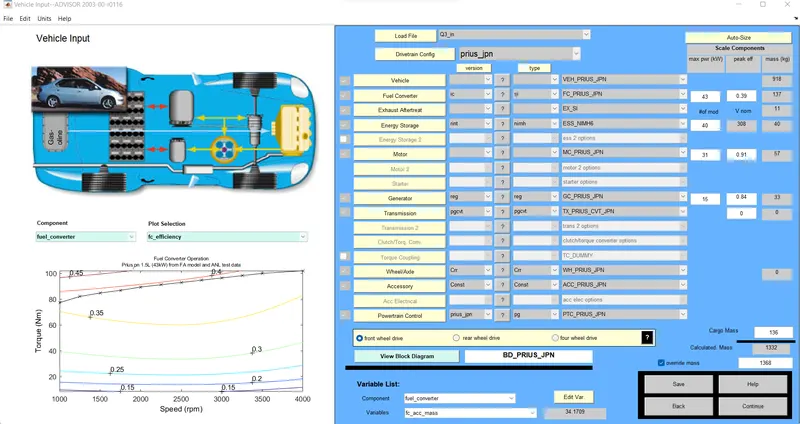
Inorder to perform the gradeability test. We keep the grade value constant and change the speed values to find out the maximum gradeability
at an optimum speed simulating for 10s.
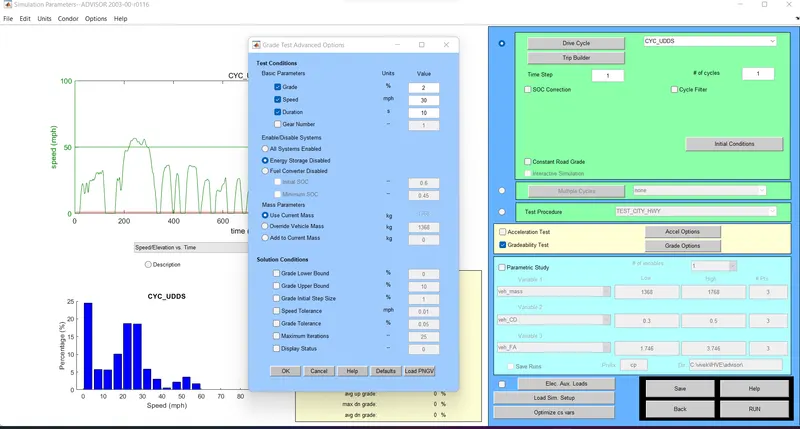
Hence the simulation is run with for gradeability test'
Following are the output results:
Case 1 :Speed=5mph (8kmph)
Gradeability=18.1%
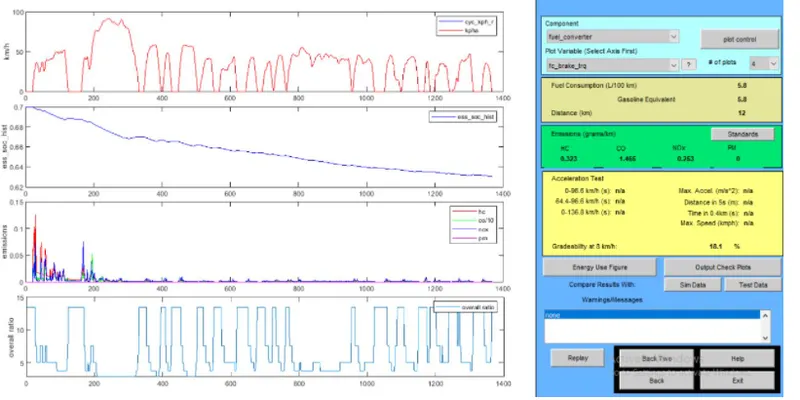
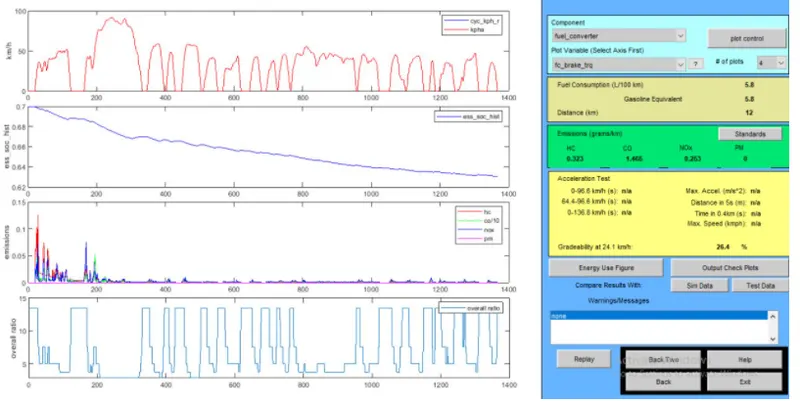
Case 2: speed =15mph(24.1kmph)
Gradeability = 26.4%
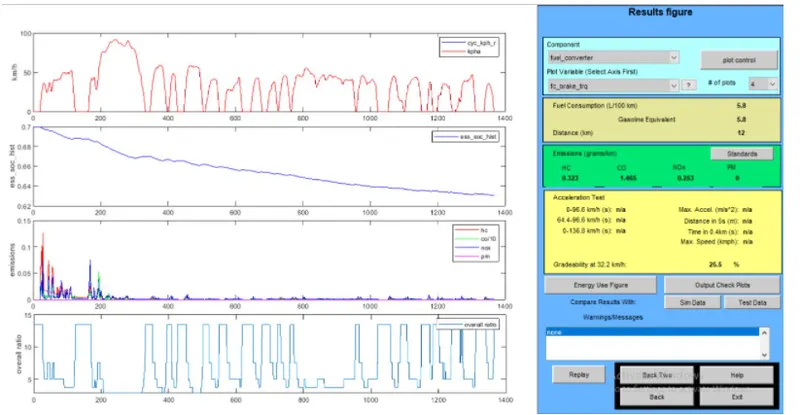
Case 3: speed =20mph(32.2kmph)
Gradeability = 25.5%
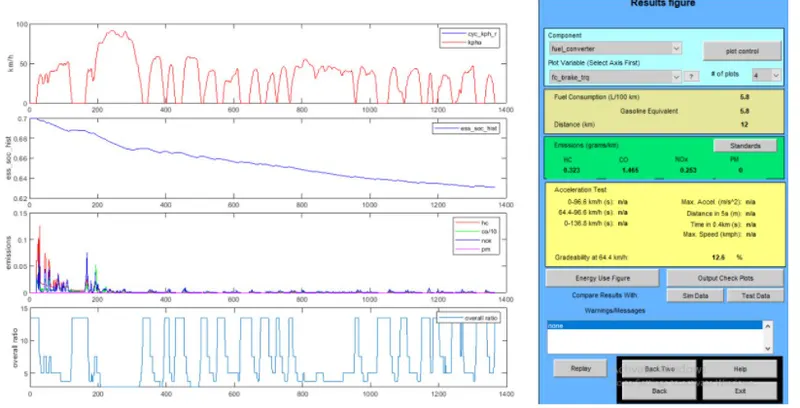
Case 4: speed =40mph(64.4kmph)
Gradeability =12.6 %
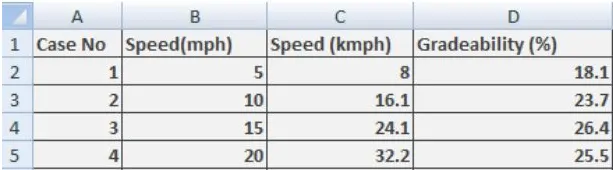
Hence speeds of 15mph to 25mph gives highest Gradeability value which make them the optimum speeds for prius.