Week-3 Challenge: ADVISOR Tool
1. For EV_defaults_in file, if cargo mass is 500 kg with all other default conditions, can the vehicle travel for 45 km with FTP drive cycle? Conclude your observations.
Ans:
ADVISOR (ADvance VehIcle SimulatOR) is used to construct model that use 'macro' statistics from duty cycles and cyle-averages efficiencies of components for near-instantaneous prediction of fuel consumptions and performance and it is data stuctured platform developed by National Laboratory for Renewable Energy (NREL) and Department of Energy, USA from 1994 to 2004.
EV-default is choosen in file with cargo mass of 500kg as shown in fig.. highlighted
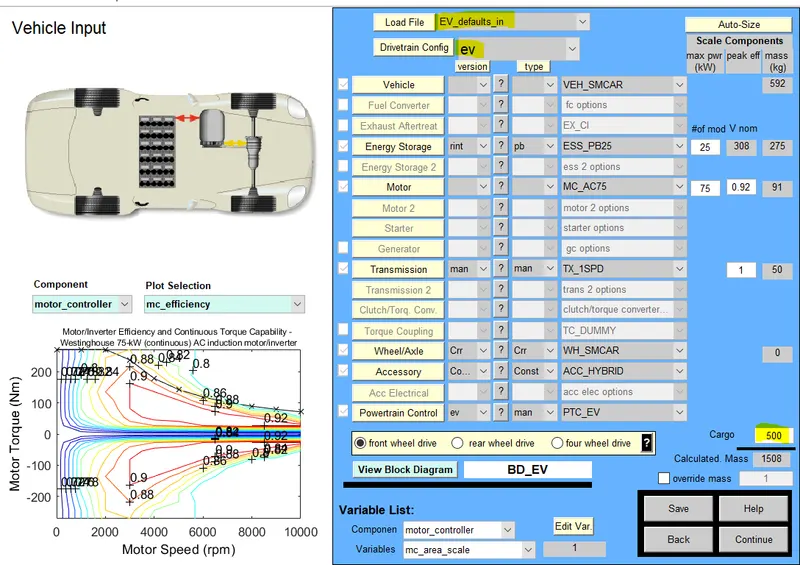
from above vehicle fig.. it is observed that the vehicle in pure EV because of only Battery energy source on single motor is there.
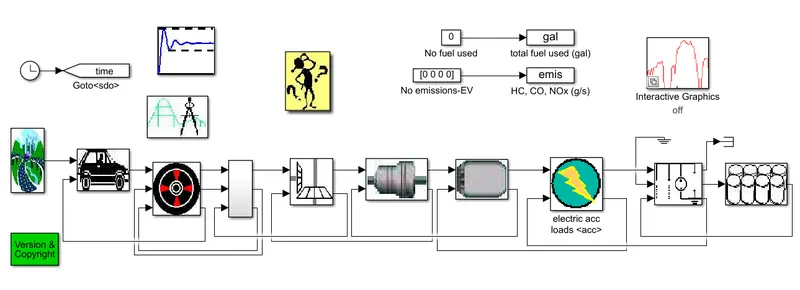
block diagram is shown in bellow which is completely data structure and 2D-Lookup tables.
as you can see it starts with driving cycles and end with battery capacity because ADVISOR is Backward-Looking model.
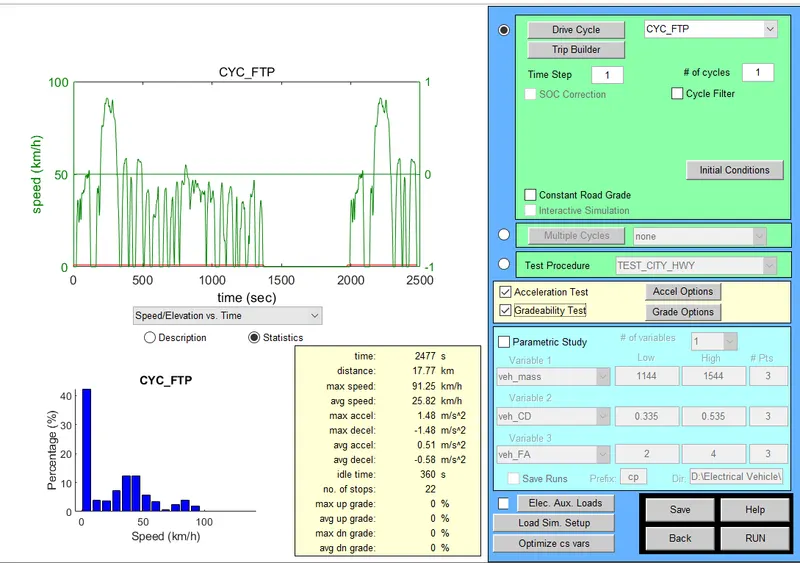
and FTP driving cycle is fed to the vehicle shown in fig.. and we can see in the graph, bar chart is the range of speed and their percentage in overall cycle.
and all other parameters are considered default values and ran the simulation, the results are
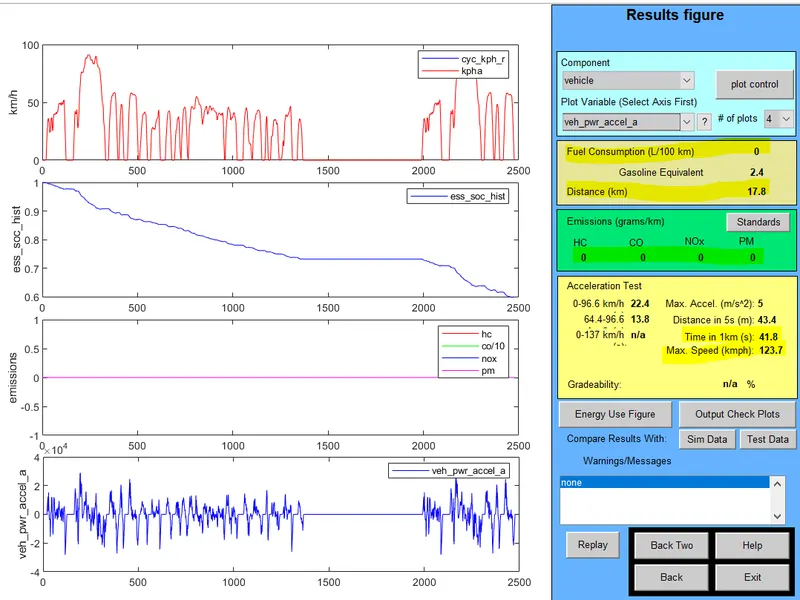
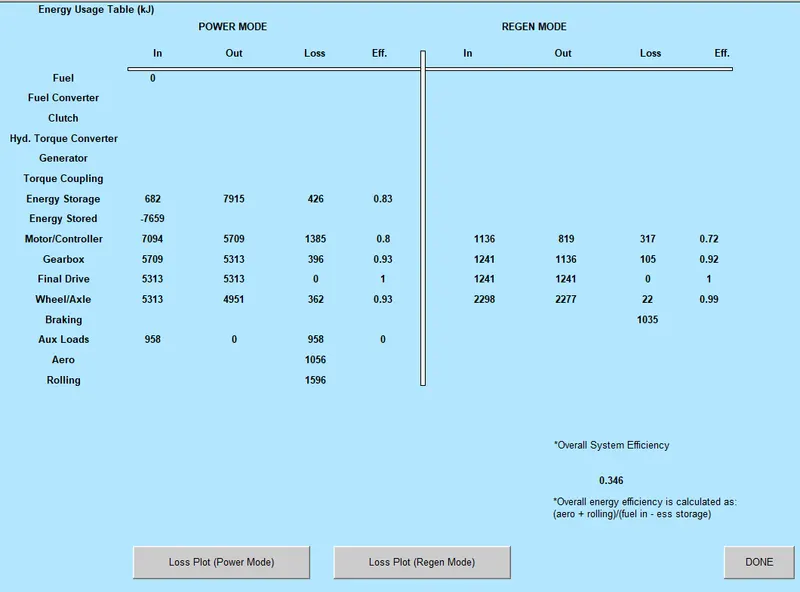
there is no fuel power conversion because of which is pure EV
from the above results Total distance travelled by vehicle is 17.8 km only, not meeting our required distance i.e 45 km. To tranvell km we need to run for three FTP driving cycles.
as we taken EV, there is no emissions gases so eco-friendly and no fossil fuel consumption so no green-house gasses. on left side you can see the Graphs of different parameters and we can choose by our choice.
if you obser the accleration test data, the max. speed is 123.7 kmph and took 41.8s to reach 1 km and max. accel. is 5 m/s^2.
From second graph (SoC) entire driving cycle it is observed that only 40% of battery energy utilised and 60% is remainig.
overall efficiency is 34.6% which is quite high.
%%%%%%%%%%%%%%%%%%%%%%%%%%%%%%%%%%%%%%%%%%%%%%%%%%%%%%%%%%%%%%%%%%%%%%%%%%%%%%%%%%%%%%%%%%%%%%%%%%%%%%%%%%%%%%%%%%%%%%%%%%%%%%%%%%%%%%%%%%%%%%%%%%%%%%%%%%%%%%%%%%%%%%%%%%%%%%%%%%%%%%%%%%%%%%%%%%%%%%
2. In the above case, try changing the battery capacity and repeat the simulation.
battery capacity changed from 25 to 35 shown in fig.. and keeping other all parameters as first case
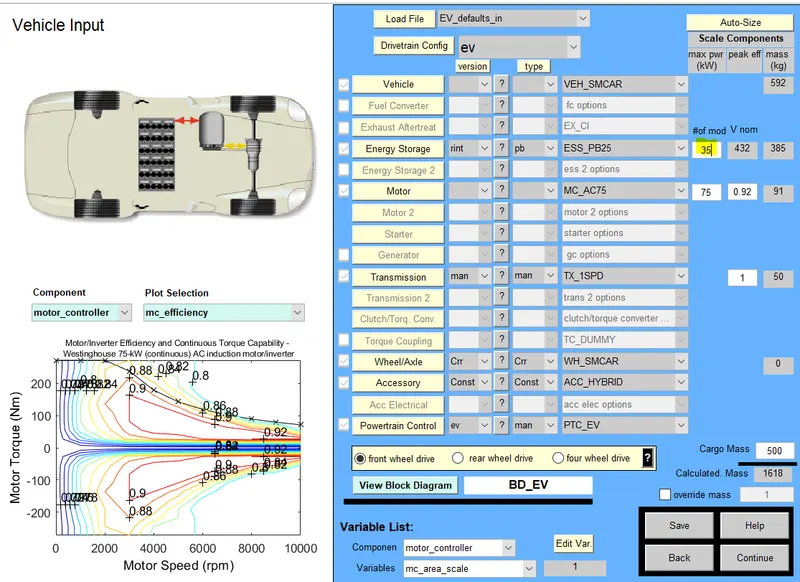
Results
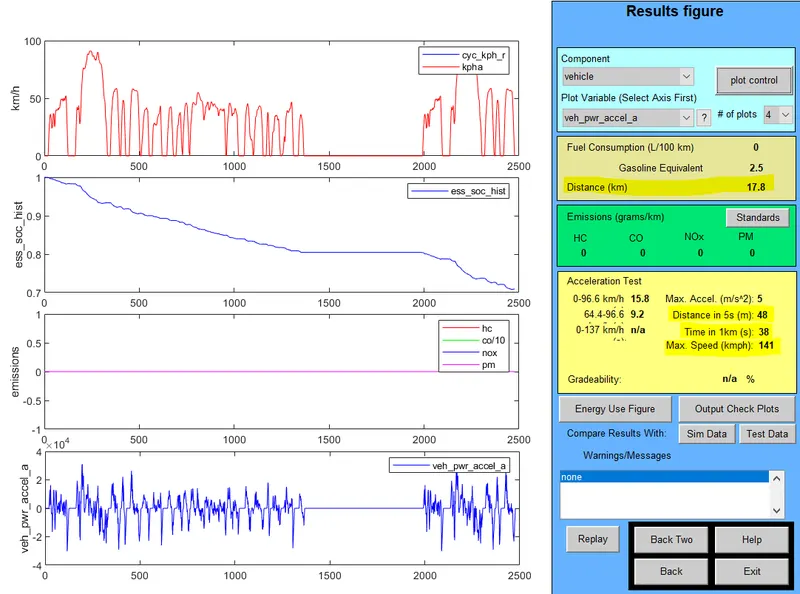
from the out put results it is observed that there is no change in distance tavelled because of it dipends on the driving cycle and the majority of changes we can observe in acceleration window.
if you obser the accleration test data, the max. speed is 141kmph (previous 123.7 kmph) and took 38s to reach 1 km (previous 41.8s) and max. accel. is same i.e 5 m/s^2. time to reach 96.6 kmph is decreased from 22.4s to 15.8s.
From second graph (SoC) entire driving cycle it is observed that only 30% of battery energy utilised and 70% is remainig and in last case 60% only left. so that range of vehicle increased with increasing battery capacity. battery got charged during regenerative braking.
also we can obser changes in other parametrs also, to check goto Energy use fig.. and output check plots options in the results tab page for more details of vehicle.
%%%%%%%%%%%%%%%%%%%%%%%%%%%%%%%%%%%%%%%%%%%%%%%%%%%%%%%%%%%%%%%%%%%%%%%%%%%%%%%%%%%%%%%%%%%%%%%%%%%%%%%%%%%%%%%%%%%%%%%%%%%%%%%%%%%%%%%%%%%%%%%%%%%%%%%%%%%%%%%%%%%%%%%%%%%%%%%%%%%%%%%%%%%%%%%%%%%%%%
3. Perform gradeability test with PRIUS_Jpn_defaults_in file
Compare your results in table and conclude.
Ans:PRIUS is basically fully hybrid vehicle developed by Tayota japan. it has engine with 43kW power and motor and generator of 31kW, 15kW each. it has charging and regenerative control to charge the battery so that it improves the range of vehicle. also we can get extra torque while accelerating with high slopes so that vehicle can achive desired speed in less time. other parameters can see in below fig...
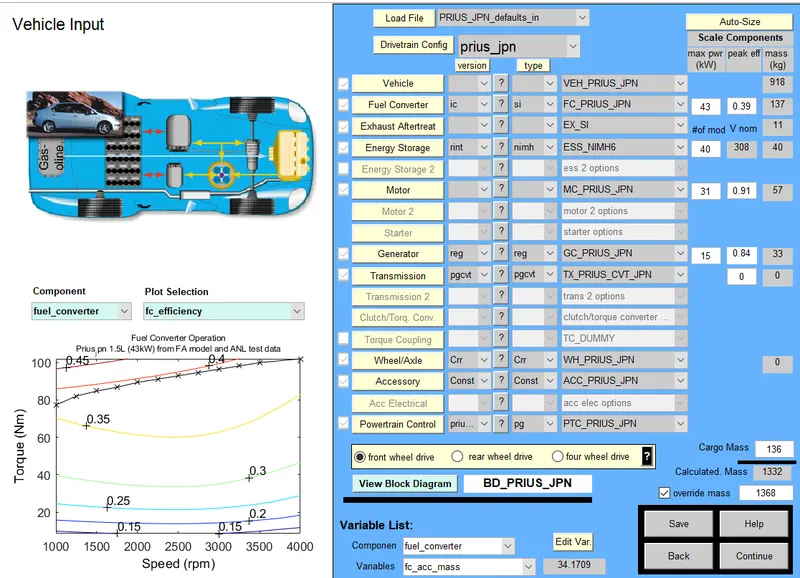
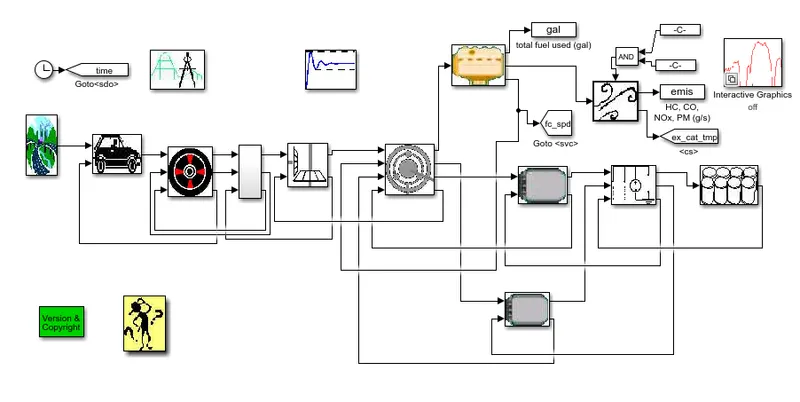
here we can see engine and generator blocks where as in first case only motor present. also can see planetory gear system for proper power sharing between 3 sources.
and FTP driving cycle is fed to the vehicle shown in fig.. and we can see in the graph, bar chart is the range of speed and their percentage in overall cycle.
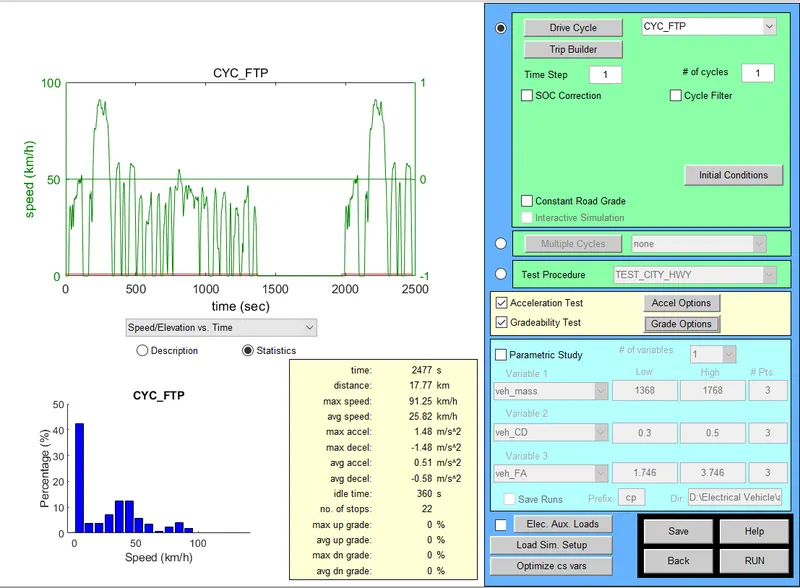
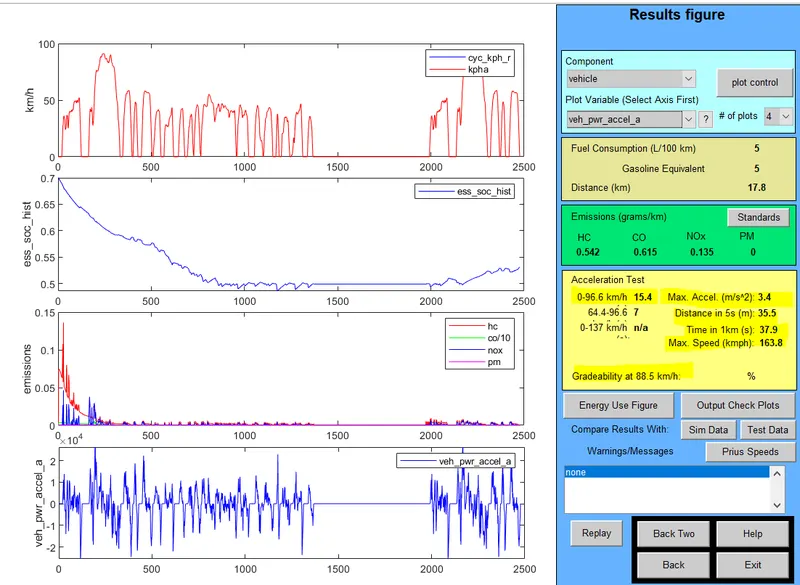
from the out put results it is observed that there is no change in distance tavelled 17.8km because of it dipends on the driving cycle and the majority of changes we can observe in acceleration window and power windows. over all power rating of vehicle is very high compared to first case.
if you obser the accleration test data, the max. speed is 163.8kmph (previous 123.7 kmph) which is very high because of extra torque is given by both motor and generator working as motor mode and took 37.9s to reach 1 km (previous 41.8s) and max. accel. is same i.e 3.4 m/s^2. time to reach 96.6 kmph is decreased from 22.4s to 15.4s as comparing with first question.
From second graph (SoC) entire driving cycle it is observed that only 22% (0.55/0.7) of battery energy utilised and 78% is remainig and in last case 60% only left. so that range of vehicle increased with increasing with Hybrid control logic. battery got charged during regenerative braking and with generator it cleary see in SoC graph
because of engines there is gasseous emission from the vehicle engine are showed in third graph i.e HC=0.542 g/km, CO=0.615 g/km, NOx=0.135g/km and PM=0 g/km which are harmful to envirinmental
also we can obser changes in other parametrs also, to check goto Energy use fig.. and output check plots options in the results tab page for more details of vehicle.
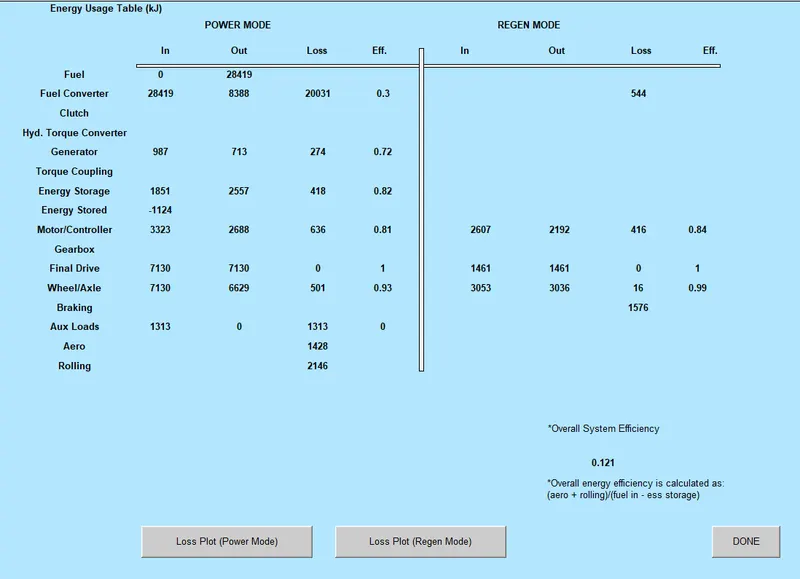
here we can see the energy conversion in power mode and regenerative mode. here fuel conversion columns also present because of engine but in first case there in no engine so all energy conversion is only due to motor only.
overallefficiency is 21.1% because IC Engines operates at very low efficiency.
in this vehicle they have implemented planetory gear mechanism to share the power anomg three sources.
we can see the varius advantages in this vehicle compared to first case but it is not fully eco-friendly to environment because of emisiion of gasses.
but performance wise which is far better than the first case where we can get higher torque and good acceleration performance, energy saving and sharing between souces. range also is high, better graph in Soc state etc.
for more details please find the attachments and see the results tab.