Simulation using ADVISOR Tool
Aim: In this project, we have to carry out the following studies:
Study 1. For EV_defaults_in file, if cargo mass is 500 kg with all other default conditions, can the vehicle travel for 45 km with FTP drive cycle? Conclude your observations.
Study 2. In the above case, try changing the battery capacity and repeat the simulation.
Study 3. Perform gradeability test with PRIUS_Jpn_defaults_in file.
Compare your results in table and conclude.
About ADVISOR tool:
ADVISOR, NREL’s ADvanced VehIcle SimulatOR, is a set of model, data, and script text files for use with Matlab and Simulink. It is designed for rapid analysis of the performance and fuel economy of conventional, electric, and hybrid vehicles. ADVISOR also provides a backbone for the detailed simulation and analysis of user defined drivetrain components, a starting point of verified vehicle data and algorithms from which to take full advantage of the modeling flexibility of Simulink and analytic power of MATLAB.
You may benefit from using ADVISOR if you want to:
- estimate the fuel economy of vehicles that have not yet been built
- learn about how conventional, hybrid, or electric vehicles use (and lose) energy throughout their drivetrains
- compare relative tailpipe emissions produced on a number of cycles
- evaluate an energy management strategy for your hybrid vehicle’s fuel converter
- optimize the gear ratios in your transmission to minimize fuel use or maximize performance, etc.
The models in ADVISOR are:
- mostly empirical, relying on drivetrain component input/output relationships measured in the laboratory, and
- quasi-static, using data collected in steady state (for example, constant torque and speed) tests and correcting them for transient effects such as the rotational inertia of drivetrain components.
ADVISOR was preliminarily written and used in November 1994. Since then, it has been modified as necessary to help manage the US DOE Hybrid Vehicle Propulsion System subcontracts. Only in January 1998 was a concerted development effort undertaken to clean up and document ADVISOR.
Since then, over 4500 individuals have downloaded one or more versions of ADVISOR, including all of the OEMs and major suppliers. About 2/3 of the users are from industry and 1/3 from universities. A short list of major ADVISOR users includes:
- DaimlerChrysler
- Ford Motor Company
- General Motors Corp.
- Delphi Automotive Systems
- Visteon
- and hundreds of others.
Study 1:
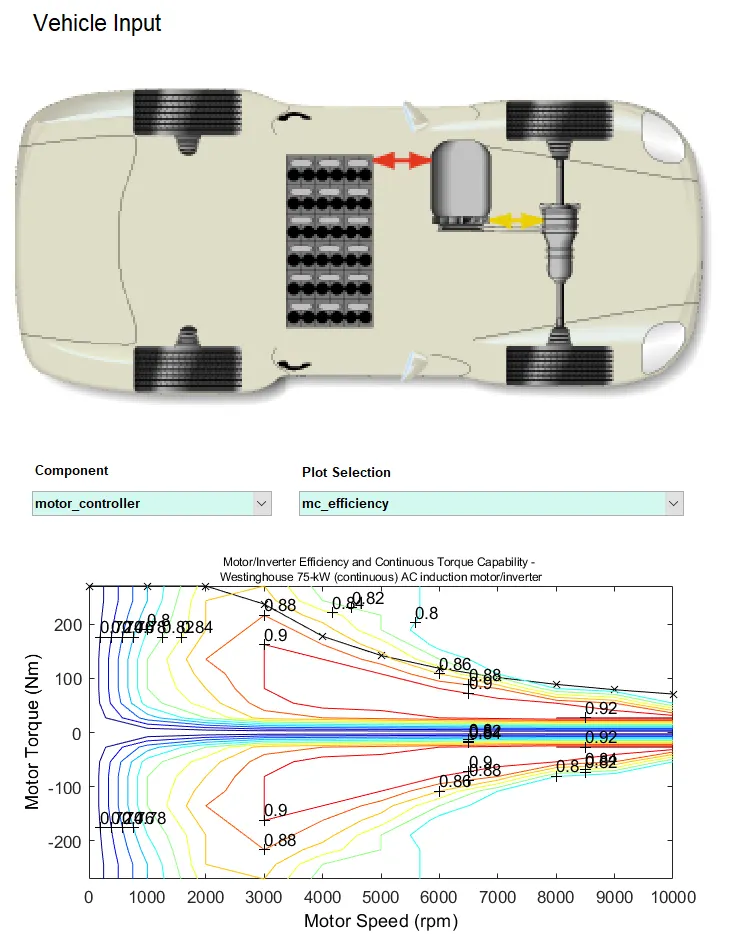
To carry out study 1 the ADVISOR tool must be launched and there the model file is selected.In this case the file is EV_defaults_in.
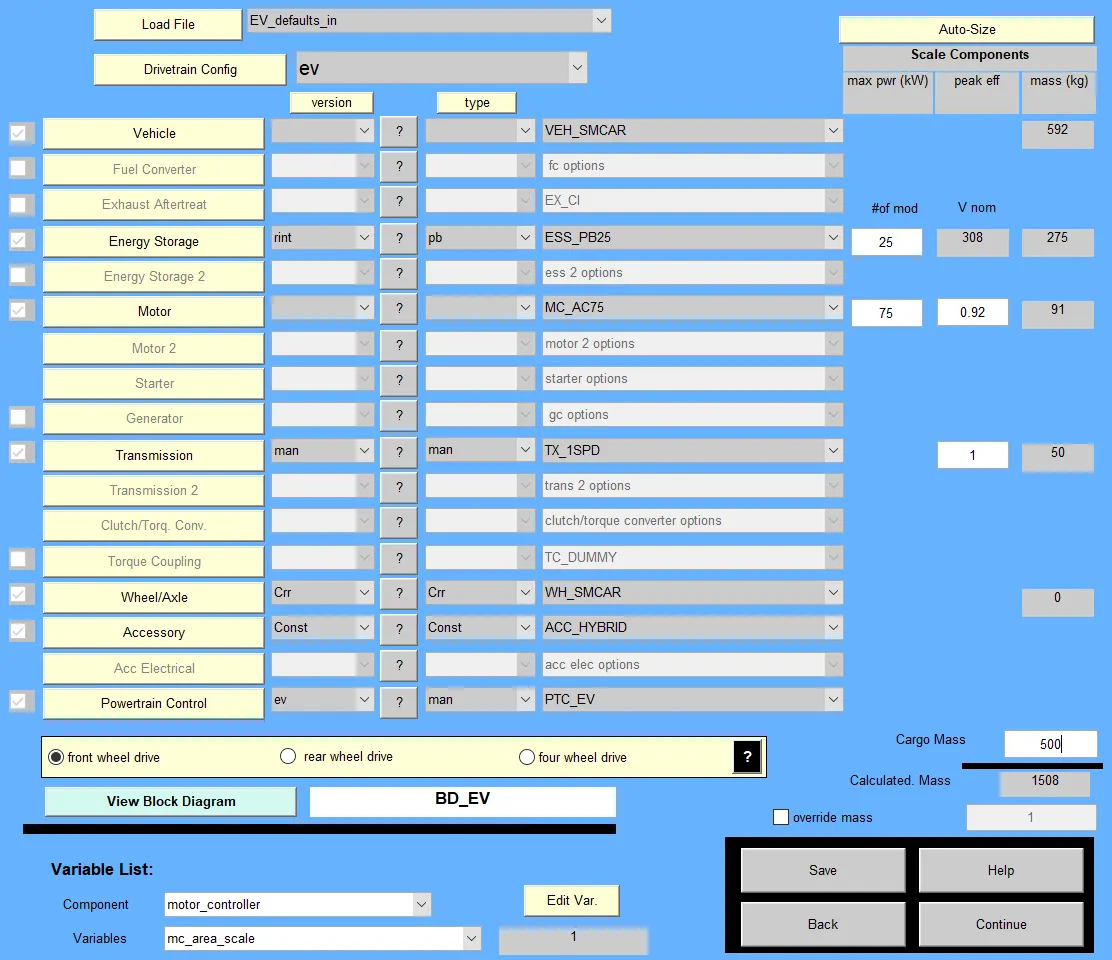
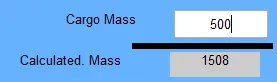
According to the problem statement the cargo mass is set to 500 kg.
Clicking on the continue button and select the desired drive cycle which in this case is FTP drive cycle.
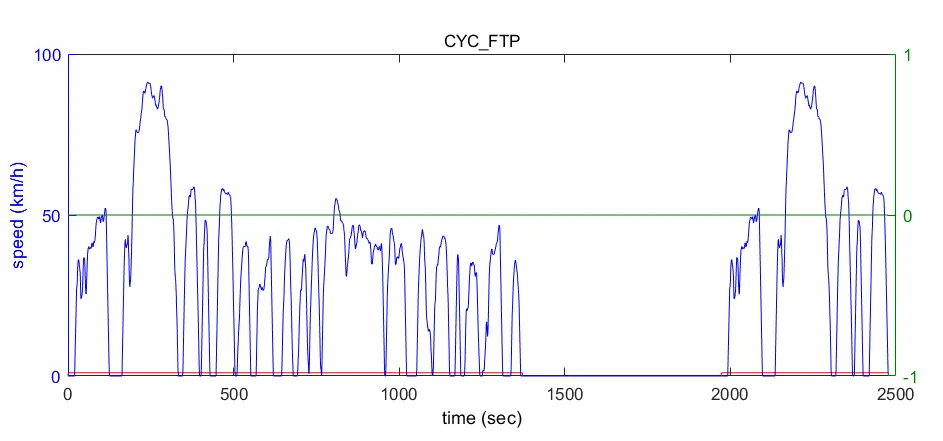
Now looking at the stastics of this drive cycle below,
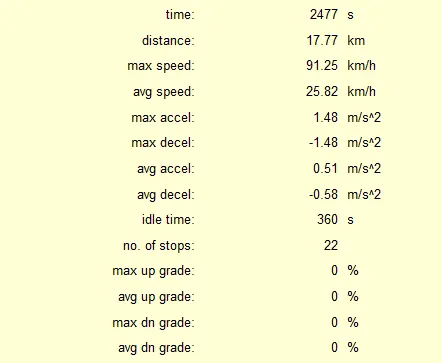
It is found that for each cycle the distance covered will be 17.77 km in 2477 seconds with an average speed of 25.82km/h.
So to run the vehicle for 45km it is needed to add atleast 3 such cycle so that it can be determined whether it can go upto 45 km or not.
In this case no. of cycles added are 4.
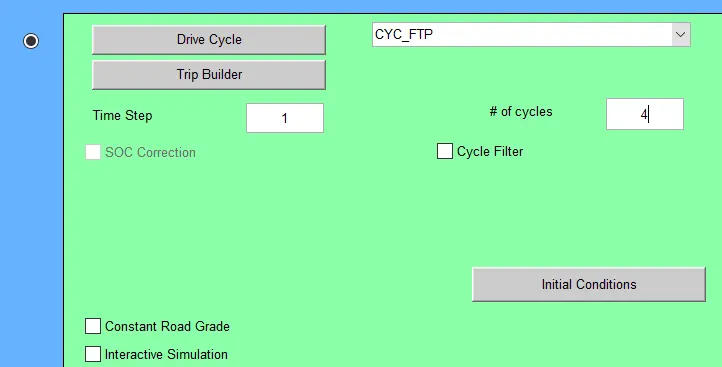
Taking everything else as default the simulation is finally started to run.
Result:

So it can be clearly seen that the vehicle stopped at 41.4km distance and hence it failed to travel 45 km .
The reason can be seen in the next figure that the soc reaches to zero before completing the target distance.Hence the battery gets exhausted at the red mark.

Study 2:
In this study we have to carry out the above experiment with just changing the battery capacity.
So in this the no of modules in increased and set to 36.
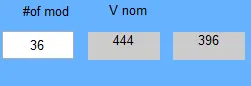
It is seen that by increasing the number of modules the battery voltage capacity has become 444 V .
Now rerun the model and see the results.
Result:

So in this case the the vehicle is able to travel 58.3km which means the target has been achieved.
It can be concluded that the range of the electric vehicle can be increased by increasing the battery capacity.
Study 3:
To carry out study 3 the vehicle model is selected which in this case is PRIUS_Jpn_defaults_in. The drive cycle selected for this experiment is UDDS.
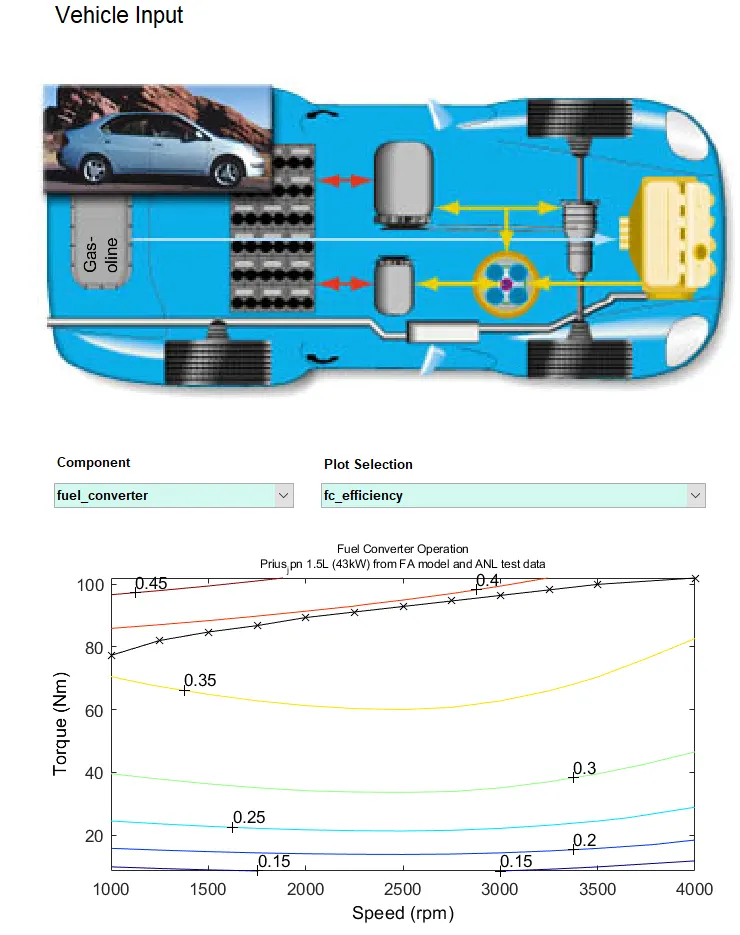
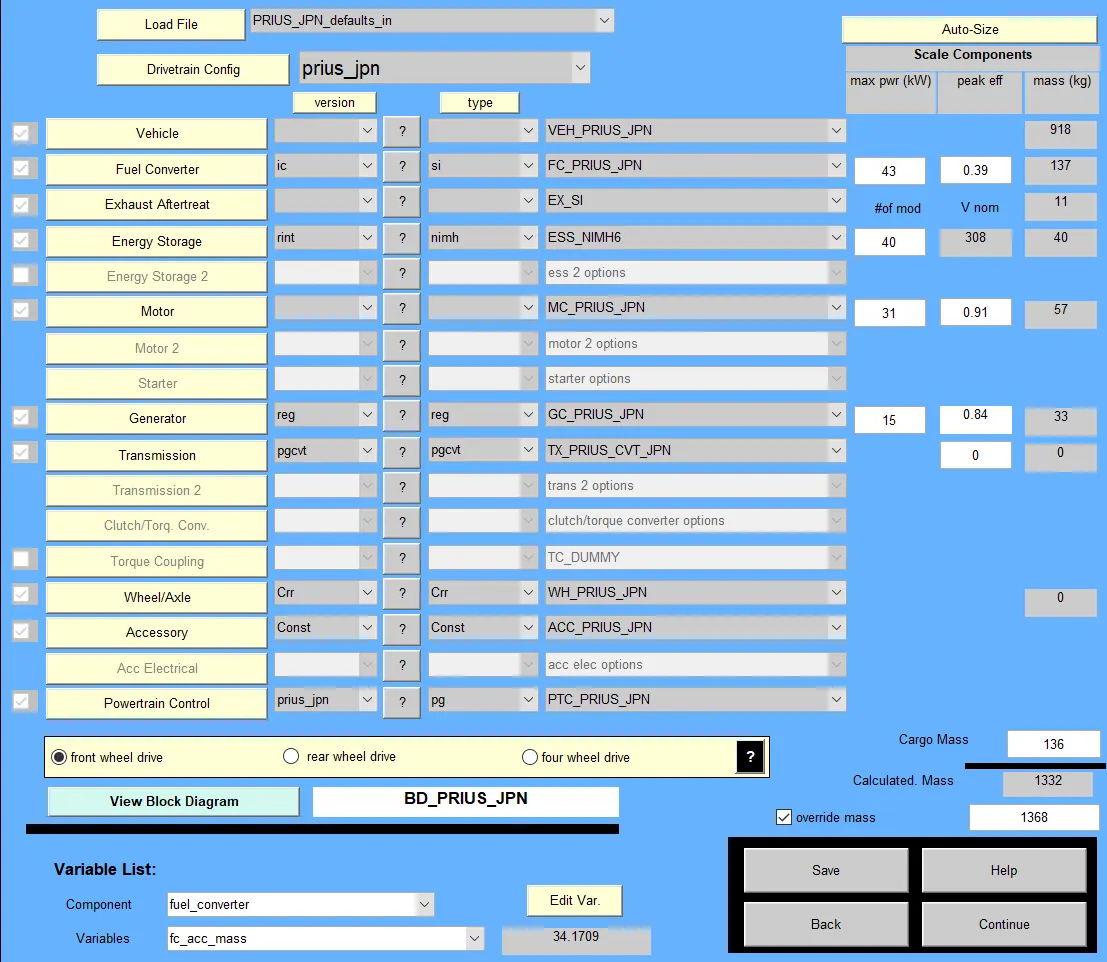
Above is the PRIUS model whose gradeability test to be carried out.
Gradeability:
Gradeability is defined as the highest grade a vehicle can ascend maintaining a particular speed. When designing an automobile, various performance targets are kept in view, the major ones being weight, fuel economy, power, torque, speed, and acceleration, gradeability is given a lesser significance unless a special purpose vehicle is being designed like a Sports Utility Vehicle (SUVs) or other heavy duty vehicles. Urban vehicles do have to encounter situations where they might have to ascend slopes like a basement or a bridge. These situations might prove to become difficult for the driver when on full load, hence making it an important performance factor not only for Special Purpose vehicles but also to those driven in the urban land.
Gradeability is measured in multiple ways, mainly:
As an angle of inclination to the horizontal (20˚, 30˚, 45˚, etc.).
As a percentage of rise over run.
As a ratio of one part run to some particular number of parts (1 in 20 meters, 1 in 50 feet, etc.)
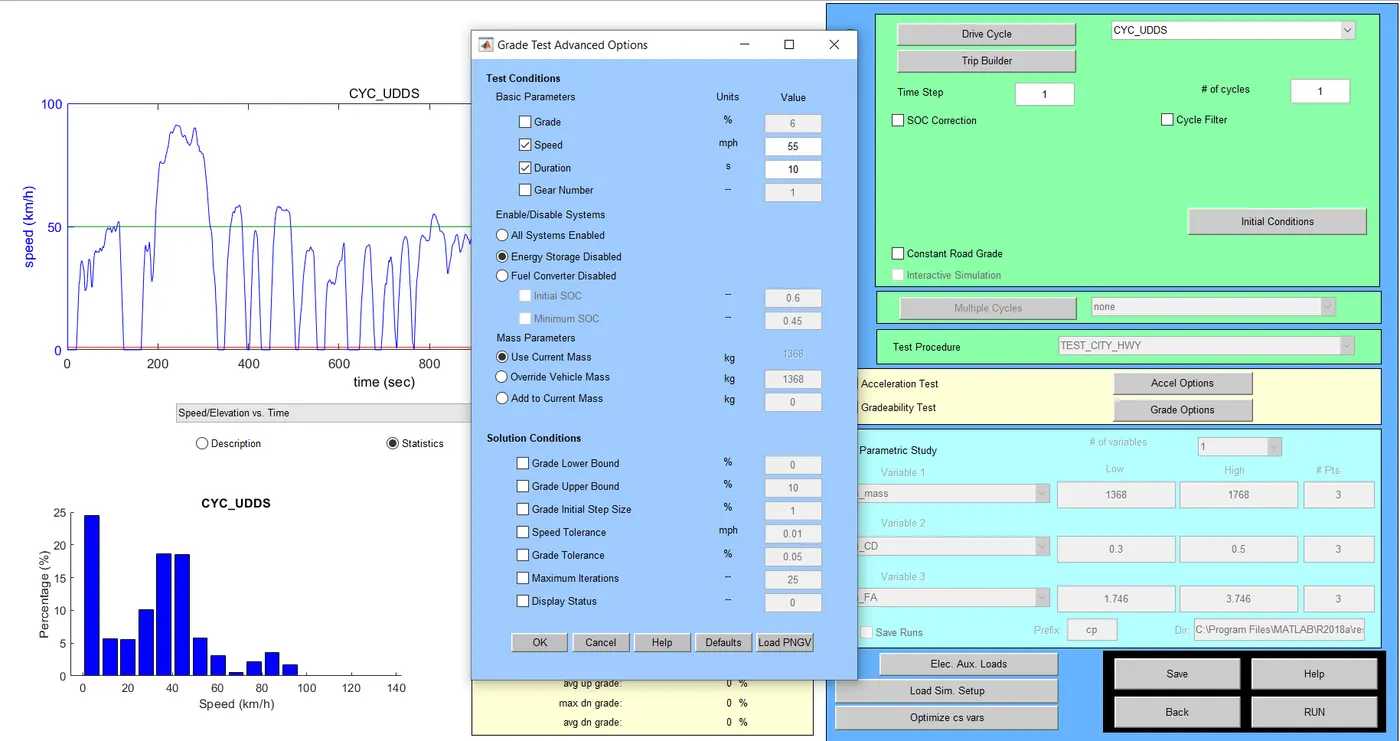
So the experiment will be carried out in 11 different speeds but with the same duration.The speed corresponds to the highest gradeability will be considerd as the best speed to climb a slope.
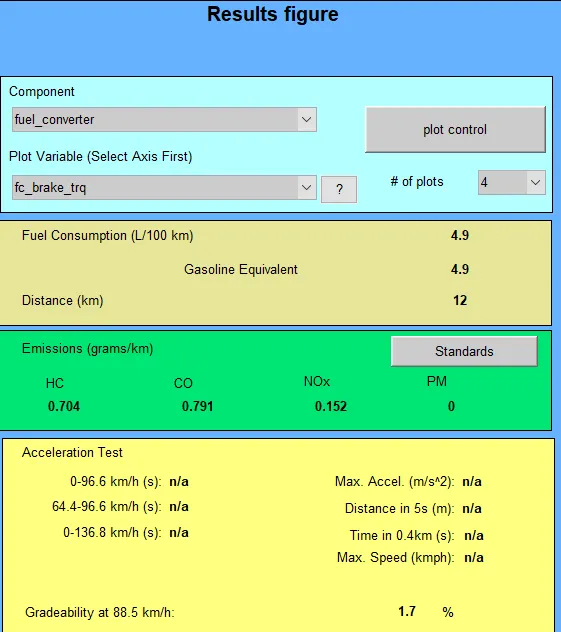
This is the gradeability at 55mph.
Similarly carrying out the gradeability tests at various speeds and tabulated the data we get:
| Sr.No. | Speed(mph) | Gradeability(%) |
| 1 | 55 | 1.7 |
| 2 | 60 |
1.5 |
| 3 | 65 | 1.2 |
| 4 | 70 | 0.9 |
| 5 | 75 | 0.7 |
| 6 | 80 | 0.3 |
| 7 | 50 | 2 |
| 8 | 45 | 2.2 |
| 9 | 40 | 2.5 |
| 10 | 35 | 2.4 |
| 11 | 30 | 2.5 |
Conclusion:
In the above data we found that gradeability is gradually decreasing from 55 mph to 82 mph and increasing from 50 mph to 30 mph.
We have seen that the speeds 40,35 & 30 mph have the highest gradeability.
Hence we have come to an conclusion that this vechicle can easily overcome a slope if it is moving in a speed range of 30-40 mph as this range has the highest gradeability.