Week-3 Challenge: ADVISOR Tool
AIM:
To use the ADVISOR tool and simulate the following
1. For EV_defaults_in file, if cargo mass is 500 kg with all other default conditions, can the vehicle travel for 45 km with FTP drive cycle? Conclude your observations.
2. In the above case, try changing the battery capacity and repeat the simulation.
3. Perform gradeability test with PRIUS_Jpn_defaults_in file
Compare your results in table and conclude.
INTRODUCTION:
ADVISOR (Advanced Vehicle Simulator) tool is a model written in the widely used MATLAB/Simulink software environment. Developed by USA's NREL (National Renewable Energy Laboratory), it can be used to simulate and analyze conventional, advanced, light and heavy vehicles, including hybrid electric and fuel cell vehicles. ADVISOR tests the effect of changes in vehicle components (such as motors, batteries, catalytic converters, climate control systems, and alternative fuels) or other modifications that might affect fuel economy, performance, or emissions. The user can alter simulation results by selecting vehicle component types, sizes, and parameters.
The ADVISOR tool can be downloaded from the internet and its code can be imported into the MATLAB command window.
QUESTION 1:
1. For EV_defaults_in file, if cargo mass is 500 kg with all other default conditions, can the vehicle travel for 45 km with FTP drive cycle? Conclude your observations.
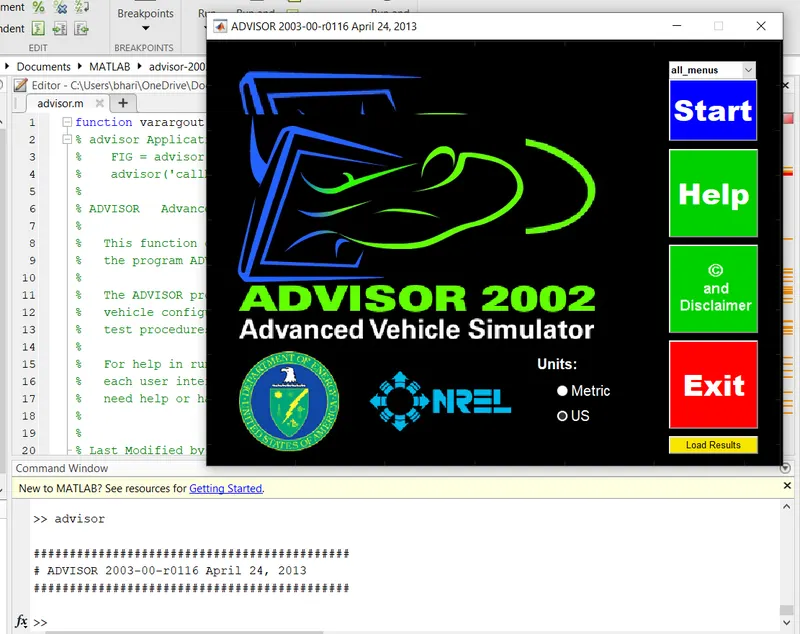
Import the ADVISOR script into the MATLAB window. To open the ADVISOR tool go to the command window and type 'advisor'. The screenshot is displayed below for a better understanding.
Start the simulator. Now we will see the vehicle input page of the tool which is shown below.
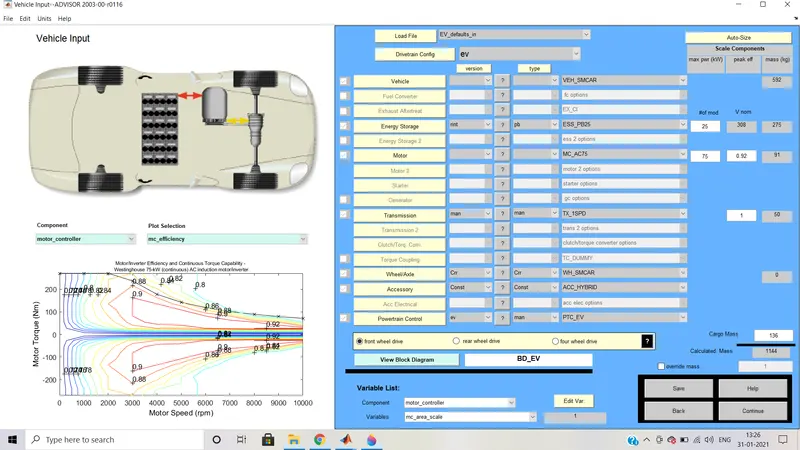
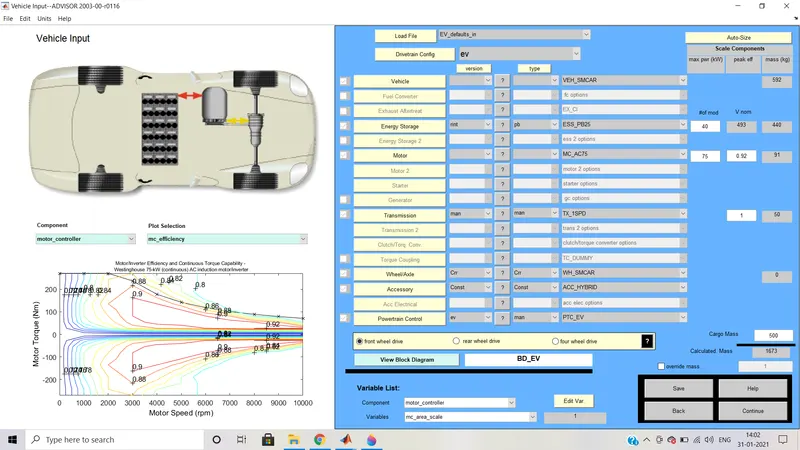
We are asked to perform tests on a conventional EV which has the file name 'Ev_defaults_in'. So in the LOAD dialog box, select that file name to view the vehicle setup and its parameters. Now the above screenshot displays the vehicle parameters of a pure EV.
The question asked here is that if the cargo mass is 500kgs, can the vehicle travel for 45 kms with the standard FTP drive cycle. FTP drive cycle is nothing but the Federal Test Procedure, a series of drive cycle tests already done by the US environmental protection agency to measure fuel emissions and fuel economy of passenger cars. This test was actually created for fossil fuel vehicles, but they are now also used to estimate the distance travelled by EV's in a single charge.
Now change the cargo mass to 500kgs in the vehicle input. After changing the cargo mass to 500 click on continue to view the drive cycle.
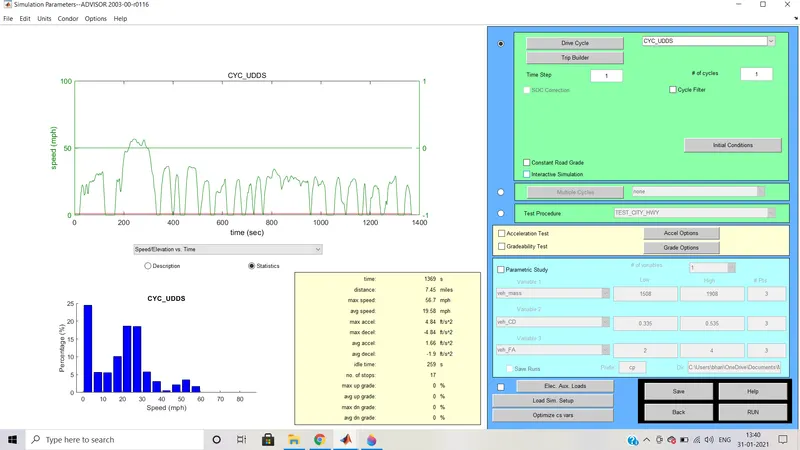
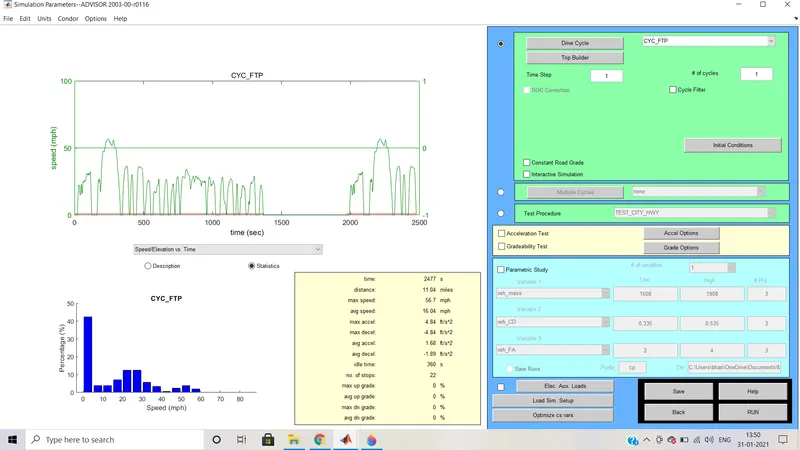
The default drive cycle that we have in ADVISOR tool is the UDDS (Urban Dynamometer Driving Schedule). We change that to FTP drive cycle and click on RUN to view our results.
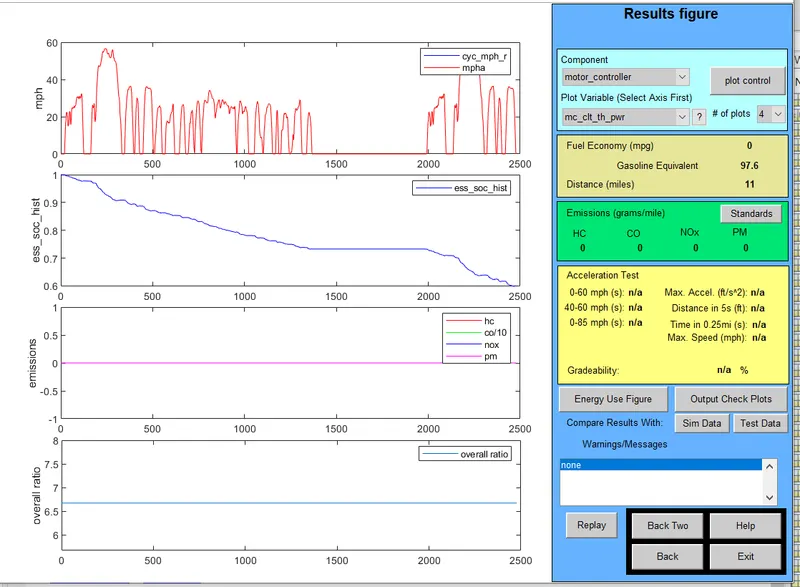
The first plot is the FTP drive cycle plot showing us the speed for a time span of 2500 secs approx. This FTP drive cycle takes approximately 2430 seconds to cover a distance of 17.8 kms. The maximum speed and average speed from the drive cycle is found out to be 56.7 mph and 16.04mph.
From the results, we can see that the SOC (State Of Charge) has declined from 100% to 60%. It may increase at times due to regenerative braking. The SOC reaches zero after 5500 secs.
Emission is 0% in this case since this is a pure EV.
With the default battery module as 25, we need atleast more than 3 times of this drive cycle to make the vehicle reach a distance of 45 kms.
The distance covered after 3 drive cycles is 41.4 kms, and the SOC ends at 5500 secs.
QUESTION 2:
2. Try changing the battery capacity and view the results.
We try and increase the battery capacity to 40 modules instead of 25 and view our results.
The drive cycle is kept the same and the results are viewed.
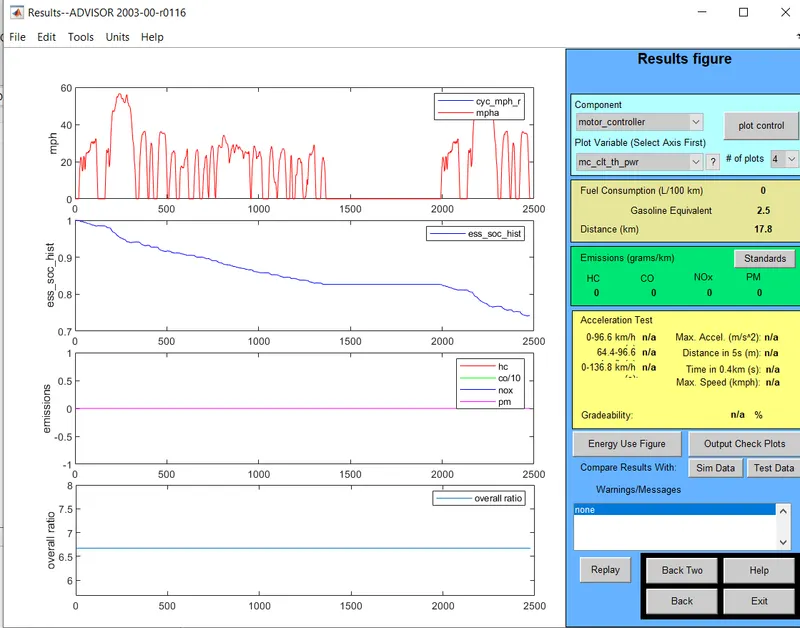
The SOC declines to 75% at 2475 secs. Hence the decline is lesser if the battery capacity is increased.
The SOC declines to zero in the 4th cycle at 8500 seconds with a distance of 64.5 kms.
From this, we arrive at a conclusion that if the battery module is increased, the economy of the EV is increased.
QUESTION 3:
3. Perform gradeability test with PRIUS_Jpn_defaults_in file. Compare your results in table and conclude.
In the load dialog box click on 'PRIUS_Jpn_defaults_'. The vehicle input page is displayed.
This is the TOYOTA PRIUS model. This is a fully hybrid EV designed by TOYOTA in 1997.
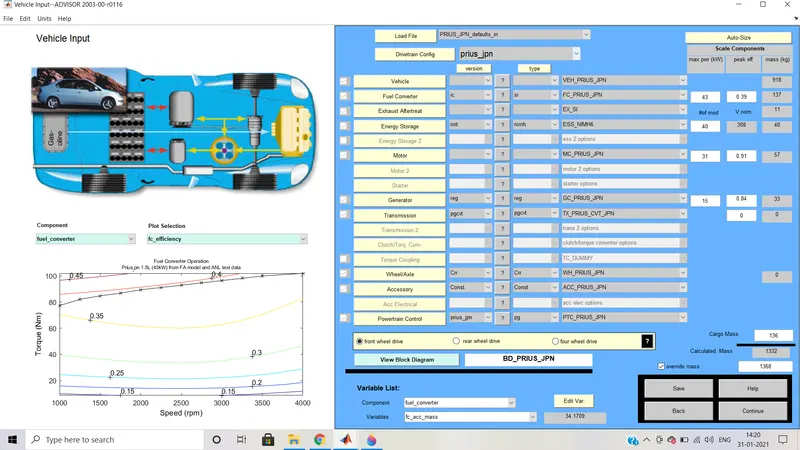
This model has a battery module of 40. Without changing any input parameters, we are going to perform the gradeability test. The default drive cycle UDDS is kept.
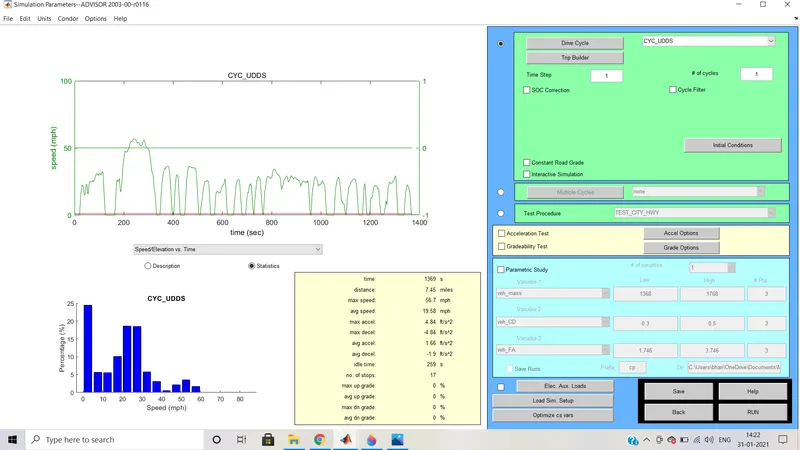
The drive cycle data are as follows:
a). The vehicle has covered 7.45 miles in 1369 secs.
b). The max speed is 56.7 mph while the average speed is 19.58 mph.
Now enable the gradeability test option. The parameters are given below:
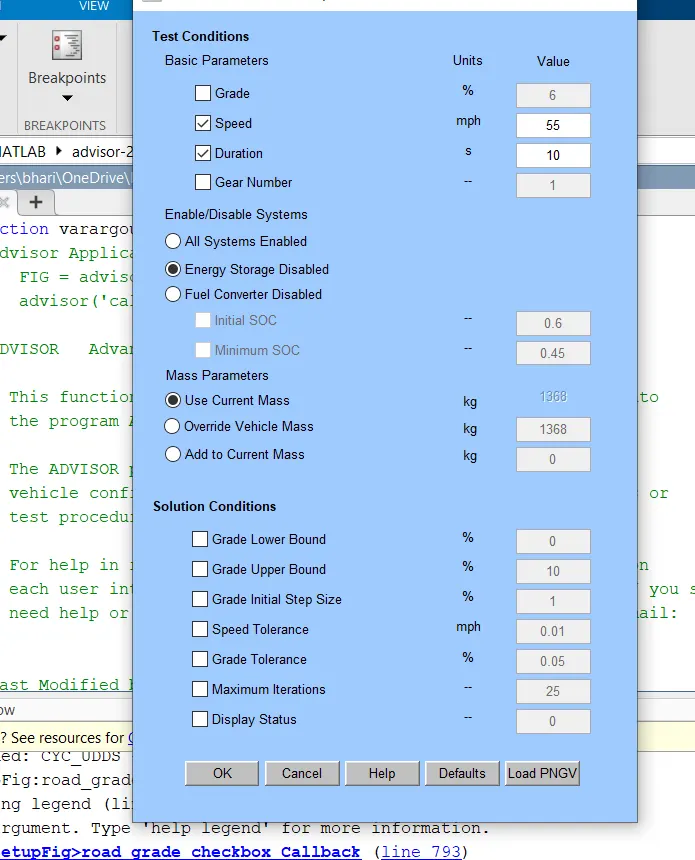
Now let us look at the gradeability for the default speed.
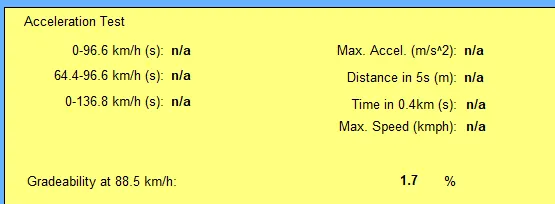
Change the speed to arrive at a better understanding of the relationship between speed and gradeability. We have set 2 different values 60 & 70 mph to see where the gradeability of the EV fails.
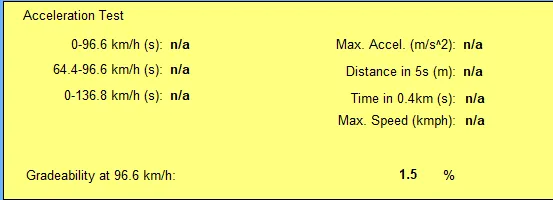
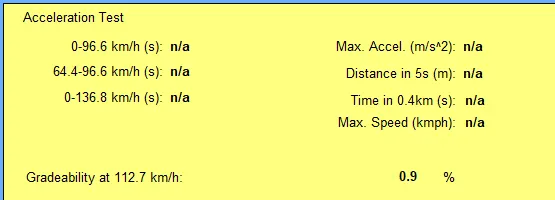
After 100 mph the gradeability fails.
According to the results shown above, the gradeability decreases with increase in speed.