Week 3 Challenge
QUESTION 1
1. State the primary load cases to be considered for design.
The primary load cases to be considered for the design are
- Dead load
- Live load/Imposed load
- Wind load
- Earthquake Load
2. What is One – Way slab?
- The ratio of the longer span to the shorter span is greater than 2 is a one-way slab
- Where Lx/Ly is greater than 2
3. What is the value of the unit weight of structural steel and soil?
The unit weight of structural steel and soil is given in IS 875 part
- The unit weight of structural steel is 7840Kg/m^3
- The unit weight of soil is 18KN/m^3
4. Name a few sections that can be defined using the Properties tab in STAAD Pro.
- Circular section
- Rectangular section
- Trapezoidal section
- Tee section
- General section
- Tapered section
- Tapered Tube
5. Define Primary Beams.
Primary Beam:
A horizontal beam connecting columns (supported or shear connected.)
Function:
- It will transfer the load from the secondary beam(if present) to the columns.
QUESTION 2
1. State the factors and parameters that influence the design pressure intensity of a high-rise building.
The factor that influences the design pressure intensity of high-raised buildings are
K1= Probability factor
K2= Terrain factor
K3=Topography factor
2. Mention the load transfer process of a Reinforced Concrete Building.
- Slab
- Secondary beam
- Primary beam
- Columns
- Foundation
QUESTION 3
1. Differentiate One-Way and Two-way slabs. Elaborate on each slab type.
| One-Way SLAB | TWO-Way SLAB |
| the load is carried in one direction perpendicular to the supporting beam | the load is carried in both directions |
| the bending moment occurs only in one direction i.e. the shorter direction in One Way Slab | Slab bending moment occurs in both directions |
| L/B>2 | L/B<= 2 |
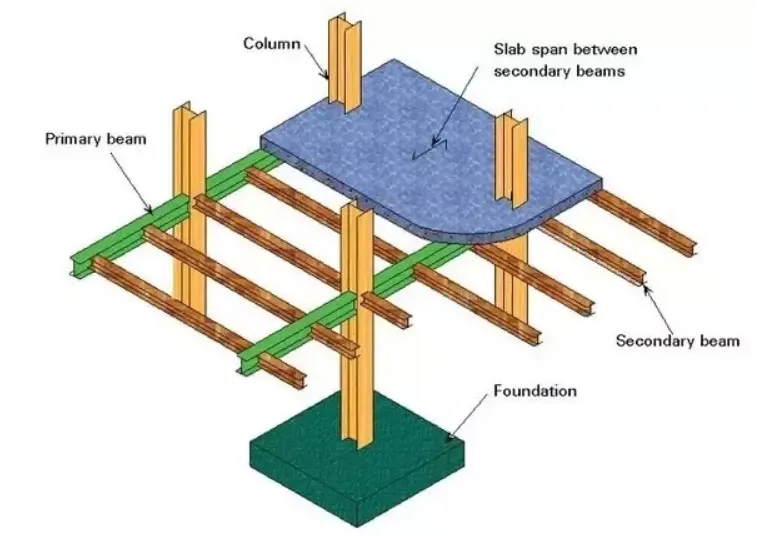
2. Explain the concept of secondary beams with a proper sketch.
Secondary Beam:
A horizontal beam connecting primary beams (supported or shear connected.) Function: It will transfer the load to the primary beam and not directly connected to the columns
3. Mention the Primary load cases.
a. State the Indian Standards for each load case
DEAD load = IS 875 part 1
LIVE load = IS875 part 2
WIND load = IS85part 3
SEISMIC load= IS13927
b. Detail the parameters of each load case
Dead load
- Unit weight
- The volume of the section
Live load
It depends upon the type of building
c. Brief each load case
- A load case is a combination of different types of loads with safety factors applied to them
- A structure is checked for strength and serviceability against all the load cases it is likely to experience during its lifetime
4. Detail the steps in assigning Properties and Support to a model using STAAD Pro sequentially.
- Go to the property section
- Click on Define material
- Select the section, Rectangular section, circular section, Etc
- Select the material type
- Click add and close
- Select the material type and assign it to the selected view for the support
- Click on the support
- Click on the create
- Select the type of support do we want to assign to the section
- Click on add close
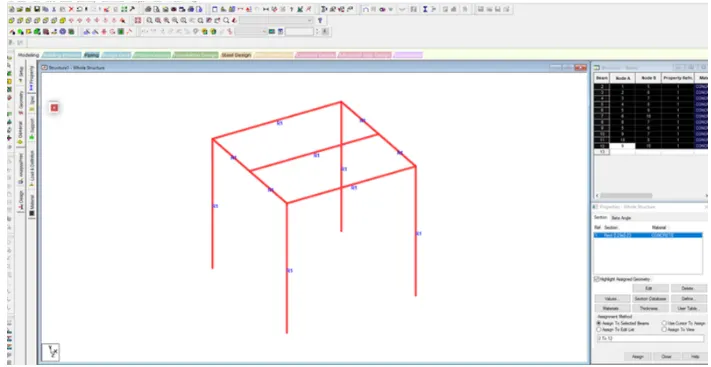
5. Brief the steps to be followed to create and assign secondary beams in STAAD Pro
- First, create a simple model by using the nide in STAAD pro
- Click on the create beam option and create a beam in the direction of the X and Y-axis
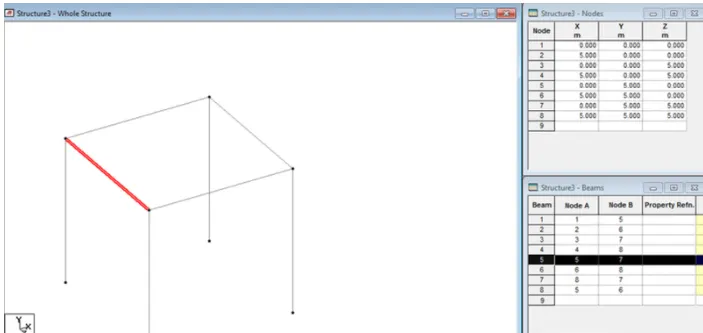
- Click on any primary beam in the section
- Right-click and add a new node in the beam section a node will be added
- Again click on the create beam
PRACTICAL
Calculate the wind pressure for the given building
a. Building Dimension: 20m x 30m x 20m height RCC
b. Building usage: Hospital block in the city center
c. Location: Darjeeling
Wind pressure [Pz]=0.6V12
Vz=Vb*K1*K2*K3
Vb=50
K1=1
K2=1.12
K3=0.5
Vz=0.5*1*1.12*0.5=28
2. Calculate the Dead load and Live load for the above building concerning IS standards ( assume suitable sections )
Dead load = Unit weight * Volume of the section
Dead load = 25*[0.5*0.23*1]=2.875KN/m
Live load
Considering the general building
Bathrooms and toilets in all types of building
Kitchen
- Dwelling houses 2 1.8
- Hostel, hotel, etc 3 4.5