Week 3 Challenge
Objective:
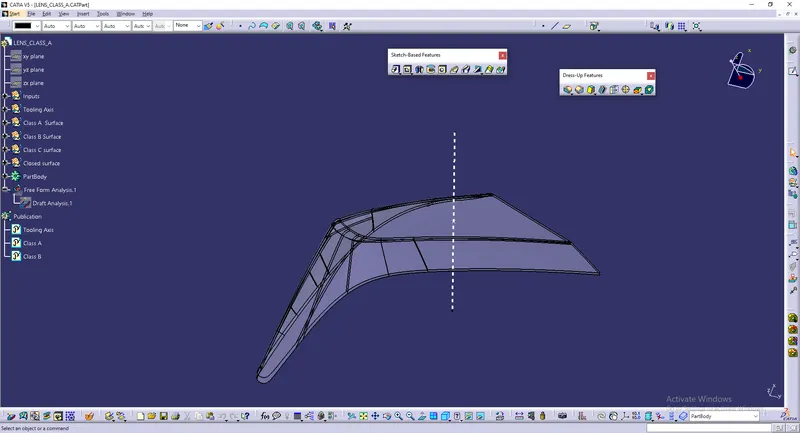
- To create a closed product using the given Class A surface
- And derive a proper specification tree by following proper naming and order
Head light:
Cover Lens
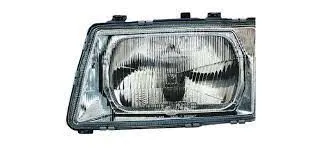
Cover lenses with dispersion optics have the task of deflecting, scattering or focusing the luminous flux collected by the reflector in such a way that the required light distribution, such as the cut-off line, is produced. This previous standard concept has now almost been completely replaced by non-patterned systems.
Types Of Head lights
- Halogen headlights
these are commom headlights which are still used in today,s production cars. They produce quite a bit of heat, as they work by electricity flowing through the filament to light up the bulb. They are cheap but nowdays more optons are available with better efficiency.
- Xenon or HID headlights
Xenon headlights are also known as high intensity discharge (HID) headlights. They don’t use a metal filament to create the light – instead, the HID bulb is filled with Xenon gas which, as it ignites, produces a bright white light.
- LED Headlights
LED headlights produce light through electroluminescence, which is more energy efficient than halogen. This process also means that LED lights will generally last longer than their counterparts, although they can be more expensive. They’re most commonly found in newer cars and it seems likely that they’ll continue to grow in popularity into the future.
Tooling Axis :
- The direction in which the mold called the tooling axisor core and cavity opens is Tooling axis
- Considering the ejection from the cavity of the mold after manufactering the interior trim must have the nominal 3 degree draft angle. Hence the tooling axis is crested by considering this factor
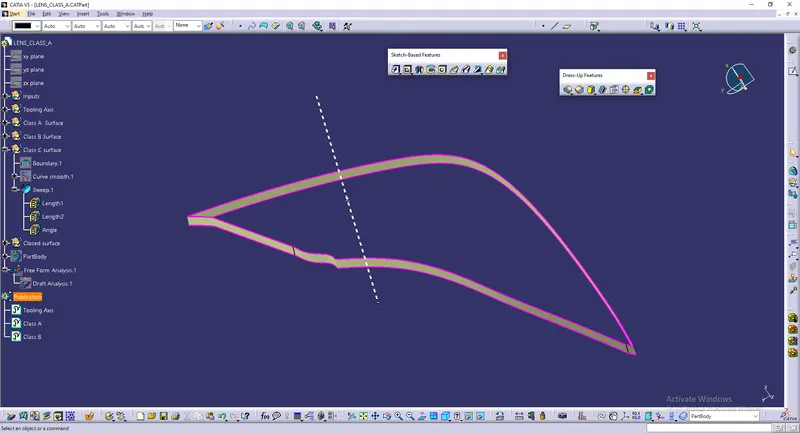
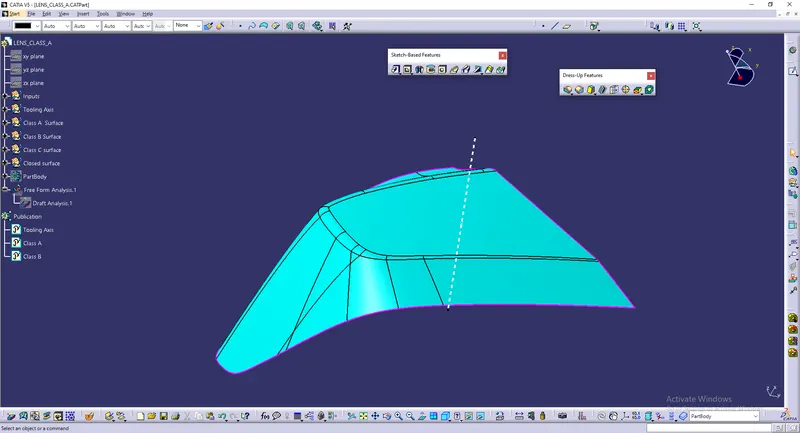
- The white clour line is the tooling axis of this surface
Material :
Poly carbonate :
- polycarbonate has good weather and UV resistance, with transparency levels almost
good as acrylic. - Applications: security screens, aircraft panels, bumpers, spectacle lenses,
headlamp lenses,
Class A Surafce :
- Class surface are the one which will be visible to the customer
- It's the exterior of the parts
- It has a optimal asthetic shape and high surface quality
Draft Analysis :
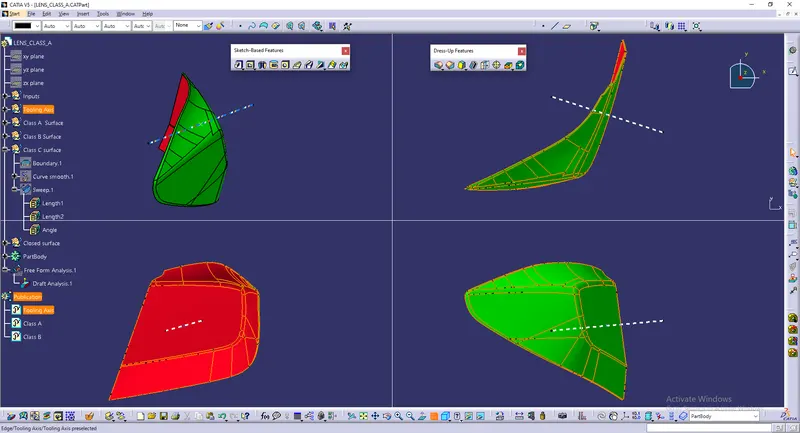
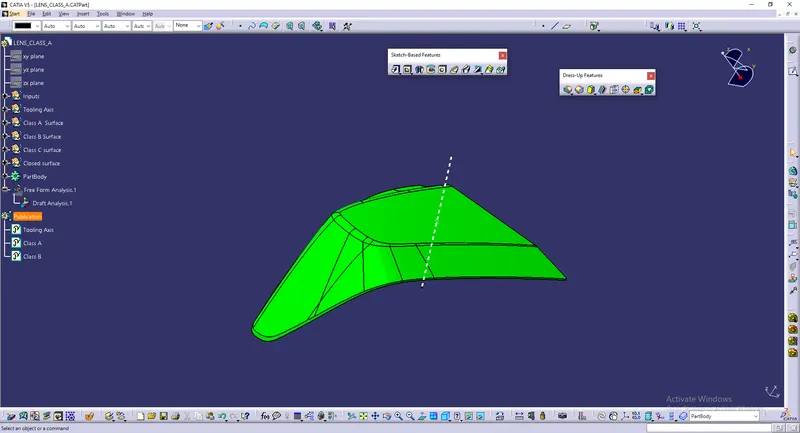
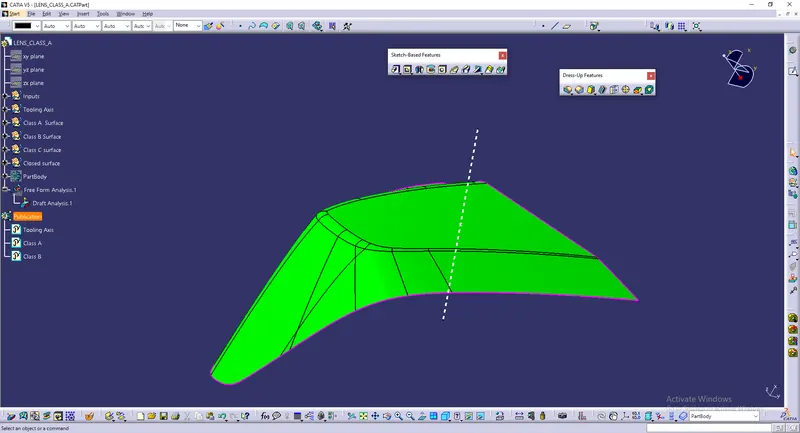
- This type of analysis is performed based on colour ranges identifying zones on the analysed element where the deviation from the draft direction at any point.
- The Green colour denotes the draft angle is in the standards (3 degree).
- The Blue colour denoted its is below (3 degree).
- The Red colour denotes the surface is not producable.
For Part :
For Class A Surface :
Class B Surface :
- Class B is the inner side of the Class a surface which will not be seen by the customer
- where it will faced in the side of core
- where the ejection will make there contact
- It contains the engineering aspects of a model.
Class C Surface :
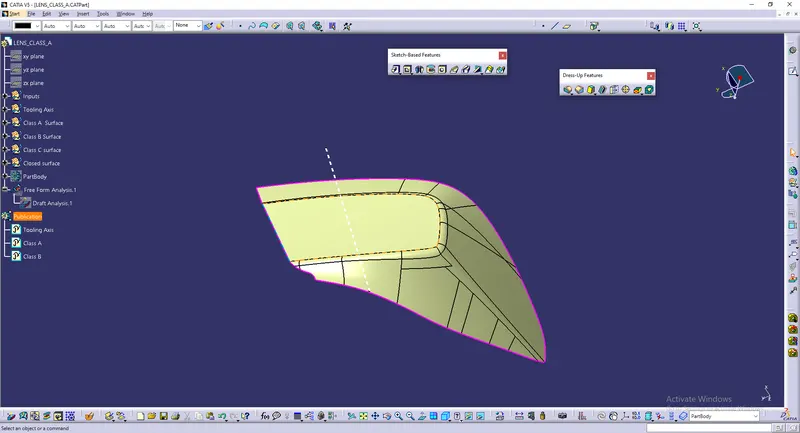
- Surface that joins class-A and class-B surfaces is class-C surface.
- Which will determine the thickness.
- Class C is often specified for interior surfaces not readily visible.