Week 8 - Challenge 4 - Bumper
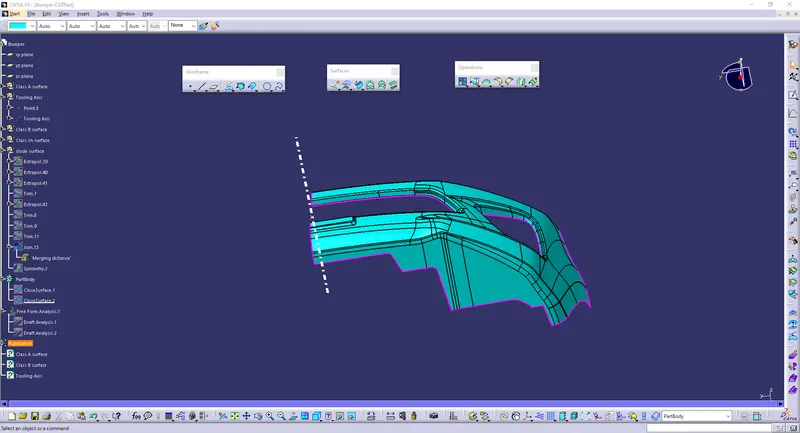
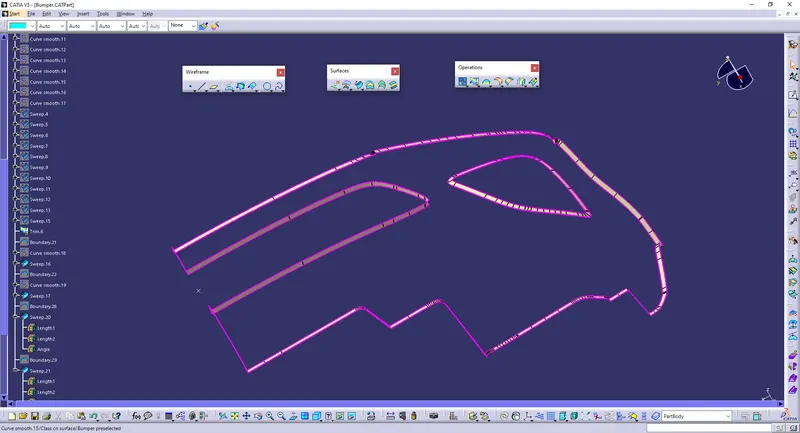
Tooling Axis :
- The direction in which the mold called the tooling axisor core and cavity opens is Tooling axis
- Considering the ejection from the cavity of the mold after manufactering the interior trim must have the nominal 3 degree draft angle. Hence the tooling axis is crested by considering this factor
- The white clour line is the tooling axis of this surface
Material :
ABS - acrylonitrile-butadiene-styrene
- The production costs isn lowand it is sturdy.
- Aesthetically pleasing structure.
- Its ability to withstand being heated and cooled multiple times make it highly suitable for recycling.
- ABS has low heat and electricity conductivity that is especially helpful for products requiring electrical insulation protection.
- It also offers excellent impact resistance and can absorb shock effectively and reliably.
| Tensile Strength | 40-50 | Mpa |
| Notched Impact Strength | 10 - 20 | Kj/m² |
| Thermal Coefficient of expansion | 70 - 90 | x 10-6 |
| Max Cont Use Temp | 80 - 95 | oC |
| Density | 1.0 - 1.05 | g/cm3 |
pc - polycarbonate
- High performance plasticsAmorphous polycarbonate polymer offers a unique combination of stiffness, hardness and toughness.
- It exhibits excellent weathering, creep, impact, optical, electrical and thermal properties.
- It has extraordinary impact strength, it is the material for car bumpers, helmets of all kinds and bullet-proof glass substitutes.
| Tensile Strength | 70 - 80 N/mm² | |
| Notched Impact Strength | 60 - 80 Kj/m² | |
| Thermal Coefficient of expansion | 65 x 10-6 | |
| Max Cont Use Temp | 125 °C | |
| Density | 1.20 g/cm3 |
Class A Surafce :
- Class surface are the one which will be visible to the customer
- It's the exterior of the parts
- It has a optimal asthetic shape and high surface quality
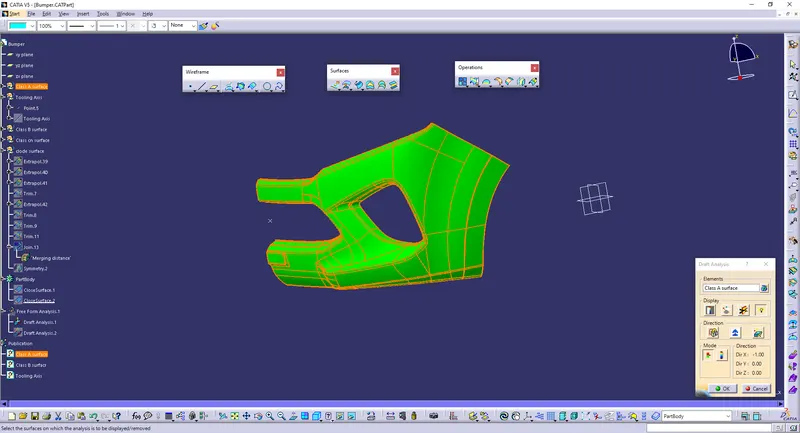
Draft Analysis :
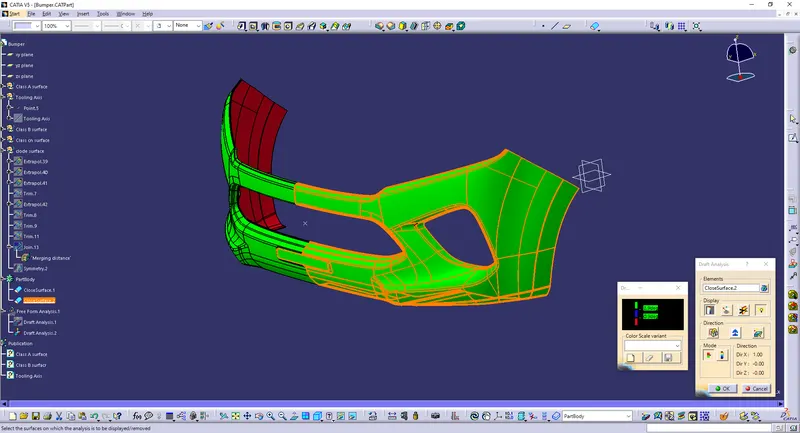
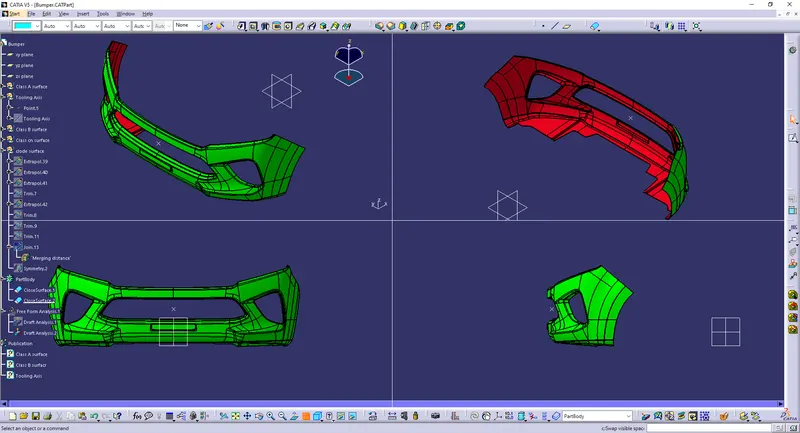
- This type of analysis is performed based on colour ranges identifying zones on the analysed element where the deviation from the draft direction at any point.
- The Green colour denotes the draft angle is in the standards (3 degree).
- The Blue colour denoted its is below (3 degree).
- The Red colour denotes the surface is not producable.
For class A :
For Part :
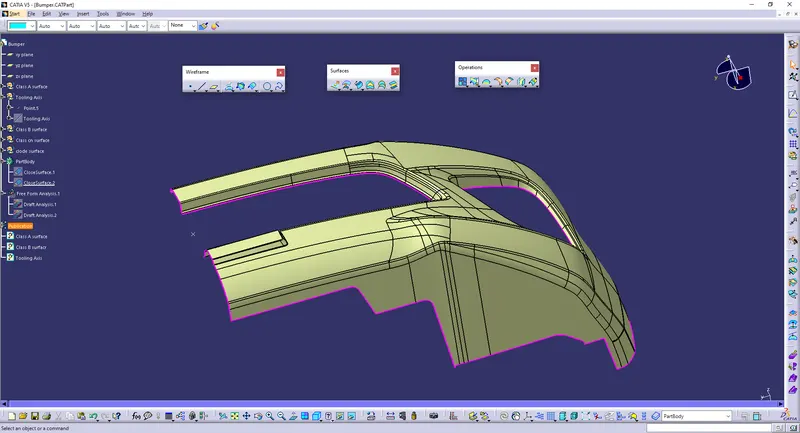
Class B Surface :
- Class B is the inner side of the Class a surface which will not be seen by the customer
- where it will faced in the side of core
- where the ejection will make there contact
- It contains the engineering aspects of a model.
Class C Surface :
- Surface that joins class-A and class-B surfaces is class-C surface.
- Which will determine the thickness.
- Class C is often specified for interior surfaces not readily visible.
conclusion :
The class A and B will be published and sent ot the next designing procces