Week 3 - Adiabatic Flame Temperature calculation
WEEK 3 : Project “ADIABATIC FLAME TEMPERATURE”
Aim: The project aims to determine the Adiabatic flame temperature of various fuels at various operating conditions using programming tools Python , Cantera and compare their results.
** Note : There exists differences in the results of Python program which are manually programmed to find the AFT using Newton-Raphson numerical technique and where as Cantera programs are using inbuilt “auto” functions to solve for AFT thus by having higher order accuracy.
Methodology: To investigate the AFT and effects of variations in fuels and operating conditions on AFT we will set up 4 cases as mentioned below :
Case 1: Investigate AFT variation for methane fuel in constant volume chamber as function of equivalence ratio.
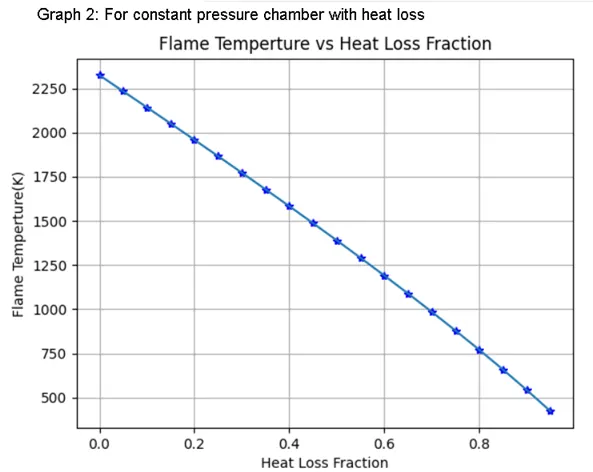
Case 2: Investigate AFT variation for methane fuel in constant pressure chamber as function of heat loss fraction at stoichiometric condition.
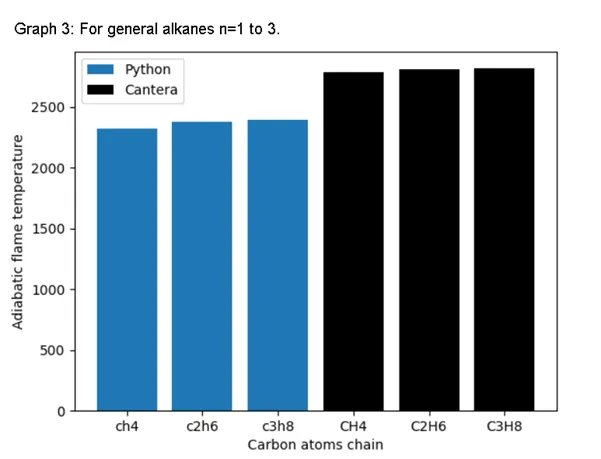
Case 3: Investigate AFT variation for alkanes of carbon chain from C=1 to 3 i.e. Methane, Ethane , Propane at stoichiometric condition.
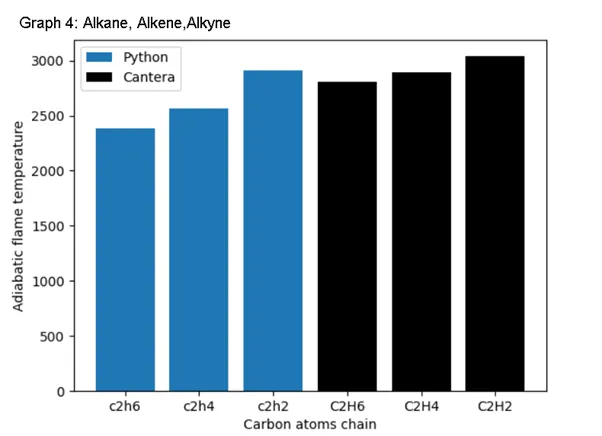
Case 4: Investigate AFT variation for alkanes, alkenes, alkynes of carbon chain C=2 i.e Ethane , Ethene ,Ethyne at stoichiometric condition
Results:
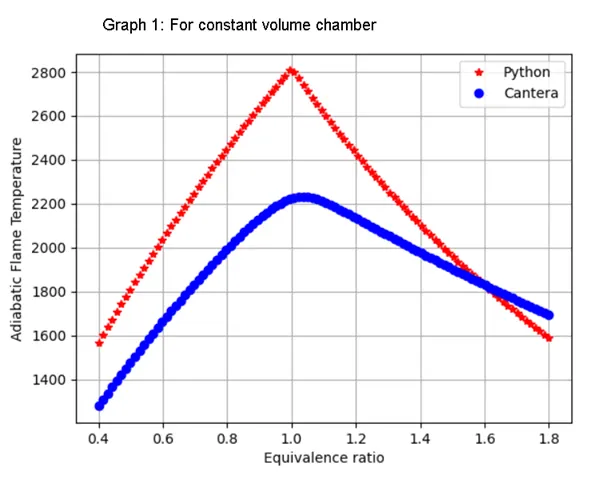
Case 1: AFT is calculated for equivalence ratio ranging from 0.4 to 1.8 , the reasons for considering these extremes is due to rich and lean blow conditions. The results as shown in graph 1
**Python**
Max AFT = 2807.350304906472 for equivalence ratio = 1
**Cantera**
Max AFT = 2232.9378202925704 for equivalence ratio =1.0363636363636364
The graph concludes that max heat release is possible at stochiometric condition or near to it. Moving away from it will lead to change in equivalence ratio. Moving towards left will result in lean conditions , where more quantity of air is present and the decrease in temperature is as result of heating the excess air. Similarly moving right leads to rich conditions where fuel is present in greater quantity which leads to incomplete combustion thus leading to decrease in temperature. The difference in both peaks of python and Cantera is due to result of Cantera including more radical and intermediate species and having more heat dissipation.
Program code: https://drive.google.com/file/d/1sjAaFBp9zL-OmSlZ1bOvlUy5N63GSZ2d/view?usp=sharing
Case 2: Investigate AFT variation for methane fuel in constant pressure chamber as function of heat loss fraction at stoichiometric condition.
Heat loss = Heat released on combustion – Heat lost
Heat released on combustion = Change in enthalpy of reactants and products
Heat lost = mass heat loss = heat loss factor * latent heat value
AFT = 1678.8049530661992 for Heat Loss Fraction (HLF) = 0.35
Program code: https://drive.google.com/file/d/1k7OIUBIIQsc7_BSxZpHaxpwWa4Sh8P8r/view?usp=sharing
Case 3: Investigate AFT variation for alkanes of carbon chain from C=1 to 3 i.e. Methane, Ethane , Propane at stoichiometric condition.
It is observed from graph 3 that with rowing increase of carbon atoms there is increase of absolute heat ,i.e it supports the statement and align with decrease in H/ C ratio leading greater quantity of heat release.
Program code: https://drive.google.com/file/d/1NBfbNUGdYSXFRWUbYYFoIOGPKl3z-Agu/view?usp=sharing
Case 4: Investigate AFT variation for alkanes, alkenes, alkynes of carbon chain C=2 i.e Ethane , Ethene ,Ethyne at stoichiometric condition
The graphs 4 shows that Alkynes posses the high energy content due to the more covalent bonds compared to other alkene and alkanes.
Program code: https://drive.google.com/file/d/1oQX215MG0NQLDDNxdmDpns7NTmOQ34Bj/view?usp=sharing