Week 2 Session 7
SERIES HYBRID
As we can see in the figure the series hybrid vehicle has the drive train such as only the motor is connected to the transmission gear box and engine is drive to charge the battery and to drive the motor
such type of powertrain are mostly used in commercial and military vehicles
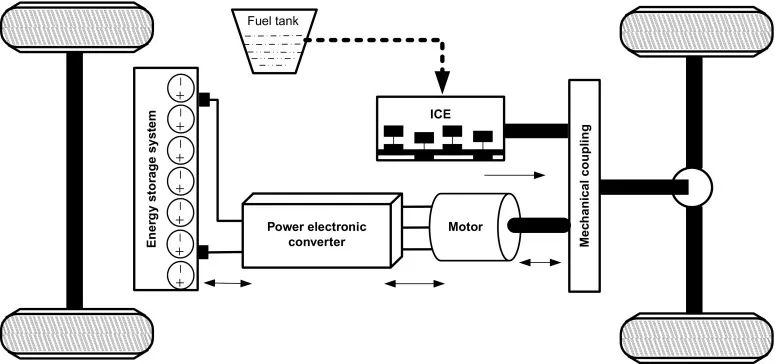
in the parellel hybrid vehicle the power is tranmitted through both the engine as well as motor the vehicle can rus as motor alone which is called battery mode and engine alone which is callled engine mode and if required the vehicle can also run by powering from both engine and motor which is called hybrid mode
in the series parellel type of vehicle there are two parellel paths one for engine and and other for electric mode and there a generator in between which is in series to battery
How the architecture changes
Several architectural differences are involved in moving from one of these types of EV to the next.
The most obvious is battery capacity, which is measured in kilowatt hours (kWh). Since the electric motor in a MHEV is only assisting a gas engine, it might have a battery that is 1 kWh or less. An HEV’s battery has to deliver enough power to run the vehicle for brief periods, so it might be as large as 8 kWh, while a PHEV could have a battery as large as 15 kWh to drive farther on electric power only.
The battery in a full BEV has to power everything in the vehicle, all the time, so typical BEV capacities range from about 40 kWh to 80 kWh, although some are now emerging with batteries as large as 200 kWh.
The biggest architectural change comes when moving from HEV to PHEV. That is the point where outside power — from the grid, possibly from an outlet at the vehicle owner’s house — now enters the vehicle. Receiving alternating current (AC) power from the outlet means the vehicle has to have an inlet, leading to an onboard charger that converts the power to direct current (DC) to charge the battery. As the battery powers devices in the vehicle, the power stays DC but requires an inverter to change to AC to power the electric motors.
The PHEV always has a gas engine to fall back on and has a smaller battery, so conventional charging will likely be sufficient to charge it in a short amount of time. PHEVs can typically charge in a couple of hours with a Mode 2 charging cord – that is, one that can plug into a standard household outlet.
For BEVs, this method could take more than a day to fully charge their higher-capacity batteries, so many BEV owners opt to install a wall-mounted EV charger in their home and/or use public charging stations, including fast-charging stations that can potentially charge the BEV in under one hour.
Consequently, when moving from a PHEV to a BEV, this change in charging speed becomes a consideration that drives architectural decisions. While BEVs remove all ICE components, which reduces complexity, the requirement for faster charging means adding DC charging capabilities.
High-speed charging means higher power. While ICE vehicles use 12-volt batteries, BEV batteries often deliver 350 volts, with some OEMs even going as high as 800 volts. Higher power requires larger and more robust cables and connectors to allow for faster charging.
The voltage has to be stepped down for different components — especially electronics that run on 12V or less — but overall this is an efficient approach that saves energy. OEMs are discovering that even mild hybrids can achieve efficiencies by using 48V for higher-power components such as air conditioners or active-suspension systems and then stepping down voltage for electronics. Using 48V also makes it seamless to turn the engine on and off when starting and stopping.
All of these pieces — the batteries, converters, inverters, wires and connectors — add weight and complexity, but OEMs can reduce that complexity with a thoughtful approach that takes into account the full electrical/electronic architecture, such as Aptiv’s smart vehicle architecture
Selecting and purchasing an electric vehicle involves trade-offs and decisions that, assuming all goes well, will lead to a big payoff in ensuring greener mobility. That is true for designing and building one, too.