Week 2 - Flow over a Cylinder.
Aim: To flow over a cylinder and explain the phenomenon of Karman vortex street.
About Reynolds no:
- The Reynolds no (Re) is a dimensionless number after the Osborne Reynolds, defined as the ratio of Inertial forces to the viscous fluids, given as
Re=(rho*v*L)/µ
Where,
Re=Reynolds no ,
Rho)=density,
V=velocity,
µ=Dynamic viscosity
Significance:
Reynolds no is used in forced convection.
Force convection is a type of heat transfer, in which fluids are forced to move ,in order to increases heat transfer.
Reynolds is used to predict the flow patterns in different flow situations ,At low Reynolds no the flow tends to be laminar flow &while at the high Reynolds no the flow is turbulent
- Re<2000, laminar flow for pipe
- Re>2000, transition flow
- Re>4000, turbulent flow.
Reynolds Transport Theorem:
Fluids are generally described using either the Eularian or Lagrange approaches
Eularian Approach:
- The flow field is analyzed by looking at the fluid flow passing through a specific region in space for varying time, This specific region of space across which the fluid passes and transport mass , momentum and Energy is called Control volume. Furthermore the area bounding the control volume is called Control surface.
Lagrange Approach:
- The flow field is analyzed by following a fluid parcel as it moves in space with time This parcel referred to as Control mass, a Control mass is defined as system of fixed mass & fixed identity (ie., the same set of particles present in the parcel.)
The Reynolds transport theorem(RTT)is used to transform the Conservation laws of Fluid dynamics derived using Lagrange approach to Eularian form & vice-versa.
It is Essential to review the concepts of Extensive and Intensive properties.
The fundamental governing equations of fluid dynamics are Continuity, Momentum& Energy, The Continuity eq indicates the Conservation of mass(m), the Momentum indicates the Conservation of Linear Momentum, (mV) & the Energy equation indicates the Conservation of Energy (E). The parameters m, mv, E represent Extensive properties. These properties depend on the mass of the system, Therefore the governing equations are basically the time rate of change of different Extensive properties.
Intensive properties are independent of mass of the system and defined as the Extensive properties per unit mass
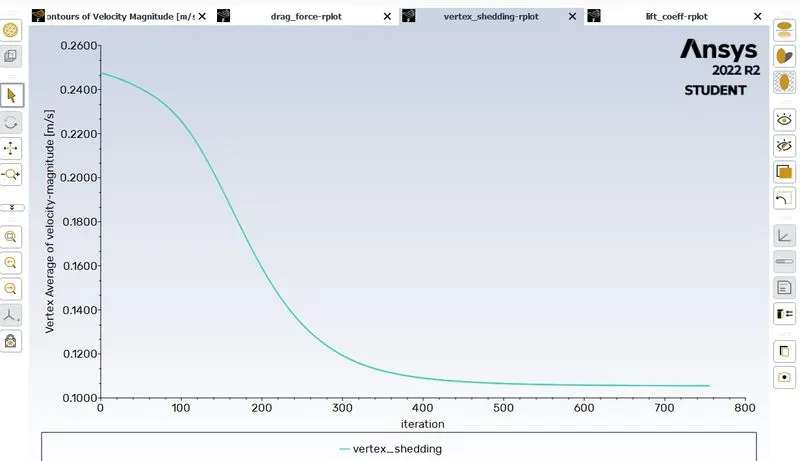
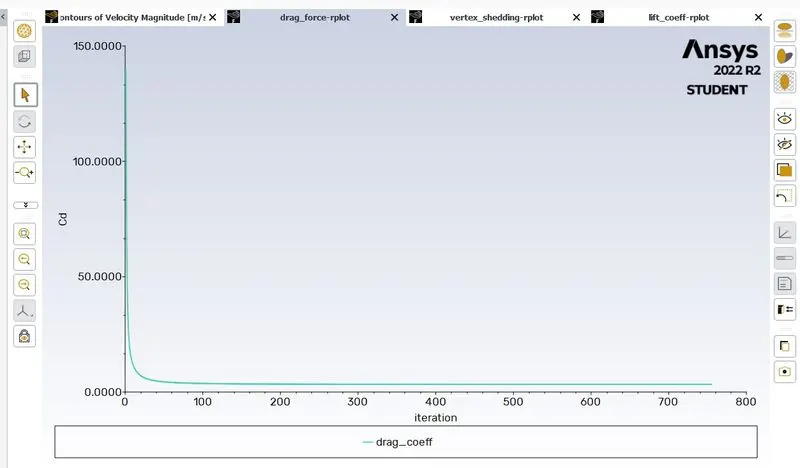
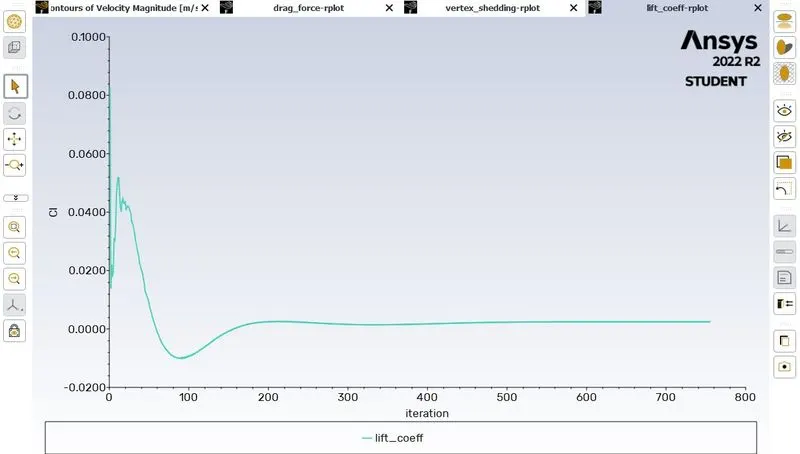
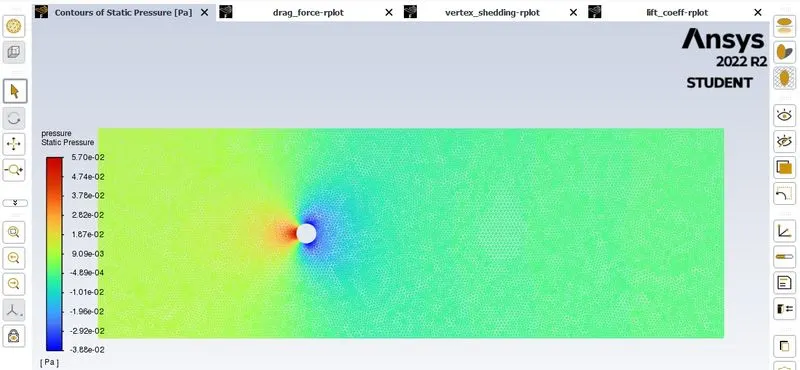
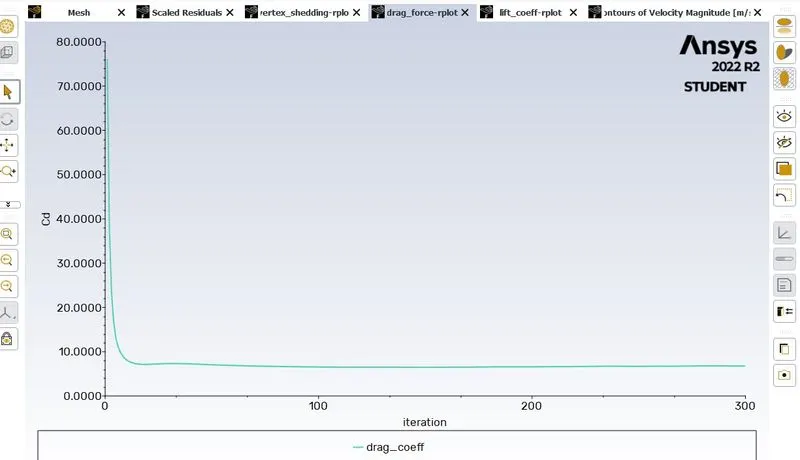
For RE10 with velocity0.25
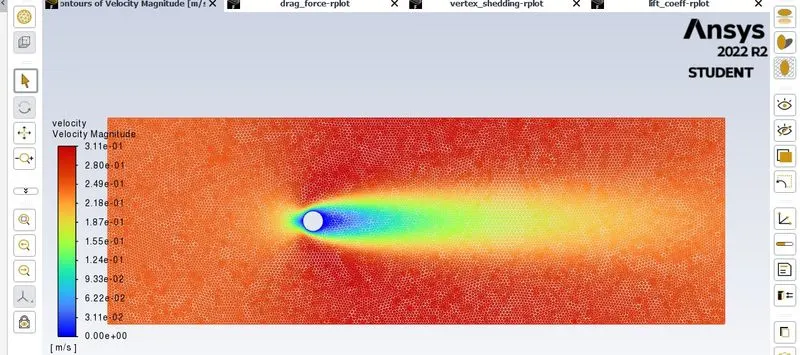
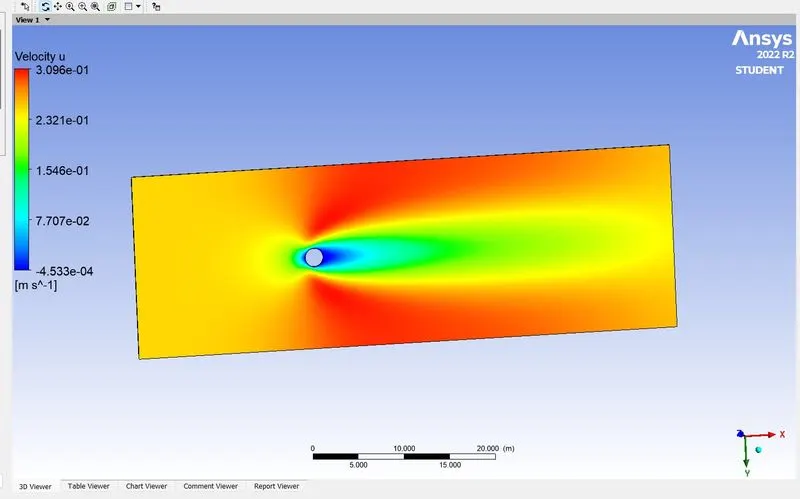
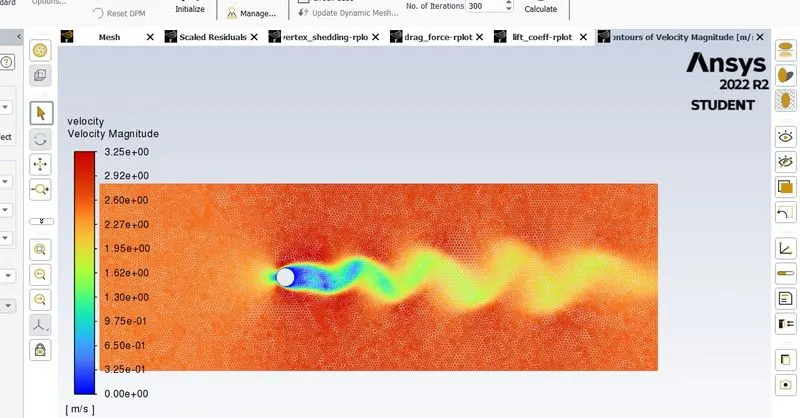
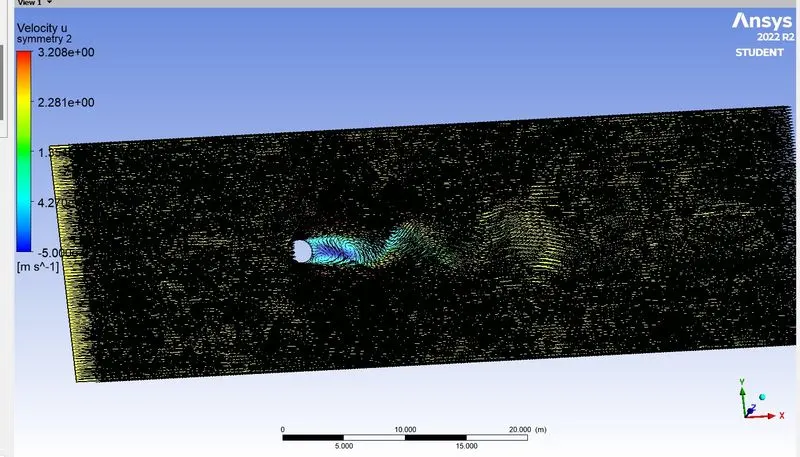
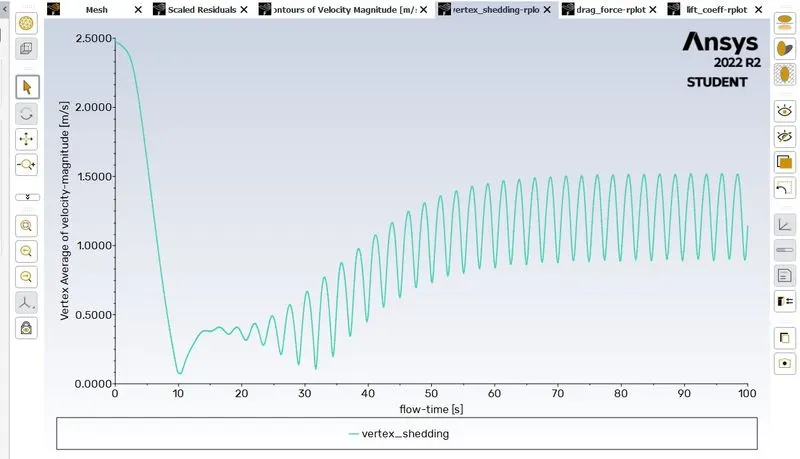
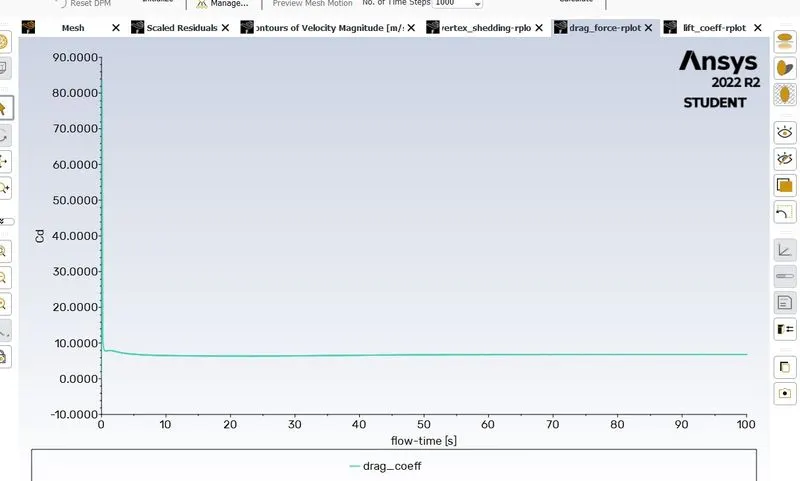
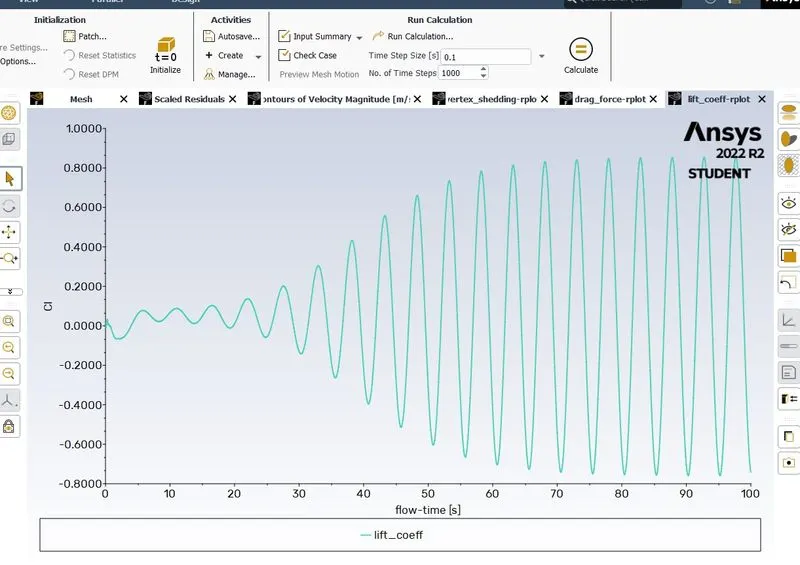
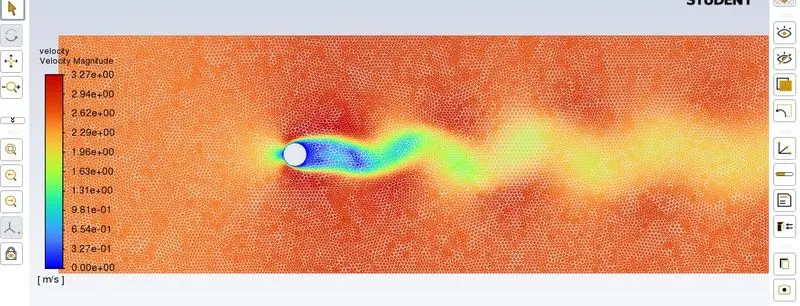
For Re 100 with velocity 2.5
steady:
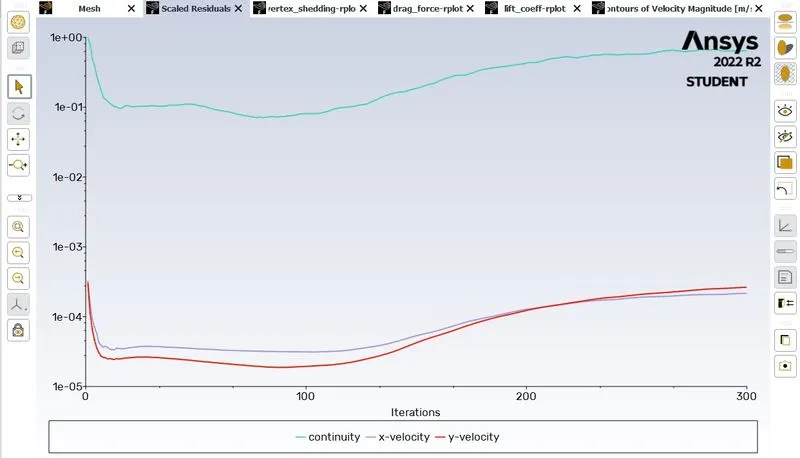
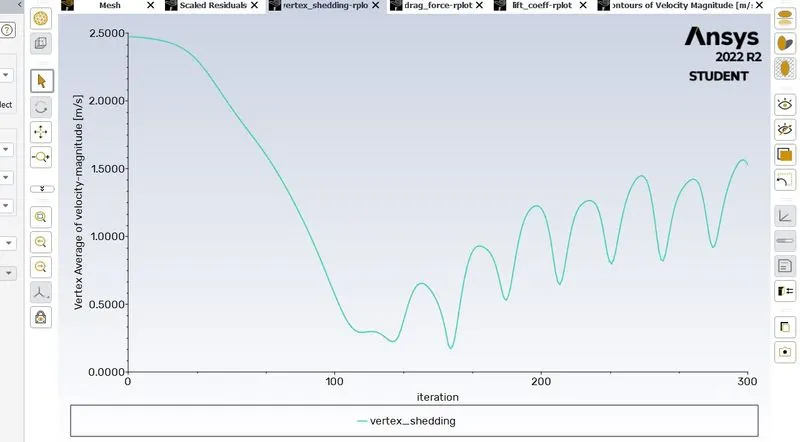
Unsteady:
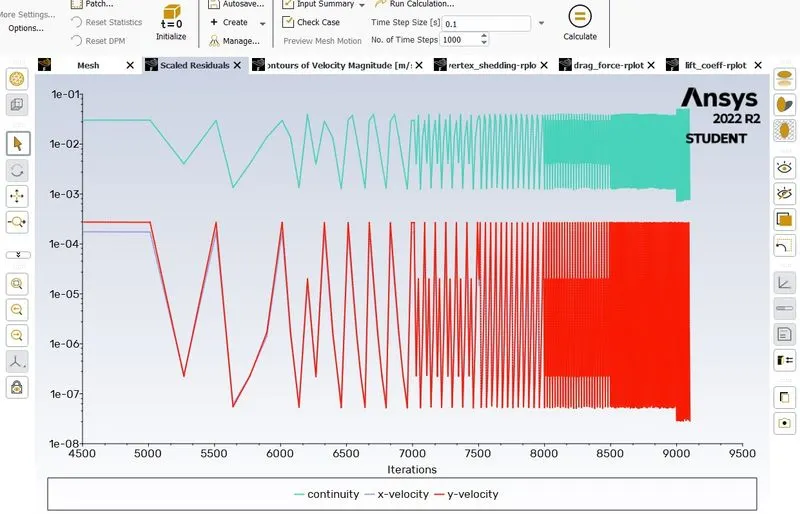
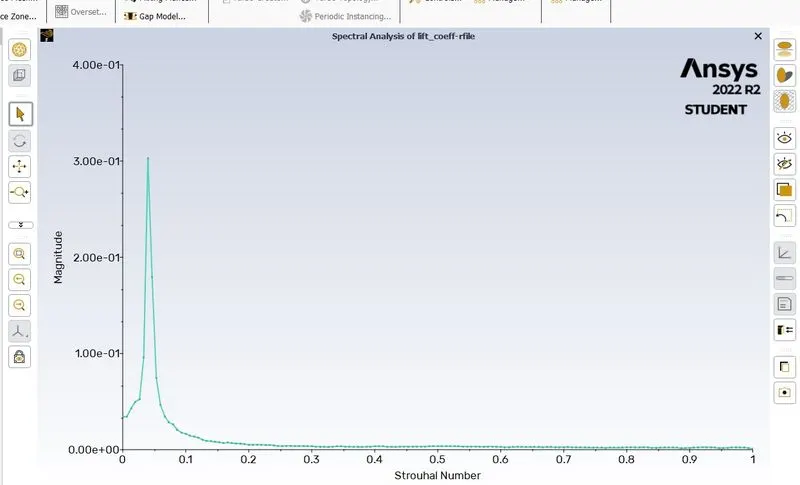
Strouhal No:
For Re 1000 with velocity 25
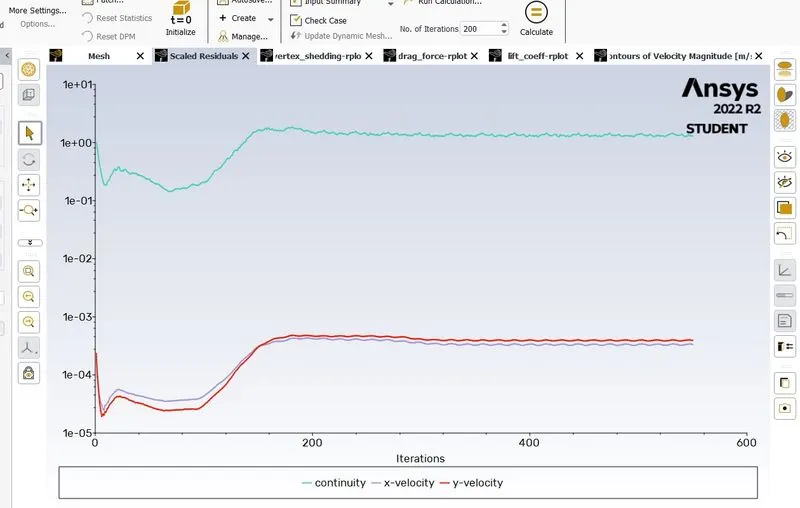
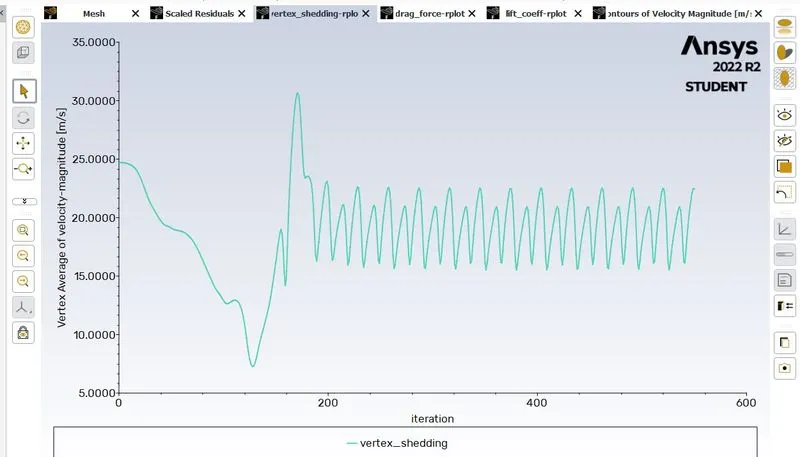
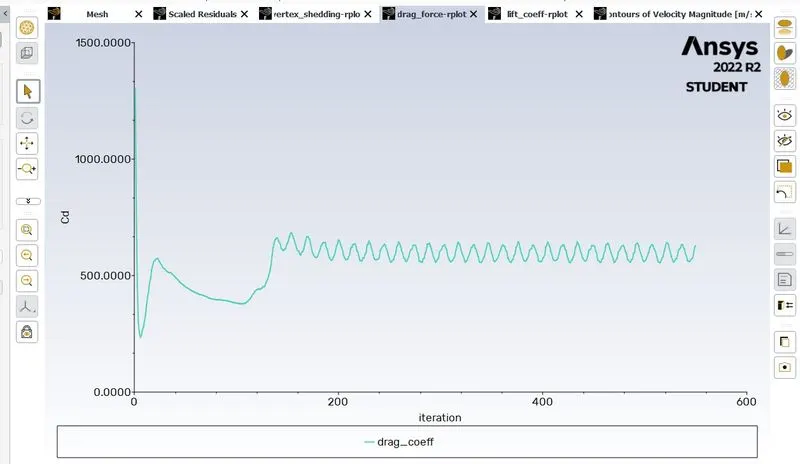
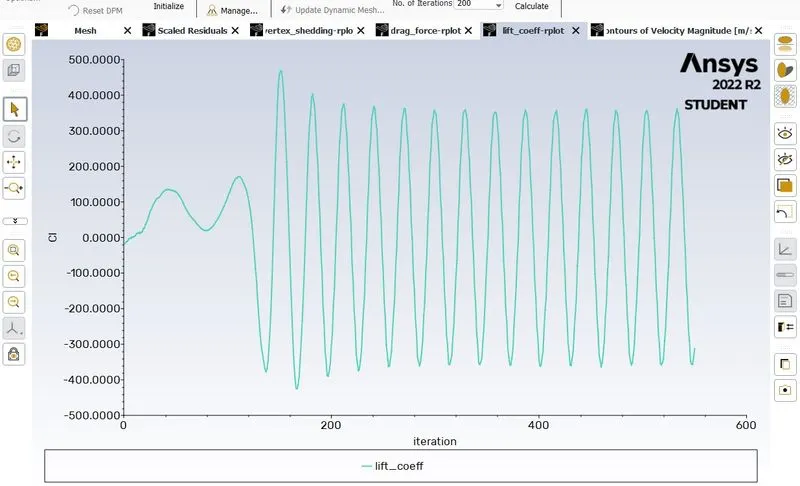
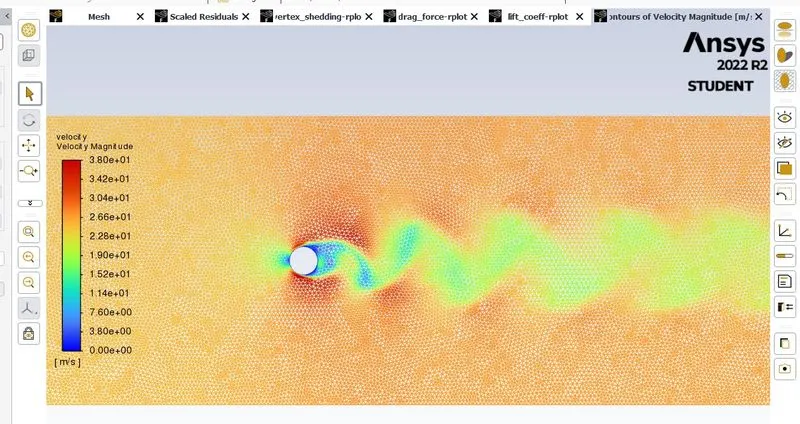
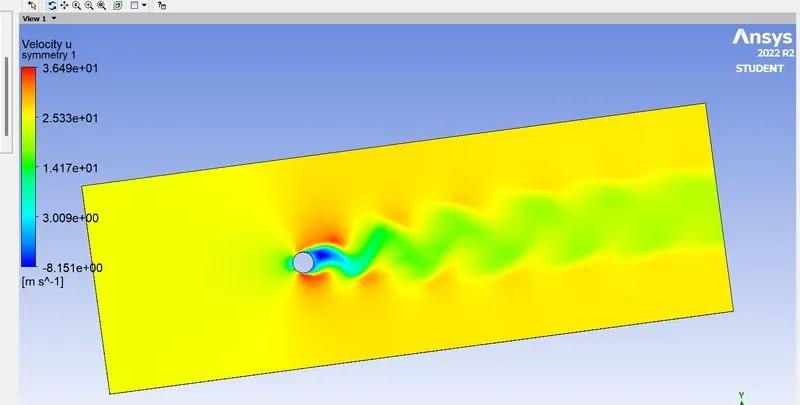
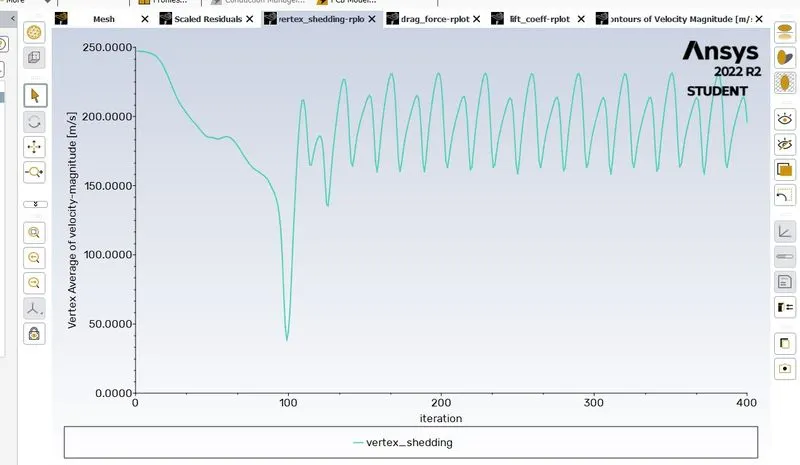
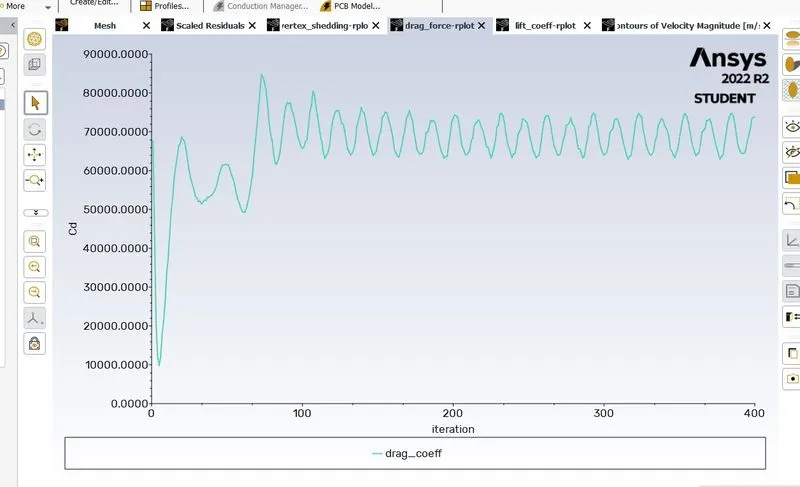
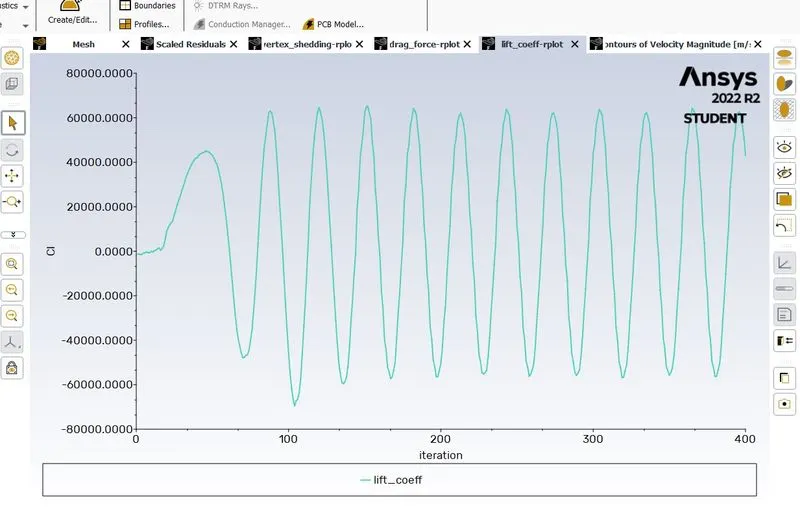
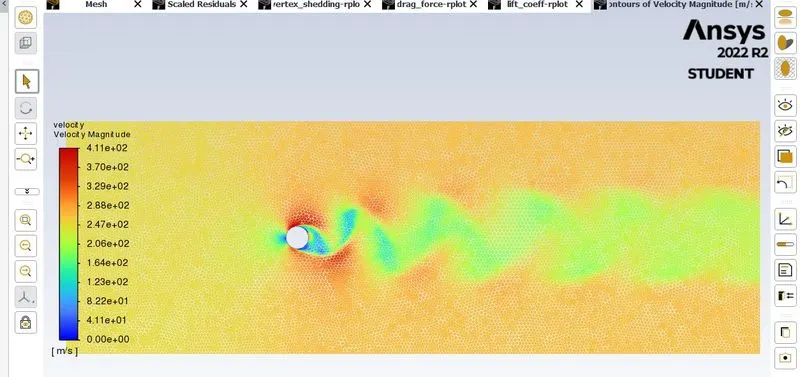
For Re10000&with velocity250
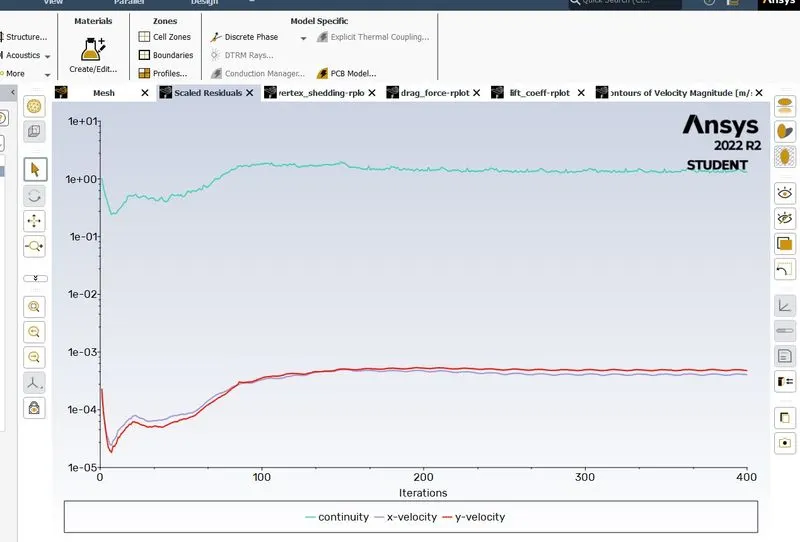
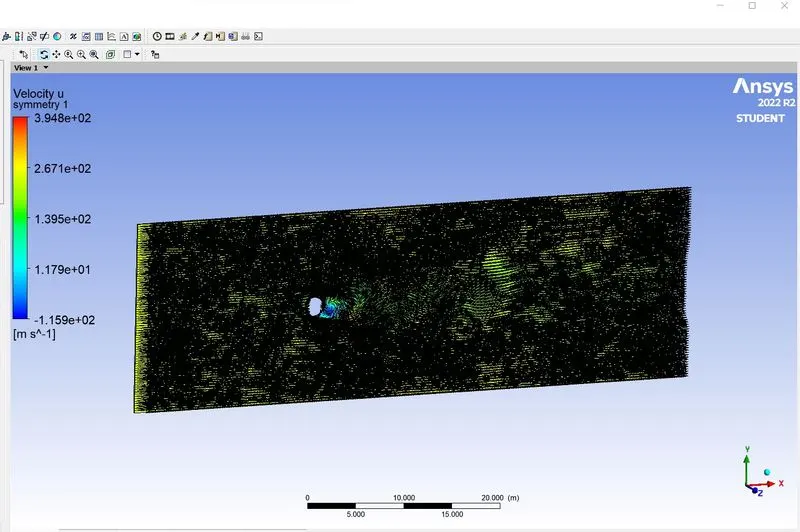
l
For Re100000 with velocity 2500
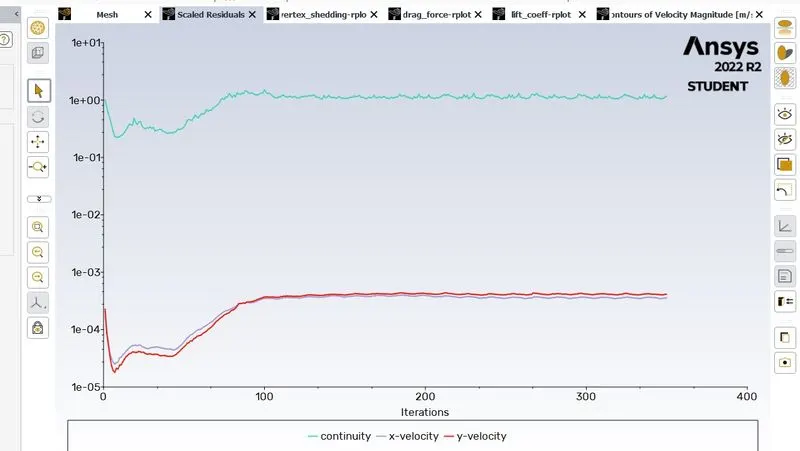
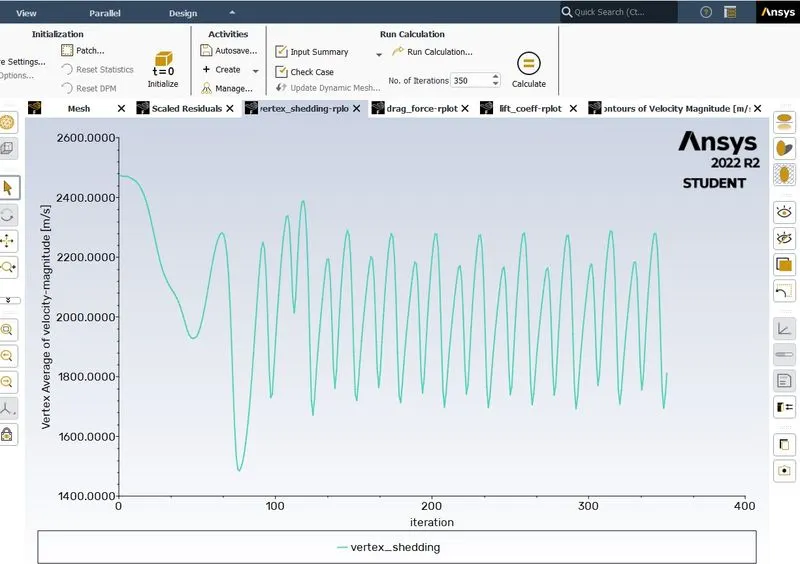
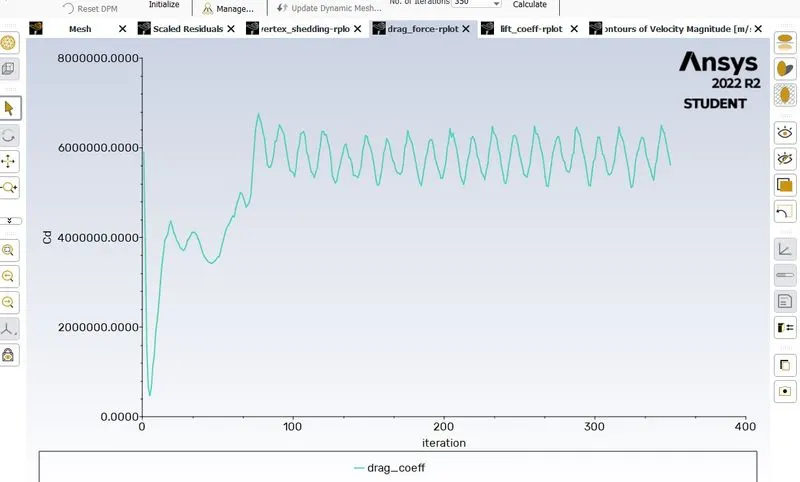
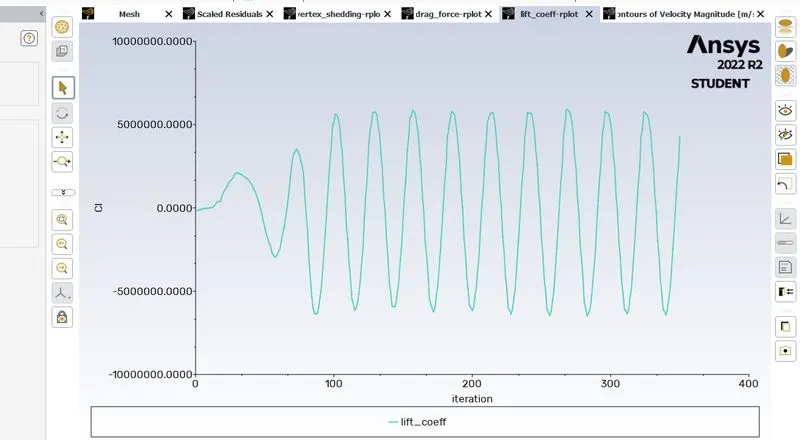
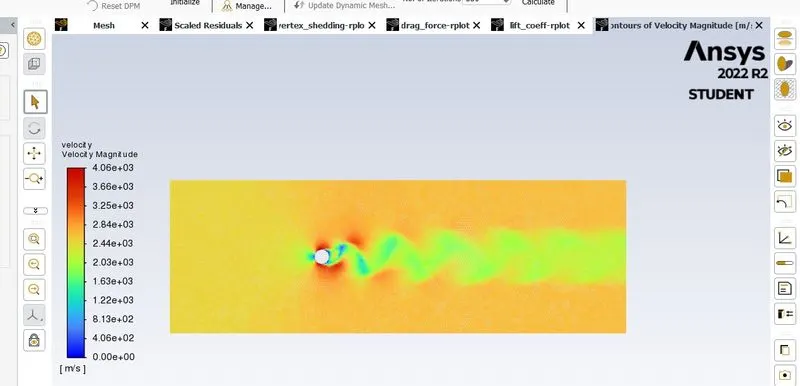
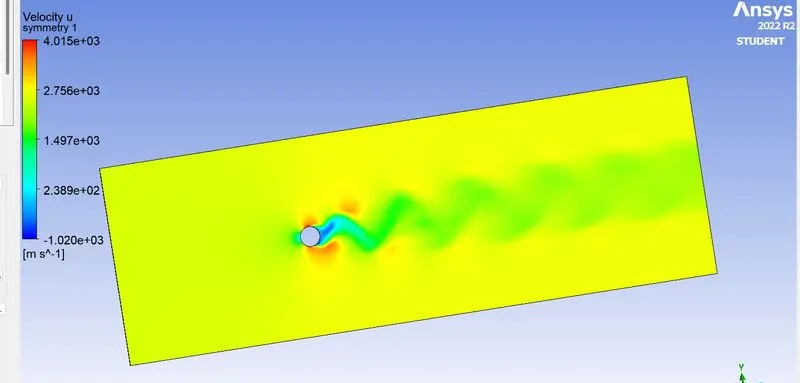
For re10, 100,1000,10000,100000
vertex_shedding = 0.10552301, 1.5288556 , 22.466896 , 196.23364 , 1810.3418
Cd = 3.3244335, 6.7679636 , 628.35958, 73776.876 , 5624872.7
Cl = 0.0024539759, -0.63616047, -312.13326, 43070.022 , 4345640.8
As per Observation:
- As per my observation its an External flow with an obstuction,ie., is Cylinder walls ,we know ,there is an obstuction in any flow there will be change in the direction of flow ie.,flow over cylinder & here we come across how the vervex shading happens,its due to the obstruction of cylinder walls over the flow ie., korman vortex : and also stagnation point & with wake region
Vortex Shading:
Karman vortex street:
- In fluid dynamics ,vortex shedding is an Oscillating flow that takes place.
- It is a chain of vortices that are Observed when a liquid or gas flows over Extended cylinderical bodies with longitudinal axis perpendicular to the direction of Motion of Continious Medium.
- Karman vortex street is a repeating pattern of Swirling vortices caused by a process known as Vortex shedding which is responsible for the Unsteady separation of flow of fluid.
- A vortex street at a certain range of flow vortices specified by a Reynolds no.
- Von karman vortices are formed by flow streams separating when flowing around obstructions.
- The vortices are depending on the size and shape of the body of a fluid and velocity.
- These vortices produce sinusoidal force acting on the body perpendicular to the flow
- For cylinder the frequency(w) in herz of the shedding is related to the diameter(D) and wind speed via Strouhal no
ie., S=w*D/v
Stagnation point:
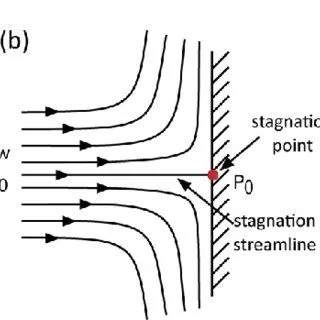
- When a fluid is a passing in the direction the fluid stops at (Po)and the fluid velocity becomes zero at point (Po) and this point is called Stagnation point.
- Stagnation point exists at the surface of object in the flow field is brought to rest by the object
Imp note points:
- The static pressure is highest when velocity is zero & max at the stagnation points,here all velocity head is converted to pressure head.
- Stagnation point is the point at which fluid is stopped by(reversible & adiabatic ) ie., all kinetic energy is converted into pressure Energy isentropically.
Wake region:
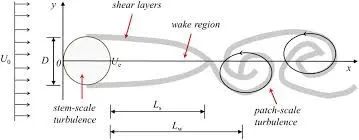
The above region specified is the wake region.
and also
Conclusion:
- By increasing the velocity ,the vortex shading is forming but not to the effect of re100 , i thought that due to increase in velocity the vortex shading also increases along the length of the body.
- when we watering the wall when we give obstruction by the fingure, the flow of direction changes and forms flow separation ,with some wake region .
- The velocity fluctuation are in the range of given initial velocities given & graually decreases upon obstruction..