Understanding Explicit and Implicit analysis method using an analytical approach
OBJECTIVE:
Solve the given equation F (u) = u3 + 9u2 + 4u using explicit and implicit method. Write a detailed report stating the
PROCEDURE:
- The equation of Force:
F(u) = u3 + 9u2 + 4u
- Equation of stiffness can be found as below
K = dF/du
K = 3u2 + 18u + 4
- To solve these equation and find load vs displacement effect for simple bar under tension, two different methods can be employed.
- Explicit
- Implicit
EXPLICIT ANALYSIS
Solving these equation with 3 equal load increment with ΔF = 1
Step 1
- U(0) = 0
- K(u) = 4
- ΔF = 1
- Δu1 = ΔF/k(u) = (1/4) = 0.25
- U1 = u0 + Δu1 = 0+ 0.25 = 0.25
- F1int = (0.25^3) + 9(0.25^2) + 4(0.25) = 1.578125
Step 2
- U1 = 0.25
- K(u1) = 3(0.25^2) + 18(0.25) + 4 = 8.6875
- ΔF = 1
- Δu2 = ΔF/k(u2) = 1/8.6875 = 0.1151
- U2 = u1 + Δu2 = 0.25 + 0.1151 = 0.3651
- F2int = (0.3651^3) + 9(0.3651^2) + 4(0.3651) = 2.708749
Step 3
- U2 = 0.3651
- K(u2) = 3(0.3651^2) + 18(0.3651) + 4 = 10.9717
- ΔF = 1
- Δu3 = ΔF/k(u2) = 1/10.9717 = 0.09114
- U3 = u2 + Δu3 = 03651 + 0.09114 = 0.4562
- F3int = (0.4562^3) + 9(0.4562^2) + 4(0.4562) = 3.792809
|
Step |
ΔF |
U |
Fext |
Fint |
Residual = Fint - Fext |
|
1 |
1 |
0.25 |
1 |
1.578125 |
0.578125 |
|
2 |
1 |
0.3651 |
2 |
2.708749 |
0.708749 |
|
3 |
1 |
0.4562 |
3 |
3.792809 |
0.792809 |
Based on the above table, we can say that the difference in forces i.e. residual is considerable. To reduce this residual, more no. of iterations can be performed. So smaller the steps lesser the residual value.
The reason being there is no intermediate step for checking for the equilibrium between external and internal forces. So it approaches the solution quickly but have some errors in it.
Implicit Analysis
For implicit analysis, the tolerance set is 0.01. So if the residual is greater than 0.01, then newton Raphson iteration is required. Also the load increment is equal in this case as well i.e. ΔF = 1
STEP 1:
- U(0) = 0
- K(u) = 4
- ΔF = 1
- Δu1 = ΔF/k(u) = 0.25
- U1 = u0 + Δu1 = 0.25
- F1int = (0.1834^3) + 9(0.1834^2) + 4(0.1834) = 578125
- R1 = F1int – F1ext = 0.578125
Since R1 > 0.01, Newton Raphson iterations are done.
Δu1(1) = `[R1(1)]/[k(u1(1))` = - 0.06654a
u1(2) = u1(1) + Δu1(1) = 0.25 – 0.06654 = 0.1834
F1(2) = 1.04249
R1(2) = 0.04249 > 0.01, So Newton Raphson required
Δu1(2) = `[R1(2)]/[k(u1(2))` -0.07228
u1(3) = u1(2) + Δu1(2)= 0.17772
F1(3)= (0.17772^3) + 9(0.17772^2) + 4(0.17772)1.000753
R1(3) = 0.000753 < 0.01, so no further iterations.
Thus,
u1 = 0.17772
F1 = 1.000753
R1 = 0.000753
STEP 2:
- U1 = 0.17772
- K(u) = 3(0.17772^2) + 18(0.17772) + 4 = 7.29371
- ΔF = 1
- Δu2 = ΔF/k(u) = 0.137104
- U2 = u1 + Δu2 = 0.3148
- F2int = (0.17772^3) + 9(0.17772^2) + 4(0.17772) = 2.18228
- R2 = F1int – F1ext = 0.18228
Since R2 > 0.01, Newton Raphson iterations are done.
Δu2(1) = `[R2(1)]/[k(u2(1))` = - 0.018294
u2(2) = u2(1) + Δu2(1) = 0.3148 – 0.018294 = 0.2965
F2(2)= 2.003276
R2(2) = 0.003276 < 0.01, so no further iterations.
Thus,
u2 = 0.2965
F2= 2.003276
R2 = 0.003276
STEP 3:
- U2 = 0.2965
- K(u) = 3(0.2965^2) + 18(0.2965) + 4 = 9.60073
- ΔF = 1
- Δu3 = ΔF/k(u) = 0.10416
- U3 = u2 + Δu3 = 0.4006
- F3int = (0.2965^3) + 9(0.2965^2) + 4(0.2965) = 111
- R3 = F1int – F1ext = 0.111
Since R3 > 0.01, Newton Raphson iterations are done.
Δu3(1) = `[R3(1)]/[k(u3(1))` = -0.009493
u3(2) = u3(1) + Δu3(1) = 0.3911
F3(2)= 3.000855
R3(2) = 0.000855 < 0.01, so no further iterations.
Thus,
u3 = 0.3911
F3 = 3.000855
R3 = 0.000855
|
Step |
ΔF |
U |
Fext |
Fint |
Residual = Fint - Fext |
|
1 |
1 |
0.17772 |
1 |
1.000753 |
0.000753 |
|
2 |
1 |
0.2965 |
2 |
2.003276 |
0.003276 |
|
3 |
1 |
0.3911 |
3 |
3.000855 |
0.000855 |
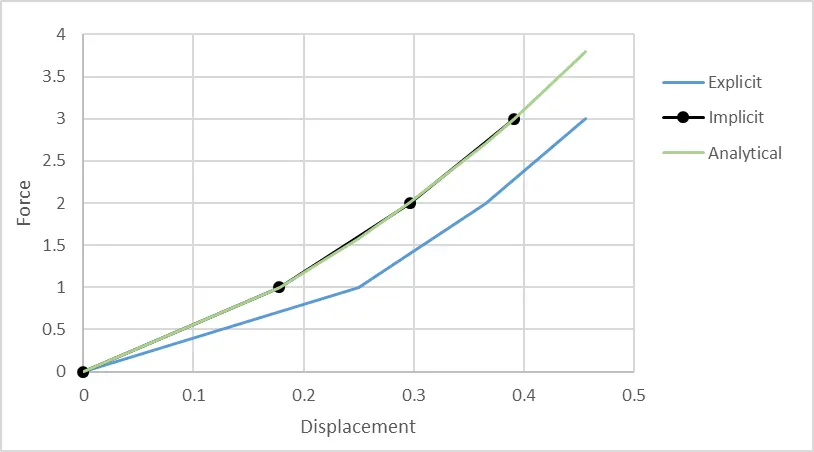
Based on the above table, we can say that the residual is very low and the solution is quite accurate. This is due to the intermediate equilibrium check done and iteration performed using newton Raphson method. This has eliminated the result deviation and provided an accurate output. But the intermediate step has taken more time to come to equilibrium and thus this process although accurate, is slow.
CONCLUSION:
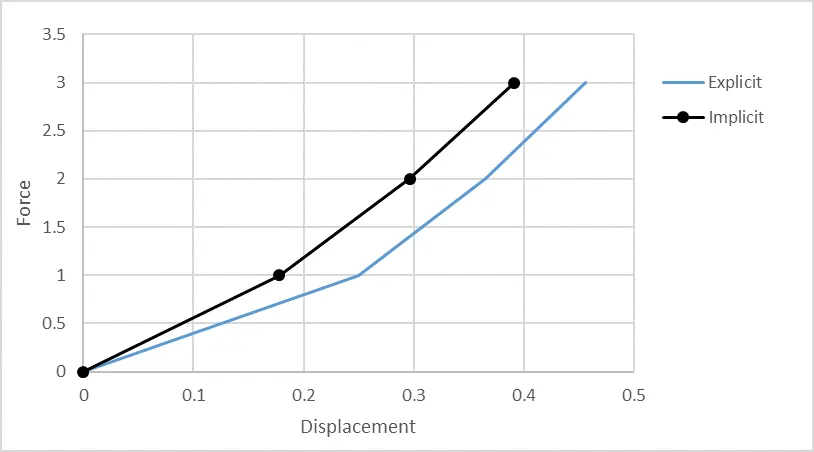
From the above tables on results from explicit and implicit analysis, following graph can be derived. It is evident from the results that the residue in implicit solution is minimal whereas residue between forces is substantial in explicit method. Thus it can be concluded that implicit method provides a much better solution for lower steps whereas the number of steps needs to increase considerably in explicit method to increase its accuracy and decrease the effect of residual error. But since equilibrium iterations are done in implicit method, it becomes very slow whereas explicit is fast method. So depending upon the application and computational power available, both methods have its own pros and cons