Week - 2 - Explicit and Implicit Analysis
Title: Study of Implicit and Explicit Analysis method.
Aim: In this study, it is observed that what are the major differences in the Explicit and Implicit Analysis method in accordance with the solution they offer. And what are the possible areas where they can be used?
Implicit Analysis: In Implicit analysis method of solving, the unknowns are found using the matrix inversion method. In this method the current state and later state of the system is used to determine the value of the system. for e.g if S is to be calculated at n+1 time then the dependent variables of S will be used at n+1 and n. So this makes this method to use large computational power. Hence in this method solution of each step is a series of iterations to establish equilibrium within a certain tolerance. There is no such requirement of the minimum time step, this method can be used with higher time step values.
Explicit Analysis: In this method, there is no requirement of inversion of matrix and the nodal accelerations are solved directly so it reduces the effort of iterations. But to obtain numerical stability, it is important to have a certain minimum time step. i.e the time step should be less than Courant time step. This method handles non-linearities with ease.
Following example shows the differences in these methods and their solutions.
The following equation is solved for both the methods,
`F(u) = u^3 +9u^2 +4 u`
`K(u) = (dF(u)) / (du) = 3u^2 + 18u +4`
Implicit Method:
Newton Raphson method is used to bring equilibrium and then follow the other steps.
Step 1 : u = 0
`K(0) = 9(0)^2 +18(0) +4`
`K(0) = 4`
`deltaU = (deltaF) / (K(0)) = 1/4 = 0.25`
`u1= u(0) + deltaU = 0.25`
`fext = 1`
`fi = (0.25)^3+9(0.25)^2 + 4(0.25)`
`f1 = 1.518`
Residual `R= fi-fext = 1.578 - 1`
`R = 0.578 ` which is greater than tolerance hence we need to approximate the U as well
`U1 = U1^0`
`dU^1 = (-k(u1)^0) ^-1* R = -0.06` `
therefore U1 is
`U1^1 = U1^0 + dU^1 = 0.25 -0.06 = 0.184`
`R^1 = fi - Fext = 1.0469 - 1 = 0.04`
which is again greater than tolerance
hence `U1 = U1^0`
`dU^2 = dU^1 - (ku1^1)^-1 * R^1 = -0.0-0.005 = -0.0713`
`u1^2 = u1^0 + du^2 = 0.25 - 0.0713`
hence updated u1 is 0.178
`fi = 1.007`
`R^2 = 1.007-1 = 0.007`
As it is under tolerance final value of u1 is 0.1787
Step 2 :
` u = u1 = 0.178`
`K(u1) = 9(0.178)^2 + 18(0.178) + 4`
`K(u1) = 7.489`
`deltaU2 = 1/7.489 = 0.133`
`u2 = u1 + deltaU2 = 0.311`
`fext = 1`
`fi = (0.311)^3 + 9 (0,311)^2 +5(0.311)`
`f1 = 2.144`
Residual `R^0 = fi-fext = 2.144-2 = 0.144`
greater than tolerance, the steps which were used above are repeated and then the following value of u2 is obtained
u2= 0.296
Step 3 : Same procedure is followed and we get
u3 = 0.391
Following table shows the values;
| Step | `deltaF` | `deltaU` | U | Fext | Fi | Residual |
| 1 | 1 | 0.25 | 0.178 | 1 | 1.007 | 0.007 |
| 2 | 1 | 0.113 | 0.296 | 2 | 2.004 | 0.004 |
| 3 | 1 | 0.098 | 0.391 | 3 | 3.001 | 0.001 |
Explicit Method :
`dleta(F) = K delta(U)`
Step 1:
Consider `delta(F) = 1 and u(0)= 0`
Therefore
`K(0)= 3(0)^2 +18(0) + 4 =4`
`deltaU1 = 1/4 = 0.25`
`u1 = u(0) +deltaU1 = 0.25`
`u1 = 0.25`
Step 2 :
u= u1
`K(u1) = 3(0.25)^2 + 18(0.25) +4 = 8.687`
`deltaU2 = (deltaF)/(K(u1)) = 1/8.687`
`delta U2 = 0.115`
`u2 = u1 + deltaU2 = 0.25 + 0.115`
`u2 = 0.365`
Step :
u = u2
`K(u2) = 3(0.365)^^´2 + 18(0.365) + 4`
`K(u2) = 10.96`
`deltaU2 = ((deltaF)/K(u2)) = 1/10.96 = 0.091`
`u3 = u2 + deltaU3 = 0.365 + 0.091 = 0.456`
`Fext = deltaF + deltaF + deltaF = 3`
`f1 = (u1)^3 + 9(u1)^2 + 4(u1) = 1.578`
`f2 = (u2)^3 + 9(u2)^2 + 4(u2) = 2.707 `
`f3 = (u3)^3 + 9(u3)^2 + 4(u3) = 3.791 `
| Step | `deltaF` | `deltaU` | u | fext | fi |
| 1 | 1 | 0.25 | 0.25 | 1 | 1.578 |
| 2 | 1 | 0.115 | 0.365 | 2 | 2.707 |
| 3 | 1 | 0.091 | 0.456 | 3 | 3.791 |
Following are the Graphs for the Explicit and Implicit
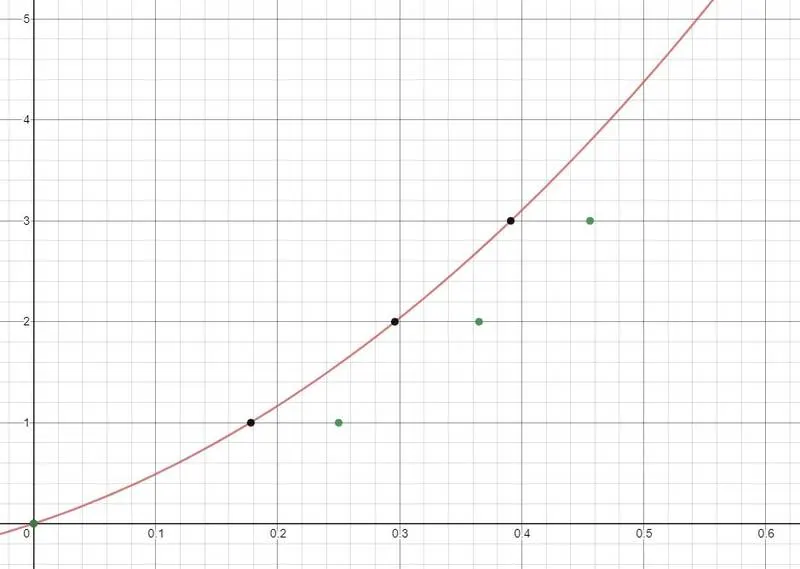
It can be clearly concluded from the graph that the explicit solution (green) deviates by a large amount than the implicit solution(black) with the exact solution( red). This identifies that the implicit solution gives higher accuracy than the explicit solution. Hence whether the implicit or explicit analysis should be used depends on the application. In cases such as Crash, where high deformation occurs its like trading off the accuracy when we use implicit here, it won't give accurate result as the time step would be high and it would not be possible to capture the exact scenario. While in case of the static analysis its recommended to use implicit analysis as the end scenario is important rather than the Time history of the analysis. So as an engineer it is our role to select the type as per the needs.